New Delhi (AFP) – Raped by her husband on her wedding night aged 17, Divya described her repeated suffering — an all-too-common account in India, permitted by a terrifying colonial-era legal loophole.
“I told him I have never had sex, and asked him if we can take it slowly and try to understand it,” 19-year-old Divya said.
“He said: ‘No, the first night is very important for us men’.”
He then slapped her hard, ripped her clothes off and forced himself on her.
What followed her arranged wedding in 2022 was 19 months of sexual and physical abuse.
“If I was hurt, it was invisible to him,” said Divya, whose name has been changed to protect her identity.
“He used to have sex with me ruthlessly”.
Six percent of married women aged 18-49 report spousal sexual violence, according to the government’s latest National Family Health Survey.
In the world’s most populous country, that implies more than 10 million women have been sexual victims of their husbands.
Nearly 18 percent of married women feel they cannot say no if their husbands want sex, according to the health survey.
And 11 percent of women thought a husband was justified in beating his wife if she refused, it found.
‘Victorian mentality’
Under India’s inherited British-era penal code, an exception clause stated that “sexual acts by a man with his own wife, the wife not being under fifteen years of age, is not rape”.
India introduced a new penal code on Monday but the exception clause remains — although it does raise the minimum age that a man can rape his wife to 18.
Lawyer Karuna Nundy is challenging that.
Nundy, who has a case for the All India Democratic Women’s Association (AIDWA) rights group at the Supreme Court, condemned the clause as “colonialism from a Victorian mentality”.
She holds a “fervent hope” for change, mentioning some of the more than 50 nations who have outlawed it.
Chief Justice D. Y. Chandrachud called it an “important issue” this year.
But the decade-long case has made painfully slow progress.
In May 2022, a two-judge bench in the Delhi High Court issued a split verdict.
One judge, C. Hari Shankar, said that while “one may disapprove” of a husband forcibly having sex with his wife, that “cannot be equated with the act of ravishing by a stranger”.
The other judge, Rajiv Shakdher, disagreed.
Shakdher said it “would be tragic if a married woman’s call for justice is not heard even after 162 years”, referring to the British-era statute.
Monika Tiwary from Shakti Shalini, a rights group which supports sexual violence survivors, said marriage should not shield a crime.
“How can marriage change the definition of rape?” she said.
“Getting married does not take away the rights over your body.”
Arranged marriages
“Most of the survivors do not really have this understanding that it is not okay, and it is marital rape,” Tiwary added.
“The moment we label it and attach a law to it, people start recognising it, awareness increases”, Tiway added.
Divya’s marriage was arranged, like many in India.
But her family did not pay the usual hefty cash dowry to the husband — something he used against her.
“He would taunt me by saying ‘It’s not like your parents gave any dowry, I can at least do this’,” Divya said.
“At times he would put a knife on my throat and dare me to say no. (He would say) ‘You are my wife, I have full rights on you’.”
Swati Sharma, a 24-year-old mother of two, said she married a man for love.
The first time her husband assaulted her was after their first daughter was born.
“I used to think: ‘Okay, we are married, so we can do this’,” she said.
Death threats
When he was angry, he would take it out on her. If she refused sex, he accused her of having an affair.
The tipping point came when he stripped her naked in front of their children, waiting until they slept.
“Then he proceeded to have sex with me,” she said. “He didn’t leave me till he had his way.”
She packed her bags, took her children and left.
But despite the abuse, some women return to violent husbands fearing for their children, and under intense social pressure.
Sharma also returned to her husband, after he went to counselling and persuaded her to come back.
While Divya escaped, she still lives in fear.
Her husband messaged her mother threatening that he “will not let her live”.
But she says she is “proud” that she left.
“There are many girls who still endure this, happening to them day and night,” she said.
A local court in Shangla has convicted a person for the abduction and ‘marital rape’ of his minor wife and sentenced him to life imprisonment, and imposed a fine of Rs300,000 on him.
Dawn’s Umar Bacha, in his report, states that the judge convicted the accused on two counts and sentenced him under section 365-b (kidnapping) of the Pakistan Penal Code to life imprisonment with a fine of Rs100,000 and to 25 years imprisonment with a fine of Rs200,000 under section 376 (rape) of PPC.
The court acquitted seven of the convict’s family members due to a lack of evidence.
The lawyer appearing for the convict said that the victim was his client’s legal wife, and hence, he committed no offence.
However, the judge, in his judgement, observed that a close and critical reading of section 375 PPC, defining the offence of rape, made no exception to marriage.
“If the allegation of rape in marriage is ignored, yet another question is the victim’s juvenility. The victim, being just above 16 years of age, is still covered in the definition of ‘child,’ being under 18 years of age,” the verdict read.
The victim’s mother in the FIR stated that her husband died around ten years ago, and around two years ago, she arranged the Nikkah of her daughter (the victim) with the accused, but Rukhsati was yet to take place.
She had put a demand to the family of the accused to arrange separate accommodation for her daughter before formal marriage, but they declined. She alleged that on the night of the incident, the accused, along with his father and four other relatives, barged into their house and forcibly took away the victim while the complainant, her son and another daughter were beaten and tied.
In the beginning, FIR was registered for abducting the girl, but eventually, when she was recovered by police, different provisions of PPC and Khyber Pakhtunkhwa Child Protection and Welfare Act, dealing with sexual assaults and sexual abuse, were also included in it.
The girl, upon her recovery after four days, said in a statement that she was assaulted during captivity, and her medical examination also confirmed that she was subjected to sexual assault.
The court eventually found the accused guilty of the offence of the abduction of the victim and having sex without her consent.
Even though the lawyer Mian Safeer said it was the first-ever conviction in a case of ‘marital rape’ after amendments in 2021 but a man in Karachi was sentenced to three years in jail after he was found guilty of having non-consensual sex with his wife earlier in the year on January 20.
January 20 marked the date when a landmark verdict from a session court in Karachi changed the landscape of the judicial approach in terms of intimate partner violence.
It has been precisely two weeks since the court announced in “The State vs Javed” that the “ocular version is also supported by the medical evidence which shows that the victim was a habitual passive agent of sodomy.” Sher Bano from Karachi lodged a complaint against her husband Javed at the police station about him subjecting her to sodomy despite her attempts to stop her. About two months after their marriage, she informed her mother-in-law, who didn’t say anything to him, she said, adding that then she disclosed her ordeal to her sister and brother, after which she lodged an FIR against her husband on November 23, 2022.
Garnering a fierce debate online, this also raised a couple of questions in my mind. If this was a case of sodomy, then why is it dubbed as a marital rape? Or are they both linked? I contacted Barrister Haya Zahid from the Legal Aid Society to hear her explain the legal complexities around these terms. Haya was welcoming and answered all my questions which helped me shape this article. Legal Aid Society has now been working for the last one decade. It started as a free legal aid clinic for the marginalized sections of society, especially women and children, and has now spread all over Sindh. In the last few years, they have proceeded with over a hundred cases of sexual violence, most including charges of sodomy and rape.
Haya’s works mostly surround policy and reform. Staying true to the mission statement to connect vulnerable and disempowered end users of justice with effective and expedient services for the delivery of justice, she runs the legal aid clinic efficiently and effectively. Her team includes 33 lawyers providing free services across Sindh. For instance, she is working on Fatima from Ranipur’s case, and her team is documenting the delays and lapses of the legal system. Apart from compiling research-based data, they are training judges and prosecutors. They even assist prosecutors, as they did in The State vs Javed case, Advocate Behzad Akbar from Legal Aid Society was writing arguments for the public prosecutor because they must proceed as sexual violence is a crime against the state. They train prosecutors for such cases, helping them in preparing the case.
“The reason we are all very excited is that in the current scenario in Pakistan, intimate partner violence is more common than rapes conducted by strangers” she started by setting the premise. “Spousal sexual abuse is physically and mentally more damaging. Women usually have tended to remain silent. According to our records, they come to our legal aid office to find out what they can do and most of them opt to tread the path of obtaining ‘khula’ which is accompanied by economic disadvantages. The majority of them do not pursue cases for protection against domestic violence let alone speaking about the intimate partner violence that they go through.”
Haya made it a point to mention that most of their clients of sodomy have been male children. Their parents feel less stigmatized in fighting for justice compared to the parents of female children. Sher Bano’s plea was refreshing in a way that she very soon left her husband after the marriage, informed her family about what she had to face and that this is not normal and fought the good fight. She put up with all the medical and legal requirements and despite certain minor discrepancies in her testimony, the judge had to take a broader approach as the claims were substantiated.
The State vs Javed
In the case the victim Sher Bano filed a case against her husband after approximately four months of marriage because he used to commit oral and anal sex despite her disapproval. She confided in her mother-in-law but was ignored. She eventually took the matter home, consulted a doctor and with the support of her family, lodged an FIR against her husband. She remained steadfast during the trial as the husband and his sisters accused her of being in love with someone else and therefore wrongly blamed his husband for sodomizing her. They even tried to use piles, which she suffered from, as an excuse to prove her claim wrong. Her grit is as Haya said, “music to the ears” because she emerged victorious.
What is Marital Rape in Pakistan’s constitution?
High Court Advocate Nimra Arshad in an explainer recorded by Dawn News sheds light on the term. There is still no such term as Marital Rape defined by the law but after the Criminal Law Amendment Act 2021, the definition of rape was broadened in Article 375 of Pakistan Penal Code. Previously, the implication of the law was that rape is when a man has non-consensual sex with a woman who is not his wife but now the definition involves non-consensual sex between a man and a woman irrespective of what relation they share.
The punishment is laid out in Article 376 of PPC which can be a death sentence or life imprisonment for 10-25 years.
Criticism over three-year punishment
Barrister Haya Zahid explained that rape has more punishment in law as compared to sodomy. Because the primary abuse in this case, proven in front of the court, is sodomy, the case proceeded in line with the Criminal Law Amendment Act 2021. This law is pivotal in this case as the definition of rape was totally reformed in this amendment and was hence used in this case. According to an amendment in article 375, a person is said to have committed rape if the person penetrates his penis, inserts, or manipulates any object or part of the body to any extent into the vagina, mouth, urethra or anus of another person against their will, without consent, or consent being taken with coercion. Considering this a case of sodomy, it was still treated as marital rape because the victim was in a spousal relation with the offender and their marriage was intact when she filed the case. Resultantly, the court declared that the accused was not able to prove his point of any personal enmity that the victim (the wife) had an affair with somebody else and therefore, she implicated him falsely. “The prosecution has, thus succeeded in proving the charge against the accused only under section 377 Pakistan Penal Code beyond a reasonable shadow of doubt, therefore this point is answered accordingly,” the final verdict declared.
“This has become a seminal case where conviction of a spouse took place for sexual abuse,” Haya said enthusiastically.
They can recontest the conviction of three years which is much less than that of rape, but this may damage the case as it would be put to trial again and because the victim has gone through a lot, this will be draining for her too.
Response over conviction
Social media is mostly celebrating the verdict. BOL Network contacted LAS, and Advocate Safia Lakho represented them in their morning session where she not only explained the proceedings of the case but explained how this case will be a trailblazer in the legal history of Pakistan. “So many women, oblivious of the law itself, silently enduring the pain daily, have got to know about their rights through this judgment and it is a great achievement indeed,” she said.
However, some critics are saying this is not a case of marital rape, this is sodomy. Haya reinstated, “The definition of rape has changed as per law; this is rape happening in the context of a spousal relationship which is the highest form of intimate partner violence that there can be. We are acknowledging it as the first ever conviction of marital rape under the changed definition of rape which is in place since 2021”.
Interpretation of the verdict in the Islamic context
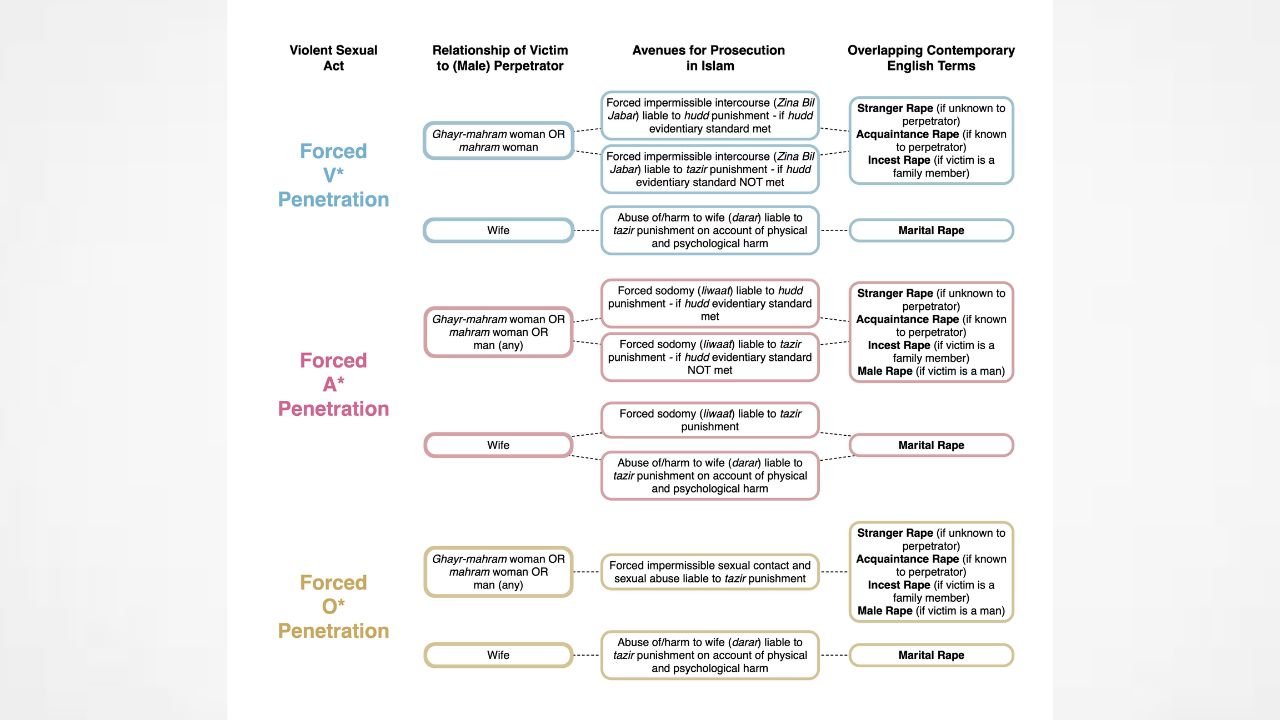
To understand the popular claims and interpretations used by the masses to either condemn or appreciate the conviction of marital rape I talked to multiple scholars including Mufti Mohammad Sohail Ahmad who is an MPhil in Usool-e-Din (Principles of Religion) from International Islamic University, Islamabad, now serving in Nottingham, UK. He delineated the basic principles as laid by the main text of the Qur’an: In Islamic schools of thought, there are two ways to go about it: Hadd and Tazir.
Hadd is equivalent to a death sentence, implying that strict action needs to be taken for the severity of the crime. Tazir on the other hand is a punishment for an offence that is culpable, and this is to be decided by the ruler or a judge according to the severity of the crime. It is strongly impermissible for a man to have sexual intercourse with his wife when she is menstruating. The other thing that is frowned upon by the laws of Islam is sodomy or unnatural sex- a crime strongly punishable by Islam.
Three-quarters of Islamic schools of thought consider Hadd to be implemented in cases of sodomy.
Image taken from @_Abdullah_Salehon X
The other scholar I consulted was Dr. Fazal-e-Hannan who is a PhD from Punjab University, Lahore and is serving as Sheik-ul-Hadith in Jamia Nazamia, Lahore. The unanimous response lays out the condemnation of the act of sodomy and applause for the verdict of the court. “It is good precedent set by the court,” Mufti Sohil Ahmad asserted, “making most of the latest medical and technological advancement to identify these crimes is a welcome change in Pakistan.”
As for the fact of a man forcing himself over his wife and inflicting pain upon her, they agreed that it is liable for a punishment. Islam stresses that husbands ought to be kind and considerate about the emotional, mental, and physical state of the wife. Allah says, “and live with them in kindness” [Quran 4:19] It is even stressed by the Prophet (SAW) as he said: “Be kind to your wives.” [Al-Bukhari and Muslim].
Javed Ahmed Ghamidi, in one of his lectures, emphasized that the relationship of a husband and wife is mutual and there is no other opinion about it.
However, the bottom line is that there are protocols of Islam that need to be followed for sexual intimacy. If violated, then needs to be dealt with accordingly.
Repudiation of implied consent theory
Advocate Nimra Arshad in her explainer describes that many people use religion to describe their chauvinistic views about the concept of marital rape whereas Islam is the same religion which provides women the protection, kindness and care they deserve in a marriage and if that is not given, there is a reasonable exit available too.
Pakistan’s law is essentially an extension of British law as proposed by Sir Matthew Hale who believed that a marriage perpetually gives man consent to treat his wife as a property. This implied consent theory is long been amended in the UK under Sexual Offences Act 2003 where spousal rape now falls under sexual assault, but the remnants of that law are very much intact in our country.
Final thoughts
Sher Bano has paved the way for women to not submit to unjust and violent behaviour in the name of marriage. This case also highlights the importance of support of the family which makes a woman invincible, especially in a society like ours. As much as raising awareness is the duty of the state, it is equally a compulsion for it to ensure the safety of citizens by making pertinent, pragmatic, and bold laws. Not recognizing marital rape as the highest form of intimate partner violence is a fact that remains in place till today.
In a legal first, a man has been sentenced to three years in jail after he was found guilty of having non-consensual sex with his wife, a punishable act under Section 377 (unnatural offences) of the Pakistan Penal Code, The News has reported.
Additional Sessions Judge (South) Ashraf Hussain Khowaja announced the reserved judgment in Karachi after recording evidence and final arguments from both the defence and prosecution sides.
He sentenced the convict named Javed to three-year rigorous imprisonment and ordered him to pay a Rs30,000 fine. If he fails to pay the fine, he would have to undergo an additional one month of simple imprisonment.
“From a perusal of evidence brought at the trial by the prosecution, it appears that the victim has fully established a commission of sodomy with her by the accused being her husband,” the judge observed.
“Though the victim/complainant contradicted some facts relating to the period of her stay with the accused, putting her signature on the memo of site inspection at PS, suffering from disease of piles and her age which are immaterial facts which would not be fatal to the prosecution case,” he added. The judge noted the medical evidence supported this version. On the other hand, he said the accused failed to establish “enmity” that her wife loved somebody else and therefore she implicated him falsely. The convict’s sisters who appeared as defence witnesses failed even to disclose the name of the alleged affair of the victim, he added.
The victim testified that her husband would commit sodomy with her despite her attempts to stop him. About two months after their marriage, she informed her mother-in-law, who didn’t say anything to him, she said, adding that then she disclosed her ordeal to her sister and brother, after which she lodged an FIR against her husband on November 23, 2022.
Advocate Bahzad Akbar of the Legal Aid Society, who represented the complainant, contended that sodomy falls within the definition of rape and marital rape in this case after an amendment brought to Section 375 of the Pakistan Penal Code in 2021.
He said that the woman’s testimony and medical evidence corroborated the charges against the accused, requesting the judge to punish Javed as per the law. “I am not sure about other provinces but this is certainly the first such conviction over marital rape in Sindh following the amendment,” he told The News. He added there are no known convictions on charges of marital rape in the country. An FIR had been lodged under Section 377 of the PPC at the Chakiwara police station on the woman’s complaint.
We all know that the latest act in the cesspool that is the Pakistani drama circus was the controversial promo of ‘Tere Bin’ which aired last week. The trailer implied that female lead Meerab (played by Yumna Zaidi) was raped by her husband Murtasim (played by Wahaj Ali).
Twitter users were shocked, tagging the actors, production staff and even the writer, Nooran Makhdoom herself, to criticise the development as deeply misogynist and horrifying. But then, instead of reassuring the audience, Makhdoom decided to fan the flames even more with controversial statements given to Arab News, defending the marital rape by saying that it has been going on for a long time on Pakistani screens.
Mmmm.. still not a good reason though.
Finally, the episode has aired and it turns out, the sex was not rape. It was consensual.
Yes, you read that right.
We are dragged through the first agonizing 15 minutes of Mariam’s marriage, and her reluctance to open her heart, yada yada.
And then we are reluctantly led to THAT scene where our favorite toxic jori, Murtasim and Meerab, actually did the deed in a consensual manner, but even that led to a lot of ronay dhonay.
Twitter was mostly amused but some were horrified at how a once popular show has destroyed itself by pandering to sensationalism. Kudos to them for taking out the marital rape but really, where is the plot going?
This is some new level of sh*t writing I mean who the tell cries this way on a consensual sex and why the hell did they promoted it as MR and were justifying it everywhere!?????
Not wanting to burst anyone’s bubble but #TereBin has seriously gone down the drain! MR was clearly part of script which has been changed last min with voiceovers and now none of Meerub’s reactions will make zero sense as usual!
Trigger warning: victim blaming, discussions of marital rape, assault
Pakistani drama ‘Tere Bin’ has been in the eye of a social media storm since yesterday a controversial scene from the drama serial went viral on Twitter. In the scene, the female lead Meerab (played by Yumna Zaidi) is raped by her husband Murtasim (played by Wahaj Ali) after she accuses him of attempting to start an affair with Haya.
Social media users, who had already labelled the drama as problematic for past controversies like slaps, attempted suicide, stalking and poor story pacing, declared that they were dropping their support for the once-popular drama. But it turns out, the writer behind the drama Nooran Makhdoom, is not moved by the backlash, defending it as a ‘a demand of the serial’, in an interview with Arab News Pk.
“It’s a situation which was the demand of the serial that will lead to the climax,” explained Makhdoom.
She also went on to defend the story by saying she won’t be changing the script because of fans:
“If the audience isn’t getting it, I can’t change it,” she said. “It’s just a drama. They should wait for the entire story to unfold instead of taking issue with every episode.”
Makhdoom also pointed out that such a horrfiying trope is not being used for the first time, and that the entire production team or director had not objected to the scene:
“It’s not like this has happened onscreen for the first time. It’s just that this project has received such wide recognition that people reacted strongly to the recent twist.”
Makhdoom also shared with Arab News that she had not initially added the slap and the spit scene, which was added in before filming, but she took complete responsibility for writing the script:
“If you speak of my social responsibility, I created a story and I stand by it,” she said. “And this is not an unusual occurrence; it has happened before.”
This revelation has led to more backlash on social media, with hasthags like ‘Shame on Tere Bin makers’ and ‘Nooran’ trending on Twitter, and users calling for a boycott of the drama.
SHAME ON TERE BIN MAKERS for getting us addicted on a toxic show like this. Like a drug. You lying if you say you won’t be there on Wednesday watching this show. You know you have become so deluded despite of all the red flags, “k shyd kch acha hojye”. i’m sorry for all of us
— Jia (Murtasim Khan Era ) (@Jiaharrington) May 20, 2023
how do u sit there and act like nothing happened knowing u traumatized millions of people without warning
If I hyped this show and gave it eyeballs, I feel obliged to condemn this atrocity too. I’ve never been more uncomfortable and traumatized seeing a piece of art. y’all marketed the “chemistry” & romance and misled the audience high time ‼️
Trigger warning: discussions of marital rape, assault
In the topsy-turvy world that is Pakistan right now, ‘Tere Bin’ is playing its part by keeping fans running around in circles. With the love-hate relationship between the main leads Murtasim (played by Wahaj Ali) and Meerab (Yumna Zaidi) switching from adorable to toxic to downright horrifying in the recent episode, fans have had enough.
The recent episode of the drama tried to one-up itself to see how low it can go in disappointing its viewers, with once again the writers deciding to bring out the Murtasim caught cheating with Haya card, and ending the episode with Meerab’s assault.
From the promo, viewers can definitely assume that Meerab has been assaulted by her husband and has chosen to leave him.
Was it necessary that Murtasim, who is currently one of the most feminist male leads on our screens, be thrown under the bus just to churn up some views? Why did the writer even assume that after stalking, slapping and attempted suicide, this ‘love story’ had to hit its peak with the most heinous thing: domestic violence?
Legal analyst Reema Omer criticised the scene on Twitter, writing:
“TW: After months of justifying Murtasim slapping, shoving, dragging, asking Meerab to jump off the roof to prove her chastity + other toxic/violent behaviour, even #TereBin fan club is up in arms over the possible marital r*pe suggested by the promo Some silver lining, I guess.”
TW: After months of justifying Murtasim slapping, shoving, dragging, asking Meerab to jump off the roof to prove her chastity + other toxic/violent behaviour, even #TereBin fan club is up in arms over the possible marital r*pe suggested by the promo
Founder of ‘Something Haute, Aamna Isani wrote that she was shocked by the depiction of assault, and how could this possibly be a chance after this that Murtasim’s character would be redeemed.
If Murtasim actually does end up assaulting Meerub, then I’ll have no qualms in saying that this enjoyable trashy romance just became pure trash. Nothing justifies it. Nothing will then redeem him. #TereBin
Many were tweeting that this was the end of their support for the drama, given that there is no possible justification to depict marital rape and domestic abuse.
Nooran Makhdoom i swear this is your last drama i had ever watched in my life i wasted my 6 months just watching this the character i love the most #murtasim from past 6 months totally break my heart how can you write such foolish scripit with marital r**pe #TereBinpic.twitter.com/95JV4u8DG8