Tag: market sentiment

  • Pakistan Stock Exchange achieves record high, crossing 58,000 points

    Pakistan Stock Exchange achieves record high, crossing 58,000 points

    A positive shift in market sentiment fueled the Pakistan Stock Exchange’s (PSX) upward trajectory as the benchmark KSE-100 Index surpassed the historic 58,000 level for the first time in Wednesday’s trading session.

    At 12:45 pm, the benchmark index reached 58,203.85, marking a noteworthy increase of 832.27 points, or 1.45 per cent. 

    Widespread buying, particularly in index-heavy sectors such as automobile assemblers, cement, chemicals, commercial banks, fertiliser, and oil and gas exploration companies, contributed to this surge, with OMCs also registering gains.

    The benchmark index climbed by 294 points, or 0.51%, the previous day, settling at 57,371.59.

    This sustained bullish trend reflects improved economic indicators in the country and the interim government’s successful negotiations with the International Monetary Fund (IMF) for the first review, unlocking $700 million in funding.

    Analysts expect that, following the review, Pakistan will attract additional inflows from both multilateral and bilateral partners.

    Commenting on this rapid yet anticipated recovery at PSX, Mohammed Sohail, CEO of Topline Securities, stated, “PSX is experiencing one of the fastest but not unexpected recoveries.”
  • Pakistan’s stock market surges above 56,500 for the first time in history

    Pakistan’s stock market surges above 56,500 for the first time in history

    The bullish momentum persisted in the Pakistan stock market today, propelling the key stock gauge to an unprecedented level above 56,000 for the first time in history.

    By the session’s close, the index had reached a historic high of 56,523.58, marking an impressive surge of 1,132.21 points, or 2.04 per cent day-on-day. Notably, the KSE-100 index had experienced a notable gain of 2,268.33 points, or 4.27 per cent, in the preceding week.

    Throughout the day, the index remained in positive territory, achieving an intraday high of 56,583.59 (+1,192.22) and a low of 55,644.68 (+253.31) points. The KSE-100 Index witnessed a total volume of 300.341 million shares traded.

    The prevailing positive sentiment is attributed to the recent PIB auction on November 8, which exhibited a substantial decline in yields.

    This decline may indicate market expectations of an earlier-than-anticipated reduction in interest rates.

    Additionally, investors are anticipating a higher weighting for Pakistan in the upcoming review by global index provider Morgan Stanley Capital International (MSCI), scheduled for tomorrow.

    In today’s session, out of the 100 index companies, 57 closed higher, 23 closed lower, 1 remained unchanged, and 19 were untraded.

    The strength of the KSE-100 index was supported by sectors such as power generation and distribution, fertiliser, commercial banks, cement, and automobile assembly.

    Contributing positively to the index were companies like HUBC, EFERT, MTL, BAHL, and MCB, accumulating significant points.

    On the other hand, the KSE-100 Index faced a downturn primarily due to the refinery sector, Inv. Banks/Inv. Cos./Securities Cos., Transport, Leather & Tanneries, and Automobile Parts & Accessories.

    Companies exerting downward pressure on the index included MEBL, UPFL, KEL, OGDC, and NATF. The intricate dynamics of today’s market underscore the varied performances across different sectors and companies within the KSE-100 Index.

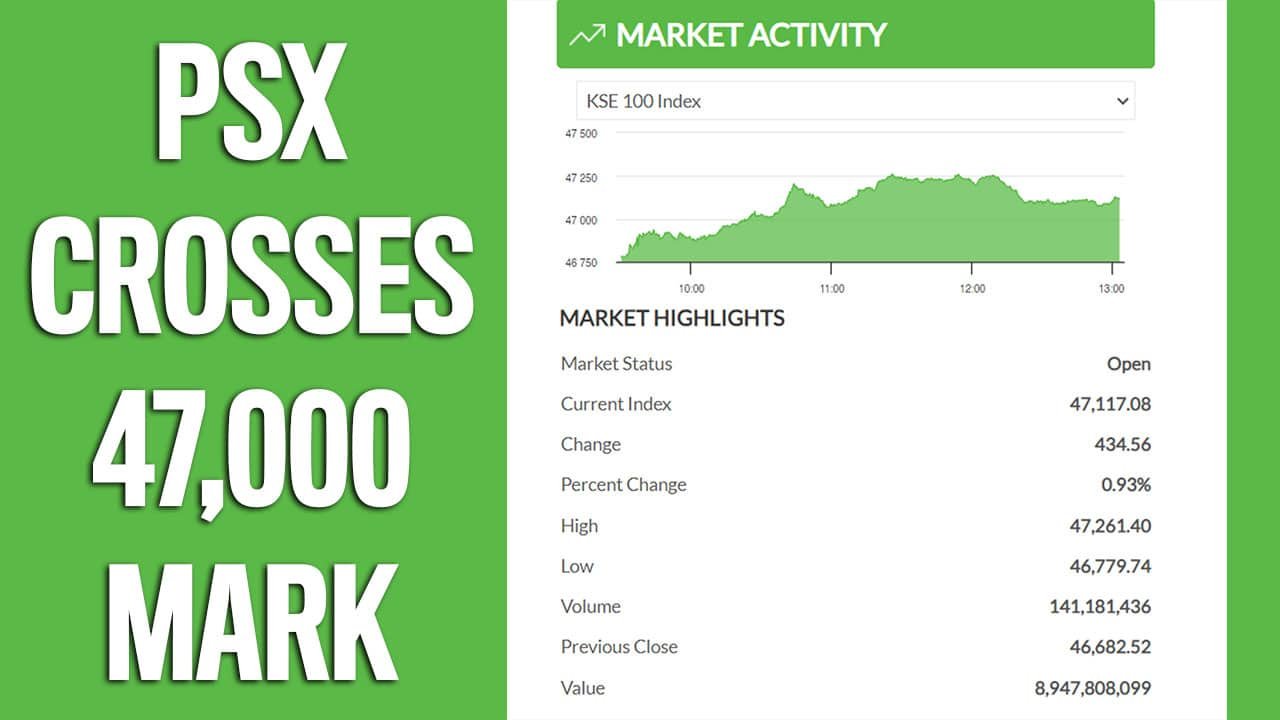
  • Pakistan Stock Exchange surges to 21-month high as KSE-100 index crosses 47,000 mark

    Pakistan Stock Exchange surges to 21-month high as KSE-100 index crosses 47,000 mark

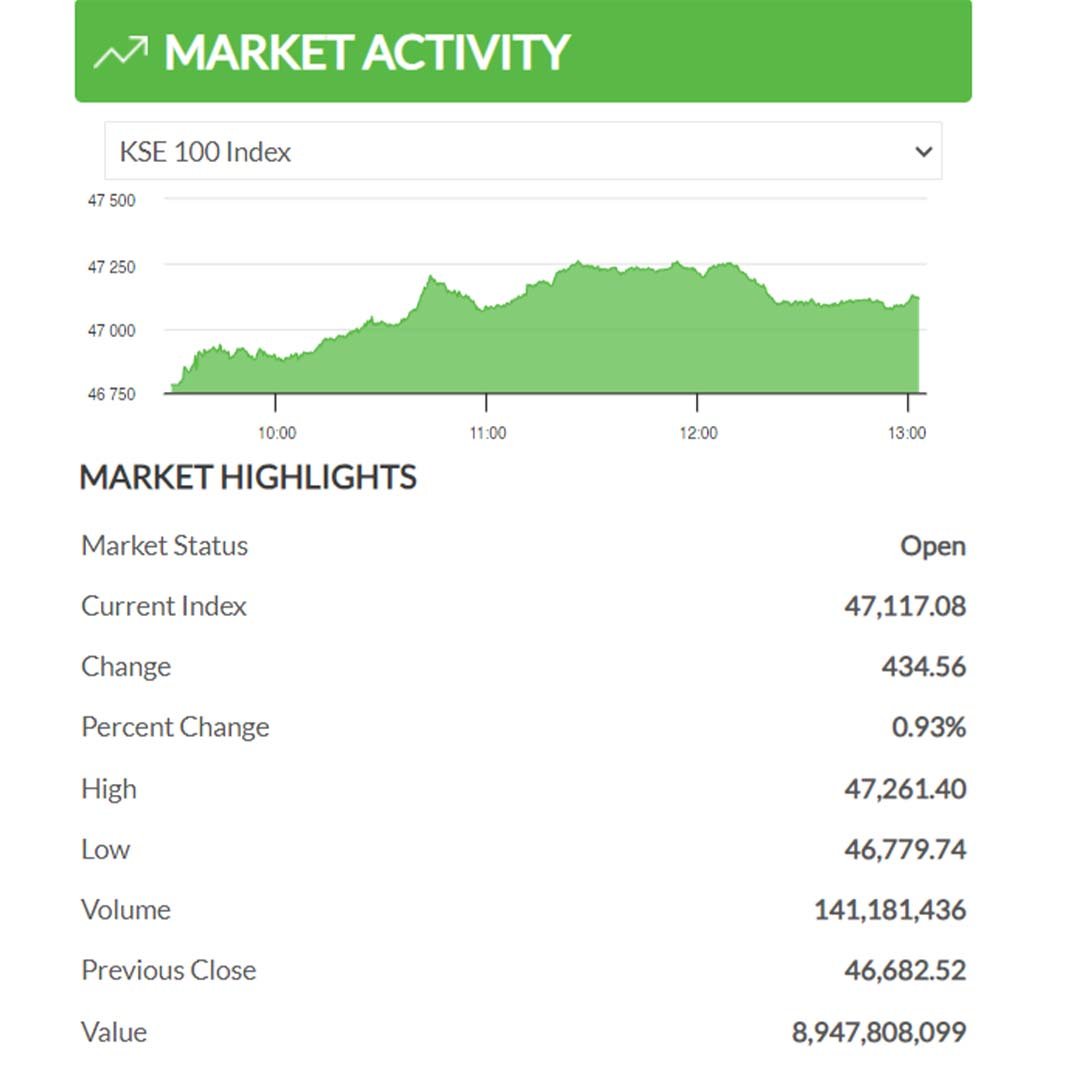
    The Pakistan Stock Exchange witnessed a significant surge as the benchmark KSE-100 index surpassed the 47,000 milestone on Thursday, reaching its highest point in 21 months. This remarkable upswing was fueled by positive market sentiment following the recent International Monetary Fund (IMF) deal.

    Notably, the bullish position was further fortified by impressive corporate performance, particularly within the index-heavy sectors. At 12:10 pm, the benchmark index surged by 560 points, settling at 47,242.9 points, marking its peak since November 8, 2021, as reported by Arif Habib Limited (AHL), a prominent brokerage firm.

    AHL emphasized that the market had recorded a noteworthy gain of 5,751 points (13.9 per cent) since the staff-level agreement with the IMF for the $3 billion Standby Agreement (SBA).

    This positive momentum was attributed to increased valuations after securing the IMF SBA facility, as explained by Tahir Abbas, AHL’s Head of Research, in an interview with Geo.tv. He highlighted that the current Price-Earnings Ratio (PER) of the KSE-100 stands at 3.7x, which is relatively lower compared to the lowest recorded during the previous financial crisis in 2008 (3.9x).

    Abbas asserted that the market remains attractive, and as a result, the positive momentum is expected to continue. Analyst Saad Ali, an expert in the capital market, attributed the market’s favorable performance to the combination of IMF optimism and the outlook for enhanced macro stability, which has been complemented by strong corporate results during the present result season. Despite facing challenging macroeconomic conditions, several banks and companies have managed to surpass expectations in terms of earnings and payouts.

    Last month, Pakistan signed a short-term deal with the IMF, a crucial step that helped the country avert a potential default and bolster its foreign exchange reserves. This move has played a pivotal role in supporting the current bullish trend in the stock market.

    In conclusion, with the positive impact of the IMF deal and encouraging corporate results, the Pakistan Stock Exchange’s benchmark KSE-100 index has achieved substantial growth, positioning itself at a 21-month high. The market outlook remains promising, and experts predict further gains ahead.

  • Currency crisis alert: Pakistani rupee could drop to Rs350 against dollar without IMF assistance

    Currency crisis alert: Pakistani rupee could drop to Rs350 against dollar without IMF assistance

    The Pakistani rupee is poised to face a significant downfall, with expectations that it may plummet to as low as Rs350 against the US dollar. This alarming projection has raised concerns among stakeholders, as the weakening currency is anticipated to have far-reaching implications, particularly in terms of inflationary pressures that will disproportionately affect the lower and middle classes.

    According to Geo, the steep devaluation of the rupee, which has already lost approximately 20 per cent of its value this year, positions it among the worst-performing currencies worldwide.

    Experts, including economists Ankur Shukla and Abhishek Gupta, attribute this weakness to a range of factors. Capital flight from Pakistan is intensifying due to the growing apprehension that the International Monetary Fund (IMF) may not provide the much-needed bailout required to prevent a fiscal default in the upcoming fiscal year commencing in July.

    The delay in receiving aid, which has been stalled since November, is suspected to be linked to political unrest, further exacerbating the rupee’s decline. The country’s leadership has been plagued by instability since the removal of Imran Khan, Chairman of Pakistan Tehreek-e-Insaf (PTI), through a no-confidence motion vote in April last year.

    Khan’s recent arrest has heightened tensions between him, the government, and the military. Following his imprisonment, the rupee experienced a sharp drop to a record low of 299 per dollar, only to partially recover and stabilize at 285 after his release.

    Multiple experts are warning of an imminent massive drop in the rupee, with some analysts even foreseeing a further 20 per cent depreciation. The currency’s future trajectory heavily depends on the ongoing clashes between Khan and the government, as well as the IMF’s decision regarding financial assistance.

    Adil Ghaffar, CEO at Premier Financial Services Pvt in Karachi, concurs, stating that failure to secure the loan could lead to a slump in the rupee’s value to Rs350 per dollar in June. Market sentiment remains precarious, and economists such as Farooq Pasha highlight the persistent uncertainty surrounding the rupee’s path.

    In the near term, politics will continue to pose a key risk until the elections. The bond market has also been adversely affected, with bond investors growing increasingly nervous as the spread between Pakistan’s dollar bonds and US Treasuries reached a record high of over 35 per cent this month.

    With the looming prospect of the rupee’s significant decline, the economic landscape of Pakistan hangs in a precarious balance.