Tag: Media Matters for Democracy

  • “Human Rights Watch’s statement based on gossip”, Pakistan challenges report on media bill

    “Human Rights Watch’s statement based on gossip”, Pakistan challenges report on media bill

    Pakistan responded to a dispatch by the Human Rights Watch (HRW) Associate Asia Director, Patricia Gossman, on the proposed media bill. Pakistan condemned the claims of the organisation and termed the statement “factually incorrect”.

    “The statement of Human Rights Watch is factually incorrect as there is no plan to introduce the regulatory body through an ordinance,” read the letter from Pakistan’s Embassy in Washington DC.

    The letter further added, “HRW is misled and its statement is based on hearsay and gossip.”
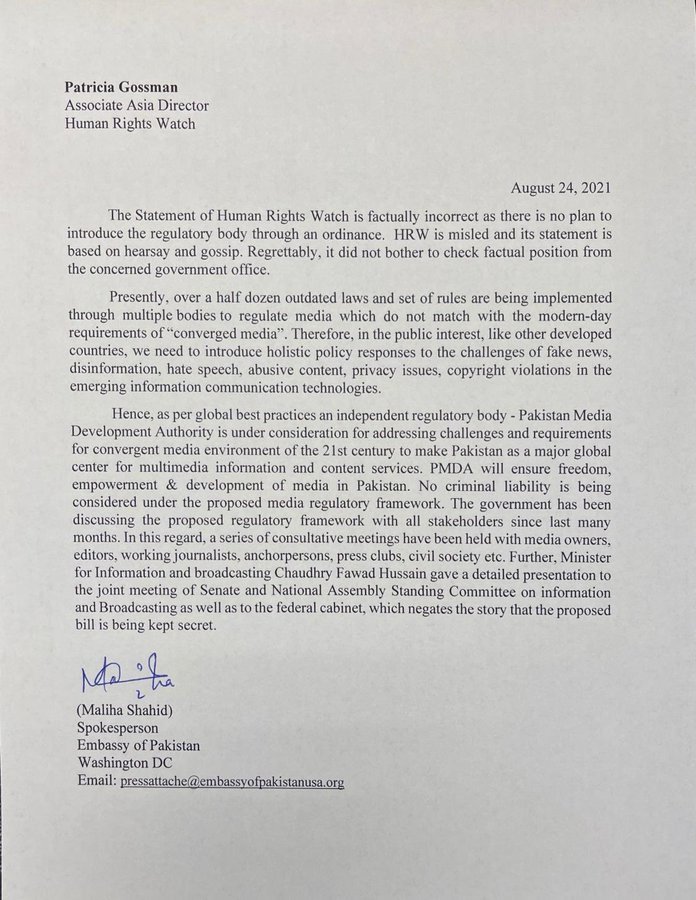
    “In the public interest, like other developed countries, we need to introduce holistic policy responses to the challenges of fake news, disinformation, hate speech, abusive content, privacy issues, copyright violations on the emerging information communication technologies.”

    The letter further states, “Hence, as per global best practices and independent regulatory body – Pakistan Media Development Authority is under consideration for addressing challenges and requirements for convergent media of the 21st century to make Pakistan a major global center for multimedia information and content services.”

    Patricia Gossman took to Twitter and wrote, “Wow. You have identified no inaccuracies in our article and you have failed to provide a draft of the law. What are you hiding?”

    https://twitter.com/pagossman/status/1430426802049196036

    Meanwhile, in its statement, HRW said, “The government claims an ordinance setting up the Pakistan Media Development Authority (PMDA) would replace the ‘fractured’ regulatory environment and fragmented media regulations currently in place. The proposed PMDA would bring all media in Pakistan – print, television, radio, films, and digital media – under one regulator.”

    The proposed law would also increase government control by allowing government officials to be appointed to key positions.

    With journalists under relentless attack for doing their jobs, the Pakistan government needs to stop trying to control reporters and instead start protecting media freedom, added HRW.
  • EXCLUSIVE: ‘I did the speech knowing I would lose my job,’ Hamid Mir

    EXCLUSIVE: ‘I did the speech knowing I would lose my job,’ Hamid Mir

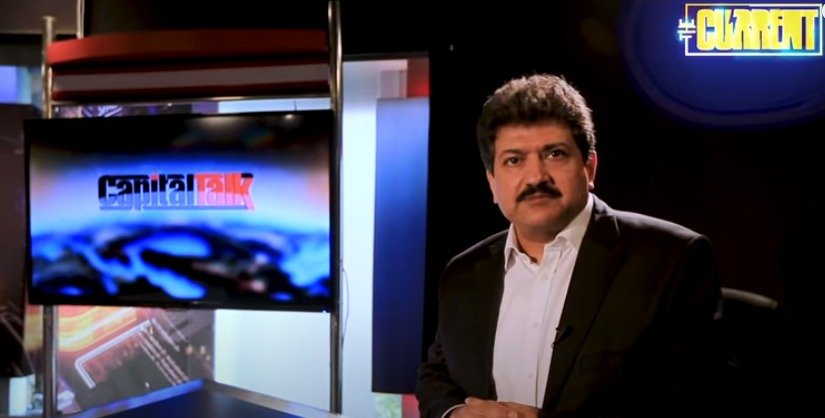
    Hamid Mir doesn’t sound like he’s down. On the contrary, the seasoned journalist sounds energised and alive. His phone was dead (or switched off) for the past two days, when The Current tried to reach out to him. Eventually when we got through, he didn’t pause for a second and gave us his version of the event that led to his removal from his flagship show, ‘Capital Talk’ on Geo News.

    “What will Geo probe?” he said when asked that Geo News had stated that they would “check for violation of policy and law” in a speech given by Hamid Mir “that resulted in backlash from different segments of society”.

    “My speech did not air on Geo News, it was not published in the newspaper,” Mir said categorically, “so how is Geo responsible when it never appeared on their television screens?”

    But Mir does admit that the pressure is intense on the management of his channel, which ultimately falls on him. “I am always prepared for pressure,” he says calmly, “I offered to leave the channel on Friday night when I was asked to clarify my statement. I told the management that when I never spoke on your channel, why do I need to issue a clarification? I was then told not to tweet on the issue and also that I should not take part in any other programmes,” Mir explained. “I was going to go on different news channels and said that I am not going to discuss my speech but to discuss the media ordinance. I was asked not to do so and therefore, I didn’t. I did tell them [management] that ‘they’ will ask you to remove me from the programme in a day or so and that’s exactly what happened.”

    When asked what it was about this particular case that drove Mir to give the speech, he said it was because of a man in a wheelchair.

    “When I was about to speak, if you notice in the video, there is a man on my right side sitting on a wheelchair. The man is an old journalist Qaiser Butt and he randomly said, ‘Larki ka bhai ho sakta hai‘ (it can be the girl’s brother) implying that Toor was part of an illicit relationship. That made me angry since Asad was standing right there as well. I got de-tracked and said, ‘larki ki maa bhi ho sakti hai jo General Rani hai‘. But it’s not just that.”

    Mir says the biggest reason for speaking out had been building up for the past three weeks. “In the past two, three weeks, some female colleagues were complaining that they were being threatened and one told me that ‘they’ came to her house. They didn’t cause her any harm but gave her a message.” He added that two female journalists also wanted to file a case but they have restrictions that are different. “Their husbands tell them not to report the cases; they face problems with their in-laws.”

    Mir is hopeful for change this time. “I did the speech knowing I would lose my job and I was prepared for that,” he says. “Right now, as I am speaking with you, I am at a meeting with the Human Rights Commission of Pakistan (HRCP). Hina Jilani is also here and the Pakistan Federal Union of Journalists (PFUJ) is going to be releasing a white paper on the new cases that have come up. I can’t tell you, I have been swamped with calls of people that are now finally coming forward with cases and want to raise their voice.”

    “Lots of people are taken off air, but there has never been such a big reaction,” Mir says, explaining that in this particular case, the local and international reaction is bigger than he expected. “I am getting a lot of calls from international networks wanting to cover the story and because of this interest, I believe that some pressure will be put on the political government for accountability.”

    “Lots of ministers are messaging me in private, lending their support,” Mir said. “Perhaps this time, we might see some actual change.”

    Hamid Mir was taken off air on Monday.

  • Pakistan performs poorly, scores 30/100 on freedom of expression report

    Pakistan performs poorly, scores 30/100 on freedom of expression report

    Pakistan has performed poorly with respect to legal and practical protections for the right to freedom of expression of its citizens during 2020, according to a new assessment report published by Media Matters for Democracy.

    The Pakistan Freedom of Expression Report 2020 was launched through a webinar on Wednesday.

    Speaking at the report launch, European Union (EU) Ambassador to Pakistan Androulla Kaminara said the report provides a comprehensive analysis of the state of freedom of expression in Pakistan and highlights some concerning trends.

    “Freedom of Expression is enshrined in the European Charter of Fundamental Rights. It is also one of the important aspects of Pakistan’s GSP plus commitment to upholding the international Human Rights Conventions and a key priority in the Strategic Engagement Plan between EU and Pakistan.”

    “As this report confirms, the situation of journalists and documentation of threats they face through attacks, intimidation and harassment is particularly concerning. Disinformation is another area of concern, and one, which the European Union is working to address both at home and abroad. Misleading or false information can put lives in danger. It is crucial to resolutely counter disinformation with transparent, timely and fact-based communication and thus reinforce the resilience of societies,” she said.

    The report documents the situation of freedom of expression in Pakistan with a new index based on six dimensions namely the legal environment, press freedom, digital expression, pluralism, the socioeconomic and political situation.

    Pakistan scored low on all six dimensions to provide an overall score of only 30 points out of a total of 100 points on the assessment index. This cumulative score fell in the range of “poor” protections for freedom of expression in the country.

    The report found that during the year 2020 Pakistan’s media and Internet regulatory authorities continued to exert arbitrary legal and regulatory restrictions on speech and online content, by ordering bans, suspensions, and advisories against social media apps, entertainment content, and news discussions of social and political issues.

    Journalists remained vulnerable to physical, legal, and digital threats in the absence of long-awaited legislation on journalists’ safety, according to the study.

    The report found that at least eight individuals connected with the media were killed, at least 36 journalists were attacked in the line of duty, 10 were arrested, and as many as 23 instances of arbitrary detentions in connection with news reporting and online expression were recorded across Pakistan during the year.

    Women journalists were especially targeted with coordinated online attacks as they reported on political issues and the government’s pandemic response.

    The report noted that the coronavirus pandemic intensified the challenges to freedom of expression and access to information in Pakistan.

    Internet users were consistently exposed to disinformation while journalists reporting on the pandemic faced physical safety risks and restrictions on access to information sources, and many young citizens without Internet services found themselves abandoned as education systems shifted online, according to the report.