Tag: mental health

  • ‘Meera is perfectly fine’

    ‘Meera is perfectly fine’

    Imran Abbas has stepped in to defend Meera after reports of her being admitted to a mental facility in the United States started doing the rounds on social media and television.

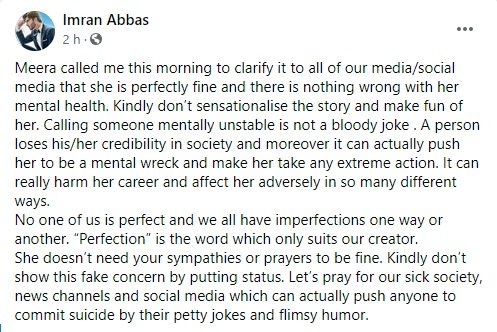
    “Meera called me this morning to clarify to all of our media/social media that she is perfectly fine and there is nothing wrong with her mental health,” wrote Abbas on social media. “Kindly don’t sensationalise the story and make fun of her. Calling someone mentally unstable is not a bloody joke.”

    “She doesn’t need your sympathies or prayers to be fine. Kindly don’t show this fake concern by putting status. Let’s pray for our sick society, news channels and social media which can actually push anyone to commit suicide by their petty jokes and flimsy humour,” the actor added.
    Meanwhile, speaking exclusively to The Current, Meera’s manager Hasan said that the actor is doing perfectly fine and is working on a few projects in the States. He said that she does know who started this terrible rumour and asserted there is no truth to it.

    When asked about the video of Meera’s mother Shagufta Zahra, in which she appeals to Prime Minister Imran Khan to bring back her daughter, Hasan said that Zahra is elderly and hard of hearing. He added that Meera had recently gone to get vaccinated for COVID-19 and had narrated details of her experience to her mother who misunderstood them.

    On the other hand, speaking to a local media outlet, Meera’s mother claimed that reports of the actor being admitted to a mental facility were true.

    “I received a call from Meera on April 5 and she kept crying,” Zahra told the media outlet. “She was telling me that the US police is sending her to a psychiatric facility. She did not tell me why they were doing that, but said she repeatedly told them that she was an actor and not mentally ill.”

    Read more – Meera loses her phone, seeks help on social media

    Speaking to the same media outlet, Meera’s manager Muhammad Qasim and another family member trashed the reports and Zahra’s claims saying that “Meera is perfectly fine, both in terms of her mental and physical health”.

    Qasim alleged that the actor’s mother is spreading rumours to resolve a personal dispute. Meanwhile, the family member said that Meera is in fact in touch with her father and there is more to the story than what is being discussed on social media.

    As per the latest ‘reports,’ Meera has been released from the psychiatric facility after her husband Captain Naveed paid $50,000 to get her released. The report further claimed that the actor has been given 48 hours to leave the United States.

    The Current has reached out to Meera for further clarification.

  • Virat Kohli opens up about his battle with depression

    Virat Kohli opens up about his battle with depression

    In a recent podcast with Mark Nicholas, Indian captain Virat Kohli opened up about his battle with depression. Virat’s performance was disastrous during India’s 2014 tour of England. He only scored 134 runs in five Tests, which made him feel like the “loneliest guy in the world”.

    Talking about suffering from depression, Kohli said, “I did. It’s not a great feeling when you wake up knowing that you won’t be able to score any runs, and I think all batsmen have felt that at some stage or the other, where you’re not in control of anything at all. And I just couldn’t understand at all how to get over it.”

    Looking back at his difficult phase, the Indian captain said, “I think that when you look back at a very difficult phase, you realise that you had to go through that phase fully to be able to understand what’s wrong and rectify it and move forward, and just open yourself up for change, accept that there are things that are going wrong. But that was a phase where I literally couldn’t do anything to overturn what I was going through and it was tough.”

    He continued, “I felt like I was the loneliest guy in the world. And that’s what happens, you can really push yourself into a downward spiral, where you feel like you’re going further down with each day that passes. But when things turn around, you feel that maybe I was being too harsh on myself, I was putting myself down way more than what was required for me to change. So now I understand with years passing by, that there’s a line that needs to be drawn and beyond that line, if you’re going downwards, it’s absolutely not required.”

    Kohli also revealed how Sachin Tendulkar’s advice helped him. “I did have a chat with him about the mental side of things as well and the thing that he told me was, in cricket what he experienced was if you are going through a strong negative feeling and if that is coming into your system regularly, it is best to let it pass. If you start fighting that feeling, it grows stronger. So, that is the advice I took on board and my mindset really opened up from then on.”

    During the podcast, Virat also praised his wife Anushka Sharma by calling her his, “Pillar of Strength” and added that no one understands him better than her.

    Last month, Anushka Sharma and Virat Kohli welcomed their baby girl, Vamika.

  • Death by suicide killed more people in October than COVID-19 in Japan

    At least 2,153 people committed suicide in Japan in the month of October while the total number of deaths from COVID-19 is 2,087, according to the latest statistics shared by the government of Japan. As per Japan’s National Police Agency data, the number of suicide cases increased to 2,153 in October from 1,805 in September.

    The data also revealed that COVID-19 has taken a disproportionately higher toll on women than men. Suicide among women increased by almost 83% last month compared to the same month the previous year. In comparison, male suicides rose by approximately 22% over the same time period.

    Layoffs, social isolation and anxiety triggered by the pandemic are said be the key causes behind the surge in suicide rate.

    Japan is one of the few developed countries that release suicide data frequently and has the world’s second-highest suicide rate after South Korea but the suicide rate in the country was declining until the pandemic.

    Unlike, most countries impact of COVID-19 has not been very severe in Japan but the country’s existing mental health crisis has been made worse because of the pandemic.

    Earlier this year, the United Nations issued a warning that the coronavirus disease 2019 (COVID-19) pandemic could create a global mental health crisis. According to a survey conducted by World Health Organisation, the demand for mental health services has increased worldwide. The survey also revealed that the COVID-19 pandemic has disrupted or halted critical mental health services in 93% countries.

    Meanwhile, WHO has also recommended all adults to do a minimum of 150 minutes of vigorous physical activity per week, even more, for well-being and mental health in the COVID-19 era. It has also recommended children and adolescents to include an average of one hour of daily physical exercise into their routines and limit time in front of electronic screens.

    People of all ages must compensate for growing sedentary behaviour with physical activity to ward off disease and add years to their lives, it added.

  • Five science-oriented tips to deal with work stress

    Five science-oriented tips to deal with work stress

    We all have those days where almost everything is stressful and it becomes difficult to cope with even the little things happening around. It is normal to go through stress at work but it can affect your mood and performance if you don’t learn to cope up with it. Here are some extremely helpful, science-oriented tips that will help you deal with work-related stress. 

    Work out

    Exercise is proven to be one of the best stress relievers. Many people claim that exercising helps them get rid of all negative energies, resulting in a better mood. It pumps up your endorphins, the chemicals produced by your body to relieve stress and pain. Not everyone likes hitting the gym every day, so it’s better to find a physical activity you can enjoy and then try sticking to it. Working out can help you improve your overall physical and mental health.

    Write it down 

    Writing down your feelings and problems is another best way to deal with the stress coming from it. When you write, you let it out. So, instead of bottling your work-related frustrations, it is best to write it out. Journaling is considered to be an effective practice to deal with the stress at your workplace. This can also help you monitor the things that cause you stress. 

    Drink tea/coffee

    Since winter is around the corner, this doesn’t seem to be a bad idea. Caffeine is what always helps you stay focused even when there are chances for you to get distracted by things going around. Consumption of your favorite cup of tea and coffee will keep you motivated and improve your performance at work. You can even set up a tea/coffee station at your workplace so all your team members can also reduce their workplace stress. 

    Take a step back

    You don’t have to force yourself when you clearly need a break. Take a break from your work, turn away from your desk, close your eyes, and take a deep breath. Remember you are a human, not a machine, you need a break to function properly. If you need a little more, step out, go for a walk, and breathe in fresh air.  

    Play music

    Music is also a great stress-buster. Pop in some headphones and listen to your favorite songs – especially the ones which make you feel light, positive, and motivated. It somehow distracts you from the present situation and takes you to another dimension where you feel relaxed. 

    Apply these five scientifically-proven tips to deal with work-related stress to pull yourself together and breathe easily. Last but not the least, it is highly recommended to leave work at work and unwind yourself at home.

  • COVID-19: Experts say mental illnesses on the rise in Pakistan

    COVID-19: Experts say mental illnesses on the rise in Pakistan

    With many people now reporting symptoms like post-traumatic stress disorder (PTSD), depressive equivalents, and anxiety, coronavirus has started affecting the mental health of people, including healthcare providers in Pakistan and the rest of the world.

    According to the details, an increasing rate of abuse is also being witnessed in the world, including Pakistan. However, the situation is worse in war-torn countries like Syria, Iraq, Yemen, and Afghanistan.

    Speaking at an international conference on “Mental Health for All: Greater Investment – Greater Access. Everyone, Everywhere” at Jinnah Postgraduate Medical Center (JPMC), mental health experts from Pakistan and other parts of the world said that the countries with a serious economic crisis like Pakistan have been also badly affected by mental health issues during the pandemic.

    The chief guest, Professor Haroon Ahmed said coronavirus had started affecting the mental health of people all over the world, and in Pakistan people with a newer type of depression and symptoms of PTSD were approaching psychiatrists for treatment.

    “People are complaining of symptoms like post-traumatic stress disorder (PTSD) due to COVID-19- related stress and experiences. A newer type of depression, which is not clinically depressed, is also being observed where people are feeling lonely and [exhibiting] a lack of interest in daily life. These issues have a close relation to COVID-19 and its impacts on the daily life of people.”

    Professor Haroon said that he was glad that people are now breaking taboos and openly admitting that they are under treatment for depression, anxiety, and other mental disorders. He noted that an estimated 70% of depression is due to a biochemical imbalance in the brain, which is not the fault of the patient.

    “I have been saying this for the last several decades that there is no need to hide mental illnesses,” he said and added that mental health was given low importance but it was a high prevalence health issue in our society.

    Meanwhile, president-elect WPA Professor Afzal Javed claimed that the prevalence of mental health issues was not less than cancer or cardiac ailments in the world, and it was estimated that now 25 to 30% of the world’s population was suffering from some kind of mental illness.

    It’s right time to assign more resources for mental well-being, treatment, and cure in countries like Pakistan, he added.

  • ‘Meray phone kay darwazay hamesha khulay hain,’ Yasir Hussain tells his colleagues

    ‘Meray phone kay darwazay hamesha khulay hain,’ Yasir Hussain tells his colleagues

    The tragic suicide and death of Bollywood actor Sushant Singh Rajput has prompted a debate on mental health and the importance of being there for your friends and loved ones. Yasir Hussain, in a social media update, has told his friends and colleagues in the industry that he is available for them and is just a phone call away.

    Koi bhi depression ka shikar ho, toh mujhe call karay. Aap ko hasana mera kaam hai (Anyone who is experiencing depression, please call me. Making you laugh is my job then),” said the actor, adding “Love you all”.

    Other than Yasir, Mahira Khan, Maya Ali, Osman Khalid Butt and Mawra Hocane also urged their followers to be kind and listen to the silent cries of those around them.

  • India’s Shami opens up about having suicidal thoughts before comeback

    India’s Shami opens up about having suicidal thoughts before comeback

    India fast bowler Mohammed Shami has revealed how he thought of committing suicide while struggling with personal problems before making a spectacular comeback to the national side.

    Shami battled weight issues, injury and a legal quarrel with his estranged wife before a stellar performance at the World Cup last year re-established the 29-year-old as a key player.

    With cricket and sports halted in the coronavirus lockdown, Shami opened up about his own and his family’s fears to teammate Rohit Sharma during an exchange on Instagram.

    “I think if my family had not supported me back then I would have lost my cricket. I thought of committing suicide three times during that period due to severe stress,” said Shami.

    “I was not thinking about cricket at all. We were living on the 24th floor. They were scared I might jump from the balcony.”

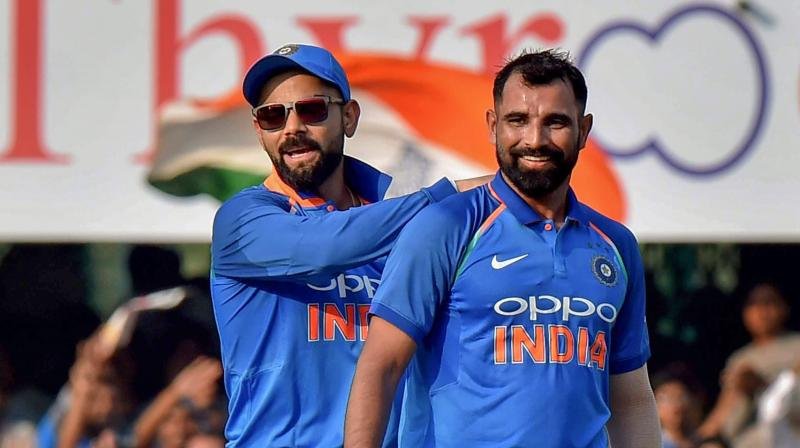
    With Virat Kohli

    Shami’s contract with the Board of Control for Cricket in India (BCCI) was withheld in 2018 because of allegations of domestic violence, only to be reinstated later.

    The bowler also struggled with injury that saw him spend nearly a year on the sidelines, leading to weight gain. He said his family and friends helped him bounce back.

    “My two or three friends used to stay with me for 24 hours (during my days of depression). My parents asked me to focus on cricket to recover from that phase and not think about anything else,” he said.

    “I started training then and sweated it out a lot at an academy in Dehradun.

    “Then my family explained that every problem has a solution no matter how big the problem. My brother supported me a lot.”

    A lean and hungry Shami made a strong comeback in the Indian team at the 50-over World Cup. He took 14 wickets in four games including a match-winning hat-trick.

    Shami has claimed 180 wickets in 49 Tests and 144 scalps in 77 one-day internationals since making his debut for India in 2013.

    Last year Shami led the pace pack in the absence of yorker king Jasprit Bumrah and claimed 13 wickets during India’s 3-0 home Test sweep of South Africa.

    Skipper Virat Kohli heaped praise on the fast bowler, saying, “he is someone who can change the complexion of the match totally when you don’t see it coming”.

  • Deepika Padukone delivers heartening speech on mental health at Davos

    Deepika Padukone delivers heartening speech on mental health at Davos

    Deepika Padukone is on a mission to make the world a better place.

    After standing in solidarity with students of New Delhi’s Jawaharlal Nehru University (JNU) who were protesting after masked assailants wielding batons and iron rods attacked the university leaving more than two dozen injured, she delivered a powerful speech on mental health at the the World Economic Forum in Davos. The actor received the Crystal Award at the annual event for her work on spreading awareness about mental health.

    The actor spoke about her mental illness journey at the event saying she had a love-hate relationship with it, and highlighted that depression and anxiety were common illnesses that could be treated.

    “My love and hate relationship with this has taught me a lot and I want to tell everyone suffering from this that you are not alone.”

    “Depression is a common, yet serious illness. It is important to understand that anxiety and depression is like any other illness and treatable. It was experience with this illness that encouraged me to set up Live Love Laugh,” she said, while speaking about her foundation. Deepika was diagnosed with depression in 2014.

    Highlighting the impact mental illnesses have people and on the economy, she said, “One trillion dollars is the estimated impact of depression and mental illness on the world economy. In the time it has taken me to accept this award, the world has lost one more person to suicide”.

    Padukone, who received the award on Martin Luther King Jr Day, also quoted the civil rights activist in her acceptance speech.

    “For in the words of Martin Luther King, everything that is done in this world is done with hope,” she said.

    Padukone started voicing her opinion on the importance of mental health through her foundation The Live Love Laugh Foundation in June 2015.

    Through the program, the actor launches nationwide awareness as well as destigmatisation campaigns. The foundation raises awareness about adolescent mental health disorders and organises training sessions, research and lecture series that feature some of the best known thinkers and achievers.

    Padukone was last seen in biographical drama Chhapaak, which she also produced. Directed by Meghna Gulzar, the movie is based on real-life acid attack survivor Laxmi Agarwal, who was attacked in 2005 at the age of 15.

  • Armeena Khan opens up about the time she was ‘severely malnourished’

    Armeena Khan opens up about the time she was ‘severely malnourished’

    Following Adnan Malik and Mawra Hocane, Armeena Khan is the latest celeb to open up about her battle with stress, anxiety, low self-esteem and poor mental health.

    In an Instagram post, the actor shared that this decade she conquered her eating disorders caused by her stressful media job. She revealed that she lost a lot of weight and ended up weighing 39 kgs only because of which she was “severely malnourished”.

    Armeena explained that she was “sharing this story not as a victim but as a victor.”

    “I conquered these and so I class them as some of my biggest achievements these last few years. I am happy in my skin now, I meditate and I eat healthy and I have a general feeling of well-being,” she wrote.

    https://www.instagram.com/p/B7CUx3UD8fM/?utm_source=ig_embed

    Armeena is one of the most vocal actors in the industry. Last year she made headlines after she heavily criticised Priyanka Chopra for her pro-war statements.

    The actor has also been part of several successful projects including Bin Roye and Janaan.

  • Why practicing mindfulness is important

    One of the most misunderstood concepts of modernity is ‘Multitasking.’ Multitasking at our jobs and social media interactions have reduced our ability to retain focus on one thing at a time. 

    However, if we introduce the practice of mindfulness in our lives – one can not only rejuvenate the complex networking of neurons of our brain but the abilities like concentration, time-management, and stress management can also be improved to phenomenal extend. 

    Here are some easy mindfulness exercises which you should consider to add in your daily life:

    STOP

    When you’re in a stressful moment, a popular mindfulness exercise called S.T.O.P. can be helpful. 

    • Stop. Just take a momentary pause, no matter what you’re doing. 
    • Take a breath. Feel the sensation of your breathing, which brings you back to the present moment. 
    • Observe. Acknowledge what is happening, for good or bad, inside you or out. Just note it. 
    • Proceed. Having briefly checked in with the present moment, continue with whatever it was you were doing. 

    PRACTICE MINDFULNESS DURING MEETINGS 

    Another very useful technique that can be practiced in group forms is by practicing it in the office with your colleagues. Meetings can be wastage of time when people aren’t listening. Here is how you can introduce mindfulness in your office meetings:

    • No phones or computers allowed at meetings, whenever possible. 
    • If you need a note taker, have one person act as secretary and circulate the notes afterward. 
    • Give uninterrupted opportunities to speak to people in the meeting. 

    Mindfulness works; that is why from Google to General Mills, they have started teaching mindfulness in their offices. You should do it as well.