
Tag: Middle East Tensions

  • Gold rates in Pakistan edge closer to historic high

    Gold rates in Pakistan edge closer to historic high

    The price of domestic gold is swiftly climbing, inching closer to its historic peak, with 24-karat gold now standing at Rs238,900 per tola, marking an increase of Rs1,800 in a single day.

    Back in June 2023, the pinnacle of gold prices saw 24-karat gold reaching Rs240,000, making the current rate just Rs1,100 short of that milestone.

    March witnessed a notable surge in the price of gold, with the precious metal gaining a significant Rs19,100, mirroring the upward trend in international gold rates.

    According to the Karachi Sarafa Association, the price of 24-karat gold stands at Rs204,818 per 10 grams, marking an increase of Rs1,543 from the previous session. Meanwhile, 22-karat gold is quoted at Rs187,750 per 10 grams.

    International gold rates are on the rise, fueled by escalating tensions in the Middle East and growing expectations for an imminent rate cut by the US Federal Reserve.

    In yesterday’s trading session, spot gold closed at an unprecedented high of $2,280.82. Daniel Ghali, commodity strategist at TD Securities, attributed this surge to the inflow of safe-haven demand triggered by Israeli strikes on Iran’s embassy in Syria, as reported by Reuters.

    Ghali further noted that the recent spike in gold prices may also be influenced by short covering activities among family offices and proprietary trading shops.
  • PKR sustains positive momentum, gains 0.04% against US dollar in ninth consecutive session

    PKR sustains positive momentum, gains 0.04% against US dollar in ninth consecutive session

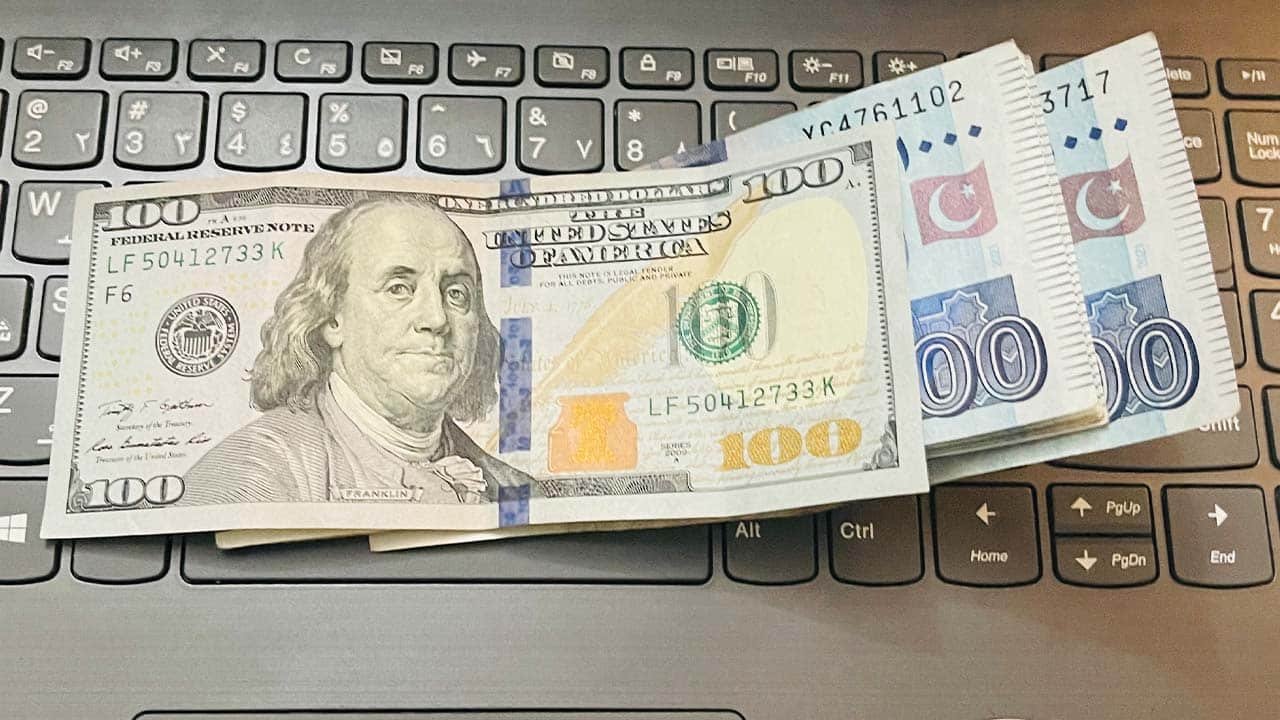
    In the inter-bank market, the Pakistani rupee continued its positive trend against the US dollar for the ninth consecutive session on Monday, appreciating by 0.04 per cent to settle at Rs280.24, reflecting a gain of Re0.12, according to the State Bank of Pakistan (SBP).

    During the preceding week, the Pakistani rupee sustained its upward movement, appreciating by Rs1.04 or 0.37 per cent against the US dollar, settling at 280.36 in the inter-bank market.

    This surge in value is attributed to the recent announcement of a staff-level agreement (SLA) between Pakistan and the International Monetary Fund (IMF) on the first review of the $3 billion Stand-by Arrangement (SBA). Consequently, the approval of the second tranche of the package ensued.

    The IMF Executive Board completed the first review of the SBA last week, facilitating an immediate disbursement of $700 million.

    As of January 5, the foreign exchange reserves held by the State Bank of Pakistan amount to $8.15 billion, with expectations of further augmentation through IMF inflows.

    On the global front, the US dollar experienced a decline on Monday amid renewed anticipations of a Federal Reserve rate cut in March.

    Simultaneously, the Chinese yuan faced challenges, hovering near a one-month low ahead of forthcoming economic data releases.

    The likelihood of a Fed cut in March gained traction following unexpected December data indicating a decline in US producer prices, prompting a slide in US Treasury yields. The US dollar index remained stable at 102.50, exhibiting minimal fluctuations in recent sessions.

    In the realm of oil prices, a significant indicator of currency parity, a slight uptick was observed on Monday. This movement was influenced by concerns over potential supply disruptions in the Middle East, following strikes by US and British forces aimed at preventing Houthi militia in Yemen from attacking ships in the Red Sea.

  • IMF’s $700 million tranche approval crucial for Pakistani rupee’s recovery

    IMF’s $700 million tranche approval crucial for Pakistani rupee’s recovery

    The Pakistani Rupee (PKR) is expected to rebound against the US dollar this week, with this revival contingent on the approval of the next tranche by the International Monetary Fund (IMF).

    Last week, the PKR weakened by 1.78 rupees (0.6 per cent), closing at Rs280.57 against the US dollar, marking a second consecutive week of decline. On the last trading day, it reached a high of Rs280.5 and a low of Rs280.15 against the greenback.

    In the open market, the rupee depreciated by 50 paisa, closing at Rs279.5 for buying and Rs292.8 for selling, compared to Rs279 and Rs282 a week ago.

    The rupee’s decline is attributed to expectations of the IMF’s approval for the next $700 million tranche of its $3 billion loan. Geopolitical tensions in the Middle East and decreased export receipts have also played a role.

    Despite hopes for recovery post-IMF approval, concerns linger about its long-term stability, with Goldman Sachs predicting a short-lived strong performance.

    The rupee’s fate remains tied to the 280 level until the IMF’s decision. The upcoming weeks and months hold uncertainty amid global economic challenges and geopolitical issues.

    Economists and financial experts are closely watching events, especially the IMF’s decision, which will significantly impact Pakistan’s economic stability as it strives to restore economic health and growth.