Tag: Migrant boat disaster

  • Refugees, migrants return home after boat tragedy, file cases against traffickers

    Refugees, migrants return home after boat tragedy, file cases against traffickers

    After the migrant boat disaster that occurred off the coast of Greece earlier in June, claiming the lives of over 300 Pakistani immigrants, around 40-50 Pakistanis that were initially waiting in Libya to set sail for Italy are now returning home.

    According to reports by Dawn, these illegal immigrants had paid at least PKR 2.5 million each to different human traffickers and their agents, in order to reach Europe via sea travel. However, last month’s horrific tragedy has prompted many to return home to Pakistan. 

    Upon their return, complaints were lodged against the human traffickers in order to reclaim the astronomical amounts paid. According to the Station House officer of Gujrat Federal Investigation Agency (FIA) police station, Irtaza Ansar Warraich, 125 cases have been filed in the last four weeks in connection to the boat tragedy. Of these complainants, those recently returning from Libya are also included.

    Most of the returning immigrants are residents of Gujrat and Mandi Bahauddin, as reported by a local senior official of the FIA in a conversation with Dawn

    According to one of the last total 12 Pakistani nationals who survived the boat tragedy, Usman Siddique, there is allegedly 20,000 illegal immigrants who are at human trafficker safe houses in Libya, waiting for their turn to travel to Europe.

    Officer Warraich also told Dawn that, since the boat disaster, at least 35 suspects involved in illegal human trafficking have been arrested, including notorious trafficker Muhammad Saleem Suniara. 

    Suniara had nine cases registered against him in FIA’s Gujrat circle alone. He is also accused of sending money via hundi to his brother Asif Suniara, who is the main person accused in the migrant boat tragedy.

    According to Aaj News, Asif is allegedly hiding in Libya currently and still operating safe houses containing migrants waiting to be moved to Europe.

  • The Weight of a Life

    The Weight of a Life

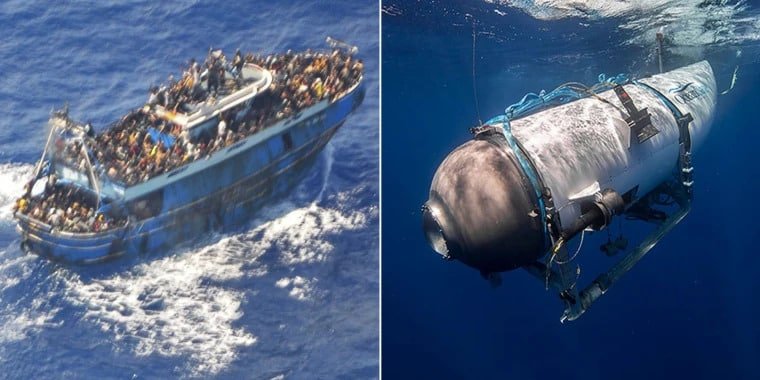
    In the last week alone, the world has been witness to two immense tragedies that played out at sea. Tragic as both events were, the public seems to be divided on which party to extend their empathy and/or sympathy toward: the 300+ Pakistani migrants that drowned after a trawler capsized off the south coast of Greece, or the Pakistani billionaire and his 19 year old son that died in an implosion thousands of metres below the surface of the North Atlantic Ocean?

    One only need to peruse through the comments under The Current’s reporting on the tragedies to understand what the two sides believe in. On the one hand, individuals are calling out the difference in response to both calamities and suggesting that Shahzada Dawood, Vice-Chairman of Engro Corporation, made a choice to die when he paid $500,000 for him and his son to travel to see the Titanic’s wreckage. Yet, this side maintains, the migrants aboard the trawler had ‘no choice’ but to embark on such a perilous journey to better fortune. 

    On the other hand, people are shocked by the Pakistani public’s ability to extend and withdraw empathy on the basis of an individual’s wealth – or lack thereof. The Dawoods were renowned philanthropists in the country, donating millions of their wealth to education and healthcare (notwithstanding the argument that, admittedly, it’s probably because they had those millions to spare). Should empathy not be extended to the wealthy that donated vast amounts to projects providing higher-education opportunities to Pakistanis? Should empathy only be extended if the wealthy are charitable?

    What is perhaps most interesting – and also practically self-evident – is the anger drawn from the media coverage of both tragedies. The OceanGate submersible was dominating global headlines the second it was announced ‘missing’, up until the moment they realised there was no hope. Meanwhile, the Greek migrant boat tragedy only saw a couple days of reporting – even though there is currently an ongoing investigation concerning the complicity or negligence of both Greek authorities and border authority Frontex on the discrepancies found in communication. 

    While there is more than plenty to criticise in regards to the stark difference with which both calamities were responded to, it is hugely counterintuitive to compare the loss of lives. It is indeed likely that the migrants were condemned to their deaths by the authorities. In transcripts published by AlarmPhone, and analyses of vessels in the area around the time the trawler sent out an alarm signal, discrepancies in official statements made by the European authorities are enough to merit investigations. Moreover, accusations have abounded regarding the Greek coast guard’s role in the eventual capsize. Pakistani survivors of the wreck reported that the boat only capsized after the Greek coast guard started towing it. 

    Of course, anger is bound to arise when one compares that scenario to a full-blown military-scale search for the five individuals onboard the missing submersible. However, the people offering no sympathy to Shahzada and his young son Suleman,  simply because they paid a lot of money to be in that position, are largely misplacing their anger. The tragic plight of migrants and refugees is not new to us: they were not simply left to their deaths only because they are poor as compared to the Dawoods. 

    Anti-immigrant sentiment is on the rise in Europe. Far-right parties with anti-immigrant policies have risen in popularity and have become quite verbose on how unwelcome immigrants are. Within such a growing sentiment – while it by no means justifies the tragedy – one simply cannot expect the same level of frantic search. It isn’t because those lives were not worth the search: it’s because those lives, in the clinical eyes of the Europeans, simply meant a burden on their existing economy and resources. 

    So yes, we should be angry. We should be absolutely livid at such blatant disregard for life. But to redirect that anger to two completely innocent Pakistanis who also encountered a tragic fate, simply because they’re rich, is quite unfounded. It could have made sense if the two incidents were correlated beyond just their occurrence in the sea – say, if the authorities meant to search for the migrants were redirected to the submersible. 

    At the end of the day, the families of the migrants have seen their entire world shatter, much like the Dawood family. To weigh the worth of lives on such a material basis such as wealth is counterintuitive to the anger felt by the loss of them. And to compare such tragedies distracts us from the larger, more pertinent structural issues that led to the worst migrant boat disaster in recent history. 

  • Greece migrant boat disaster; Pakistani survivors claim vessel was deliberately sunk

    Greece migrant boat disaster; Pakistani survivors claim vessel was deliberately sunk

    According to video accounts of Pakistani survivors, Greek authorities deliberately sunk the vessel and provided no rescue efforts. 

    In the video, survivors can be heard saying: “They have done this [on purpose]. They have sunk it themselves.” The other added, “We did not sink for five days, so why would we sink now?”

    They recounted that the ship’s engine had broken down, leaving them still for almost a week. “We did not drown even though our engine had [completely] shut down. [the boat] sunk because of the one-maund-rope they threw into the boat.”

    In an investigation conducted by the BBC, many discrepancies were found in the statements released by the Greek authorities. For one, the coastguard claims that in the hours before the boat capsized, it was on a “steady course to Italy and not in need of rescue.” 

    However, analysis of the movement of other ships in the area suggests that the migrant boat was not moving for at least seven hours before the disaster. This corroborates eyewitness accounts of Pakistani survivors.

    The UN has called for an investigation into Greece’s handling of the disaster. Greek authorities have not yet responded to the BBC’s findings. 

    FIA arrests 10 alleged traffickers

    Calamity struck a migrant boat that capsized off the south-eastern coast of Greece last week on Wednesday, leaving hundreds of Pakistani migrants dead. On Sunday, Prime Minister Shehbaz Sharif announced a high-level investigation to trace the human traffickers behind the incident. So far 10 alleged traffickers have been arrested in connection to the tragedy.

    The Federal Investigation Agency (FIA) arrested the suspected human traffickers from Azad Jammu and Kashmir, and another one from Karachi airport who was attempting to flee abroad, Geo News has reported.

    The 10 suspected traffickers are “presently under investigation for their involvement in facilitating the entire process” according to Chaudary Shaukat, an official from Pakistan-administered Kashmir.

    Condemned Pakistanis

    Last week in the early hours of Wednesday morning, a migrant boat capsized off the Southern Peloponnese while on its course to Italy from the Libyan town of Tobruk. The Guardian reported most of the victims were men from Pakistan and Afghanistan. More sinister details have since emerged from witness accounts.

    According to witnesses, the Pakistanis onboard were ‘forced below deck’ where they had far less chance of surviving a capsize. The Observer also reported that crew members were maltreating the Pakistanis below deck when they would appear in search of fresh water or tried to escape.

    The number of Pakistani lives lost is estimated to be around 298. 135 of them are reported to be from the Kashmir region. Greek authorities have yet to release a confirmation on Pakistan’s death toll.

    Mismanagement and alleged cover-up

    Many questions have been raised since witness accounts spread across global news, specifically about the role of Greek authorities in the tragedy.

    On Friday, two days after the accident, a spokesperson of the Greek government claimed that their assistance had been refused by the migrant boat after they threw a rope to the vessel to “stabilize and check if it needed help.” This contradicted the coastguard’s earlier statements that it had kept a ‘discreet distance’ from the boat.

    According to a witness interviewed by CNN, Greek authorities were seen towing the vessel with ropes, but since the ropes were tied in the “wrong places”, the boat capsized.

    The witness, Tarek Aldroobi, had three relatives on board. He told CNN, “Their boat was in good condition and the Greek navy tried towing them to the beach but the ropes were tied in the wrong places,” Aldroobi said. “When the Greek navy tried pulling them it caused the boat to capsize.”

    Nikos Alexiou, a spokesman for the coastguard, defended their response. He said their patrol boat only used a small rope to stabilize itself while it was close to the migrant boat, and that they were unable to tow it.

    In an interview with CNN, Alexiou explained: “Regretfully there was movement of people, a shift in weight probably caused by panic and the boat capsized. As soon as we got there, we started our rescue operation to collect those who were in the water.”

    In a report by The Guardian, Maurice Stierl, from the Institute for Migration Research and Intercultural Studies at Osnabrück University in Germany, responded to the coastguard’s defense: “What caused the sudden shift in weight? Was there a panic on board? Did something happen during the attempt to provide them with something? Or was it towed? And due to this towing, did the boat go down?”

    According to Stierl, EU countries ‘weaponise time’ by delaying rescue as long as they can. “They have managed to build in delays into European engagement at sea. They’re actively sort of hiding, in fact, from migrant boats, so that they are not drawn into rescue operations. We can see how a strategy is being created, that slows down –actively and consciously slows down – rescue efforts,” Stierl explains.

    Questions arose over whether the Greek coastguard should have intervened earlier, as government officials confirmed patrol boats and cargo ships had been shadowing the migrant vessel since Tuesday afternoon.