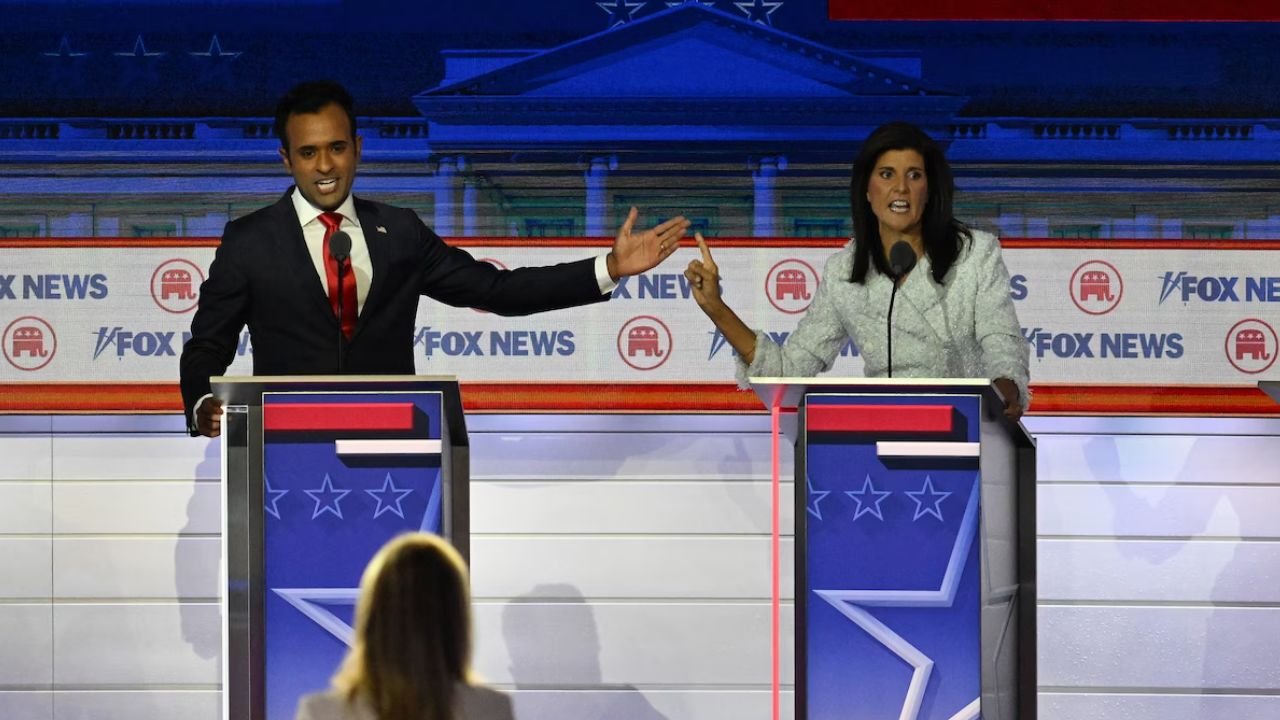
Of the many attacks between this year’s US presidential candidates, some of the harshest have pitted Vivek Ramaswamy against Nikki Haley.
Ramaswamy went so far as to hold up a sign at a debate calling the South Carolina former governor and UN ambassador corrupt over her corporate work — and she has hit back hard, calling him untrustworthy and berating him for mentioning her children.
Personal attacks are routine in US politics, and both Haley and Ramaswamy, a 38-year-old entrepreneur who has never held elected office, are facing uphill climbs to wrest the Republican nomination from former president Donald Trump.
But the two have something in common — they are children of Indian immigrants. Also expected on this year’s ballot is Democratic Vice President Kamala Harris, whose mother came from India and whose father was born in Jamaica.
Indian Americans are split on whether the Ramaswamy versus Haley feud channels larger community tensions, but what is uncontestable is that Indian Americans are more politically prominent than ever before — and increasingly wearing their identity proudly.
It is another sign of success for the community, whose average household income is the highest of any US ethnic group.
Raj Goyle, a former state lawmaker in Kansas and co-founder of Indian American Impact, a South Asian American political group, said that ethnic groups in the United States historically have waited for a greater comfort level and critical mass before entering politics.
“Indian Americans actually have had a quicker journey than other immigrant communities in terms of political success,” he said.
He noted that Indian Americans are unusual as an immigrant group in that many arrived as educated professionals, highly regarded by other Americans.
“When the first wave of us were elected, we had to think about how voters would react to our ethnicity,” Goyle said.
While racism still exists, “Now, I think there’s a very good argument to make that it’s a huge plus.”
While few give Ramaswamy much chance of winning the presidency, his candidacy marks a watershed in his embrace of his religion.
Asked at a debate in Iowa about his religion, Ramaswamy said: “I am a Hindu. I won’t fake my identity.”
Ramaswamy, who has made his name as a Trump-style rabble-rouser denouncing “woke” politics, has cast his Hinduism as in line with conservative Christian beliefs and has voiced opposition to gay marriage.
He also explained to voters in farm state Iowa, which holds the nation’s first caucus, how he is a vegetarian due to his religion.
Meanwhile, a Trump campaign aide, Chris LaCivita, told voters to “beware” of Ramaswamy’s diet, also calling him a “fraud.”
While few give Ramaswamy much chance of winning the presidency, his candidacy marks a watershed in his embrace of his religion.
Asked at a debate in Iowa about his religion, Ramaswamy said: “I am a Hindu. I won’t fake my identity.”
Ramaswamy, who has made his name as a Trump-style rabble-rouser denouncing “woke” politics, has cast his Hinduism as in line with conservative Christian beliefs and has voiced opposition to gay marriage.
He also explained to voters in farm state Iowa, which holds the nation’s first caucus, how he is a vegetarian due to his religion.
Meanwhile, a Trump campaign aide, Chris LaCivita, told voters to “beware” of Ramaswamy’s diet, also calling him a “fraud.”
Despite the prominence of Republicans like Haley, Ramaswamy and Jindal, the community has overwhelmingly voted Democratic.
Dipka Bhambhani, an Indian American writer based in Washington, said the feud between Haley and Ramaswamy showed a divide within the community.
Haley grew up helping with the bookkeeping at her parents’ clothing store, while Ramaswamy, an Ivy League graduate, was born in Ohio to an engineer father and psychiatrist mother and later married an Indian American doctor.
“When I first saw the animus from Ramaswamy toward Haley, I knew what it was about. There are wealthy Indians out there who malign other Indians for deviating, exercising American choice in who they marry, how they worship and the like,” Bhambhani said.
“Ramaswamy criticizing Haley has been (a source of) anguish for so many of us in the Indian community. There are enough spears thrown at people of color in this country. Do we really need an Indian man to take up arms against his Indian sister?”
But she said the Indian American candidates at the end of the day were Americans, even as they brought Indian values such as commitment to family.
“It would be nice to see someone in the presidency who embodies those Indian values,” she said.