Tag: misinformation

  • Fact check: Islamabad Police confirm elderly protester is safe, debunking suicide rumours

    Fact check: Islamabad Police confirm elderly protester is safe, debunking suicide rumours

    In the midst of ongoing nationwide protests against escalating electricity bills, rumours of a tragic incident have emerged, capturing the attention of social media users and news outlets alike. A post that quickly gained traction depicted an elderly man, purportedly driven to despair by soaring electricity prices, who tragically took his own life by jumping off a bridge in Rawalpindi.

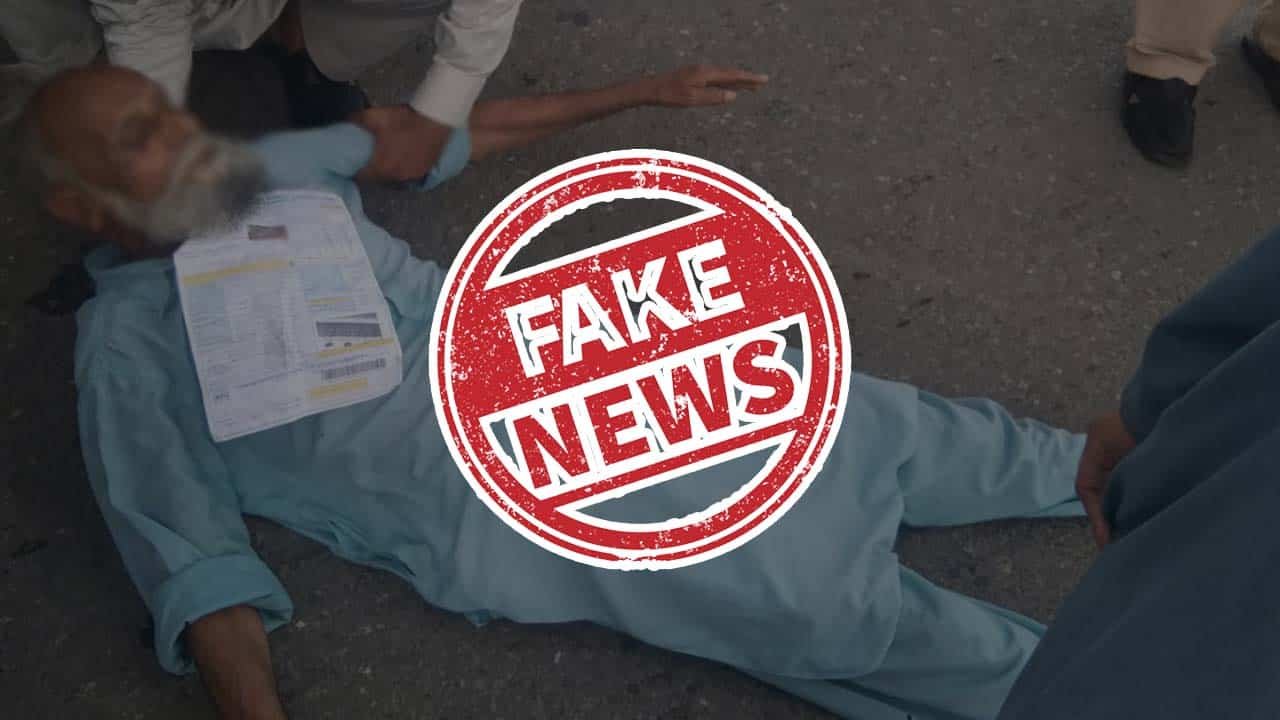
    The accompanying image showed the man lying on the road, an electricity bill resting on his chest. However, an investigation by the Islamabad Police has since confirmed that these claims are false.

    The viral post elicited an outpouring of sympathy and concern from prominent social media figures and digital news platforms, who shared the purported tragedy with deep sadness. However, as the post gained momentum, it also caught the attention of the Islamabad Police. Responding to the viral news, the authorities swiftly addressed the situation, clarifying that the incident as portrayed never occurred.

    In an official statement, the Islamabad Police stated, “The case of an elderly citizen jumping from a bridge has been circulating on social media. However, there is no truth to this news. While the elderly citizen did fall during the protest, he later safely returned home. Videos of this incident went viral among citizens on social media platforms. It’s important for citizens to refrain from disseminating such false information and instead report any suspicious activities by calling 15.”

    This incident serves as a reminder of the critical role that accurate information plays in shaping public perception and understanding of events. As protests continue to unfold across Pakistan, staying vigilant against the spread of unverified news is paramount to upholding the integrity of the ongoing discourse.

    Read more: Taxes in your electricity bill: What Pakistanis are paying and what for?

    It is crucial for both individuals and media outlets to exercise responsible reporting, ensuring that the facts are presented accurately and without distortion.


  • YouTube to remove any ‘totka’ cancer remedies that can be harmful and ineffective

    YouTube to remove any ‘totka’ cancer remedies that can be harmful and ineffective

    YouTube is set to remove content that promotes ineffective or harmful cancer treatments and discourages professional medical care-seeking. The decision is part of YouTube’s effort to refine its medical moderation guidelines, following experiences combating misinformation on subjects like COVID-19, vaccines, and reproductive health.

    In the future, Google’s video platform will apply medical misinformation policies when addressing high public health risks, relying on established health authority guidance, and countering potential misinformation-prone topics. This approach aims to cover a broad range of medical subjects while maintaining a balance between harm reduction and open debate.

    YouTube clarified its stance in a recent blog post, emphasising action against both harmful treatments and unproven alternatives presented as substitutes for established options. Notably, promoting vitamin C supplements as a replacement for radiation therapy would be prohibited.

    These policy updates come over three years after YouTube collaborated with major tech platforms to combat COVID-19 misinformation. While the platform previously acted against vaccine misinformation, it intensified efforts during the pandemic, eventually banning all vaccine misinformation by late 2021.

    YouTube also took steps against other videos violating its medical misinformation policy, including those endorsing “unsafe abortion methods” or spreading “false claims about abortion safety.”

    Divergence among major tech platforms’ approaches to COVID-19 misinformation emerged after their initial united front in early 2020. Twitter stopped enforcing its COVID misinformation policy in late 2022 due to an acquisition by Elon Musk. Meta also recently relaxed its moderation approach, particularly in countries like the US, where COVID-19 is no longer a national emergency.

  • Fawad Chaudhry’s 2019 video misrepresented by Indian media as response to Chandrayaan-3

    Fawad Chaudhry’s 2019 video misrepresented by Indian media as response to Chandrayaan-3

    A video of former information minister, Fawad Chaudhry, has been circulating on Indian media, purportedly showing him responding to India’s Chandrayaan-3 moon mission. In the video, Fawad is heard saying that Pakistan did not feel the need to work hard and send a moon mission, which has led to ridicule from Indian social media users.

    However, it is important to clarify the context of this video. The video is dated back to May 26, 2019, during which Fawad Chaudhry served as the Minister of Science and Technology in Pakistan. He was discussing disputes over sighting the Ramzan and Eid moons and announcing the release of a 5-year lunar calendar with the assistance of the science ministry. His statement was related to the moon sighting for the Islamic festivals and was not a direct response to India’s Chandrayaan-3 mission.

    During the TV show in May 2019, Chaudhry was referring to the Ministry of Science and Technology’s viewpoint on the sighting of the Eid moon. He stated, “We have a point of view in the Ministry of Science and Technology. Wherever the moon is, it is visible. Its location is known. It is known when the moon birth is taking place. Where it will be at what altitude, it is known exactly.” This statement had no connection to Chandrayaan-3, as it predates the mission by more than 4 years.

    Unfortunately, some Indian media outlets published this old video without proper research and presented it as a recent interview related to the Chandrayaan-3 mission. This led to misinterpretation and ridicule of Fawad Chaudhry on Indian social media platforms.

    In summary, the viral video of Fawad Chaudhry is not related to India’s Chandrayaan-3 mission, but rather pertains to moon sighting for Islamic festivals and dates back to May 2019. The claims of his recent mocking of the Chandrayaan-3 mission are not accurate and should be treated with caution to avoid misrepresentation.

  • Factcheck: Is Afghan singer Hasiba Noori dead?

    Factcheck: Is Afghan singer Hasiba Noori dead?

    Claim: Afghan singer Hasiba Noori had been killed in Peshawar

    On Monday, social media was ablaze with news that Afghan singer Hasiba Noori had passed away in Pakistan under mysterious circumstances, having taken refuge here after the takeover of the Taliban in Afghanistan. Conflicting news reports emerged on social media where accounts said she had passed away in Peshawar, while others said that she had been killed in Quetta.

    A journalist, Izharullah, shut down rumors of Noori’s death in Peshawar, saying that there was no such information available with the police.

    However it was senior journalist Iftikhar Firdous who took to his Twitter account to say that the news was fake, and the Afghani singer is alive and well in Quetta.

    The Current spoke with Firdous on how he reached out to the Afghan singer, and he revealed that he had managed to get in touch with Noori after contacting at least 300 people for 12 hours. Firdous had a video call with Noori, which confirmed that his source was reliable and the news that she died was fake.

    On the viral picture of Noori’s alleged corpse lying in a hospital bed, Firdous revealed that it was taken after a surgery in Karachi, the singer had clarified.

    Currently, Noori is in Quetta, and has informed Firdous that she will post a video to squash these rumors.

    The claim is false.

    The singer also shared a video on her TikTok account to silence the rumors.

  • ‘Mission Majnu agaya’: Pakistani Twitter users roast economics professor for spreading fake news

    ‘Mission Majnu agaya’: Pakistani Twitter users roast economics professor for spreading fake news

    Mission Majnu Part 2 shuru?

    Yehi tou lagta hai Steve Hanke babu ko, who took to Twitter to share a video of smoke rising from a building, claiming that it was a nuclear power plant in Karachi, and then proceeded to blame authorities for not taking the matter seriously.

    We would also like to point out that Steve Hank is a professor of Economics at the very prestigious John Hopkins. A professor of his stature is expected to share only the truth.

    https://twitter.com/steve_hanke/status/1668329656087629824?s=20

    Except, its not true. The video, from 12th June, is not of a nuclear power plant blast but its from a fire at a grid station in DHA, which left residents without light for hours.

    But if Pakistanis are good at anything, it is making memes to roast others. And we got some hilarious responses.

    Quick someone fly Sidharth Malhotra to Karachi!

    Mission Majnu say fact checking seekhien sir!

    https://twitter.com/legsidehack/status/1668497941256888327?s=20
    https://twitter.com/SeaweeedBrain_/status/1668353773326983180?s=20

  • Google’s technical glitch causes panic with incorrect US dollar rate of Rs186 instead of Rs286

    Google’s technical glitch causes panic with incorrect US dollar rate of Rs186 instead of Rs286

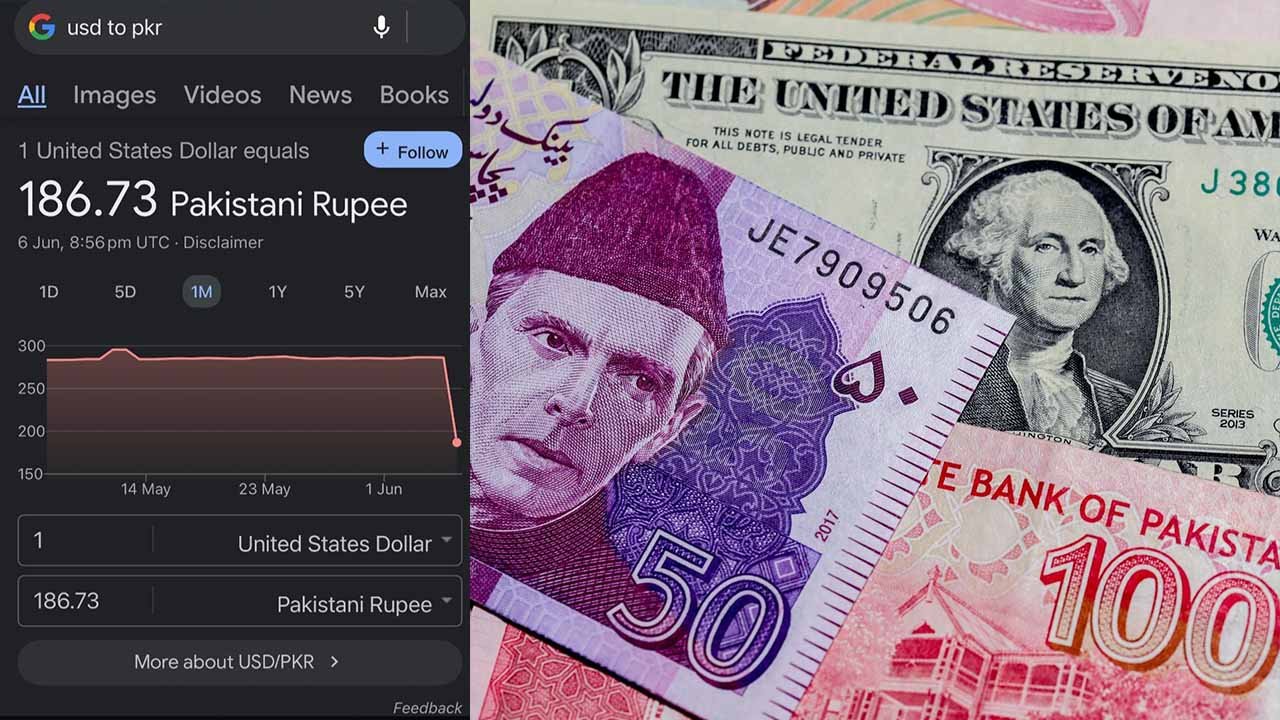
    Late Tuesday night, a technical malfunction on Google Search caused a momentary panic among investors and observers as the value of the US dollar plunged in comparison to the Pakistani rupee.

    The unexpected drop to Rs186.73 bewildered many, especially considering that the local currency hadn’t experienced a significant rebound recently.

    It was later discovered that the decline in currency exchange rates was a result of a technical problem with the search engine on the website, leading to a temporary plummet in the rates.

    This incident is not the first of its kind and has occurred multiple times in the past, leaving users puzzled by massive declines in dollar rates.

    The glitch and its impact

    On Tuesday, June 6, the interbank market closed with the Pakistani rupee at Rs286.56 against the US dollar, while it remained above Rs300 in the open market. However, due to the technical glitch on Google Search, the rates displayed on the platform inaccurately dropped to Rs186.73.

    The sudden decline surprised and concerned individuals who were monitoring the exchange rates, as it deviated significantly from the prevailing values. Fortunately, the issue was promptly identified and rectified, restoring the rates to Rs286.72.

    Recurring glitches on Google Search

    This incident marks yet another occurrence of a glitch affecting the world’s largest search engine and impacting currency exchange rates. In July of the previous year, the rates displayed on Google Search had crashed to Rs207.10, a stark contrast to the rates issued by the State Bank of Pakistan.

    According to the central bank, the rupee had closed at 236.02 against the US dollar in the interbank market. The repetition of such glitches raises concerns about the accuracy and reliability of the information provided by Google Search in matters of global financial significance.

    User Reactions and Social Media Response: The recent glitch on Google Search didn’t go unnoticed by users, with several individuals taking to Twitter to highlight the issue. One user tweeted, “Last night, the dollar crashed on Google,” emphasising the impact the technical malfunction had on the perceived value of the US dollar.

    Such reactions on social media platforms highlight the widespread reliance on search engines for real-time financial data and the potential consequences of inaccuracies caused by technical glitches.

    While the glitch was rectified, it highlights the recurring nature of such incidents on the world’s largest search engine, casting doubts on the accuracy of the financial information provided.

    As reliance on search engines for real-time data increases, it becomes imperative for platforms like Google to ensure the reliability and integrity of the information they display to prevent unwarranted panic or misinformation in the financial markets.

  • Delhi University to remove chapter about Alama Iqbal from political science textbooks

    A chapter about Allama Iqbal in a book recommended for Political Science syllabus has been removed by Delhi University, after a discussion at the Academic Council meeting.

    According to Indian news organization ANI, the Vice Chancellor, Yogesh Singh, said that those who laid the foundation to break India should not be taught to students:

    “Iqbal wrote songs supporting the ‘Muslim League’ and the ‘Pakistan Movement’. Iqbal was the first to raise the idea of the partition of India and the establishment of Pakistan and said that instead of teaching about such people, we should study our national heroes.”

    The right-wing student movement Akhil Bharatiya Vidyarthi Parishad has welcomed the motion, saying Iqbal was a ‘fanatic theological scholar’ who was responsible for the partition of India.

    “Delhi University academic council decided to scrap fanatic theological scholar Mohd Iqbal from DU’s political science syllabus. It was previously included in BA’s sixth-semester paper titled ‘Modern Indian political thought. Mohammad Iqbal is called the ‘philosophical father of Pakistan’. He was the key player in establishing Jinnah as a leader in Muslim League. Mohammad Iqbal is as responsible for India’s partition as Mohammad Ali Jinnah is.”

  • Godfather of AI resigns from Google, issues warning on dangers of AI development

    Godfather of AI resigns from Google, issues warning on dangers of AI development

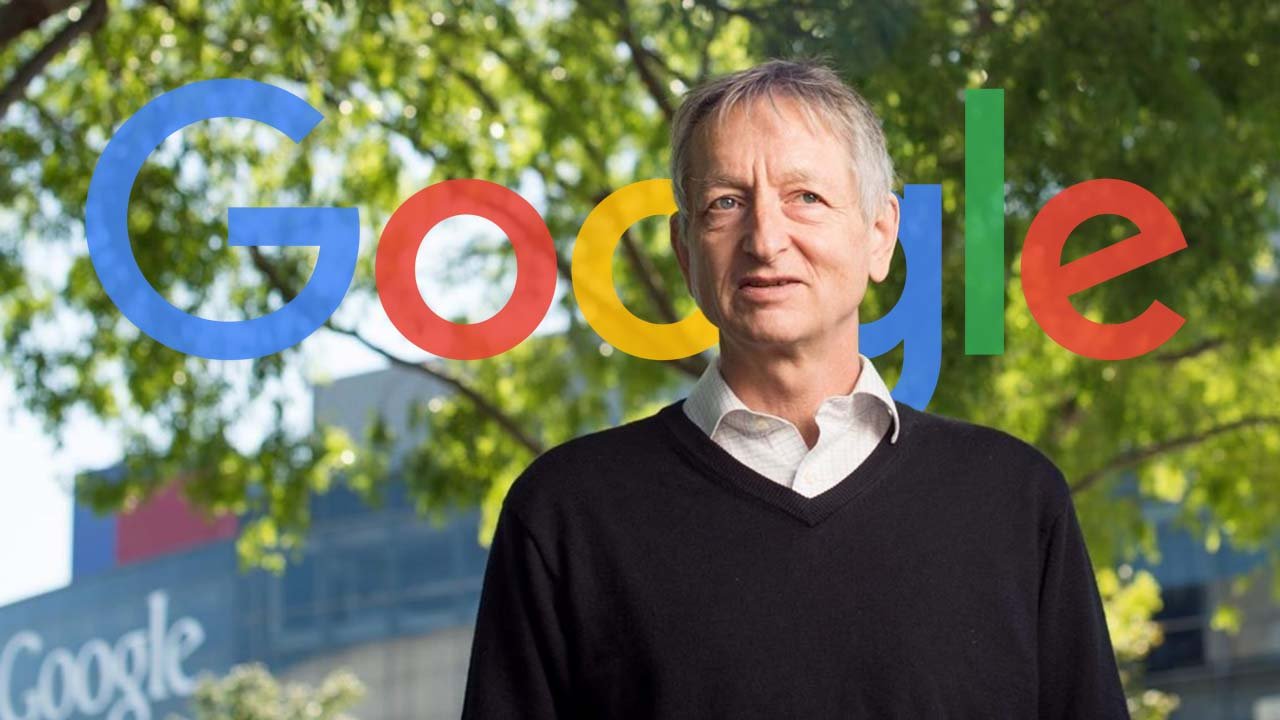
    Geoffrey Hinton, known as “the Godfather of AI,” has spent most of his career promoting the benefits of artificial intelligence, but now he is concerned about its potential dangers. He recently spoke to the New York Times about his decision to leave Google, where he co-founded Google Brain, a research team developing AI systems, citing concerns about the difficulty of preventing bad actors from using the technology for malicious purposes. Hinton is not alone in his apprehension about AI’s future, as other AI pioneers have expressed similar concerns.

    One of Hinton’s primary concerns is the spread of misinformation enabled by AI, such as deepfakes and AI-generated fake news, which can confuse people and blur the lines between reality and fiction. He worries that people will no longer be able to distinguish what is true from what is not.

    Hinton is also concerned about the rapid pace of AI technology advancement, which has been fueled by competition among major tech companies like Google and Microsoft. He is worried that the technology will become more advanced than the human brain, something he once believed was decades away from happening.

    Now 75, Hinton is dedicating the rest of his life to ensuring that the technology he helped create won’t lead to the destruction of civilization. He acknowledges the possibility that others would have developed AI had he not done so, but he still feels a sense of responsibility to help mitigate the potential negative consequences of its use.

  • Singer Annie Khalid slammed by Twitter for calling Malala ‘puppet of the West’

    Singer Annie Khalid, an icon of our childhood music scene, had given Pakistani audiences such hits as ‘Mahiya’ or ‘Princess’ but looks like not everything that is old is gold. Because now Khalid is getting slammed by social media users for making a controversial statement about education activist and Nobel laureate Malala Yousafzai.

    In reply to a random post which had asked users to share an opinion they found controversial, Khalid thought she should provide an opinion that is not only outrageous but also insensitive.

    “That Malala is a puppet of the west,” the singer tweeted.

    Twitter users were horrified, asking what exactly had Malala done to prompt such bullying from Khalid? Malala has not made any such comments about Imran Khan, aside from calling him out for his racist views on Pathans, so why solely target her for living in the West because of the threats on her life?

    Twitter users demanded that Khalid apologize, shedding light on the fact that Malala had made more efforts to speak up on the rights of Pakistani women than Khalid had ever done.

    “Don’t embarrass your self Taliban Apologist she resist Taliban brutality she talks about girl’s education you are a nobody like your leader who is taliban apologist who bought Taliban back In KPK shame on you mirasi”

    Some actually found it hilarious and ironic that Khalid is going after Yousafzai for living in the UK… when she actually lives in the UK as well.

    Some were even compared the achievements Malala continues to make while Khalid can’t say the same

    “Girl has one good song in her kitty and audacity check karo buss”

    https://twitter.com/yourdoriangray/status/1637708751439380483?s=20

    We can’t say anything else other than how deeply embarrassing it is to witness a woman flinging accusations on another woman, just because of difference of political beliefs. We sincerely hope that Pakistani celebrities would learn some decorum and stop dissing other women by distorting facts and through sheer bullying.

  • Newark mayor duped into partnership with Hindu country that doesn’t exist

    Newark in New Jersey is gaining viral traction for all the wrong reasons. The town has become the brunt of many a jokes after it was revealed that mayor Ras Baraka had been duped into forming a sister city partnership with a delegation from the ‘country’ Kailasa, which was found out to be fake six days later.

    A signing ceremony was held on March 6 between the delegation from the fake country and city officials of Newark where Baraka had said:

     “I pray that our relationship helps us to understand cultural, social and political development and improves the lives of everybody in both places.”

    Last week, Newark officials admitted that they had been scammed by the Indian fugitive Swami Nithyananda, who was the head of the delegation from ‘Kailasa”, but said they were still committed to partnering with people from diverse cultures:

    “Although this was a regrettable incident, the city of Newark remains committed to partnering with people from diverse cultures in order to enrich each other with connectivity, support and mutual respect.”

    The partnership lasted for only six days, until it was dissolved for baseless.

    The head of Kailasa, Swami Nithyananda, is an Indian guru who is currently charged with rape and child abduction by the Indian government. He has denied the accusations.

    Nithyanananda writes that Kailasa was founded in order to ensure the “restoration, preservation and propagation of authentic Hindu culture and civilization after centuries of oppression and subjugation. It is the home and refuge for the international Hindu diaspora.”

    According to its website, Newark is not the first town to be duped into forming the partnership, as so had Virginia, Ohio and Florida.

    Residents of Newark found the incident to be shocking. Shakee Merritt spoke to CBS that he was suprised no one did a simple Google search on whether the country was real or not.