Singer Aima Baig has shared on Instagram that she was suing the online celebrity tabloid ‘FMH Magazine’ for spreading misinformation and fake news about her for the sake of likes and traction.
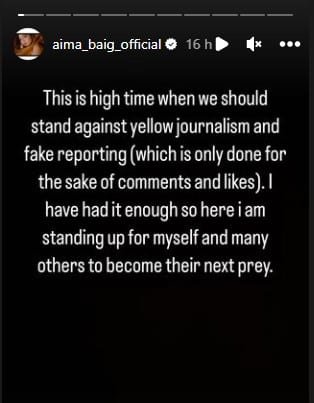
“This is high time when we should stand against yellow journalism and fake reporting (which is only done for the sake of comments and likes). I have had it enough so here I am standing up for myself and many others to become their next prey.”
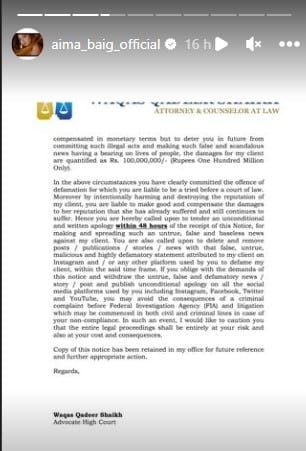
The ‘Washmallay’ singer then shared clips of the defamation notice she has sent to FMH Pakistan for posting a story that was “false, untrue, malicious and highly defamatory.”
In the next clip, the legal notice read: “Being a digital and print media/ news company, you are required under the law to be truthful, honest, correct and highly responsible for the public posts/ stories/ statements / articles/ news you publish…It is evident that the scandalous and false and defamatory statement you have attributed to my client is explicitly intended to harm her reputation and to malign her before the public, for the monetary gain you are getting from clicks, views, comments and shares of your scandalous news..”
In the last clip, the news organization was directed to pay Rs 100 million for the damages made by their misinforming post, as well as upload a written apology within 48 hours on the receipt of this notice.
Aima Baig called out FHM, an online celebrity magazine, for spreading incorrect information about her and lectured them on the importance of fact checking before publishing stories.
FHM had published a story about a re-surfaced interiview in which they claimed Baig had said that she had a crush on her elder brother, who was seven years senior to her.
Baig commented underneath the post, stating that she was horrified because she had never said such a thing.
“What in the actual f**k is that???? I never said anything stupid like that wth! Kuch to sharam kar lo yaaar. Like seriously is this really something we should be talking about, clearly not knowing how sensitive is this topic.”
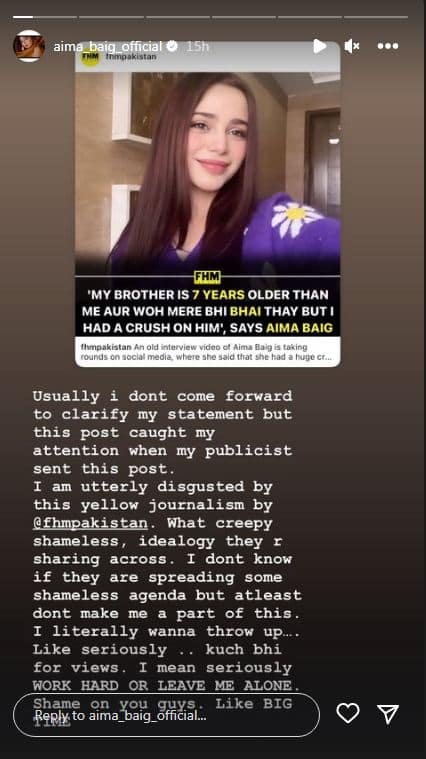
On her own Instagram page, Baig revealed that her publicist had sent her the FHM post. She said she was dissapointed by ‘yellow journalism’.
“Usually I don’t come forward to clarify my statement but this post caught my attention when my publicist sent this post. I am utterly disguisted by this yellow journalism by @fhmpakistan. What creepy, shameless ideology they are sharing across. I don’t know if they are spreading some shameless agenda but atleast don’t make me a part of this. I literally wanna throw up…like seriously..kuch bhi for views. I mean seriously WORK HARD OR LEAVE ME ALONE. Shame on you guys. Like big time.”
Baig also clarified that the story was not true, and shared the link to the interview where she had actually said that her crush was her elder brother’s best friend, when she was ten years old.
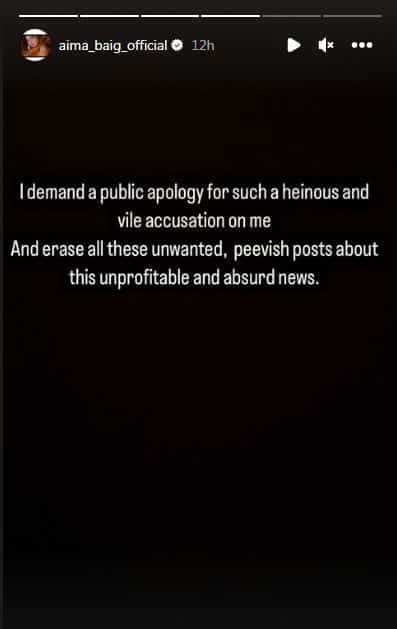
Baig also demanded an apology from the online website for spreading degrading information about her:
“I demand a public apology for such heinous and vile accusation on me. And erase all these unwanted, peevish posts about this unprofitable and absurd news.”
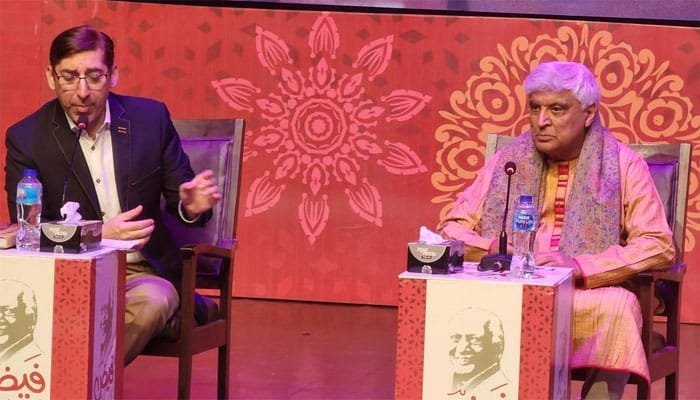
Javed Akhtar and the Indian media are congratulating themselves for “dushman kay ghar mein ja kar usko marna” after his comments criticizing Pakistan for not taking strict action against the terrorists responsible for 26/11 Mumbai attacks went viral. In an interview with NDTV channel, Akhtar claimed that Pakistanis had clapped when he had made the remark, and agreed with him. “They all clapped. They agreed with me. There are many people who admire India, want to have a relationship with us. We tend to think of countries as monolith. That is not the case. How do we connect with millions of people, who want to connect with India,” he stated.
However, the statement is incorrect as according to the complete video of Javed Akhtar’s response to a question from an audience member, there was complete silence during his Mumbai comments.
Only after the host, Adeel Hashmi, asked another question can scattered applause be heard, signaling that the audience was applauding the end of a guest’s response to a question and not a specific comment like they had done before after Akhtar’s comment on Lata.
The audience did appreciate another comment by the Indian poet. Javed Akhtar had said that Indian musicians were not celebrated in Pakistan: “We [India] have held concerts for people like Nusrat Fateh Ali Khan and Mehdi Hassan, but your country has not held a concert for Lata.” This statement is also incorrect as Indian musicians and actors have been honored with some of the highest awards given by the Pakistani government and especially have been invited to talks in Pakistani cities. Journalist Yusra Askari shared pictures of the Bollywood actors and singers who had received accolades in Pakistan.
We might not have had the privilege of hosting the genius of Lata ji but talent from across the border has always been lauded, appreciated and celebrated on our shores.
India disseminated the largest amount of Coronavirus misinformation on social media due to the country’s higher internet penetration rate, increasing social media usage and users’ lack of internet literacy, according to a new study.
The study titled ‘Prevalence and Source Analysis of COVID-19 Misinformation in 138 Countries’ was published in Sage’s International Federation of Library Associations and Institutions journal.
As per details, the study examined 9,657 pieces of misinformation made in 138 countries. They were fact-checked by 94 organisations to understand the prevalence and sources of misinformation in different countries.
“Of all the countries, India (18.07 per cent) produced the largest amount of social media misinformation, perhaps thanks to the country’s higher internet penetration rate, increasing social media consumption and users’ lack of internet literacy,” the study stated. The results also showed that India (15.94 per cent), the US (9.74 per cent), Brazil (8.57 per cent) and Spain (8.03 per cent) are the four most misinformation-affected countries.
Based on these results, the study stated that it is presumed that the prevalence of Covid-19 misinformation can have a positive association with the pandemic situation.
“Social media (84.94 per cent) produces the largest amount of misinformation, and the internet (90.5 per cent) as a whole is responsible for most of the Covid-19 misinformation. Moreover, Facebook alone produces 66.87 per cent of the misinformation among all social media platforms,” it added.
Earlier, the World Health Organisation (WHO) had also cautioned that false information on the virus is spreading and putting people in danger. WHO had advised people to make sure to double-check everything they hear with trusted sources before believing or sharing them with others.
Britain’s Prince Harry — who is often at war with the British press — was on Wednesday announced as a commissioner for a US study into misinformation online.
The non-profit Aspen Institute said it was “honoured” to have the Duke of Sussex as one of the 18 members of its “Commission on Information Disorder.”
The announcement came a day after Harry became Chief Impact Officer at San Francisco life-coaching startup BetterUp as he adds to his growing portfolio of jobs since stepping away from royal duties last year.
As part of the Aspen study, Harry will help conduct a six-month investigation into misinformation and disinformation in the American digital world that will start in April. The commission aims to identify the biggest causes of the sharing and spreading of false information and find solutions to help the government, private sector and civil society respond.
“The experience of today’s digital world has us inundated with an avalanche of misinformation, affecting our ability as individuals as well as societies to think clearly and truly understand the world we live in,” Harry said in a statement.
“It’s my belief that this is a humanitarian issue — and as such, it demands a multi-stakeholder response from advocacy voices, members of the media, academic researchers, and both government and civil society leaders,” he added.
The prince is likely to bring his own experiences of media coverage of his life to the commission.
Harry told US talk show host James Corden in February that he left royal life and moved to the United States with Meghan Markle because the British press was “destroying his mental health.”
The prince has long had a difficult relationship with Britain’s tabloids, blaming press intrusion for contributing to his mother Princess Diana’s death in a car crash in 1997.
Harry and Meghan have filed several lawsuits against newspapers and last April told Britain’s tabloids that they were ending all cooperation with them due to “distorted, false or invasive” stories.
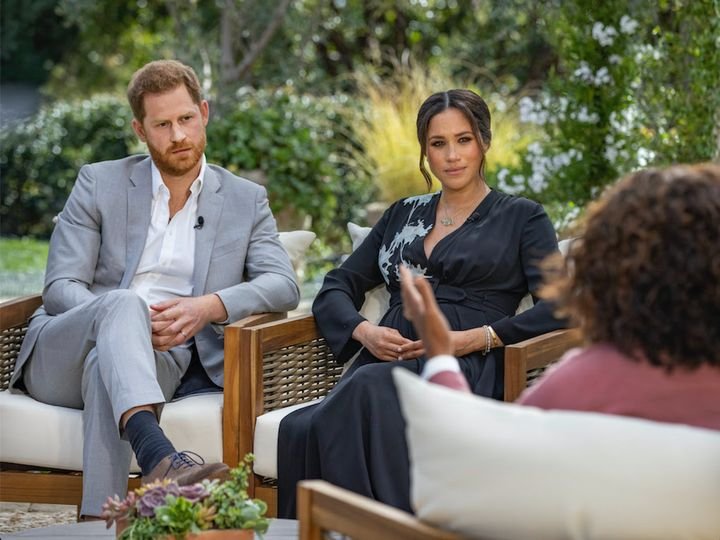
An explosive interview they gave to Oprah Winfrey this month — in which they claimed an unnamed royal had asked how dark their baby’s skin would be — plunged the monarchy into its biggest crisis since the death of Diana.
Meanwhile, Harry’s new boss at BetterUp has said that the British royal likes to be called Harry in the workplace.
“He’s a colleague, he’s a partner, and so we address him as Harry,” said Chief Executive Alexi Robichaux.
Robichaux said he met Queen Elizabeth’s grandson, through a mutual friend in late 2020, and talked about how to encourage mental wellbeing.
“Through a series of conversations over months, (we) really had a lot of shared energy and enthusiasm for how it could be really awesome to find a way to work together and advance the shared mission,” he said.
As well as being an executive, Prince Harry said in a blog post that he was also a user of the service. Robichaux said he and the coach he was paired with are still working together.
As for how much Prince Harry is being paid in his new position, Robichaux declined to say.
“As a private company, you can imagine we don’t disclose compensation information of any of our folks. But I think it’s fair to say he’s deeply invested in the success of BetterUp,” he said.
Kubra Khan has hit back at a local media news outlet for misreporting her comments about un-following Prime Minister Imran Khan on Twitter. Khan, in an interview, had shared that she unfollowed PM Khan (and Hamza Ali Abbasi) on Twitter because she didn’t want any political updates.
Sharing the misreported news on Twitter, Kubra said: “I am and will always one of the biggest supporters of [PM] Imran Khan.”
“I don’t need to follow him on “social media” to show my support,” said the actor further, adding: “But thanks for adding the negative connotation?”
I am and will always one of the biggest supporters of @ImranKhanPTI – I don’t need to follow him on “social media” to show my support. But thanks for adding the negative connotation? https://t.co/eSoNScQzyA
Earlier, during the 2018 General Elections, Kubra had said that if she had the option to vote, “it would be no other than PTI.”
So, because I’m a UK resident I can’t personally vote in Pakistan as of yet. So even if I was in the country It wouldn’t make a difference. However if I could vote it would be no other than PTI. Tomorrow will map out the future for Pakistan. Make the right decision. #NayaPakistanpic.twitter.com/t39U3Z9Tpj
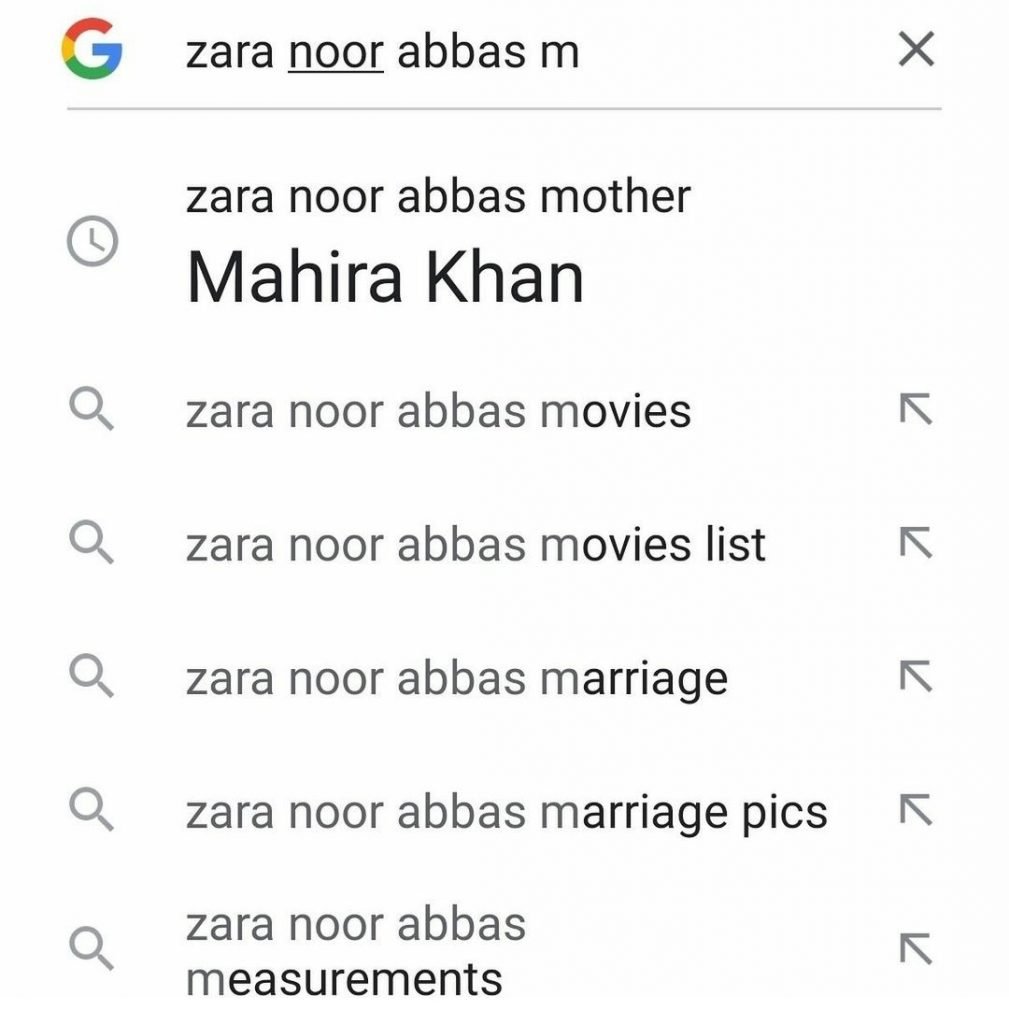
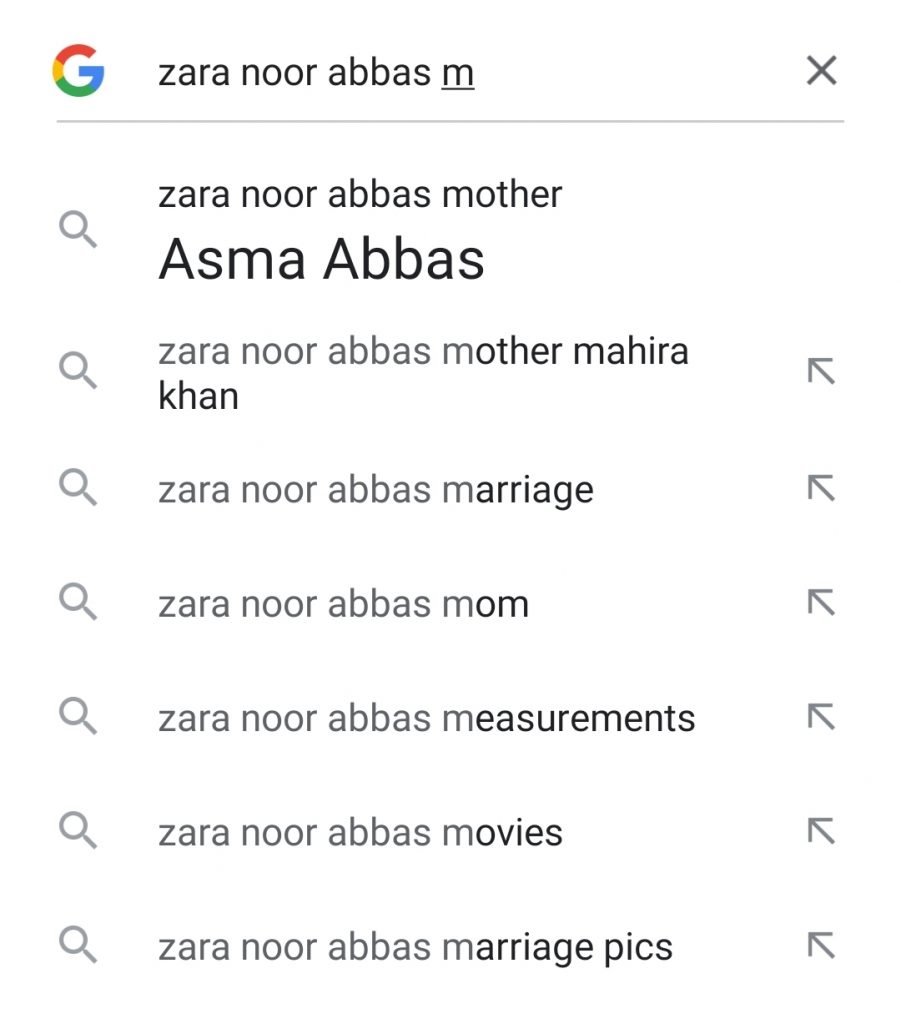
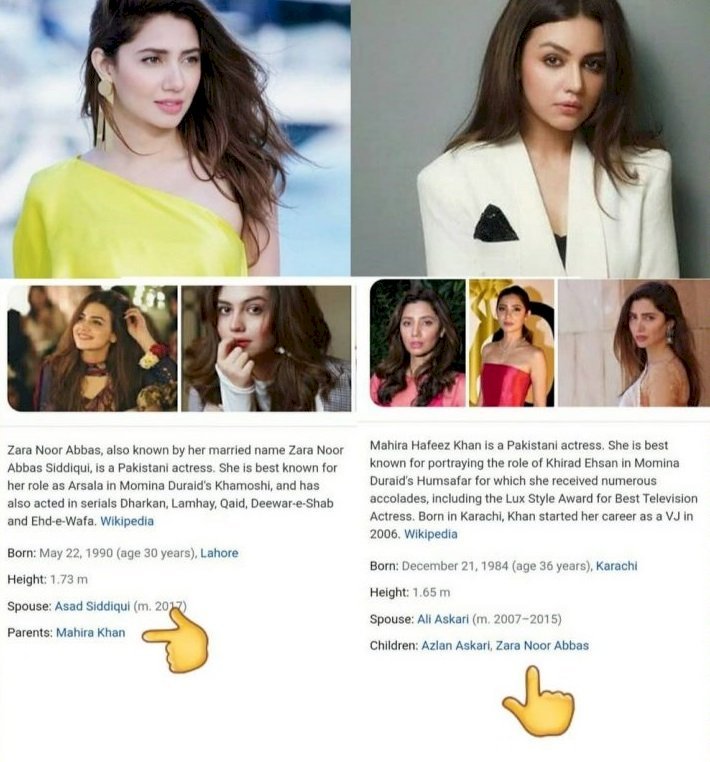
Google has reportedly listed Mahira Khan as Zara Noor Abbas’ mother.
While it is unclear why and how it happened, a screenshot of search has gone viral on social media. Meanwhile, in reality, the Khamoshi star is the daughter of Asma Abbas and niece of veteran actor Bushra Ansari.
Later, the information on Wikipedia was corrected with Asma listed as Zara’s mother.
Goes on to show that even Google and Wikipedia can mess things up and sometimes give incorrect information.
Earlier, Google had listed Esra Bilgiç as Yasir Hussain’s mother.
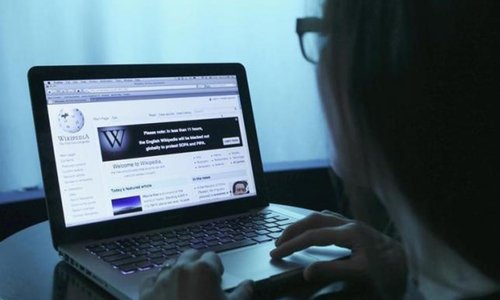
A large number of users are switching to Wikipedia as a trusted source to share and find COVID-19 updates. Around 4,504 Wikipedia pages have been created to record different aspects of the pandemic like it’s spread to different countries, research to find its treatment and popular conspiracy theories, a private media outlet reported.
Although the information on Wikipedia is available in 130+ languages, however, the English-language articles on Wikipedia about the virus alone have registered over 240 million views.
The report also says that Wikipedia Foundation observed a record five-years high traffic, with over 673 million page views in a single day –the traffic was mostly — if not completely to COVID-19 articles.
On March 12, 2020, the day World Health Organization (WHO) declared COVID-19 as a global pandemic, the main English Wikipedia article on virus received over 1.4m page views; which means that it increased by 73 per cent from the day before WHO’s declaration.
BATTLING MISINFORMATION
It is not easy to control misinformation, that is why a dedicated page titled as ‘Misinformation related to the 2019-20 coronavirus pandemic’ is constantly charting and debunking falsehoods on the outbreak. Also, a large number of people are editing information by citing credible sources.
Hello, everybody.
Coronavirus news is piling up, and Wikipedia editors are keeping pace. We’ve seen more than 12k edits by 1.9k editors on Wikipedia’s article about the pandemic.
According to the editor, the key to maintain accuracy on the platform is to cite sources, a single line cited with the credible source will be published but a complete paragraph written by a doctor, without citation will not be published on the platform.