Tag: Moon Sighting

  • When are Ashura holidays expected?

    When are Ashura holidays expected?

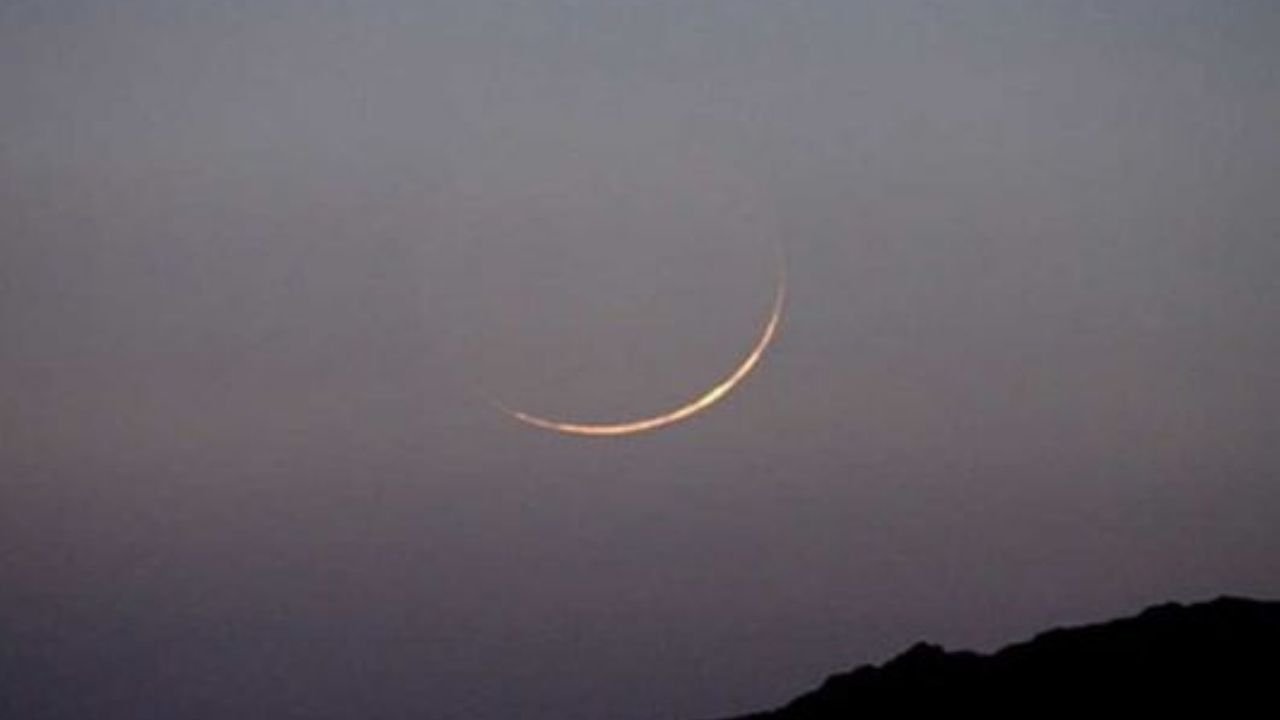
    The moon of the new Islamic year 1446 Hijri is likely to be seen in Pakistan on Sunday, July 7.

    Thus, the new Islamic year will start in Pakistan on Monday, July 8, and Ashura Days will be on Wednesday, July 17 and 18.

    However, the meeting of the central moon sighting committee, which is chaired by Maulana Abdul Khabeer Azad, will be held in Quetta on July 6, while the zonal committee meetings will also be held in the zonal headquarters in Karachi, Islamabad, and Lahore.

    In the UAE, the moon of the new Islamic year, 1446 Hijri, is likely to be sighted on Saturday, July 6.

    The UAE government has already declared a public holiday on July 7 in the private sector.

  • When are Eid ul Azha holidays expected?

    When are Eid ul Azha holidays expected?

    The Pakistan Meteorological Department (PMD) has predicted that there is a high chance of Eidul Adha 2024 to be observed on June 17, Monday.

    The PMD’s Climate Data Processing Centre has predicted that the crescent moon for Zul Hajj will be born on June 6 at 5:38 PM, reports Samaa News.

    Despite the forecasts, the Central Ruet-e-Hilal Committee will make the final decision regarding the moon sighting in the country.

    Holiday schedule

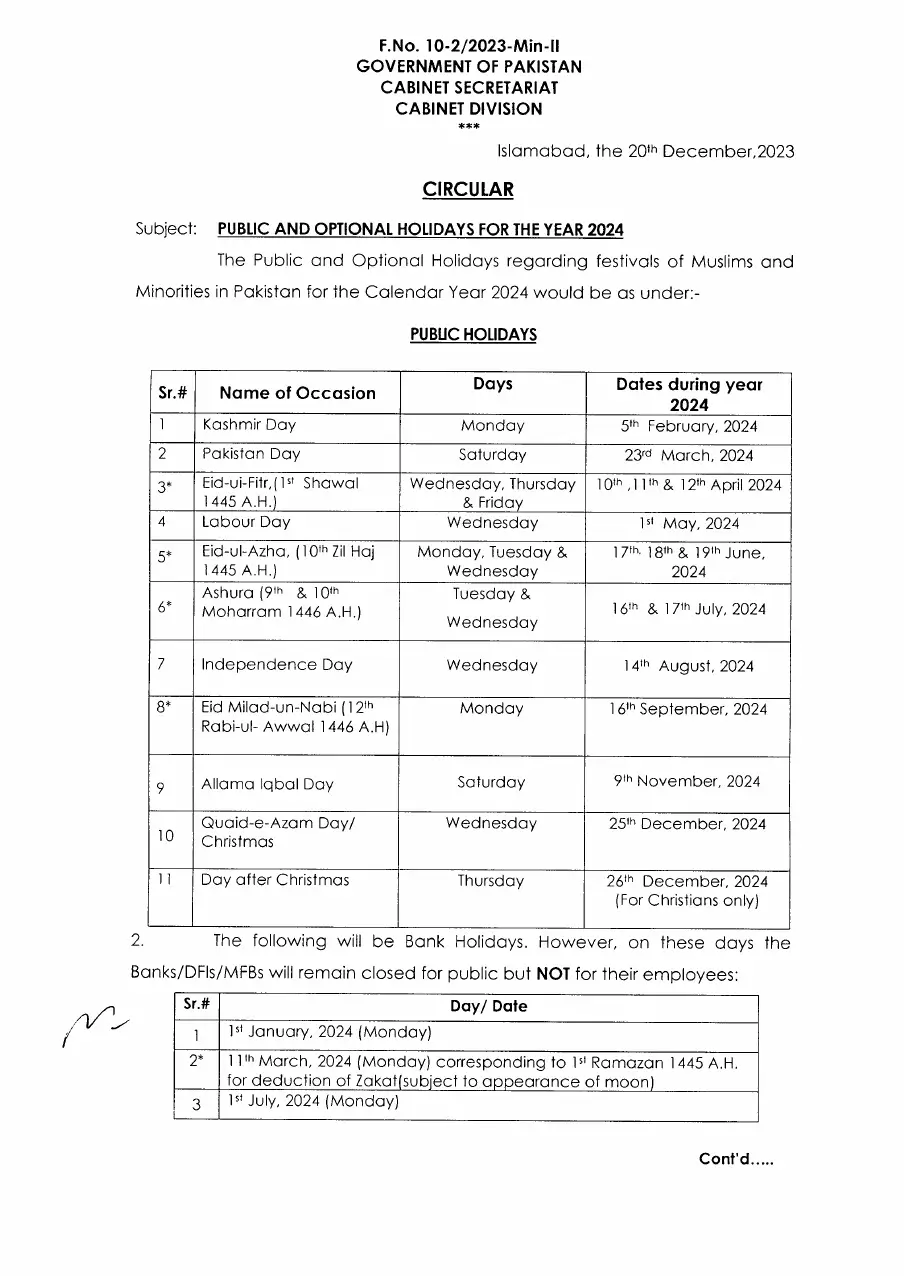
    The official 2024 holiday calendar has earmarked the Eid ul Azha holidays from June 17 to 19.

    However, considering the tendency of most government offices to remain closed on Saturdays and Sundays, the holiday period will effectively commence on June 15.

    A formal notification detailing the revised holidays will be issued by the federal government in the days leading up to Eid ul Azha.

  • When is Zul-Hajj moon expected?

    When is Zul-Hajj moon expected?

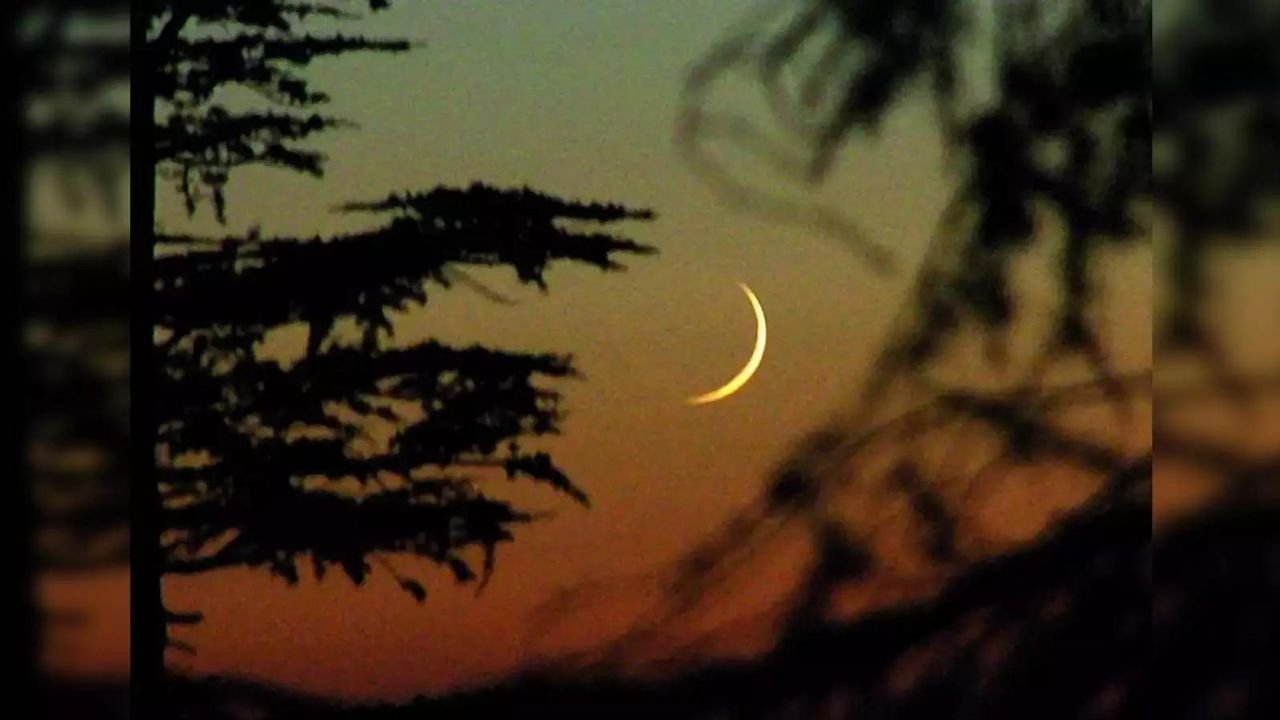
    The Meteorological Department has predicted that there is a strong possibility that the moon of Zul-Hajj will be visible on Friday, June 7.

    The Eid-ul-Azha will be on Monday, June 17, if the predictions around the Zul-Hajj moon stand true.

    The International Astronomy Center says that Islamic countries will witness the Zul-Hajj moon on Friday, June 7, according to the Al-Arabiya report.

    If the moon is visible, the first Zul Hajj will be on June 8, otherwise, it will be on Sunday, June 9, that is, the first day of 10 Zul Hajj Eid-ul-Azha will be on Monday, June 17, or Tuesday, June 18.

    However, the final announcement of the date of Eid-ul-Azha in Pakistan will be made by the central Moon Sighting Committee after the sighting of the Zul-Hajj moon.

  • Know all about Eid predictions here

    Know all about Eid predictions here

    There is a strong possibility that the Shawwal moon will be visible in Pakistan today.

    The age of the moon will be complete enough to be visible to the human eye this evening, according to experts of Meteorological Department. However, the final announcement of the moon of Shawwal will be made by the central Ruet-i-Hilal Committee.

    The moon of Shawwal has not been seen in Saudi Arabia, in view of which, Eid-ul-Fitr will be held tomorrow, Wednesday, in Saudi Arabia.

    In addition to Saudi Arabia, Qatar, the United Arab Emirates, Bahrain, and Kuwait will celebrate Eid tomorrow, according to media reports in the Gulf-based newspapers. Simi­larly, Australia has also announced that Eid will be observed on Wednesday.

    The central moon-sighting body will meet at the roof of the Federal Secreta­riat’s Kohsar Block in Islamabad, while meetings of zonal and district Ruet-i-Hilal committees will be held at their respective headquarters concurrently.

    In a statement on Mon­day, the committee requ­es­ted citizens to share any information regarding sightings of the moon with the committees in their respective areas.

    If the committee manages to spot the new moon today, then Pakistan will also celebrate Eid with the rest of the world.

  • List of all public holidays in 2024

    List of all public holidays in 2024

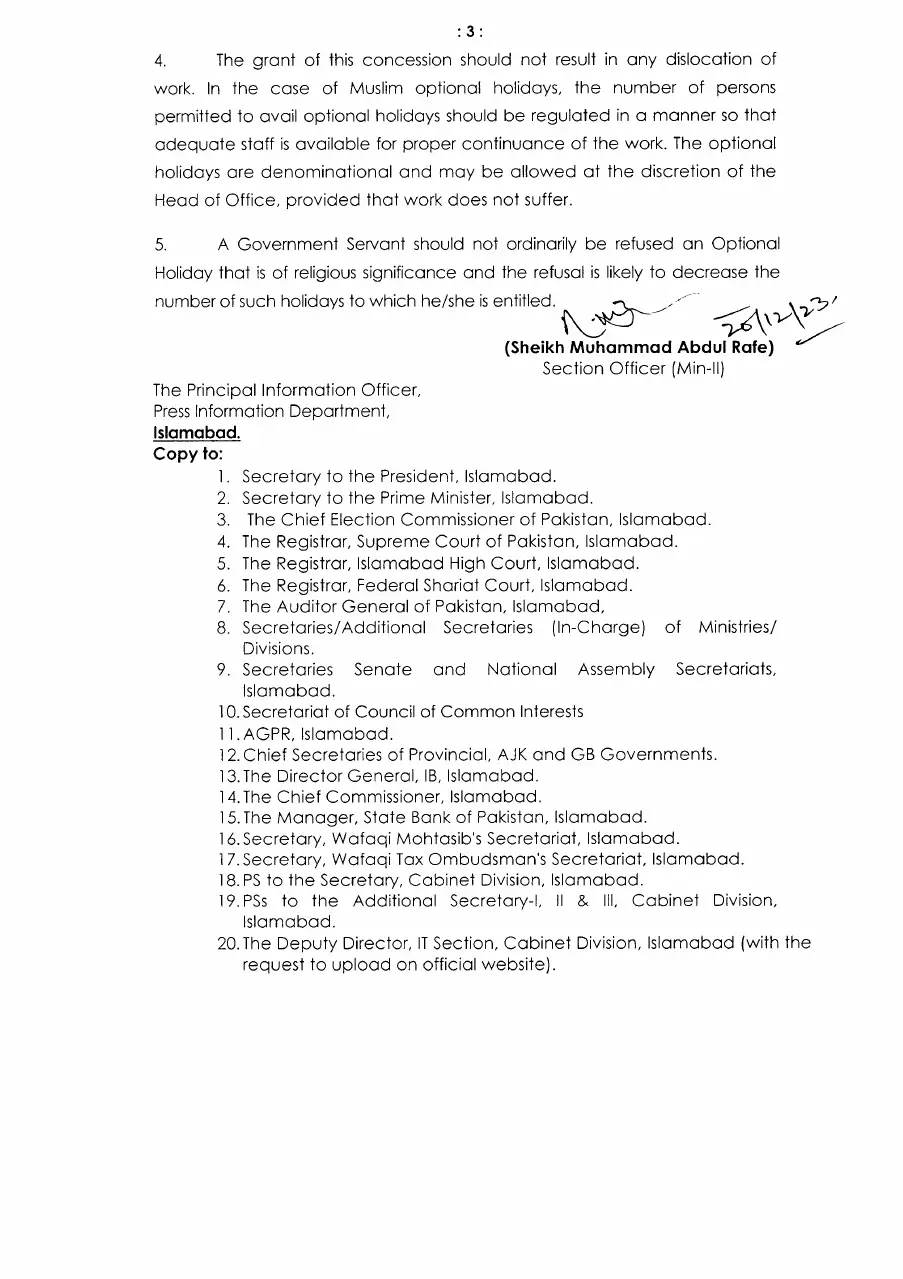
    In a notification issued by the Cabinet Division on Wednesday, the Government of Pakistan has officially declared the public holidays for the upcoming year 2024.

    The list encompasses a range of festivals and events significant to both Muslims and minorities across the nation.

    The 2024 public holiday calendar features a total of 11 days, each representing a momentous occasion celebrated widely in Pakistan.
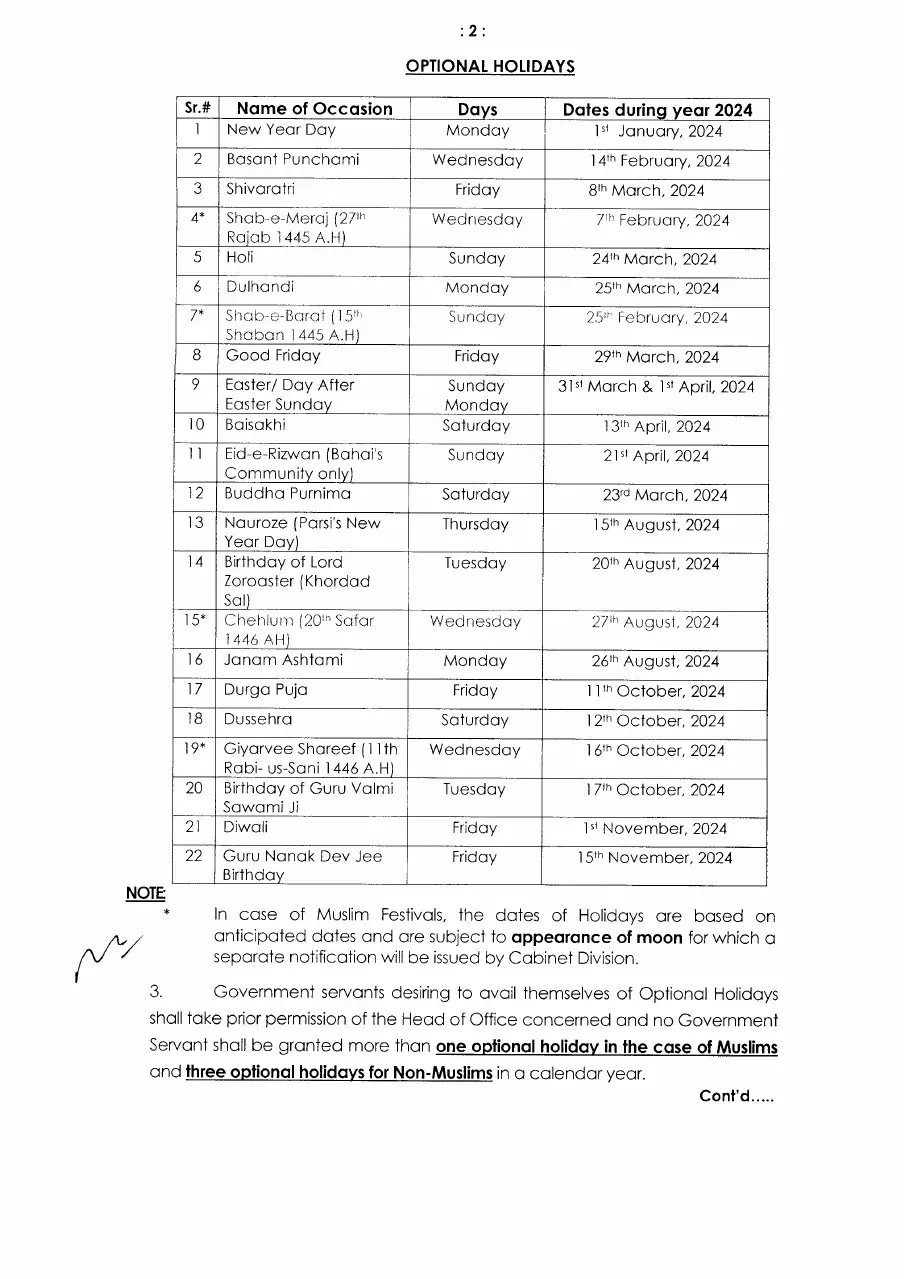
    The notification also includes optional holidays for minorities.

    To avail those they will have to take prior permission from the head of their department.

  • Pakistan mein ‘Super Blue Moon’ kis waqt daikhein?

    Pakistan mein ‘Super Blue Moon’ kis waqt daikhein?

    Once in a blue moon is going to be a reality tonight. On the night of August 31, a celestial spectacle known as the ‘Blue Moon’ will captivate astro enthusiasts around the world. Despite its name, this unique event won’t unveil a blue-hued moon; instead, it will radiate a captivating shade of orange.

    The Super Blue Moon Experience

    During this event, the Super Blue Moon will be slightly larger and brighter than a typical full moon. Supermoons shine about 40 percent larger and 30 percent brighter than regular full moons. While the size difference may not be discernible to the naked eye, binoculars can enhance the view of this captivating phenomenon.

    When and How to Observe the Super Blue Moon

    In Pakistan, the spectacular view of the Super Blue Moon can be seen from 6:25 AM PKT till 6:40 AM. The moon will be full at 6:35 AM PKT.

    European viewers will have an extended opportunity to witness the moonrise, providing an additional chance to catch a glimpse of this celestial event. In London, the moon will rise at 8:08 PM BST. For those in New York, moonrise is set for 7:45 PM EDT, followed by moonset at 7:33 PM EDT, with the full moon radiating its brilliance at 8:37 PM EDT.

    In Los Angeles, both moonrise and sunset are scheduled for 7:36 PM PDT, and the full moon will grace the sky at 5:37 PM PDT. London residents can experience the Blue Moon at 7:52 PM BST during sunset and 8:24 PM BST, with the full moon’s appearance at 1:37 AM BST.

    Understanding the Blue Moon Phenomenon

    A Blue Moon is an extraordinary astronomical event that occurs when a supermoon or full Moon coincides with a perigee—when the Moon is closest to Earth in its orbit.

    While Blue Moons aren’t exceedingly rare occurrences, they remain intriguing phenomena in the world of astronomy. The most recent Blue Moon graced the skies in August 2021, as reported by Space.com. With the average lunar cycle spanning approximately 29.5 days, a year typically accommodates 12 lunar cycles, totaling 354 days. As a result, roughly every 2.5 years, a thirteenth full moon emerges within a given year.

    This upcoming event, the super blue moon, marks the final chapter of a four-part lunar sequence and is anticipated to be the third-largest moon visible throughout this year. It’s important to note that the term “blue moon” has no connection to the moon’s color; it merely signifies the occurrence of two full moons within a single calendar month.

    How rare is a blue supermoon?

    According to NASA, the blue supermoons are a very rare phenomenon. It mentions that these moons often only appear once every ten years due to astronomical conditions. But occasionally, the interval between blue supermoons can be as long as twenty years. While blue moons only account for 3% of full moons, supermoons account for around 25% of all full moons. Although the interval between super blue moons is highly erratic—it can be as long as 20 years—the average is often 10 years. The following super blue moons will take place in pairs in 2037, in January and March.


  • Energy ministry announces uninterrupted power supply during sehr, iftar and taraweeh in Ramzan

    Energy ministry announces uninterrupted power supply during sehr, iftar and taraweeh in Ramzan

    The Ministry of Energy announced on Wednesday that no loadshedding will take place during sehr, iftar and taraweeh in the holy month of Ramzan, in accordance with the instructions of Prime Minister Shehbaz Sharif.

    The Prime Minister has directed for an uninterrupted supply of electricity during Ramzan, and the ministry has subsequently issued directives to power distribution companies to ensure this.

    The ministry has requested that DISCOS ensure the supply of electricity during sehr, iftar, and taraweeh, with zero load management an hour before and after sehr, and one hour before iftar and three hours after.

    According to Geo, control rooms will be established at the operation circle level to guarantee an uninterrupted supply of power. Additionally, special teams have been formed to address grievances at division and sub-division levels.

    In the event of transformer failure, additional transformers and trolleys will be made available. Today (Wednesday), the Central Ruet-e-Hilal Committee will convene in Peshawar for the sighting of the Ramzan ul Mubarak 1444 AH moon.

  • Ramzan to begin from April 14, announces MoST

    The Ministry of Science and Technology has announced that the holy month of Ramzan will commence on April 14 in Pakistan.

    “The moon of Ramzan, 1442 AH will be sighted on the evening of April 13, 2021,” said the ministry in a tweet. “The first of Ramzan will be on April 14, 2021. The moon will be clearly sighted in Islamabad, Lahore, Peshawar and Karachi.”

    Minister of Science and Technology Fawad Chaudhry also shared the announcement on social media.

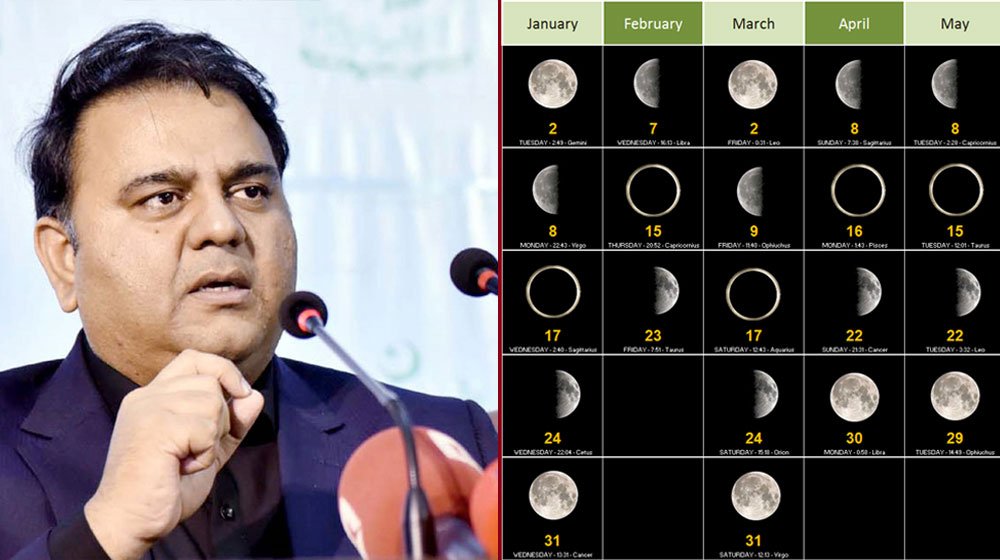
    Chaudhry has been a vocal critic of the old-fashioned and outdated moon-sighting procedure, arguing that Pakistan should opt for science and technology to follow the moon cycle. He often clashed with the Ruet-e-Hilal committee on this.

    In December, last year the government appointed Moulana Abdul Khabir Azad as the new head of the committee replacing Mufti Muneeb-ur-Rehman.

  • Consensus on moon sighting? New Ruete Hilal Committee chief for joining forces with Fawad Ch

    Consensus on moon sighting? New Ruete Hilal Committee chief for joining forces with Fawad Ch

    In a first, the newly appointed chief of Ruete Hilal Committee, Maulana Abdul Khabir, has expressed his willingness to adopt scientific knowledge in moon-sighting “within the limits of Shariah”. 

    According to Dawn, Khabir made the remarks during a meeting with Federal Minister of Science and Technology Fawad Chaudhry who had over the past year made headlines for his tussle with former committee chief Mufti Muneebur Rehman over the Islamic calendar and moon sighting.

    The meeting came after Fawad informed Khabir about setting up observatories in Islamabad for moon sighting. 

    “In this modern age, every problem has been solved with the help of scientific knowledge and only nations that use science are making progress. Islam and science are not contradictory but the importance of knowledge in Islam distinguishes it from other religions,” the publication quoted Fawad as saying.  

    The minister reportedly assured Khabir of full cooperation, adding that his office would support the committee to reach consensus with the help of science. 

    Earlier, Muneeb had opposed Fawad’s offer to use technology in moon sighting and expressed dismay over the minister developing a five-year lunar calendar containing all dates of Islamic events in Pakistan, including Ramzan, Eidul Fitr, Eidul Azha and Muharram. 

    The new chairperson, however, has expressed willingness to cooperate and even asked the federal minister to make every effort to take Mufti Shahabuddin Popalzai on board to reach a nation-wide consensus on moon sighting. 

    Mufti Popalzai, of Peshawar’s Qasim Ali Khan mosque, had also opposed use of science and latest technologies. 

    Maulana Khabir has said he would also like to bring the committee on a visit to the ministry to brief them on the importance of scientific research and how it could benefit all, reports say.

  • ‘Eid tomorrow,’ says Fawad ahead of moon-sighting committee’s meeting

    ‘Eid tomorrow,’ says Fawad ahead of moon-sighting committee’s meeting

    Ahead of the Ruete Hilal committee’s meeting scheduled for later today for moon sighting, Federal Minister for Science and Technology Fawad Chaudhry has said that the Shawwal moon could be sighted tonight.

    “The Shawwal moon was born on May 22 at 10:30 pm and will be visible between 7:36 pm and 8:15 pm tonight in Badin, Thatta and Pasni,” Chaudhry said while addressing a press conference in Islamabad on Saturday, and also tweeted it.

    The minister said that according to the calendar prepared by his ministry, Eid will be celebrated on May 24 in many countries including Pakistan. He also shared the link to ‘The Ruet’ app on Twitter.

    Saturday will be the last day of Ramzan and Sunday is the first day of Eid in many countries.

    The government has earlier announced six Eid holidays from May 22 to 27 both of the public and private sectors. According to a notification issued by the Ministry of Interior, Friday, May 22 to Wednesday, May 27, will be Eid holidays in the country.

    Meanwhile, addressing the presser, Fawad regretted that “there are always different announcements by the Reute Hilal Committee and Qasim Khan Mosque [of Peshawar, headed by Mufti Popalzai].”

    He also rejected the notion that there was no relation between the sighting of the moon according to Islamic practices and the use of technology in doing so.

    “Nowhere in the world is moon sighting an issue. With advances in technology it has become easier to sight the moon,” Fawad said.