Tag: Munib Akhtar

  • CJP brings back Justice Mansoor Ali Shah, Munib Akhtar to bench-formation committee

    CJP brings back Justice Mansoor Ali Shah, Munib Akhtar to bench-formation committee

    In an interesting development, newly-sworn Chief Justice of Pakistan (CJP) Yahya Afridi has reconstituted the Practice and Procedure Committee of the Supreme Court (SC).

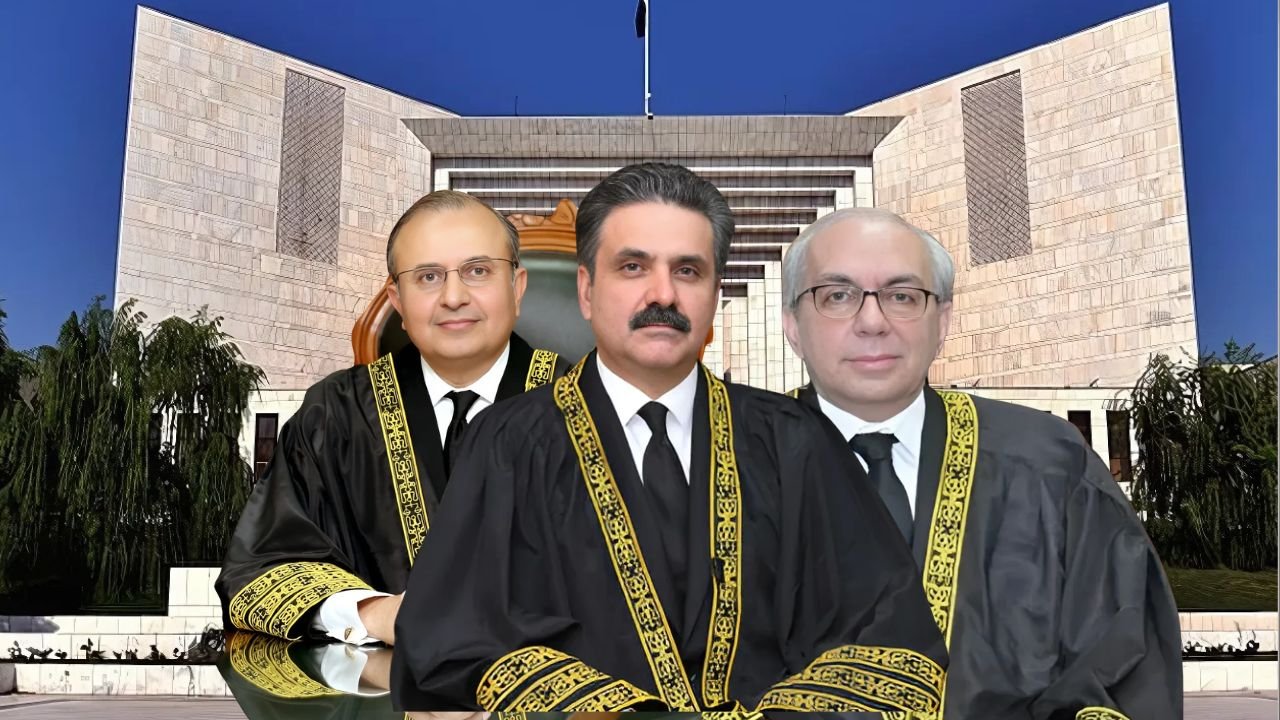
    As per the details, CJP Afridi, on his first day as the top judge, brought back Justice Mansoor Ali Shah and Justice Munib Akhtar to the apex court committee that decides on bench formation and case fixation.

    This means that no bench can be formed, or cases can be heard without their assent.

    “In supersession of this court’s office order of even number dated 20-09-2024 and in the exercise of powers under section 2 (1) of the Supreme Court (Practice and Procedure Act) 2023 as amended by the Ordinance eight of 2024, the Hon’ble Chief Justice of Pakistan has been pleased to reconstitute the requisite committee,” read a notification issued by the SC on Saturday.

    “The committee stands constituted as under: Justice Yahya Afridi, chief justice of Pakistan, Justice Mansoor Ali Shah, senior puisne judge and Justice Munib Akhtar,” it added.

    Originally, the committee was supposed to consist of the three senior-most SC judges to deal with cases under Article 184(3) of the Constitution — often referred to as the apex court’s suo motu jurisdiction.

    Following an ordinance last month to amend the Supreme Court (Practice and Procedure) Act 2023 — a law that aimed to curtail the chief justice’s powers — the top judge could now pick any SC judge to be the third member of the body.

    Subsequently, Justice Isa had removed Justice Akhtar, the second in the line of seniority after the CJP, from the committee and made Justice Aminuddin Khan a part of it.

    At the time, Justice Khan was fourth in the line of seniority after the CJP, while Justice Afridi was the third senior-most judge.

    Speaking at the full court reference Friday, CJP Yahya had stressed that the “rule of law shall rule” and the principles of trichotomy of power shall prevail during the time ahead.

    He indicated that the immediate focus would be on districts furthest away, on improving the justice delivery system and facilitating the cases of women, children, and the disabled.

    During a hearing earlier this week, Justice Afridi said a separate category would be created for cases where any law had been challenged or needed constitutional interpretation — in line with the 26th Amendment that entailed the formation of constitutional benches.
  • Will Justice Yahya Afridi accept his nomination as chief justice?

    Will Justice Yahya Afridi accept his nomination as chief justice?

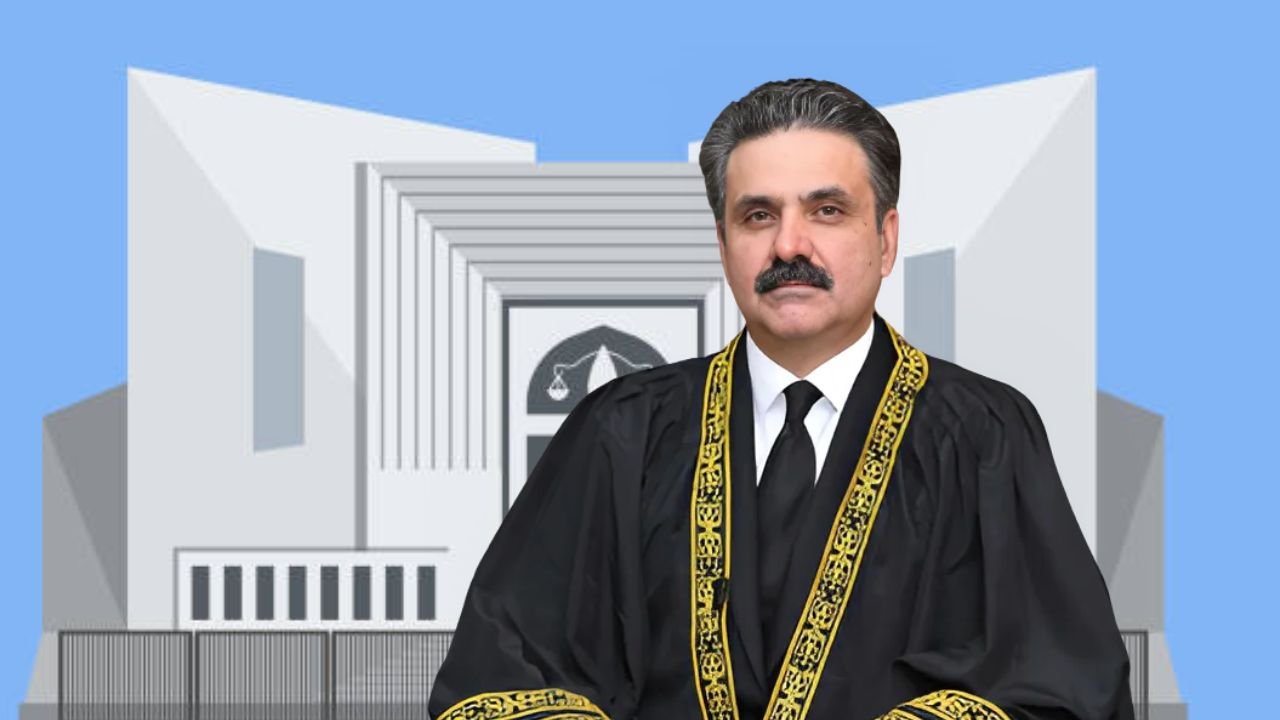
    With Justice Yahya Afridi’s name being finalized as the next chief justice of Pakistan (CJP), opposition leader and netizens are speculating whether Justice Afridi will be accepting the post or not.

    President Asif Ali Zardari on Wednesday appointed Justice Yahya Afridi as the next CJP, who will take over the reins from incumbent CJP Qazi Faez Isa later this week. Justice Afridi has been appointed for a fixed three-year term starting on October 26, said a statement from Aiwan-e-Sadr.

    Soon after Justice Afridi’s nomination by a special parliamentary committee, formed under the 26th Amendment, PTI leader Hamid Khan, in conversation with a private media outlet on Tuesday night, expressed hope that Justice Afridi “would decline the position”.

    The statement left the internet divided, with people speculating whether Justice Afridi will be accepting the position of the country’s 30th CJP.

    Some social media users went on to suggest that Justice Afridi should not accept the position owing to the changes in process of appointment of the country’s top judge under the 26th Amendment.

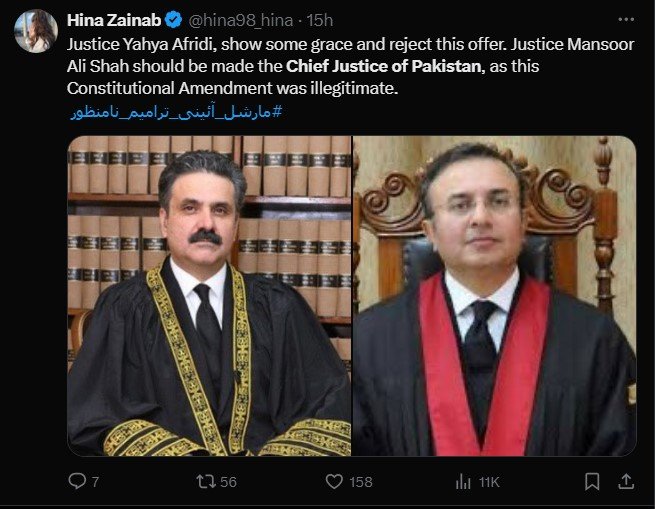
    “Justice Yahya Afridi, show some grace and reject this offer. Justice Mansoor Ali Shah should be made the Chief Justice of Pakistan, as this Constitutional Amendment was illegitimate,” wrote one user, calling out the ruling coalition.

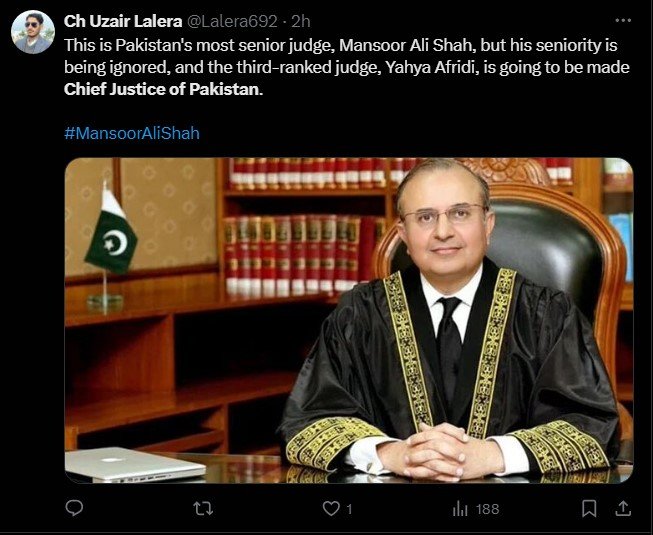
    Showing concern over the appointment of the third senior-most judge instead of senior-most Justice Mansoor Ali Shah after CJP Qazi Faez Isa, another user wrote, “This is Pakistan’s most senior judge, Mansoor Ali Shah, but his seniority is being ignored, and the third-ranked judge, Yahya Afridi, is going to be made Chief Justice of Pakistan.”

    It may be noted that neither Justice Afridi himself, any Supreme Court (SC) judges nor other relevant authorities have so far hinted at the possibility of Justice Afridi refusing to take charge as the country’s top judge. Instead, media reports on Wednesday afternoon claimed that the incumbent chief judge among other members of the judicial community had already congratulated Justice Afridi.

    On late Sunday night, the Parliament passed the 26th Amendment, ruling out the scenario of the senior-most SC judge’s appointment as the CJP. Under the changes, the appointment of the CJP shall now be made from among the three senior-most judges of the apex court on the recommendation of a special parliamentary committee.

    Justice Mansoor Ali Shah, Justice Munib Akhtar and Justice Yahya Afridi were in the race for the slot of the country’s top judge till a special parliamentary committee nominated Justice Yahya Afridi.

  • SC reserves verdict on new plea for full court on civilians in military courts case

    SC reserves verdict on new plea for full court on civilians in military courts case

    A six-member bench of the Supreme Court of Pakistan on Tuesday reserved its verdict on a new plea seeking formation of a full bench to decide the fate of the case pertaining to military trials of civilians.

    Chief Justice of Pakistan (CJP) Umar Ata Bandial, Justice Ijazul Ahsan, Justice Munib Akhtar, Justice Yahya Afridi, Justice Sayyed Mazahar Ali Akbar Naqvi and Justice Ayesha A. Malik were part of the bench.

    Senior Counsel Faisal Siddiqi had submitted the fresh plea on Monday at the behest of civil society members, asking that “all judges willing and available” be included in the bench.

    The Supreme Court reserved its verdict after discussing the matter during the hearing with other petitioners.

    During the hearing, Justice Naqvi said the law did not give permission to “pick and choose”, asking why the inquiry against civilians was not brought on record. Justice Bandial asked if Faisal Siddiqi was “hiding”, upon which he was told that the lawyer had stepped outside for some work and would be back soon.

    The apex court has already once disposed of the government’s plea to formulate a full bench.

    The reserved verdict will most likely be announced tomorrow.

  • ‘ECP ne kaisay election ki date di?’: Justice Mandokhail drops bombshell in court, sticks to detailed order

    ‘ECP ne kaisay election ki date di?’: Justice Mandokhail drops bombshell in court, sticks to detailed order

    The Supreme Court (SC) on Wednesday resumed hearing PTI’s petition against the decision of the Election Commission of Pakistan’s (ECP) to delay polls for Punjab Assembly.

    A five-member larger bench — headed by Chief Justice of Pakistan (CJP) Umar Ata Bandial and comprising Justice Ijazul Ahsan, Justice Munib Akhtar, Justice Jamal Khan Mandokhail and Justice Aminuddin Khan — is hearing the case.

    During the hearing yesterday, Justice Bandial obser­ved that the ECP did not have any right or legal backing to extend the election date till October 8 and asked the Attorney-General for Pakistan (AGP) to get instructions from the federal government in this regard.

    However, when hearing resumed today, Justice Mandokhail, explaining yesterday’s remarks, said that there was a lot of confusion on his comments and he wanted to clarify them. “I stand by my detailed order. One part of the judgement is related to the rules of administrative powers, and that the Chief Justice will be asked to form a committee of judges to look at the rules, the committee of judges will look at the rules of administrative powers, in the second part of the judgment, we four judges have automatically rejected the notices and petitions,” said Mandokhail.

    Justice Mandokhail stated that according to him the verdict of the four judges in the suo motu case was the ‘order of the court’. “The CJP has not issued an ‘order of the court’ to date.

    Justice Mandokhail said that the decision of the four judges is the order of the court. “The Chief Justice of Pakistan did not issue this order of the court. How did the president give the election date when there was no decision? Has the ECP released the schedule? Today bring in court record file; it [will not] have the order of the court; all the judges sign the order of the court.”

    He said that he stands by the brief and detailed decision he gave.

    The judge also said that the decision on who will take a suo motu case was an “internal matter” of the court.

    Here, the CJP noted that Justice Mandokhail had given his explanation but the latter interjected him, saying that he was still speaking.

    Subsequently,  PPP lawyer Farooq H. Naek demanded that a full court bench be constituted to hear the case to which Justice Mandokhail said: “Why full court? The same seven-member bench should hear the case.”

    However, the PPP lawyer contended that the current situation called for the formation of a full court bench. He also highlighted that clarification was needed regarding the SC’s March 1 verdict.

    At that, the chief justice told Naek to submit a written request in court.

    Bill:

    The government on Tuesday tabled a bill titled “The Supreme Court (Practice and Protection) Bill, 2023” in the National Assembly and adopted a resolution holding “undue interference by the judiciary in political matters as a cause of political instability in the country”.

    It is expected that the standing committee will pass the bill in its meeting scheduled for today.

    The bill proposes a committee of three judges headed by the chief justice which will be empowered to take suo motu notice as opposed to the earlier practice, which allowed the CJP to initiate proceedings under Article 184(3) in an individual capacity.

    According to the proposed law, every cause, appeal, or matter before the Supreme Court shall be heard and disposed of by a bench constituted by the committee comprising the CJP and two senior-most judges in order of seniority. It added that the decisions of the committee shall be by majority.

    In the bill, the right of appeal is being given to the accused party for the first time, which will be allowed to file an intra-court appeal within 30 days from the date of suo motu notice.