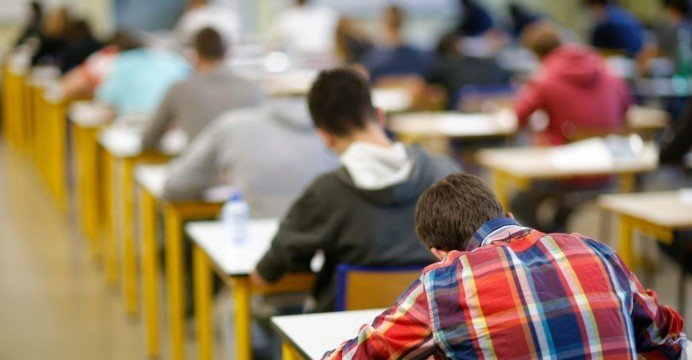
Punjab Minister for School Education Murad Raas has criticised the parents, students and teachers who are requesting an extension in school winter holidays.
“Why are parents/teachers/students wanting more winter holidays? We used to go to school in the same weather and never complained. What is wrong with this generation – no one wants to do anything! Especially study,” the minister wrote in a tweet.
Why are parents/teachers/students wanting more winter holidays. We used to go to school in the same weather and never complained. What is wrong with this generation – no one wants to do anything! Specially study.
The School Education Department held a meeting on Thursday in which the participants decided to not extend winter vacations. Education officials indicated that it would not be advantageous to extend the holidays because of upcoming examination schedules and declared that the schools will reopen on January 9. Lahore and parts of central Punjab are in the grip of intense smog, with reduced visibility in the early hours of the morning.
Punjab Minister for Education Murad Raas has requested private schools to make scarves/dupattas and caps compulsory for female and male students respectively. Murad made the request while talking about compulsory Quran classes in schools.
“I have seen in private schools that they are requesting students to brings scarfs and caps [for Quran classes] from home.”
He continued by saying that most private and public schools have scarves/duppatas included in their uniforms. He then requested all private schools make scarves part of their uniform.
صوبائی وزیر برائے سکول ایجوکیشن مراد راس کی پریس کانفرنس
This is what I was afraid of. And yet when I questioned him, I was called ‘brown karen’. Nobody who voted for PTI even try to justify this. JUST DON’T. https://t.co/JyHmuP35NL
In other news, Punjab Govt has mandated caps for schoolboys and scarves for schoolgirls. Never a day goes by without them improving quality of education in some way.
Talking about compulsory Quran classes in schools in Punjab, the provincial education minister said he has requested private schools to make caps and dupatta/scarfs as part of school uniforms. https://t.co/U0xlr1uz4T
Last month, Chief Minister Pubjab approved the appointment of 70,000 Arabic teachers for compulsory teaching of the Holy Quran in all schools of Punjab.
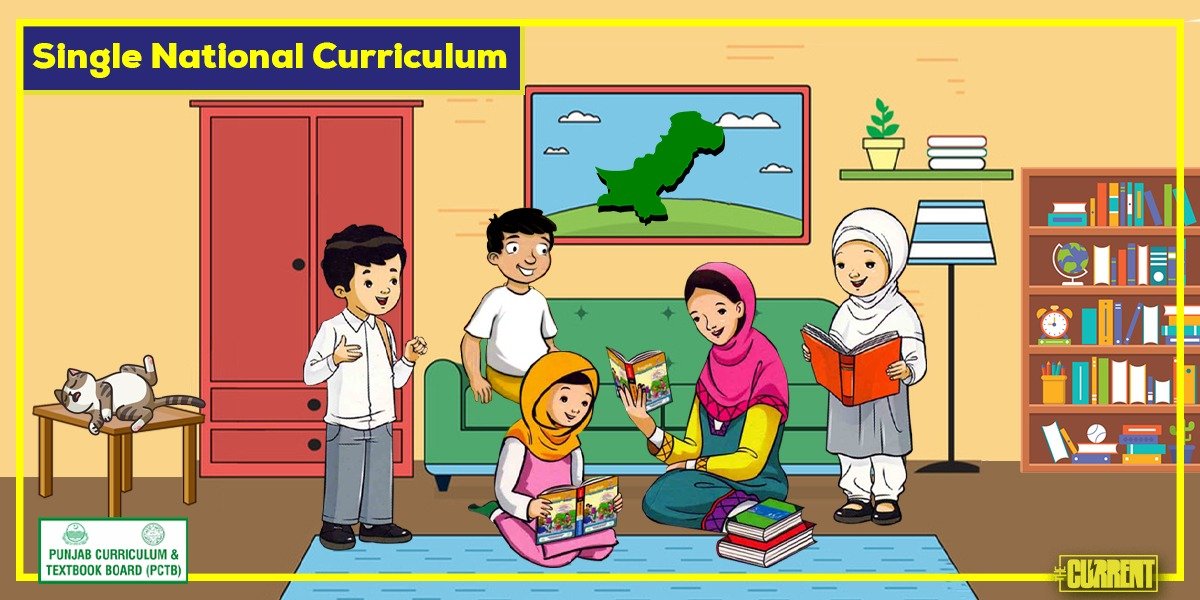
On August 16, 2021, Prime Minister Imran Khan officially launched the Single National Curriculum (SNC). The newly launched curriculum was prepared by the National Curriculum Council (NCC) and the Ministry of Federal Education, in consultation with the provinces. According to PM Khan, “SNC would transform the nation into a unified one.”
What is SNC?
According to the Ministry of Federal Education and Professional Training, the SNC is a ‘uniform’ system of education, which means the same curriculum for everyone. All public schools, private schools, and madrassas were meant to have the same curriculum so that the learning outcomes are similar and without any discrimination in teaching standards. This is not the first time SNC was imposed in Pakistan. It was previously introduced in 2006 by Former President Musharraf. Whereas the previous SNC was a curriculum-based initiative, the one introduced by the PTI government is imposing the use of the textbooks produced by the provincial boards.
Is it being implemented across the country?
No. Sindh has decided not to implement the curriculum since education is a provincial issue. Only Punjab and Khyber Pakhtunkhwa have enforced it so far. However, many schools in both provinces — including the prestigious Aitchison College, Lahore — expressed their concerns over the books in the curriculum. The Director of the National Curriculum Council (NCC), Dr Mariam Chughtai, has also said that madrassas will implement the SNC syllabus in five to six years, which undermines the reason why the government had wanted to introduce the SNC in Pakistan – to bring madrassas into the mainstream so students would be able to get jobs in other professions after they graduated.
Controversies surrounding the SNC
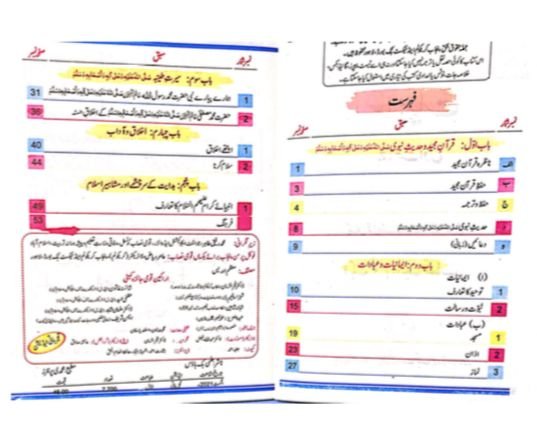
After the SNC syllabus was imposed on schools across Punjab, many controversies surrounding the books and the curriculum came forward. From the disparity in gender representation, the reinforcement of patriarchal gender roles, the lack of female heroes, and religious texts in the non-religious books.
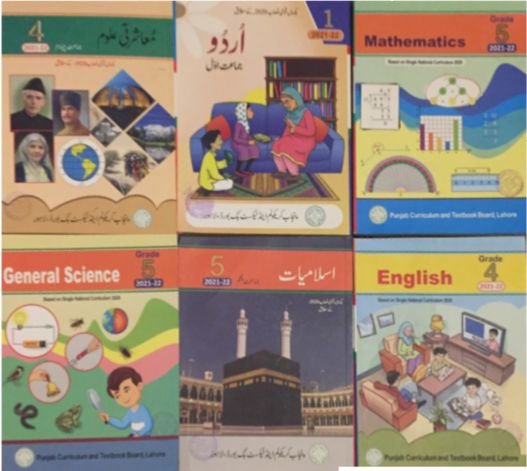
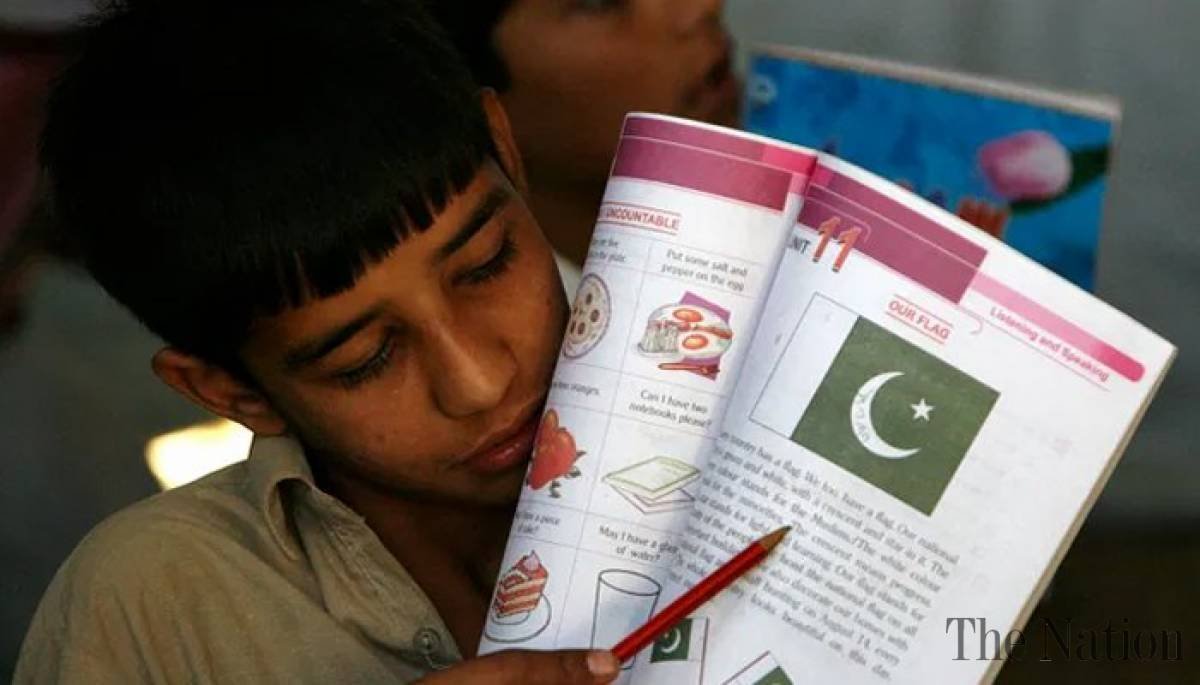
To see if the criticism is valid, The Current analysed the following books published under the Punjab Textbook Board (PTB):
Urdu books from grades 1 to 5, English books from grades 1-5, Mathematics books grades 1, 2, 4, and 5, General Science grades 4-5, Waqfiyat Aama grade 1 and 3, Social Studies 4-5, and Islamiat grade 1- 5.
Two books were not available at the time of research. Grade 3 Math and Waqfiyat Aama grade 2, which have not been included in the study.
The analysis here has been divided into two parts.
Part one comprises the data analysis of all the books included in the SNC by the Punjab Text Book board.
Part two comprises the data analysis of individual subjects being taught to the students.
We studied the total number of male and female representations in the books, a comparison of the eastern and western wear of both genders, the presence of religious (Islam and others) content in non-religious books, and studying the distribution of power roles assigned to both men and women.
Here is the list of most common criticism against the curriculum and the evidence we found:
SUMMARY OF CONTENT IN ALL SNC BOOKS
1- Disparity in Gender Representation:
One of the most debatable points in the entire SNC is the representation of men and women.
After a thorough evaluation, we found that the concerns about the disparity in gender representation are TRUE.
The study reveals that a total of 60.2 percent of the books have images of men, including boys and only 39.4 percent of the books have images of women, including girls.
2-Women represented in hijab vs non-hijab, and women in western clothes:
What the women are wearing became a source of contention in the discussion about the SNC, with critics suggesting that the women should equally represent the country in terms of the hijab, eastern clothes, and the choice to wear western wear.
It is TRUE that there is no equal representation of women’s appearance in the books.
Women’s appearance was divided into three categories.
A) Number of women wearing eastern clothes with hijab.
B) Number of women wearing eastern clothes without hijab.
C) Number of women wearing western clothes.
Our research shows that 41.6% of all women and girls in the SNC books are wearing a hijab, 28.9% are wearing eastern clothes without a hijab, and 29.4% of the images show girls wearing western wear. It is important to note that in the western wear percentage, almost all of the images are of young girls. Older women are not shown wearing western wear.
3-Men represented in eastern vs western clothes:
Since the appearance of women in eastern wear and hijab became controversial, we also studied how many times men appeared in western or eastern wear.
A massive 79.9 percent of men were seen wearing western clothes, in comparison to 20 percent dressed in eastern clothes.
4- More men in ‘power roles’ compared to women:
Another controversy suggested that the books did not show women in positions of ‘power’, and they were mostly listed as helpers or homemakers. While there were many images that showed women in ‘inferior roles’ to men, there were women that were shown in roles of power.
This controversy is TRUE.
We defined power roles shown in the books as doctor, pilot, lawyer, police officer, traffic warden, army sports personality, etc and after analysing all the books, we found that a men are given power roles three times more than women. The results in the graphic below are based on the total number of images shown of men and women in all the SNC Punjab books.
I
5. Religious content in non-religious books
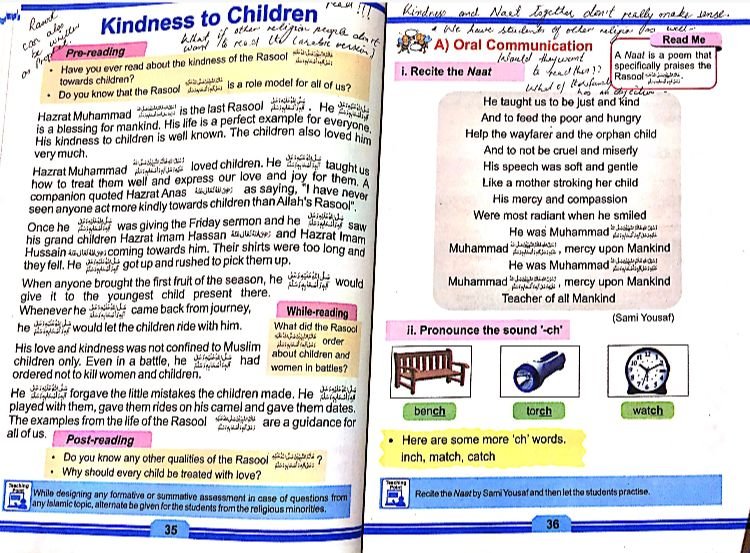
In almost all the books which were studied, we saw the presence of religious references or mentions in non-religious books. Minorities felt their rights were being compromised since books that are not for religious studies should not have references to a specific religion, which may come under the context of ‘preaching’.
In our analysis, we saw a total of 7.77 percent of religious text in all SNC non-religious books, which lends TRUTH to the fact that there is religious content in non-religious books.
Religious content is present in 7.7 percent of English, Math, Social Studies, Urdu, Science, and General Knowledge books.
7.47 percent of books have references to Islam while 0.27 percent mention other religions in all non-religious books.
Dr Mariam Chughtai, while answering a question for The Current about the religious references in non-religious books, did not provide a clear answer but stated that these are model books that require changes.
SNC BOOKS ANALYSIS – SUBJECT ANALYSIS
This section of the report comprises an analysis of individual subjects being taught to students. The subjects under study were, Urdu books from grades 1-5, English books from grades 1-5, Mathematics books grades 1, 2,4, and 5, General Science grades 4- 5, Waqfiyat Aama (General Knowledge) grades 1-3, Muashrati Uloom (Social Studies) grades 4-5.
The graphical representation of the subject-wise evaluation is as follows:
English:
In 668 pages of English books, 58.1 percent have male representation while females have 41.8 percent.
29.7 percent of women are seen with Hijab and 70.2 percent are without Hijab.
There is a total of 9.8 percent presence of religious text in English books. This is based on the total number of pages in English books.
Mathematics:
In 672 pages of the Math books, when gender representation was analysed, 51.1 percent of the books have male representation and 48.8 percent have female representation.
A total of 53.9 percent of females are seen without hijab and 46 percent are seen wearing hijab.
The Math books have a 4.1 percent presence of religious text. This is based on the total number of pages in Math books.
Urdu:
The five Urdu books comprising 791 pages. A total of 59.7 percent presence of males are seen as compared to 40.4 percent of females.
58.5 percent of women/girls are seen wearing hijab and 41.4 percent are seen without hijab.
12.8 percent of religious text is present in Urdu books. This is based on the total number of pages in Urdu books.
General Science:
Out of 310 pages, 76.8 percent have male representation as compared to 23.1 percent female representation.
64 percent of women/girls are seen without hijab and 36 percent of women/girls are seen with hijab.
The General Science books have a 0.96 percent presence of religious content. This is based on the total number of pages in Science books.
Waqfiyat Aama (General Knowledge):
49.5 percent of male images are seen in comparison to 50.15 percent of females.
23.1 percent of females are seen with hijab and 76.8 percent without hijab.
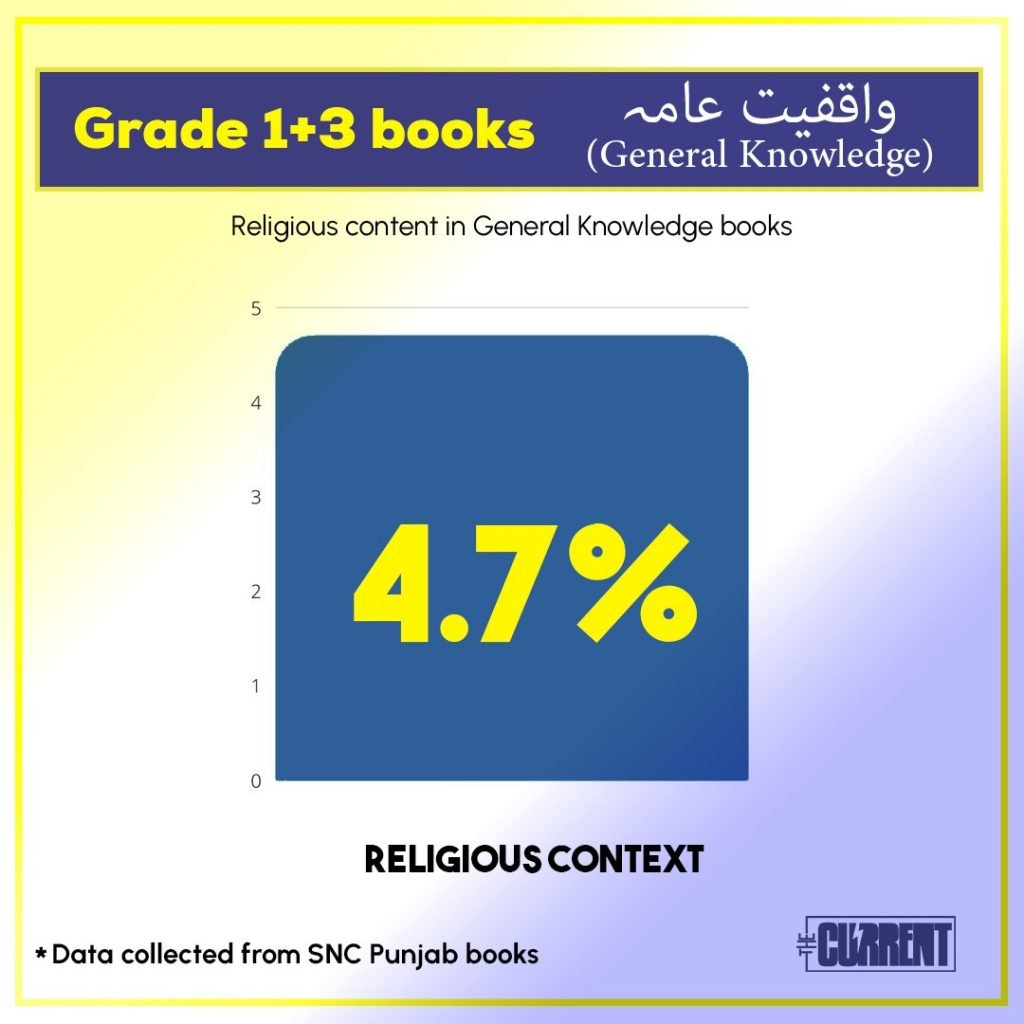
There is a 4.7 percent presence of religious text in the books studied. This is based on the total number of pages in General Knowledge books.
Muasharti Uloom (Social Studies):
From 234 pages analysed, 65.1 percent of men/boys are represented in the books and 34.8 percent of females are shown.
36.8 percent of females are seen without hijab and 63.1 percent are seen with hijab.
10.2 percent of religious content is present in the books. This is based on the total number of pages in Social Studies books.
The last portion of the report highlights the pros and cons, which we have observed in almost all the books. We have provided both positive and negative outcomes deduced from the books after careful analysis.
The positive outcome deduced from the books:
1. The books are locally published and designed. The books are affordable, with a total set for one grade set at Rs. 800 per child according to Dr Chughtai.
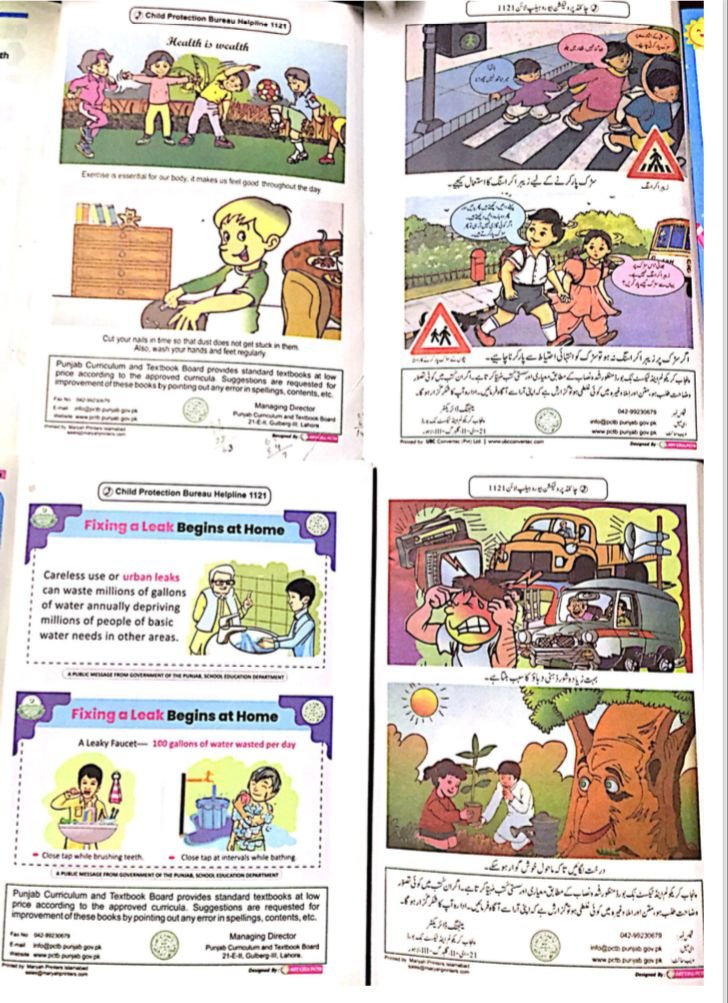
2. There is a public service message printed at the end of each book to raise awareness against talking to strangers, crossing the road, exercising, and even information about fighting dengue.
The possible negative impact of the books
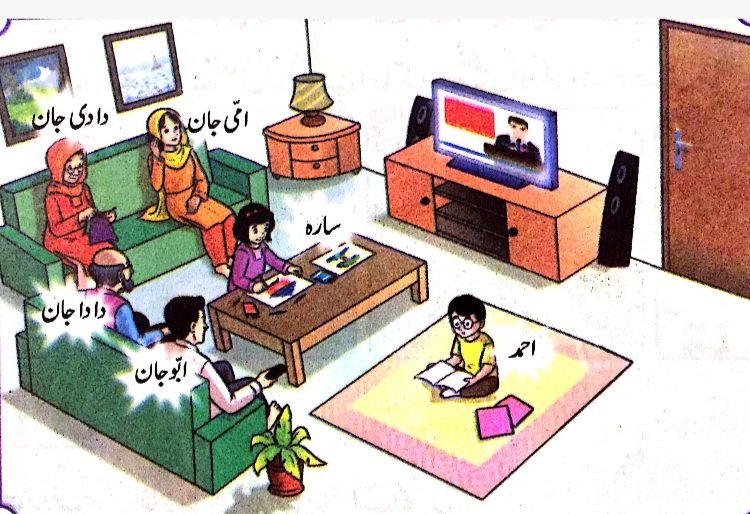
1. After analysing the books, we deduced that mostly nuclear families have been shown in the books. No representation of single parents or children being raised by guardians is seen. Moreover, the presence of both parents is seen as almost essential in all stories in the books.
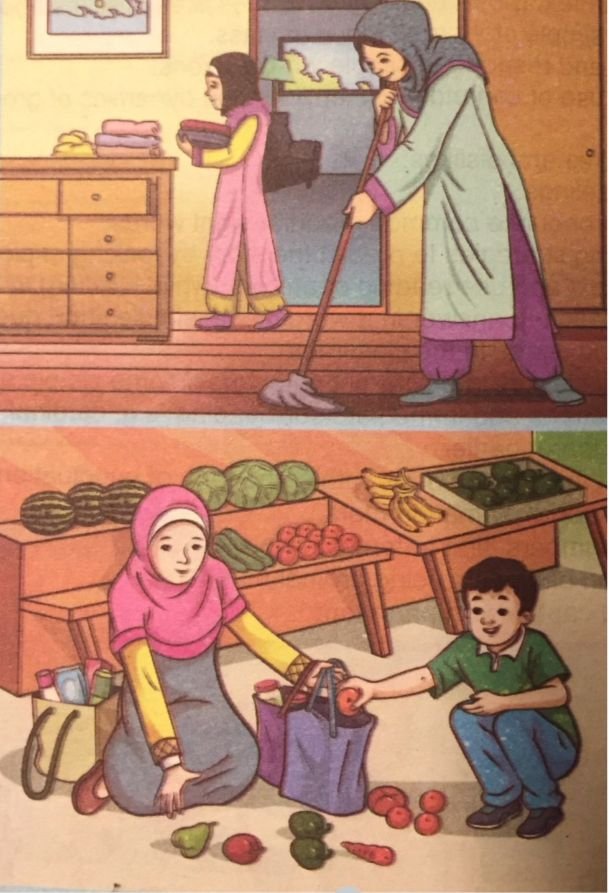
2. Women are mostly shown doing domestic work, taking care of the family, and looking after their children. In stories as well, they seem to come second to their male counterparts.
3. As discussed in detail above, there is the presence of religious text in non-religious books.
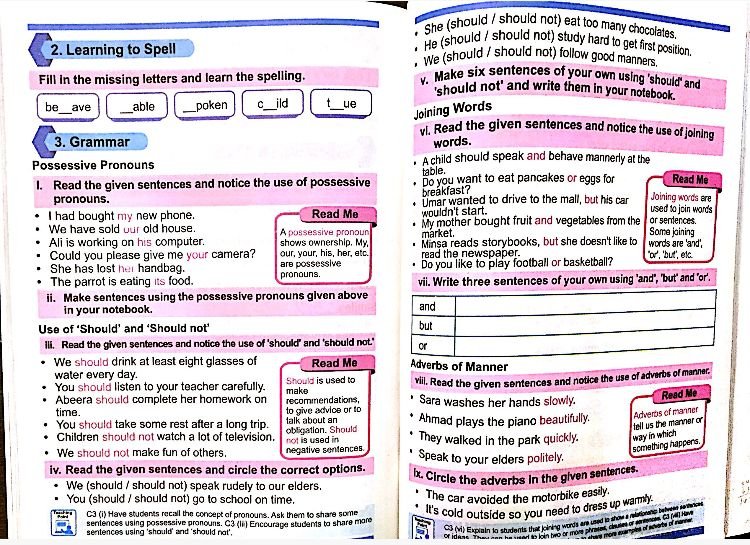
4. The stylisation of the books are difficult to understand, fonts and texts are way too clustered. The quality of the pages is not refined, making them unattractive and confusing for students.
CONCLUSION:
According to NCC director, Dr Chughtai, the curriculum is an evolving process and the books can be changed in future publications, based on the response by schools and parents. The biggest hurdle to the books is that the teachers have not been trained in teaching these new books and according to Dr Chughtai, it is up to the school to teach and implement the books. There are no worksheets given with the books and from initial student reactions, students are confused and wary of books that are laid out in a clustered fashion. There is also the subject of a language change. Where students study general knowledge, a precursor to Science, in Urdu, they switch to difficult English in grades 4-5.
While the government should be commended in trying to create a national syllabus, the forced enforcement of the books along with the lack of supplemental information and training will make this very difficult for teachers and students. Moreover, parents should be given a choice as to what they want their children to study. This implementation should be a free choice rather than that of enforcement. What would have been a practical approach is that the government should have improved the structure of the government/public schools, provided better teacher training, spent more on financially improving the conditions rather than lowering the standard for all.
*Graphics credits: Asma Ahmad (Graphic Designer)
How did we collect the data?
The percentage of male characters in the books: Divided the total number of male by the total number of characters. The percentage of female characters in the books: Divided the total number of female by the total number of characters.
The percentage of Islam: Divided the Islamic pictures or references given in the books by the number of total pages of all books. The percentage of other religion: Divided the other religions pictures or reference given in the books by the number of total pages of all books.
The percentage of female power roles: Divided the number of female by the total number of characters (female and male). The percentage of male power roles: Divided the total number of male by the total number of characters (female and male).
The same process/calculation/method was applied to the findings of each book.
Federal Minister for Education Shafqat Mahmood tweeted that he is grateful for the views, both negative and positive, on Single National Curriculum (SNC). He added that curriculums and textbooks are not static and need constant updating.
“I am grateful for the views, both negative and positive, on the single national curriculum (SNC) and on the textbooks developed to implement it,” wrote the minister.
I am grateful for the views, both negative and positive, on the single national curriculum (SNC) and on the textbooks developed to implement it. Curriculums and textbooks are not static and need constant updating. The feedback received will be a great help in the review exercise
Punjab Education Minister Dr Murad Raas reacted to the criticism following the implementation of SNC. He tweeted that he would be conducting a live session on Sunday to answer questions related to SNC.
Will be having a live session on Twitter this coming Sunday evening to answer as many questions as possible regarding Single National Curriculum. This session is specially for the parents. Will update the time slot. Looking forward.
Earlier, Sharmeen Obaid-Chinoy came forward and criticised the new curriculum. In addition, SNC is also receiving criticism on social media.
According to the new curriculum, schools will be free to teach additional material or even additional subjects. In the beginning, three subjects — Islamic Studies, Social Studies and General Knowledge — will be taught in the Urdu language at the primary level (Grade 1-5). Quranic learning with translation will also be mandatory in Grade 6-12.
Mahmood had earlier announced the SNC would be implemented from the new academic session on August 2 in all public and private schools as well as madrassah of Punjab.
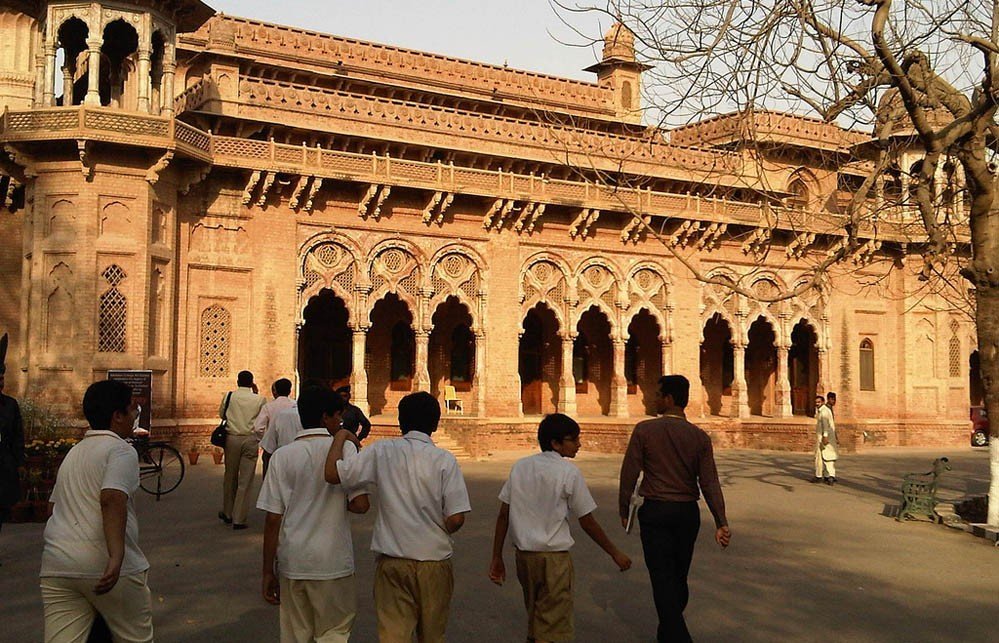
The Punjab Government warned Aitchison College, a school for boys in Lahore, via a letter on Tuesday for not implementing Single National Curriculum (SNC) within its campus.
In a tweet, Education Minister Punjab Murad Raas, while sharing the official letter stated, “Letter sent to Aitchison College Lahore for not implementing SNC in its entirety by Punjab Curriculum Textbook Board. Zero exemptions. I will not let anyone challenge the writ of the government.”
Letter sent to Aitchison College Lahore for NOT implementing Single National Curriculum in its entirety by Punjab Curriculum Textbook Board. Zero exemptions. I will not let anyone challenge the writ of the government. pic.twitter.com/lKVdWOSQy5
The letter was issued to Aitchison College Principal Michael A Thomson by the Punjab Curriculum and Textbook Board (PCTB) stating, “You are again requested/advised to kindly do not prescribe those books which have not been given Non-Objection Certificate (NOCs) by PCTB.”
Furthermore the letter reads “It is to apprise you that the PCTB reviews and issues NOCs to the books after due process not on the request of an educational institution (school/college), but on the request of book developer (person/agency/private publisher) who apply for the same.”
Parents at Aitchison told Dawnthat the administration had implemented the SNC from Tuesday. Science, Islamiat and history books were introduced in Urdu.
Prior to this notice, Federal Minister Education Shafqat Mahmood also said that there would be no exemption for Aitchison College or any other school.
Aitchison College Principal Mr Thomson hasn’t commented on this issue yet. Earlier, when an official questioned him about it, he replied that the school did not fall within the department’s purview.
What is SNC?
It is a ‘uniform system of education, which means the same curriculum for everyone but has been highly controversial because of the content and images in the books approved for the curriculum. Sindh has decided not to implement the curriculum since education is a provincial issue.
According to the new curriculum, Schools will be free to teach additional material or even additional subjects. In the beginning, three subjects — Islamic Studies, Social Studies and General Knowledge will be taught in the Urdu language at the primary level (Grade 1-5). Quranic learning with translation will also be mandatory in Grade 6-12.
Mehmood had earlier announced the SNC would be implemented from the new academic session on August 2 in all public and private schools as well as madrassah of Punjab.
Education Minister Punjab, Murad Raas took to Twitter to share pictures of the transgender community attending the first day of school. “First Day of School for Transgenders by School Education Department Punjab,” the minister wrote in a Tweet.
“We have provided them everything that is required for Schooling. Dr Aithesham Secretary School South Punjab and his team have done a great job. TransEducation is the program,” he added.
ANNOUNCEMENT: First Day of School for Transgenders by School Education Department Punjab. We have provided them everything that is required for Schooling. Dr Aithesham Secretary School South Punjab and his team have done a great job. TransEducation is the program. pic.twitter.com/pTZkfKEOYX
Education Minister Punjab Murad Raas on Tuesday said that the Punjab government will establish separate schools for the transgender community.
“We are opening first ever Transgender School in Pakistan. Why would we deny education to anyone in our country? Our first school is opening in Multan tomorrow,” tweeted Murad Raas.
He further added: “We will open such schools in all Districts of Punjab InshAllah. One step at a time. Education for All.”
We are opening first ever Transgender School in Pakistan. Why would we deny education to anyone in our country? Our first school is opening in Multan tomorrow. We will open such schools in all Districts of Punjab InshAllah. One step at a time. Education for ALL. https://t.co/Xq19NV7yix
Addressing a ceremony held regarding Insaf Afternoon School Programme (IASP), Raas said that the government decided not to enroll transgenders in regular schools because of some reservations about the behaviour of other students. He added that the attitude of students of regular schools could be insulting towards the transgender community, which was why separate schools were being established for them.
Punjab Minister for Education Dr Murad Raas has urged students in the province not to believe any any information coming from unofficial sources.
“Ignore all tweets wherever they are coming from,” wrote the minister in a tweet. “Anything to do with Punjab will be tweeted by me. Please be patient, dates will be announced in a day or two.”
“These amount of calls and messages is insanity,” he added.
Ignore all tweets wherever they are coming from. Anything to do with Punjab will be tweeted by me. Please be patient, dates will be announced in a day or two. Relax. These amount of calls and messages is insanity.
Earlier, Federal Minister for Education Shafqat Mahmood announced that schools located in COVID-19 hotspot areas will remain closed till April 11.
Mahmood also informed that after several rounds of talks, Cambridge has agreed to reschedule this year’s O’ Level exams to after May 15.
“A’ and AS’ Level exams will take place as per the original timetable following all the SOP,” stated the minister.
After detailed discussions, Cambridge has agreed to reschedule ‘O’ level exams to after May 15. Details will be shared later by them. However, ‘A’ and ‘As’ level exams will take place as per the original timetable, following all the SOPs. Wishing everyone success in the exams
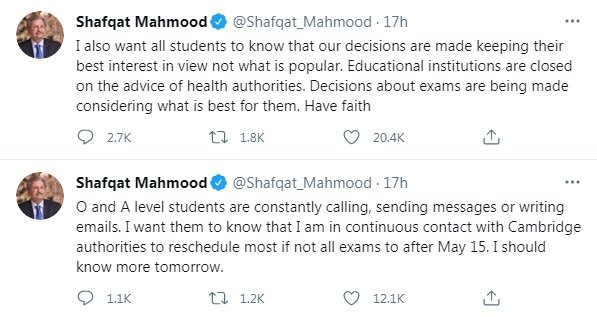
Prior to the announcement, Mahmood had told students that all “decisions are made keeping their best interest in view not what is popular”.
“Educational institutions are closed on the advice of health authorities,” said Mahmood. “Decisions about exams are being made considering what is best for them. Have faith.”
Pakistan is currently battling with its third wave of COVID-19. According to the National Command and Operations Centre (NCOC), Pakistan has reported 4,368 cases and 63 deaths in the last 24 hours.
Number of cases recorded in different provinces in the last 24 hours are as follows:
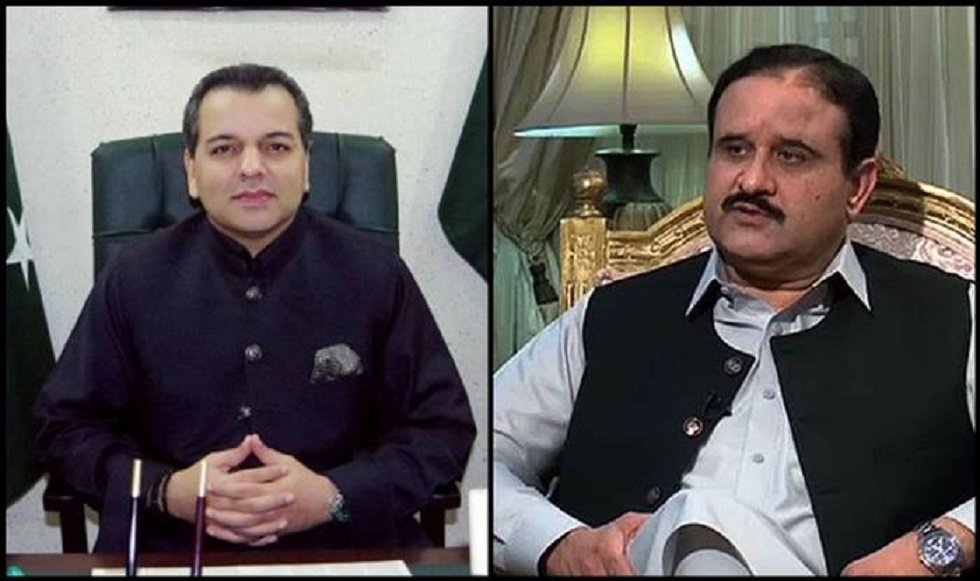
Punjab Chief Minister Usman Buzdar, irked by “insubordination” of his cabinet members, said he was being “being forced to act like a chief minister” and now he would “act like one”.
The chief minister made these comments during a meeting of the Punjab Cabinet after Education Minister Murad Raas interrupted the CM in the middle of the meeting over the removal of a civil servant.
Dawn reported that Murad earned the chief ministerial ire when he objected to the removal of Punjab School Education Department Secretary Sara Aslam, saying she was transferred a day earlier without taking him into confidence. CM Buzdar, however, took an exception to the remarks and responded in a “harsh tone”.
“Is the issue big enough to raise in the cabinet meeting, especially when it was not on the agenda?” Buzdar was quoted by the newspaper as saying.
Buzdar did not stop at this, he went on to warn his ministers about their behaviour. “I am aware of who was doing what and who is conspiring against whom. I am being forced to act like a [strict] chief minister and now that is what you people are going to get,” the CM reportedly said.
According to reports, Ansar Majeed Niazi — minister for labour and human resource — also got his share of scolding for crossing lines with CM Usman Buzdar.
The Cambridge Assessment International Education (CAIE) has agreed to revise the grades issued for the June 2020 series and has announced that the grades will not be lower than the predicted grade submitted by the school, adding that “if a grade that was issued last week higher than the predicted grade, the higher grade will stand”.
Federal Minister for Education Shafqat Mahmood announced the decision on social media and expressed his relief over the matter.
Great news. Our tireless effort has been successful. Cambridge has decided that grades for June 2020 would NOT BE LESS THAN PREFICTED GRADES SENT BY SCHOOLS. PLUS Where a grade issued last week was HIGHER THAN THE PREDICTED GRADE, THE HIGHER GRADE WILL STAND.
Cambridge has also said that they will be announcing new grades shortly. To remove any uncertainty they have also asked SCHOOLS TO INFORM STUDENTS OF PREDICTED GRADES SENT TO CAMBRIDGE. This information was provided to schools on result day
I am so glad that this issue has reached a successful conclusion and the anxiety caused to students and their parents can now ease. Congratulations everyone
Similarly, Education Minister for Punjab Dr Murad Raas tweeted the official statement of Country Director CAIE which read: “We have decided that grades we issue for the June 2020 series will not be lower than the predicted grade submitted by the school. Where a grade we issued last week was higher than the predicted grade, the higher grade will stand.”
CONGRATULATIONS: Statement Country Director CAIE: We have decided that grades we issue for the June 2020 series will not be lower than the predicted grade submitted by the school. Where a grade we issued last week was higher than the predicted grade, the higher grade will stand.
The coronavirus pandemic and subsequent lockdown this year had forced CAIE to cancel its May/June 2020 exams worldwide. The examination board later announced that certificates would be awarded without exams under a new four-step assessment mechanism which included teachers’ predicted grades, ranking order, school review/approval and standardisation.
However, after the results were announced last week, students started raising concerns and protested against the grades which were lower than their expectations and previous performance. They believed that Cambridge’s grade prediction system downgraded their qualifications, causing many to lose university placements and essential scholarships. Following the outrage, the government stepped in to assist students and Mahmood on Friday shared that Cambridge agreed to review its grading procedure.
As a result of our intervention conveying the anguish of our students, I have just heard that Cambridge has agreed to review its grading procedure regarding the recently declared results. It will announce its final verdict after review on Tuesday
Meanwhile, in a statement issued Friday, CAIE said it had been listening to feedback and suggestions from schools and students and had been “looking carefully at how to act on it.”
“Since we released our results on August 11, we’ve been listening to the feedback and suggestions from our schools and students. We know schools have been pleased that we were able to provide grades in challenging circumstances,” it said.
It added, “We have also heard your concerns about some aspects of our process, and we understand the real anxieties Cambridge students are facing at the moment. We have been looking carefully at how to act on your feedback, and at the same time make sure schools, universities and employers continue to trust our qualifications.”
“On Tuesday, August 18, we will let you know the actions we will take,” it added.
It is pertinent to mention here that the issue at hand was not limited to Pakistan alone. According to a report in BBC, approximately 40% of A-Level results of students in England were downgraded after the exams regulator Ofqual used an algorithm based on a schools’ previous results. This sparked outrage among the public following which the UK government, after discussing the matter, announced that A-level and GCSE students in England will be given grades estimated by their teachers, rather than by an algorithm.