Tag: Muslims

  • Chinese brand Shein apologizes for selling Muslim prayer mats as decorative rugs

    Chinese brand Shein apologizes for selling Muslim prayer mats as decorative rugs

    Online Chinese retailer Shein has apologised for selling Muslim prayer mats as decorative mats after people on social media criticised it for religious insensitivity.

    In an apology note, posted to social media, the brand said: “We offer our sincerest apology to all those whom we have hurt and offended, and hope we can earn your forgiveness.”

    The brand informed its customers that the product was instantly removed from its website and that other retailers were also ordered to stop selling the products to others.

    “We have also formed a product review committee with staff from different cultures and religions so a mistake like doesn’t happen again,” read the post.

    https://www.instagram.com/p/CCRK5UPHgY0/?utm_source=ig_web_copy_link

    Many people expressed disappointment in the brand and said that the brand’s act is “unacceptable” and “highly offensive”.

    https://twitter.com/Nabela/status/1279139954250170368?s=20

  • ‘At least 229 killed in occupied Kashmir within first half of 2020’

    Indian occupied Kashmir (IoK) has seen at least 229 killings during more than 100 military operations since January, a rights group has reported.

    The Jammu and Kashmir Coalition of Civil Society (JKCCS), which operates in the region, said in its bi-annual report that from January 1 to June 30, the region witnessed the extrajudicial executions of at least 32 civilians and the killing of 54 armed forces personnel.

    It also saw 55 internet shutdowns and the destruction of 48 structures, it said.

    The report said three children and two women were also killed, while at least “107 cordon-and-search operations and cordon-and-destroy operations were conducted in the region”.

    In addition, during search operations and encounters, “vandalism and destruction of civilian properties were reported”.

    The report said that in the first six months of 2020, the media continued to be at the receiving end of pressure, intimidation and harassment by authorities, with several incidents involving the beating of journalists.

    “Besides physical assaults, a few Kashmir-based journalists were also booked under stringent charges and cases were filed against them,” it said.

    The report noted that the police filed cases against two Kashmiri journalists under the Unlawful Activities Act, which clearly infringes on the right to freedom of expression and freedom of the press as “such tactics signal a forewarning for media personnel to adhere to the state narrative”.

    It also said that high-speed mobile internet services have remained banned since August 5, 2019, noting that in the last six months, there were 55 instances of internet blockades.

    The report said India is paving the way for demographic change in occupied Kashmir on a large scale, thus institutionalising a system of domination over indigenous populations.

    “The order is a clear violation of the 4th Geneva Convention,” it noted.

    The report cited observers as warning that the new domicile law could permanently alter the demography of the disputed region.

    It also touched on the recently introduced new media policy wherein the government will examine the content of the media.

    According to the policy, the government will decide what is “fake,” “unethical” or “anti-national” news and take legal action against the journalist or media organisation concerned, including sharing information with security agencies.

  • Taliban deny plan to target Delhi, say ‘Kashmir is India’s internal matter’

    Taliban deny plan to target Delhi, say ‘Kashmir is India’s internal matter’

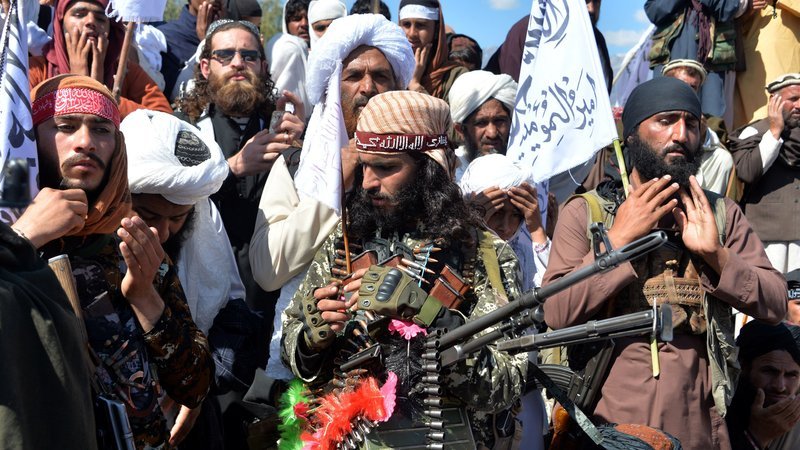
    Taliban have denied claims of joining Kashmiris’ freedom movement and attack New Delhi in retaliation against Indian atrocities under Prime Minister (PM) Narendra Modi’s regime that Pakistan and the international community fear is leading to the ethnic cleansing of the troubled valley’s majority Muslim community.

    According to Hindustan Times, the militant group has underlined that the Taliban “do not interfere in internal affairs of other countries”, saying the statement published in the media about the group joining Jihad in Kashmir was wrong.

    “The policy of the Islamic Emirate is clear that it does not interfere in the internal affairs of other countries.” Suhail Shaheen, the spokesperson for the Islamic Emirate of Afghanistan, as the political wing of Taliban calls itself, tweeted in Arabic.

    The clarification came after officials monitoring social media noted a spike in posts around claims that Taliban spokesperson Zabihullah Mujahid had said it was impossible to be friends with India unless the Kashmir dispute was resolved. The spokesperson was also claimed to have said that the Taliban, after capturing power in Kabul, would also “capture Kashmir from infidels”.

    Diplomats based in Kabul and Delhi said that the Taliban spokesperson’s clarification came after India worked the backchannels to confirm reports about the group’s approach to India, and on Jammu and Kashmir.

    New Delhi was told that the social media posts were fake and did not reflect Taliban’s position.

    But analysts have also underlined that Taliban comprises people holding different beliefs. For example, while the group has alleged deep linkages with the deep state of some countries, there are also some who favour an independent line.

  • PM asks Muslims to ‘pray on Shabe Baraat tonight’, deletes tweet after people tell him it was yesterday

    PM asks Muslims to ‘pray on Shabe Baraat tonight’, deletes tweet after people tell him it was yesterday

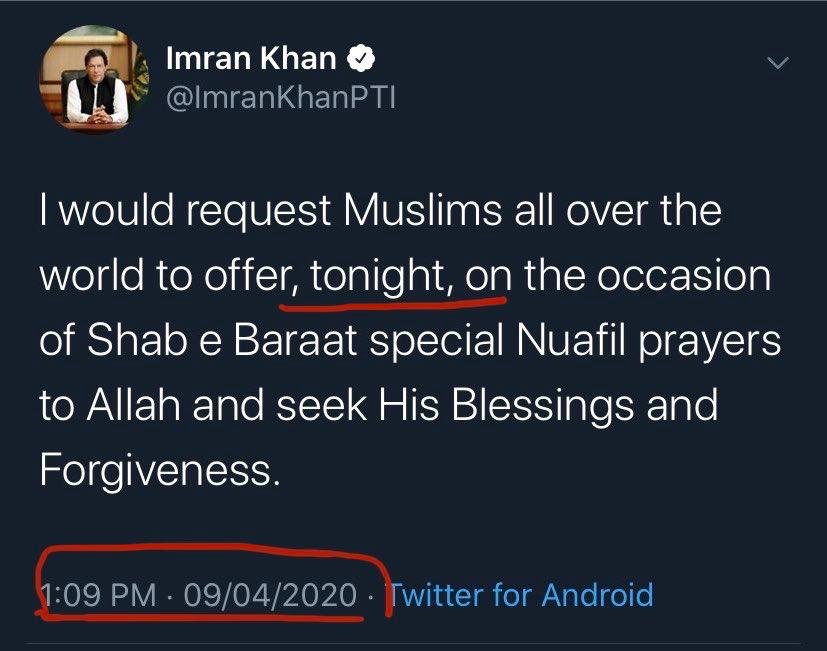
    In a Twitter blunder on Thursday, Prime Minister (PM) Imran Khan asked Muslims “to offer special Nuwafil prayers and seek Allah’s blessings and forgiveness on the occasion of Shabe Baraat tonight”, later deleting his tweet when people told him the night had already been observed a day ago.

    “I would request Muslims all over the world to offer, tonight on the occasion of Shab e Baraat special Nuafil prayers to Allah and seek His Blessings and Forgiveness [sic],” the premier tweeted on Thursday afternoon.

    While he deleted the tweet amid criticism for not knowing that the night had already been observed, here’s a screen grab:

    Twitterati, as usual, did not let go of the blunder easy:

    https://twitter.com/Andyrockz2012/status/1248190024497037313

    Mid-Sha’ban or Shabe Baraat is a holiday observed by Muslim communities on the night between 14 and 15 of the Islamic month of Sha’ban. It is regarded as a night when the fortunes of individuals for the coming year are decided and when Allah forgives sinners.

  • Delhi riots: Indian Muslims put end to decade-old land dispute with Sikhs to thank them

    Delhi riots: Indian Muslims put end to decade-old land dispute with Sikhs to thank them

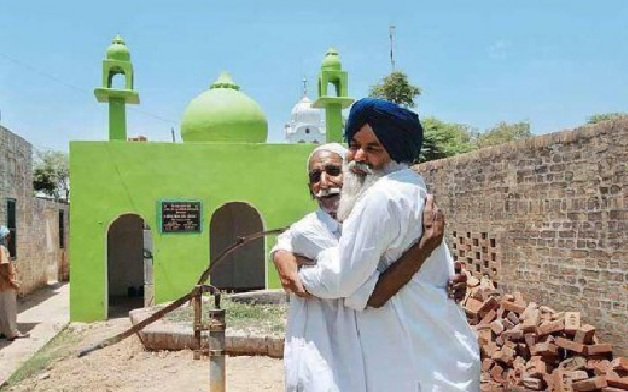
    Muslim and Sikh communities have decided to put an end to a 10-year-old land dispute that had led to riots in Saharanpur city of Uttar Pradesh (UP) back in 2014 and claimed at least three lives.

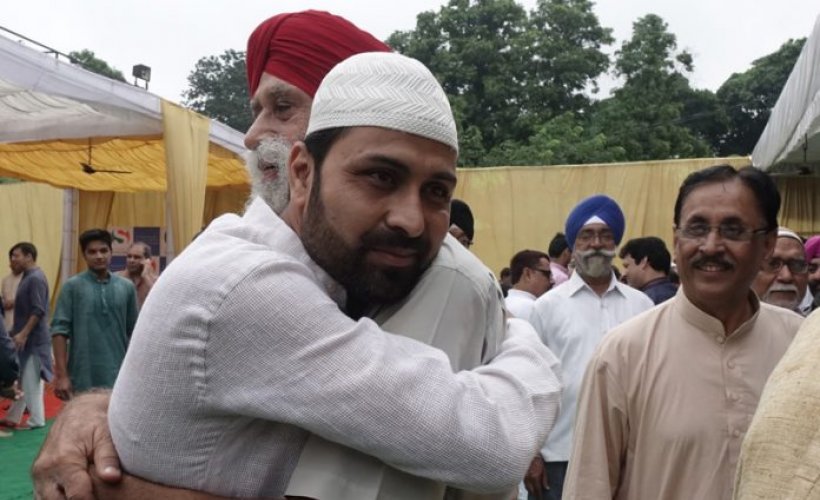
    As a gesture of gratitude for the help offered by Sikhs during Delhi riots starting last week, the Muslim community has decided to forego its claim on a piece of land that had been purchased by the gurdwara management and was a bone of contention between the two religious communities of India.

    The dispute pertains to an incident that took place two decades ago when a gurdwara committee in the Kutubsher area purchased land around an existing gurdwara with the objective of expanding the complex. After the acquisition, some old structures in the area were demolished including, allegedly, a mosque.

    Things turned violent when in July 2014 construction work to expand the gurdwara complex began. This led to large scale violence and arson which resulted in the deaths of three people and injured 33.

    The matter subsequently reached the Supreme Court of India (SCI). But now Muslims have decided to forego its claim on the piece of land. Instead, they will be allotted land at another location nearby and the gurdwara management will pay for the construction of the mosque.

    “In view of the great service and support rendered by the Sikhs to Muslims in Delhi throughout the protests and most recently during the riots in Delhi, the Masjid committee in Saharanpur decided to give up its claim over the land as a token of gratitude and thanksgiving,” Nizam Pasha, who represented the Muslim side in the Supreme Court, told The Quint.

    The petitioner, Moharram Ali, has also said that the gesture comes as a show of gratitude for the help and aid provided by the Sikh community to affected families in Delhi’s communal violence. “Sikhs stand for humanity. They help people in need. The helped people affected by the communal violence in Delhi. This is God’s work.”

  • ‘ImaanFest’: World’s first Muslim LGBTQI+ festival to be held in April

    ‘ImaanFest’: World’s first Muslim LGBTQI+ festival to be held in April

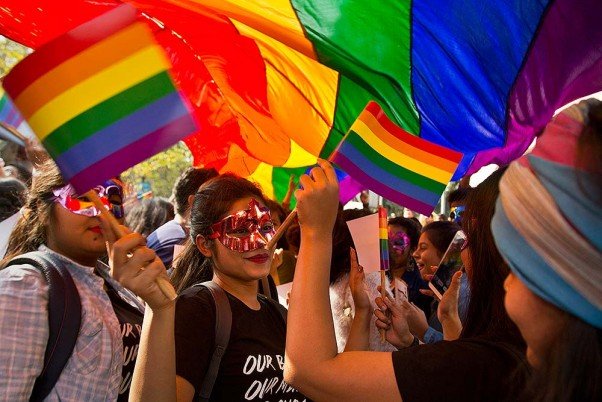
    London will on April 11 be hosting the world’s first-ever Muslim pride event, ‘ImaanFest’, which comes after a successful crowdfunding campaign by its organisers, Imaan, a leading Muslim LGBTQI+ group in the United Kingdom (UK).

    LGBTQI stands for lesbian, gay, bisexual, transgender, queer and intersex, while the ‘+’ represents other sexual identities.

    According to reports, ImaanFest organisers successfully raised close to $20,000 in order to host the event, explaining that LGBTIQ+ Muslims often found themselves isolated, without community and frequently facing homophobic, biphobic, transphobic and Islamaphobic abuse.

    “The event will build on the incredible events we organised in the past, and feature panels, discussions, speakers, arts, culture and history — a first for LGBTQI Muslims,” they were quoted as saying.

    With tickets for ImaanFest now available to members of the public, organisers are now using social media to reach queer Arab speakers and service providers who might like to get involved. Other speakers include queer British-Iraqi writer and filmmaker Amrou Al-Kadhi and trans activist Asifa Lahore.

    An Islamic online news agency, 5 Pillars UK, notes that the event has been organised “despite Islam’s strict prohibition of homosexuality”. The news agency adds that the “practice and promotion of homosexuality is considered a major sin in Islam by all mainstream schools of thought”.

    Imaan group has received a slew of negative tweets from online trolls after announcing the event over social media. But the group is responding to negative responses with “#Islamophobia”.

    Most Muslim-majority countries and the Organisation of Islamic Cooperation (OIC) have opposed moves to advance LGBTQI+ rights at the United Nations (UN), in both the UN General Assembly (UNGA) and the UN Human Rights Council (UNHRC).

    A number of Muslim countries, including Pakistan, Saudi Arabia, Yemen and Iran among others, have strict laws against homosexuality, with punishments for the same being as serious as a jail term or the death penalty.

  • As Delhi burns, Gurdwaras open doors to Muslims fleeing violence

    As Delhi burns, Gurdwaras open doors to Muslims fleeing violence

    As New Delhi Chief Minister (CM) Arvind Kejriwal suggests calling the army amid police’s failure to quell violent communal clashes that have so far claimed at least 20 lives and left hundreds of others injured, Gurdwaras are offering help to Muslim families fleeing violence in the Indian capital.

    According to a report in India Times, members of the Sikh community are not only patrolling with their neighbours of the Indian Muslim community to ensure that no one from outside attacks the latter’s homes, but many Gurdwaras — places of assembly and worship for Sikhs — are also giving shelter to the Muslims of riot-infested Delhi.

    Novelist Nilanjana Roy tweeted that she had come across news from one part of the city wherein a Gurdwara had opened its doors to anyone who needs shelter.

    https://twitter.com/nilanjanaroy/status/1232303148766617601

    Many other people shared similar stories.

    DELHI RIOTS:

    The riots — clashes between anti and pro Citizens Amendment Act (CAA) groups, which soon took a communal colour — that began earlier this week, are the worst Delhi has witnessed in recent years.

    The controversial citizenship law has been deemed discriminatory toward Muslims, against which the Muslim minority community of India has been staging protests across the country since December last year.

    With Hindu supremacist mobs running rampage in New Delhi earlier this week, things escalated quickly.

    Violence broke out in three Muslim-majority areas in north-east Delhi on Sunday and has continued since. Protesters are split along religious lines, and each side blames the other for starting the clashes.

    But the violence has been linked to a Bharatiya Janata Party (BJP) leader, Kapil Mishra, who had threatened a group of protesters staging a sit-in against the CAA over the weekend, telling them that they would be forcibly evicted once United States (US) President Donald Trump left India.

    It merits a mention that Trump had been in the country on a two-day maiden visit. When asked about the violence during a press briefing, Trump evaded the issue, saying the incident was “up to India” to handle.

  • Woke students in ‘secular’ India

    The BJP coming to power has only removed the lid from the internal realities of the unsuccessful story of Indian democracy.

    Unlike Pakistan, where student unions were banned during the military rule of Ziaul Haq, in India, student unions on campuses have successfully sustained till date. In the past few years, Jawaharlal Nehru University (JNU) has been mentioned as a refrain in discussions on student politics — particularly in terms of burgeoning progressive politics — the spillover effect of which has reached not only Pakistan, but major parts of the globe as a good omen for the oppressed.

    The student union of JNU, better known as JNUSU, was recognised as a symbol of resistance, the voice of voiceless and a representative of the marginalised and vulnerable communities within India. JNUSU gained popularity across the world after its former president Kanhaiya Kumar was arrested from campus in 2016 due to his association with a protest gathering held at JNU.

    The protest was organised by some students of the varsity on February 9, 2016, in order to commemorate the judicial killing of Afzal Guru (hanged Feb 9, 2013) and also to question the violation of human rights by the Indian state in Indian occupied Kashmir (IoK).

    Consequently, the fascist Bharatiya Janata Party (BJP) government pressed charges against the students who had organised the protest, as well as Kanhaiya, who had addressed the protest gathering. Kanhaiya, Umar Khalid and Anirban Bhattacharya were the three students who were jailed following the registration of an FIR [First Information Report] against them.

    With already popular Azadi slogans taking a different tone following Kanhaiya’s arrest, students – especially Kashmiri — took a tone that went on to prove their courage at the forefront of the struggle against Indian Prime Minister (PM) Narendra Modi’s fascist regime.

    The recent wave of mass-mobilisation in India started in the aftermath of the controversial Citizenship Amendment Act (CAA) that grants the government the right to declare people, unable to produce citizenship documents, as “illegal immigrants” and allows any declared illegal immigrant, except Muslims, to become a citizen of India on the grounds of persecution in neighbouring Muslim states.

    CAA’s implementation, however, comes after forming a National Register of Citizens (NRC). NRC has been implemented in the Indian state of Assam where people, who have not made it to the register, have either already been detained in camps or are facing the threat of landing in the same since there is no way to prove which countries do these allegedly illegal immigrants belong to.

    The massive mass-scale protests in India against the discriminatory CAA law drew much attention after the December 15 protest led by students of Jamia Millia Islamia University in a Muslim locality of New Delhi. With police cracking down on these protesting students by not only baton-charging but also shooting them, and that too on campus, tables started to turn on the Indian state.

    With students of Aligarh Muslim University protesting on campus against the brutality met out to their peers from Jamia Millia Islamia University, a new wave of resistance took over India. Fierce confrontation meted out to the cops, especially by female students, in what turned out to be the defining moment for the anti-CAA movement, as more people, although largely Muslims, joined the protests, and the same still goes on.

    Outside their campuses, students of Jamia Millia and Aligarh University are much more involved in mobilising and organising the ongoing protests. However, they are subsumed by the grandiosity of JNU and its student leadership that has expressed solidarity to Jamia students by joining one of the protests outside JNU.

    Despite a huge communication gap and both Pakistan and India’s coercive forces employed to keep people away from each other, the engagement of student-political activists gives us hope that a broader united front to fight injustice and oppression will someday be built.

    While mass participation of students, youth and religious minorities in the protests against BJP’s plan of constructing a Hindu Rashtra, which according to their publicised map, is extended to Afghanistan, seems insufficient to deal with, it is important, as well as necessary, to demand that the newly-passed legislation by the parliament be rolled back.

    But would it ensure peace and security for Muslims and other marginalised communities like Dalits, who too are at risk after the promulgation of CAA and NRC? Or in other words, does the struggle for safeguarding Indian constitution in itself, guarantee protection to religious minorities?

    Apart from the popular discourse propagated around the Indian constitution that claims it is ‘secular’, the deployment of state apparatus against lower caste people within Hindus and other marginalised and religious minorities, tell a different story, which has become clearer under the BJP. The destitution of religious minorities in terms of poverty, employment, education and above all, political representation, stands in testimony to the fact that they were reduced to ‘second-class citizens’ in the largest democracy of the world even when BJP was not in power.

    The BJP coming to power has only removed the lid from the internal realities of the unsuccessful story of Indian democracy. Therefore, it becomes much more significant for the protesters from Asam to Uttar Pradesh and from Jamia Millia to Shaheen Bagh to consolidate these anti-BJP forces in one political project which possibly would push the current discourse beyond constitutionalism, instead of leaving the burden of saving constitution and secularism on the shoulders of already underprivileged Muslim community of India.

    Amid all the recent political developments in Pakistan and India, there has been a convergence of progressive ideas across the border which is largely manifested in the unconditional solidarity extended by the Progressive Students’ Collective (PSC) among other progressive student organisations in Pakistan to their counterparts in India.

    Despite a huge communication gap and both the states’ coercive forces employed to keep people away from each other, the engagement of student-political activists gives us hope that a broader united front to fight injustice and oppression will someday be built.
  • Fate of Muslims not in UN Security Council members’ hands: Erdogan at Kuala Lumpur Summit

    Fate of Muslims not in UN Security Council members’ hands: Erdogan at Kuala Lumpur Summit

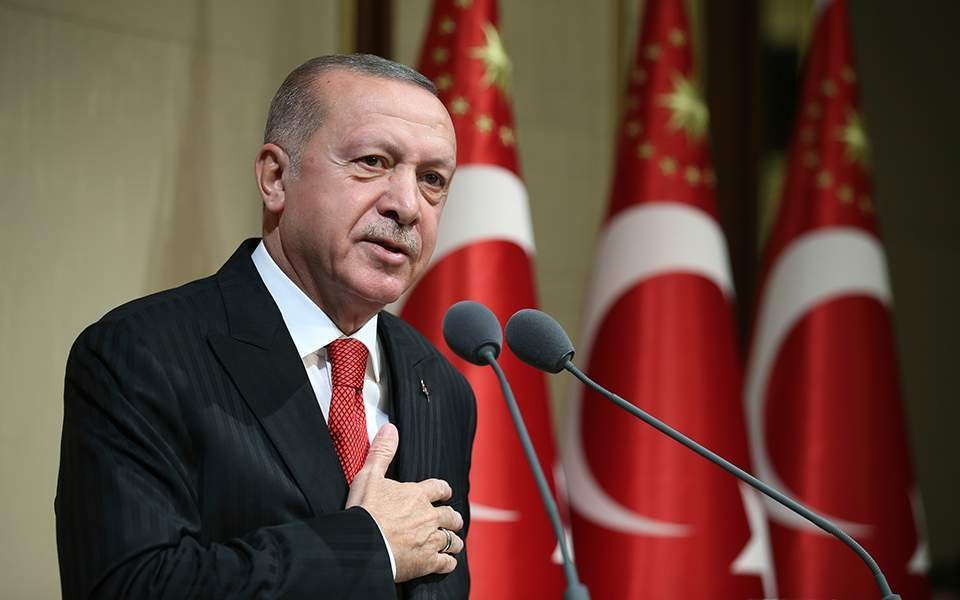
    Turkish President Recep Tayyip Erdogan on Thursday said that the fate of the world’s 1.7 billion Muslims was no longer in the hands of the five permanent members of the United Nations Security Council (UNSC).

    According to Anadolu Agency, speaking at the opening ceremony of the Kuala Lumpur Summit in the Malaysian capital, Erdogan reiterated that the world was bigger than the five permanent UNSC members, whose veto power could prove catastrophic for smaller nations.

    “The world is bigger than five” is a famous slogan repeatedly used by Erdogan to criticise the permanent council members that are China, France, Russia, the United Kingdom (UK) and the United States (US).

    He also said that Turkey did not bow to pressure to silence it, including a coup attempt, economic terror and slander. “As they try to silence Turkey, we insist on calling attention to Palestine, Gaza, the Rohingya, Libya, Somalia, and Syria.”

    Earlier at the opening ceremony, Qatari Emir Tamim bin Hamad Al Thani, Iranian President Hassan Rouhani as well as the host, Malaysian Prime Minister Mahathir Mohamad, delivered speeches.

    Hundreds of government officials, businessmen, representatives of civil societies and experts from different sectors across the Muslim world, except Pakistan and Saudi Arabia, are taking part in the summit.

    Islamabad reportedly decided not to participate in the moot after being told so by Riyadh.

  • Islamophobia heightened after Boris Johnson’s victory: report

    Islamophobia heightened after Boris Johnson’s victory: report

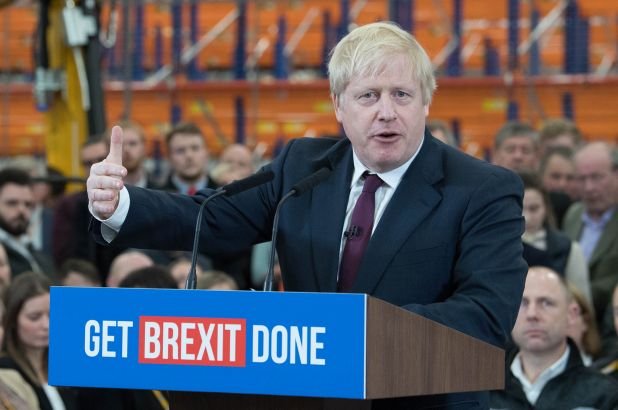
    Following Boris Johson’s ascent to the premiership, several British Muslims have started the process of leaving the United Kingdom (UK) over fears for their ‘personal safety’, a private media outlet has reported.

    The report comes as racist taunts increased sharply in wake of Johnson’s victory and far-right activists linked with his party urged Muslims to leave the UK or face the consequences.

    Manzoor Ali, the head of a Muslim charity organisation that provide food parcels for poor people in Manchester, says he wants to leave the country because he is “insecure about the future of my children.”

    In the past, Johnson has been accused of Islamophobic and racist comments on several occasions. For example, he has compared Muslim women to “letterboxes and bank robbers” in a column for The Telegraph. In another article, he called Islam a ‘problem.’

    Moreover, fear arose after several people complained that after Johnson’s victory, they were told online to leave Britain. Those who were targeted included prominent figures from immigrant backgrounds.