Tag: Narendra Modi

  • Modi invites Imran Khan to New Delhi

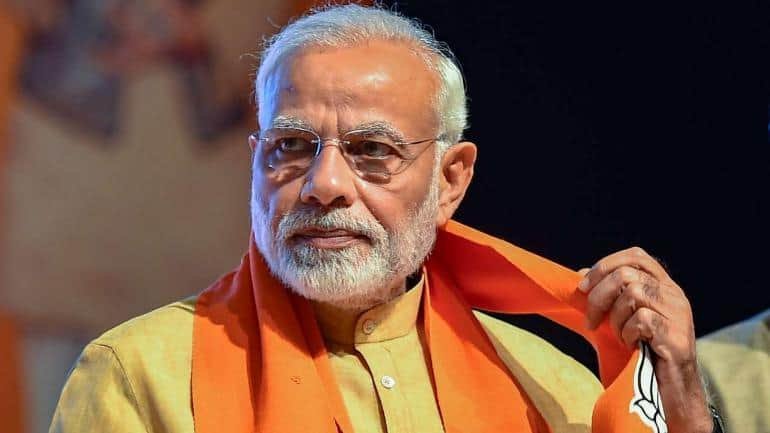
    Indian Prime Minister (PM) Narendra Modi has invited his Pakistani counterpart, Imran Khan, to participate in the Shanghai Cooperation Organisation (SCO) heads of government meeting being held in New Delhi on November 30.

    According to reports, the Indian premier invited all the eight members and four observer countries on Tuesday during the online summit of the organisation held in Moscow, chaired by Russian President Vladimir Putin.

    The News quoted sources as saying that the Russian president appreciated Pakistan’s proposals on various counts.

    Modi, who tried to demean the objectives of the SCO, tried to take on Pakistan and China in the same stroke without naming them under the garb of respect of sovereignty and said in muffled words that India believed that to enhance connectivity it was important that we move forward while respecting one another’s sovereignty and territorial integrity.

    He boasted that India had always been resolute in working in sync with principles laid out in the SCO charter, but it was unfortunate that there had been repeated efforts to unnecessarily bring bilateral issues in the SCO agenda which was in violation of the SCO spirit.

    It was an assault on Pakistan and China’s policies of enhancing connectivity in the region.

    Modi referred to the Shanghai spirit and SCO charter, but he conveniently forgot that it was India that had humiliated the two documents by its actions and inactions.

    Diplomatic sources told the English daily that none of the significant member countries’ premiers will attend the New Delhi virtual meeting except Russian PM Mikhail Mishustin while the Chinese premier, Li Keqiang, and PM Imran might not be available to attend the heads of government meeting.

    Foreign Secretary Sohail Mahmood or Additional Foreign Secretary Syed Faisal Tirmizi are likely to represent Pakistan at the huddle.
  • Calling rivals ‘traitors’ easiest trick in politics playbook, says Firdous

    Adviser to Punjab Chief Minister Firdous Ashiq Awan, while talking about the practice of labelling political opponents ‘pro-India’, said politicians use such statements because it’s easy to manipulate “anti-India sentiments” of people.

    She made these comments in a TV show in response to a question about the use of terms “traitor”, “Modi’s friend” and “Indian agent” by government officials to discredit political rivals.

    According to Firdous, it’s easy for politicians to exploit the “anti-India” sentiments of people, which was why treason allegations have remained an integral part of Pakistani politics.

    When asked if the government was using these trick to malign its opponents, Firdous said this practice is allegedly employed by all political parties, not just the government.

    However, the government has accused the opposition of peddling the pro-India narrative multiple times. In Sept this year after the opposition blocked an anti-terror legislation, the prime minister had said that by blocking Financial Action Task Force (FATF) legislation the opposition was serving Indian interests.

    Also, after the formation of the Pakistan Democratic Movement (PDM) and its aggressive stance towards the army establishment, the ministers have accused the opposition leaders, especially former prime minister Nawaz Sharif, of harming Pakistan to favour his “Indian friend”.

  • Saudi Arabia angers India over new currency notes

    Saudi Arabia angers India over new currency notes

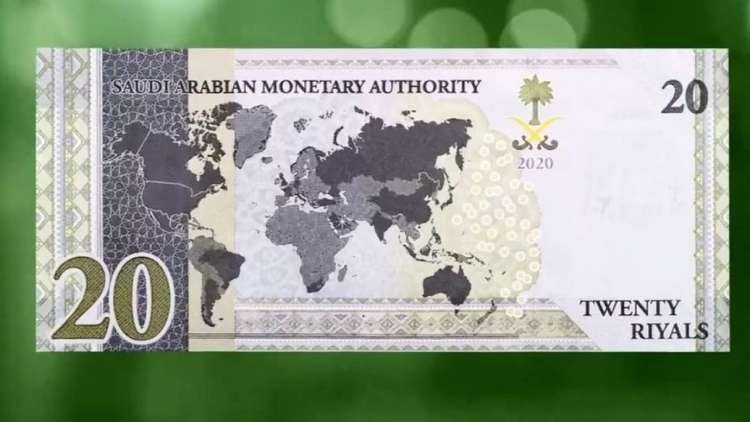
    India has lodged a protest over the issuance of Saudi Arabia’s new currency notes that do not feature Jammu and Kashmir as a part of India.

    The 20 Riyal bank note was issued by the Saudi Arabian Monetary Authority on October 24 to mark the Kingdom’s presidency of the upcoming G20 summit in November. The note, with an image of the world map, has shown Kashmir as separate states and not belonging to any of the rival Asian states of Pakistan and India.

    Anger erupted in India because of the map, even though the country has illegally occupied the territory of Kashmir and there is a United Nations Security Council (UNSC) decree recognising it as an international dispute.

    External Affairs Ministry spokesperson Anurag Srivastava is reported to have said that New Delhi has raised “serious concerns” about the banknote both at the Saudi Embassy in India, as well as at India’s embassy in Riyadh.

    “We have taken up this gross misrepresentation of India’s external territorial boundaries on an official and legal banknote of Saudi Arabia… we’ve asked the Saudi side to take urgent corrective steps in this regard,” he said.

    Additionally, it was found that the distortion was in the Pakistani map as well.

    The G20 summit is set to be held from November 21-22 this year in Saudi Arabia and India is a part of it. Although the relations between Saudi Arabia and India are seen as healthy, with Saudi crown prince Mohammed bin Salman referring to India’s Narendra Modi as his “elder brother” during a meeting last year, the new developments might create some hurdles.

    Earlier, India put a ban on Qatar-based broadcaster Al Jazeera in 2015 for publishing a map of the country that excluded Kashmir. Also, the country has frequently censored the Economist magazine for showing Kashmir as a disputed region.

  • ‘Modi has decided when India would be at war with Pakistan, China’

    Bharatiya Janata Party’s (BJP) Uttar Pradesh (UP) unit chief Swatantra Dev Singh has claimed that Indian Prime Minister (PM) Narendra Modi has “decided” on a time when India would be at war with Pakistan and China.

    A minister in UP Chief Minister (CM) Yogi Adityanath’s cabinet, Swatantra Dev Singh made the remark during an event at the home of BJP’s Sikanderpur lawmaker Sanjay Yadav.

    In a video clip of Swatantra Dev Singh’s remarks, the BJP’s UP chief draws parallels between the abrogation of Article 370 in held Kashmir, construction of a Ram temple in Ayodhya where the Babri Masjid once stood, and the ongoing India-China military standoff in eastern Ladakh.

    “Like the decisions on Ram Mandir and Article 370, PM Narendra Modi has decided when there would be war with Pakistan and China,” news agency PTI quoted Swatantra Dev Singh as saying in a video posted on social media by Yadav.

    The BJP leader’s controversial remarks come amid an intense standoff between the Indian and Chinese armies in eastern Ladakh. Both countries have held multiple rounds of diplomatic and military talks to achieve disengagement in the region.

    However, Defence Minister Rajnath Singh’s statement on Sunday contradicts the remarks made by Swatantra Dev Singh. While reiterating that India is seeking an end to the border tussle with China, Singh had said that New Delhi will not allow anyone to take away “even an inch” of Indian land.

    Launching an attack on the BJP-led Centre, Congress lawmaker Shashi Tharoor tweeted:

    “Amazing. So the PM (who will not even name the state that has encroached upon our land) is planning a war against an Unnamed Enemy, over territory he claims has never been taken, on a date that only he knows? So is this what he meant by “minimal government”!?” he said while referring to Swatantra Dev Singh’s remarks.

  • Howdy Modi: Trump calls India ‘filthy’ during final presidential debate

    Howdy Modi: Trump calls India ‘filthy’ during final presidential debate

    United States (US) President Donald Trump has described the air in India as “filthy” as he denounced Democratic rival Joe Biden’s plans to tackle climate change.

    At their second and final presidential debate, Trump renewed his criticism that action on climate change was unfair to the US.

    “Look at China, how filthy it is. Look at Russia, look at India — it’s filthy. The air is filthy,” Trump said at the debate in Nashville, adding, “I walked out of the Paris Accord as we had to take out trillions of dollars and we were treated very unfairly.”

    Trump has repeatedly blamed countries like India and China for not doing enough on climate change, labelling them as regions with air that is impossible to breathe. He has continuously argued that countries like China and India are benefiting the most from the Paris agreement.

    It is pertinent to mention here that the air in several cities in northern India is especially bad in winter months — November to February — when several factors, such as farmers burning crop stubble to clear their fields, vehicular and industrial pollution, festive fireworks and low wind speed, contribute to what doctors call a “deadly cocktail of poisonous gases”.

    Despite the spikes in air pollution year after year, few concrete steps have been taken to control it.

    During the debate, Trump also charged that Biden’s climate plan was an “economic disaster” for oil states such as Texas and Oklahoma.

    Biden had said that climate change is “an existential threat to humanity. We have a moral obligation to deal with it.”

    “We’re going to pass the point of no return within the next eight to 10 years,” he said.

    The planet has already warmed by around one degree Celsius (34 degrees Fahrenheit) from pre-industrial levels, enough to boost the intensity of deadly heatwaves, droughts and tropical storms.

    Trump’s remarks come days before Secretary of State Mike Pompeo and Defense Secretary Mark Esper visit New Delhi for talks on building the growing US-India partnership.

    At the first presidential debate, Trump also spoke critically of India, questioning its coronavirus data amid criticism of Trump’s handling of the pandemic.

    Read more – The hideous face of India under Modi

    Soon after Trump’s remarks, “filthy” and “Howdy! Modi” started trending on Twitter though many used the hashtag o highlight their concerns. The “Howdy, Modi!” event, held in Houston in September 2019 was attended by nearly 50,000 people. It was billed as one of the largest ever receptions for a foreign leader in the US and Mr Trump had called it a “profoundly historic event”.

    https://twitter.com/Su4ita/status/1319483073503744000?s=20

    https://twitter.com/dharmicverangna/status/1319537322291990530?s=20

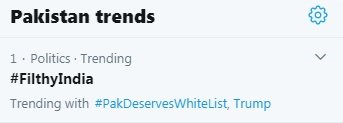
    Meanwhile, #FilthyIndia is also trending on Twitter Pakistan.

  • India says didn’t approach Pakistan for talks

    India says didn’t approach Pakistan for talks

    India’s Ministry for External Affairs Spokesperson Anurag Srivastava said that New Delhi did not approach Pakistan with a dialogue offer, as he rejected claims made by Moeed Yusuf — the prime minister’s aide on national security– in a recent interview with an Indian media outlet.

    “The statements made by him [Yusuf] are contrary to facts on the ground, misleading and fictitious. As regards the purported message that was referred to, let me make it clear that no such message was sent from our side,” Srivastava said at a weekly press briefing.

    The spokesperson termed the statement “fictitious and misleading”, saying the claim was made by the Pakistan Tehreek-e-Insaf (PTI) government to “divert attention from domestic failures” and “mislead its domestic constituents by pulling India into headlines on a daily basis”. The Indian official advised Yusuf “to restrict his advice to the establishment and not comment on India’s domestic policies”.

    PM’s Special Assistant on National Security Moeed Yusuf gave an interview to The Wire earlier this week, wherein he claimed that India approached Pakistan with a talk offer. This was the first time a Pakistani government official was interviewed by an Indian outlet since New Delhi annexed Kashmir in August last year.

    During his interview with Karan Thapar, Yusuf set five pre-conditions for the resumption of “meaningful dialogue” with India to resolve all outstanding issues, including the longstanding dispute of Indian occupied Jammu and Kashmir (IoK).

    While he said that Pakistan desired peaceful ties with India and wanted to resolve all issues through dialogue, Yusuf asserted that for any meaningful dialogue to take place between the two neighbours, India has to release all political prisoners in Kashmir, end inhuman blockade and restrictions, rescind domicile law that allows non-Kashmiris to settle in the disputed territory, stop human rights abuses and end state terrorism in Pakistan.

    “My message is peace, my message is talk. But there is an intent and there has to be an enabling environment to talk, Karan. Create that and you will find us willing the next day. Just that one step, you will see my prime minister take two – that’s his promise, he stands by it,” Yusuf told journalist Karan Thapar.

  • The hideous face of India under Modi

    India is known as the ‘world’s largest democracy’ but it is quite apparent that it has become an autocracy under the rule of Prime Minister Narendra Modi. The Modi government has marginalised the minorities, apart from a few honourable exceptions, the Indian media largely behaves like a PR machine for the right-wing government, and the judiciary, too, has become pliant. International human rights organisations are facing the wrath of the Indian government for exposing its real face. Just recently, Amnesty International India announced that it is halting its work in the country after the Indian government froze its bank accounts due to their work. The recent crackdown by the Indian government against human rights organisations and defenders was condemned by 15 international human rights organisations.

    The Babri Mosque verdict was a tight slap in the face of justice. To give a clean chit to all accused in the Babri Mosque demolition case – 32 out of 49 were acquitted as17 had died while the case was still under way – seems to say that nobody demolished the historic mosque. An Indian court said the demolition was not pre-planned despite 850 witnesses, 7,000 documents apart from TV footage and photos of what happened that fateful day. The demolition was televised and led to communal riots, which killed around 2,000 people. From the Ayodhya verdict last year to the Babri Mosque verdict just days ago, the Indian judiciary seems like a proper lackey of the Modi government. The way this verdict was celebrated by the accused, which included former Deputy Prime Minister LK Advani, shows that the verdict was expected.

    India under Modi has changed radically in just six years. The pretense of a secular India is truly over. Communalism in India was always a reality – from the Bombay riots in 92-93 to Gujarat pogrom in 2002, the Muslim minority in India largely lived in fear but at least there were constitutional protections safeguarding their rights. Now, just like the White Supremacists have been empowered in Trump’s America, the Hindutva brigade has been weaponised in Modi’s India. It is fast turning into a Hindu Rashtra. From treating religious minorities like third-class citizens to not giving a hoot about the ethnic minorities, the Indian authorities have shown time and again how shameless they can be.

    A 19-year-old Dalit woman died on Tuesday after she was allegedly gang-raped by four upper-caste men in the state of Uttar Pradesh (UP), where the controversial Yogi Adityanath rules as the chief minister. The details of the gang-rape are horrific: the young victim was beaten to a pulp and left to die. She was hospitalised for two weeks but did not make it in the end. As if the trauma of her death and what led to it was not enough for the victim’s family, the UP police cremated her body in the dead of the night without the permission and presence of her family. The victim’s brother told the BBC that “they took the body away without our permission, without the permission of my parents and cremated her”. He said the family did not even get to see her one last time. Just after this, news broke of a 22-year-old Dalit woman’s death after a gang-rape, this time too in the state of UP.

    India’s descent into fascism was expected under Modi but to witness the authorities being so blatant about it in the 21st century is still shocking. Rolling back Modi’s legacy will take generations. The process should begin before it is too late. 

  • Imran beats Trump, Modi, Putin, others with most views on UN General Assembly speech

    Prime Minister (PM) Imran Khan’s speech at the United Nations General Assembly (UNGA) is the most-watched video among world leaders on the UN’s YouTube with more than 170,000 views since it was uploaded on September 25.

    PM Imran continues to gain popularity at international forums. His recent speech made at the UNGA platform has been declared as the most viewed speech of the UNGA session on the official YouTube channel of the UN.

    According to details, more than 170,000 viewers have seen PM Imran’s UNGA speech thus so far, which is the highest number of any international leadership viewership.

    Coming in second is US President Donald Trump’s UNGA address with close to 140,000 views since it was uploaded on September 22. In third place is Indonesian President Joko Widodo’s speech, which has more than 95,000 views since it was uploaded on September 23.

    Furthermore, Iranian President Hassan Rouhani’s speech got 67,000 views, Indian PM Narender Modi’s speech has 62,000 views, Russian President Vladimir Putin’s speech was viewed by 59,000 persons, and the Chinese President’s speech was watched by 44,000 people. Afghan President Ashraf Ghani’s speech secured only 8,000 views.

    It is worth mentioning here that as many as 2,600,000 people had watched PM Imran’s UNGA speech last year.

    On September 25, the premier virtually addressed the 75th session of the UNGA.

    PM Imran used his UNGA address to warn the international community that India is planning another “ill-conceived misadventure” in a “nuclearised environment,” but Pakistan is ready to “fight for its freedom to the end”.

    He also urged the UN Security Council to play its role in preventing this dangerous conflict, which could jeopardise the entire region.

    WATCH VIDEO:

  • Modi’s Hindu Rashtra

    Modi’s Hindu Rashtra

    This year, August 5 marked the one-year anniversary of occupied Kashmir’s illegal annexation and subsequent lockdown.

    Last year, India changed the special status of the troubled valley to union territories. The gross human rights violations that followed and are still taking place is no secret. Pakistan has tried highlighting the issue internationally.  Unfortunately, the international community is least bothered because of economic reasons; every country wants a share in the Indian market pie.

    The myth of Muslim Ummah was also shattered when except for countries like Turkey and Malaysia, nobody raised voice for the plight of the Kashmiris. The same led to what appeared to be a major foreign policy shift for Pakistan as Foreign Minister Shah Mahmood Qureshi asked Saudi Arabia-led Organisation of Islamic Cooperation (OIC) to stop dragging feet on the convening of a meeting of its Council of Foreign Ministers (CFM) on the Kashmir issue.

    READ: VIDEO: FM Qureshi says Pakistan ready to ‘ditch’ Saudi Arabia for Kashmir’s sake

    Revoking the special status of held Kashmir was a step towards establishing Modi’s Hindu Rashtra. The first five years of Modi paved the way for an India that shattered all foundations of secularism. Modi regime’s six years have resulted in a wave of palpable fear amongst the Muslim minority in India. Modi’s Gujarat — where Muslims were killed as if it was a sport — is now being replicated in other parts of India; from beef lynchings to riots, the Muslim minority in India is being subjugated endlessly.

    Modi chose August 5, 2020, as the day of laying down the foundation of the Ram Mandir in Ayodhya. As the New York Times put it, “In a moment of triumph that India’s Hindu nationalists had worked toward for years, Prime Minister (PM) Narendra Modi on Wednesday set the ceremonial cornerstone for a new Hindu temple at the site of a destroyed mosque in Ayodhya.”

    This gesture was a slap in the face of the Muslim minority of India as well as the last nail in the coffin of Indian secularism. Modi’s Hindu nationalism has destroyed the fabric of Nehruvian secularism. It is a reminder that when a fascist ruler is in power, even strong traditions and constitutions cannot guarantee fundamental rights, human rights, freedom of speech and all other traditions of a free society.

    The cataclysmic shift of the Indian polity towards the right under Modi’s rule is not a surprise. In fact, what was surprising was the denial of Indian liberals when Modi was first elected in 2014. They were of the view that India’s secular traditions and constitution could never be destroyed but many pointed out how Modi’s victory was an indictment of the majoritarianism in India.

    This is happening all over the world. From Trump’s America to Brexit in Britain, the world’s shift to right-wing politics is quite disappointing. We hope that some day, sane voices of India and the world will take a stand against Modi’s fascism.

  • India continues celebrating arrival of Rafale jets that other countries dumped

    As India continues to celebrate the arrival of its Rafale jets, military experts are not only questioning its capabilities against United States (US) aircraft but are also raising questions why the Rafale jets failed to compete in the international arms markets and got dumped by a majority of nations.

    According to foreign media reports, Dassault’s Rafale was not India’s only choice as various other global firms expressed interest in the MMRCA tender. Six renowned aircraft manufacturers competed to bag the contract of 126 jets, which was hailed to be the largest-ever defence acquisition deal of India.

    The initial bidders were Lockheed Martin’s F-16s, Boeing’s F/A-18s, Eurofighter Typhoon, Russia’s MiG-35, Sweden’s Saab’s Gripen and Dassault’s Rafale.

    All aircraft were tested by the IAF and after careful analysis on the bids, two of them — Eurofighter Typhoon and Dassault Rafale — were shortlisted.

    Dassault received the contract to provide 126 fighter jets as it was the lowest bidder and the aircraft was said to be easy to maintain. After Rafale won the contract, the Indian side and Dassault started negotiations in 2012. Though the initial plan was to buy 126 jets, India scaled it down to 36, that too in fly-away condition.

    Despite boasting of awe-inspiring capabilities and selected by India after a mammoth testing & bidding process, the French origin jets didn’t see many buyers. Other than France and India, only Qatar and Egypt are using Rafale jets and that too in very limited numbers.

    As reported earlier by EurAsian Times, Russian aviation experts had claimed that Rafale jets would have been useless against the Chinese Airforce (PLAAF). The maximum speed of the Rafale jet is about Mach 1.8 compared to Chinese J-16s at Mach 2.2.

    The Rafale’s practical ceiling is also lower than the J-16s. Even in engine thrust, the Chinese J-16s aka Russian Su-35s are far superior to the French combat aircraft. Even if the Indian Air Force (IAF) was to deploy all 36 of its newly acquired jets, the technical superiority would still be on the side of China, claimed the Russian expert.

    The Rafale is one of the most expensive aircraft in the international market. India’s deal of 36 jets is worth Rs. 60,000 crores. Experts argue that the high cost is the result of many reasons including general inefficiency in the country’s defence sector, along with the small scale on which the Rafale is being produced in comparison to rival fighters such as the F-18, MiG-29 or F-35 due to which Rafale has not benefitted from economies of scale. This has contributed to its poor performance in the international markets.

    Rafale’s third buyer, India, previously proposed to acquire 126 jets under Make in India and not 36. However, it took five years for even the first five jets to arrive in India after Prime Minister Narendra Modi announced it in April 2015 during his trip to France.

    According to analysts, despite heavy marketing by the makers of Rafale, France’s relatively small and inefficient defence sector seems to have met its limit with the fighter program. The small production lines are unable to produce the aircraft quickly or efficiently and the French budget for research and development is smaller in contrast to the US or Russia.

    The aircraft is priced very steeply and most nations prefer to buy US jets not only because of the technical superiority but also to please the Americans instead of the French. The Rafales have seemingly lost the fight in the international market, despite boasting of excellent qualities.