Tag: National Assembly

  • ‘Safe exit, resignation, boots’: Rumours related to Khan on social media

    ‘Safe exit, resignation, boots’: Rumours related to Khan on social media

    The historic session of the National Assembly (NA) session to decide the fate of Prime Minister (PM) Imran Khan is taking place today as per the Supreme Court’s orders. The Opposition came out in full force but twelve hours later, there was no vote in sight.

    While parliamentarians are still waiting to vote, different rumours are circulating on social media as to what is going on – and what does PM Khan want?

    RUMOUR ONE: PM Khan is seeking a ‘safe exit’

    Different news reports are making rounds on social media suggesting that Imran Khan is looking for a ‘safe exit’. Journalist Murtaza Ali Shah in a tweet claimed: “Credible source says Imran Khan ready to step down but wants NRO (guarantees) that cases will not be registered against him & his family members; he’s fine for cases against his cabinet members etc; seeking assurances about his safety and stay. This was discussed several times.”

    https://twitter.com/MurtazaViews/status/1512786769816821761?s=20&t=Z82CW90atNGgGmJ5fiaVHA

    Jouranlist Najam Sethi confirmed the news saying, “IK seeking safe exit for self and family. Last minute moves.”

    RUMOUR TWO: PM evaluating dismissal of Chief of Army Staff

    “As per the reports received by journalists, severe differences have emerged in the cabinet of Prime Minister as he is possibly evaluating dismissal of Chief of Army Staff at 2100 Hrs. PM has been reportedly informed to ensure VONC by 2100 Hrs or he will be shown the way out,” tweeted Muhammad Ibrahim Qazi.

    https://twitter.com/miqazi/status/1512808328107278347?s=20&t=GANIZ-yA3SSg8P4Kz2EUsg

    “Chief of General Staff, Commander of X Corps, and DG ISI have pledged support to the Chief of Army Staff. Executive Offices responsible to maintain law and order have the mandate to aid the Supreme Court under Article 190,” writes Qazi.

    “The President may invoke Article 232 and proclaim emergency consequently the Prime Minister will impose Article 245 calling upon the military to act in aid of civil power. The invocation of Article 232 will have to be placed before National Assembly in 30 days.”

    RUMOUR THREE: 111 brigade takes control of PM House, Presidency

    “IK and cabinet will resign after the cabinet meeting. 111 brigade took control of the PM House and Presidency, sources,” tweets a broadcast journalist.

    RUMOUR FOUR: Imran Khan is seeking security in the capacity of “Former Prime Minister”

    Journalist Azaz Syed has claimed that Principal Secretary to the Prime Minister Azam Khan has written a letter to write to the Secretary Interior, asking for security for ‘Former Prime Minister Imran Khan’.

    RUMOUR FIVE: Imran Khan to resign

    Some rumors are suggesting that Prime Minister Imran Khan will resign before the voting on the no-confidence motion against him will take place. Islamabad based journalist, Haider Sherazi in a tweet said: “Imran Khan is going to submit the resignation.”

    RUMOUR SIX: Martial Law

    Though, no journalist or news report is hinting towards the possibility of interference of the Army in the current political scenario, it seems like social media is hearing the noise of boots. PPP’s Bilawal Bhutto-Zardari also stated that he thinks PM Khan wants martial law in the country.

    https://twitter.com/ali_abbas_zaidi/status/1512820059785527300?s=21&t=jyBA9xDPmHvrwvXQWAbqzQ
  • ‘Imran Khan stumped’: What led Khan to this point?

    ‘Imran Khan stumped’: What led Khan to this point?

    The Supreme Court of Pakistan (SCP) has “stumped” Prime Minister (PM) Imran Khan through its historic verdict on April 7. The verdict seems to have cleaned bowled Khan as the National Assembly (NA) was restored after the apex court declared the government’s decision to dissolve the assembly and NA Deputy Speaker Qasim Suri’s ruling against the Constitution. This decision is being described as a win for the Constitution of Pakistan.

    In its verdict, the top court has called for convening the NA session on April 9, at 10:00am.

    Court order

    The apex court’s five-member larger bench — headed by Chief Justice of Pakistan (CJP) Umar Ata Bandial and comprising Justice Muneeb Akhtar, Justice Aijazul Ahsan, Justice Mazhar Alam, and Justice Jamal Khan Mandokhel — heard the case and then later issued the ruling. The decision was unanimously given by 5-0 judges.

    Here is what the court order has to say:

    “In consequence of the foregoing, it is declared that at all material times the Prime Minister was under the bar imposed by the Explanation to clause (1) of Article 58 of the Constitution and continues to remain so restricted. He could not, therefore, have at any time advised the President to dissolve the Assembly as contemplated by clause (1) of Article 58.”

    “In consequence of the foregoing, it is declared that the advice tendered by the Prime Minister on or about 03.04.2022 to the President to dissolve the Assembly was contrary to the Constitution and of no legal effect,” said the order.

    The Supreme Court also “declared that the assembly was in existence at all times, and continues to remain and be so”.

    SC ordered for the session of NA to reconvene on Saturday, April 9 no later than 10:30am, saying that the session cannot be prorogued without the conclusion of the no-trust motion against Prime Minister Imran Khan.

    Pledge to fight for Pakistan “till the last ball”: PM Khan

    After the verdict was announced, PM Khan took to Twitter and said that he pledged to fight for Pakistan till the last ball.

    “I have called a cabinet mtg tomorrow as well as our parliamentary party meeting, and tomorrow evening I will address the nation. My message to our nation is I have always and will continue to fight for Pakistan till the last ball.”

    Government’s reaction to the decision:

    Information and Law minister Fawad Chaudhry took to Twitter and said, “This unfortunate decision has exacerbated the political crisis in Pakistan.”

    “Immediate elections could have brought stability to the country. Unfortunately, the importance of the people has been overlooked,” said Chaudhry.

    Minister for Human Rights Shireen Mazari tweeted, “A judicial coup happened last night down to ordering how & even at what time NA session must be held, ending parliamentary supremacy!”

    In another tweet, Mazari wrote, “The long shadows hanging over this judicial decision think the game has been won but frankly it has just started.”

    Special Assistant to the PM Dr Shahbaz Gill said, “Our forefathers cut off their necks in 1947 and crossed the Wagah border to live in an independent country.”

    “Looks like they’re back in the 1947 situation,” said Gill.

    Opposition’s reaction to the SCP ruling

    Reacting to the decision of the top court, the Leader of the Opposition Shehbaz Sharif tweeted, “Mubarak to all who supported, defended & campaigned for the supremacy of the Constitution. Today, politics of lies, deceit & allegations has been buried.”

    Pakistan People’s Party (PPP) Chairman Bilawal Bhutto-Zardari took to Twitter and celebrated the Opposition’s win by writing: “Democracy is the best revenge.”

    Pakistan Muslim League Nawaz’s (PML-N) leader Maryam Nawaz said, “Congratulations to Pakistan for getting rid of the most incompetent and most failed government.”

    Timeline of the events since April 3

    The legal battle against NA dissolution raged on for five consecutive days.

    April 3:

    National Assembly (NA) Deputy Speaker Qasim Suri on April 3 said that the no-confidence motion, presented on March 8, should be according to the law and the Constitution. “No foreign power shall be allowed to topple an elected government through a conspiracy,” he said, adding that the points raised by the law minister about Article 5 were “valid”.

    After Suri on Sunday “dismissed” the no-confidence motion against PM Khan, terming it against Article 5 of the Constitution, the legal war began. PM Khan then addressed the nation, saying he had advised President Dr Arif Alvi to dissolve the National Assembly, which the President approved. 

    CJP Umar Ata Bandial took suo motu of the dismissal of the no-confidence motion.

    April 4:

    On Monday, April 4 the CJP had remarked that the court would issue a “reasonable order on the issue”, but the hearing was adjourned after Farooq H. Naek, the counsel of PPP and other Opposition parties, presented his arguments.

    April 5:

    The Supreme Court on Tuesday, April 5 sought a record of the National Assembly proceedings conducted on the no-confidence motion filed against Prime Minister Imran Khan and adjourned the proceedings till April 6.

    PPP Senator Raza Rabbani quoted media reports about the ECP had said it was not possible to hold general elections within three months. However, the ECP denied issuing any statement concerning elections.

    April 6:

    CJP Bandial on Wednesday, April 6, said, “We first want to wrap up the case on what happened in the NA on April 3,” the CJP remarked.

    The chief justice said that “negative statements” are being issued against the court and it is being said that the court is delaying the matter.

    April 7:

    The court, in its short order, on Thursday, April 7, ruled that the deputy speaker’s ruling was “contrary to the Constitution and the law and of no legal effect, and the same are hereby set aside”.

  • ‘Return to April 3’: Twitter hails Supreme court’s verdict

    ‘Return to April 3’: Twitter hails Supreme court’s verdict

    The Supreme Court of Pakistan (SCP) has declared the National Assembly (NA) Deputy Speaker Qasim Suri’s ruling on the dismissal of a no-confidence motion against Prime Minister (PM) Imran Khan as unconstitutional and illegal.

    The session chaired by the Chief Justice of Pakistan (CJP) Umar Ata Bandial and the five-member bench has unanimously ruled that President Dr Arif Alvi’s decision to dissolve the National Assembly is “illegal” and restored Imran Khan as Prime Minister as well as his cabinet ministers. They will now face the no-confidence motion on Saturday, April 9th 2022.

    This is how Pakistani social media reacted to the decision:

  • What do the legal experts have to say about the expected SC verdict?

    What do the legal experts have to say about the expected SC verdict?

    All eyes are on the Supreme Court of Pakistan (SCP) as the country waits for the verdict of the dismissal of the no-confidence motion tabled against Prime Minister (PM) Imran Khan by National Assembly (NA) Deputy Speaker Qasim Suri. Pakistan is in a state of political chaos as the no-confidence motion against Khan was dismissed abruptly on Sunday, April 3.

    Supreme Court will announce its verdict on Deputy Speaker Qasim Suri’s ruling at 7:30pm today.

    Chief Justice of Pakistan (CJP) Umar Ata Bandial on Thursday said that it was clear that the April 3 ruling of Deputy Speaker Qasim Khan Suri was “incorrect”.

    Here is what legal experts have to say about the expected verdict.

    Ahsan Bhoon, President of the Supreme Court Bar Association (SCBA) said, “I am hopeful that the SCP will give its verdict in accordance with the constitution,” adding, “It is important to emphasise the need for an election order while maintaining the dissolution order of the Assembly.”

    SC lawyer Feisal Naqvi wrote in his op-ed in The News titled, ‘Destroying democracy from within‘: ” If today, the entire opposition can be disenfranchised on the basis of one man’s suspicions of treason, then tomorrow the entire opposition can be disenfranchised on the basis of different suspicions. No parliamentary system can work in such manner.”

    Lawyer Salaar Khan tweeted, “If the SC decides to return proceedings to the original position, the vote of no-confidence proceeds. If it fails, Imran Khan stays PM. If it succeeds, the next PM can be elected immediately thereafter. In either case, we have a stable government.”

    However, Salaar also wrote, “Mixed signals coming in from the SC. On the one hand, it has indicated that it believes the Speaker/Deputy Speaker’s ruling to be illegal. On the other, terms like ‘public interest’ and ‘stability’ suggest that we may be veering close to Necessity.”

    SC lawyer Salahuddin Ahmed tweeted, “Real mistake of SC was in not constituting a full court or larger bench of 5/7 senior-most judges. In a polarised political atmosphere; they will be lambasted whatever they decide.”

    PM Khan on March 27 claimed that the Opposition’s no-trust move is part of an alleged “foreign-funded conspiracy” hatched against his government. It is pertinent to mention here that the Opposition tabled the no-confidence motion against PM Khan on March 8. The government claims to have received the threatening communique on March 7.

    Deputy Speaker Qasim Suri on April 3 said that the no-confidence motion, presented on March 8, should be according to the law and the Constitution. “No foreign power shall be allowed to topple an elected government through a conspiracy,” he said, adding that the points raised by the minister were “valid”.

  • ‘Dissolution of Assembly deprives Pakistanis of right to choose govt’: Human Rights Watch

    ‘Dissolution of Assembly deprives Pakistanis of right to choose govt’: Human Rights Watch

    Human Rights Watch (HRW) denounced Prime Minister (PM) Imran Khan’s action of dissolving the National Assembly and escaping from facing the no-confidence motion tabled against him. “This move of the premier has infringed on the rights of Pakistani citizens to choose their government.”

    “To dissolve parliament rather than face a no-confidence vote that could remove him from power effectively deprives Pakistani citizens of their right to choose their government,” said HRW in a statement.

    The watchdog for advocating human rights said, “Move has plunged Pakistan into a constitutional crisis. Under Pakistan’s constitution, the prime minister ceases to hold office if a majority of the National Assembly votes for a motion of no confidence – Imran Khan’s party appeared to have lost its majority by April 3. The action allows Khan to continue as prime minister until a caretaker government takes over, with neither a national assembly nor a federal cabinet.”

    “Government officials threatened to blow up the Opposition in a suicide attack and called on supporters to go out and take traitors to the task,” said HRW.

    “One member of parliament from Khan’s party tweeted that all Opposition members should be shot – a tweet he subsequently deleted. Senior members of Khan’s party have called for Opposition members to be arrested for treason,” added Human Rights Watch.

    Pakistan is in a state of political chaos as the no-confidence motion against Khan was dismissed abruptly on Sunday, April 3. Deputy Speaker Qasim Suri said that the no-confidence motion, presented on March 8, should be according to the law and the Constitution. “No foreign power shall be allowed to topple an elected government through a conspiracy,” he said, adding that the points raised by the minister were “valid”.

  • ‘Didn’t show up because of the no-confidence motion against me’: Speaker Asad Qaiser clarifies stance

    ‘Didn’t show up because of the no-confidence motion against me’: Speaker Asad Qaiser clarifies stance

    National Assembly (NA) Secretariat in a statement has refuted all rumours circulating in the media in relevance to Speaker (NA) Asad Qaiser refusing to endorse the assembly dismissal on Sunday, April 3.

    “Qaiser decided not to preside over the meeting due to a no-confidence motion against him”, read the statement.

    Speaker Asad Qaiser had resisted the Pakistan Tehreek-e-Insaf (PTI) leadership’s script of rejecting the vote of no-confidence against Prime Minister (PM) Imran Khan under Article 5 of the Constitution, reports Geo News.

    On the day of voting, Qaiser did not preside over the lower house session. Instead, Deputy Speaker NA Qasim Suri conducted the session.

    Geo reports that sources privy to the matter have revealed that Qaiser reportedly was not ready to give a ruling under Article 5 of the Constitution to reject the no-trust motion against PM. The news outlet further reveals that the premier’s legal team tried hard to pursue Qaiser to foil the trust motion; however, he disagreed and refrained from attending the NA session.

    Qaiser responded with “no comments” on Geo News’ attempt to get his version. “The matter is in the Supreme Court of Pakistan, therefore I cannot talk on this,” he said.

    However, Qaiser tweeted the detailed ruling of the dismissal of the no-trust motion.

    It is pertinent to mention here that Pakistan is in a state of political chaos as the no-confidence motion against Khan was dismissed abruptly on Sunday. The move came after Suri termed it “unconstitutional”, saying that it was backed by “foreign powers”.

  • Name your candidate: President asks Khan, Shehbaz to give names for caretaker Prime Minister

    Name your candidate: President asks Khan, Shehbaz to give names for caretaker Prime Minister

    President Dr Arif Alvi has sent letters to Prime Minister (PM) Imran Khan and Leader of the Opposition in the outgoing National Assembly and Pakistan Muslim League-Nawaz (PML-N) President Shehbaz Sharif to seek suggestions for the appointment of a caretaker PM.

    The letter states that the caretaker PM will be appointed after the mutual consultation of the President, current PM, and Leader of the Opposition.

    The letter also mentions that if consultations fail, both government and the Opposition will nominate one person for the seat to a committee comprising both Govt and the Opposition.

    However, responding to the letter, Pakistan People’s Party (PPP) chairperson Bilawal Bhutto-Zardari questioned the President, saying that if there is no Assembly, then how can the Prime Minister and Leader of the Opposition exist name any caretaker prime minister? What would be the status of consultation between them?

    Bilawal also asked the Supreme Court (SC) to stop this ‘coup’.

    A day earlier, Deputy Speaker National Assembly (NA) Qasim Suri dismissed the no-confidence motion against Khan, terming it “unconstitutional”, saying that it was backed by “foreign powers” under Article 5.

    Following this development, Executives [Khan and Alvi] announced the dismissal of the National Assembly under Article 58. However, Imran Khan will remain seated as PM till the appointment of a caretaker PM.

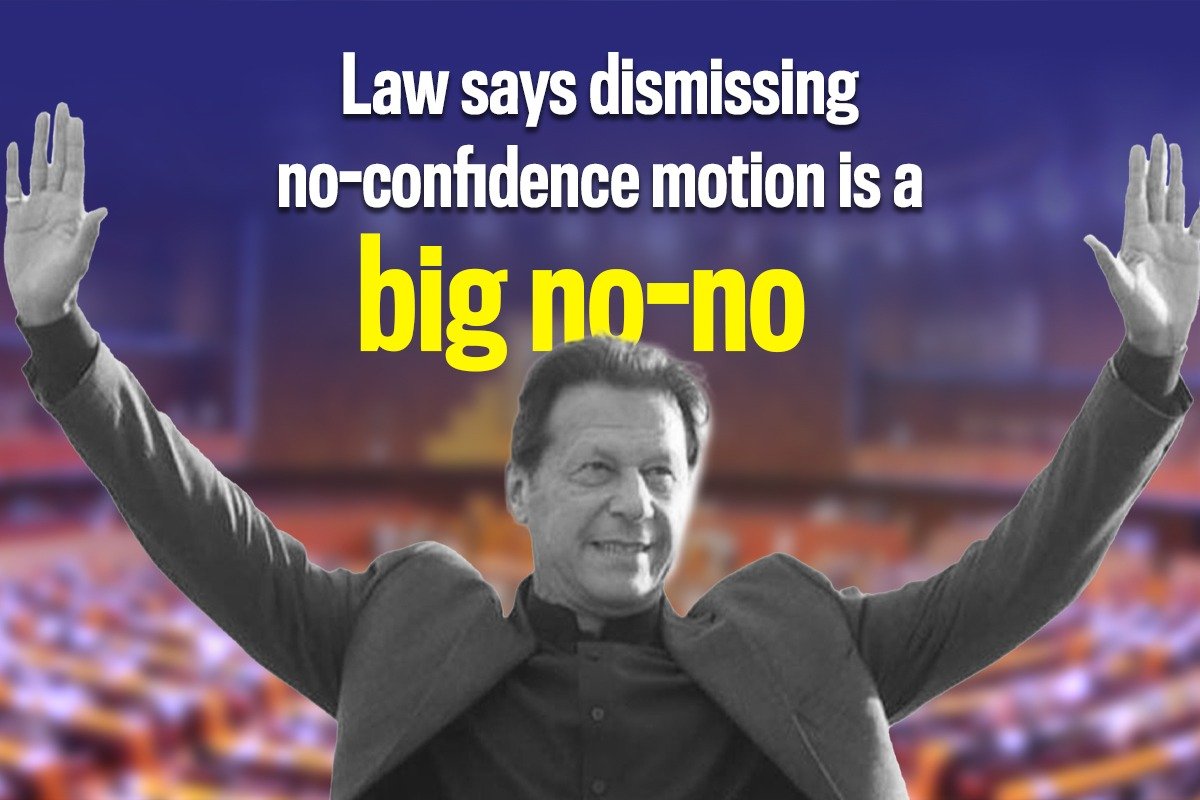
  • Explainer: Law says dismissing no-confidence motion is a big no-no

    Explainer: Law says dismissing no-confidence motion is a big no-no

    Pakistan is in a state of political chaos as the no-confidence motion against Prime Minister (PM) Imran Khan was dismissed abruptly on Sunday. The move came after National Assembly (NA) Deputy Speaker Qasim Suri termed it “unconstitutional”, saying that it was backed by “foreign powers”.

    Suri then quickly disallowed voting on the no-confidence motion and adjourned the session. Later, on PM Khan’s advice, President Arif Alvi dissolved the National Assembly, with the premier asking the nation to get ready for fresh polls.

    After the nation was left in shock, there was much talk about the “unconstitutional trump card” used by PM Khan.What everyone wants to know is: did Khan subvert the constitution of Pakistan?

    Lawyer Salaar Khan tweeted a brief comprehension of the constitutional premise of what happened on Sunday, April 3, which went viral on Twitter.

    “Instead of allowing the vote to proceed against the Prime Minister, the Deputy Speaker dismissed the resolution. After this, the President was able to dissolve the National Assembly on the PM’s advice,” tweeted Salaar.

    “Under Article 58 of the Constitution, the President may dissolve the National Assembly on the PM’s advice. However, a PM against whom a vote of no confidence ‘has not been voted upon’ cannot ask the President to dissolve the house,” wrote Salaar.

    “To get around this, the Deputy Speaker first ‘dismissed’ the no-confidence resolution submitted against the PM. He did this on the basis of a personal interpretation of Article 5, which provides for loyalty to the state.”

    “The rather feeble argument here was that because the letter that Pakistan had received from the US suggested a regime change would improve relations, the vote of the no-confidence motion, itself, was against anti-state,” said the lawyer.

    “The irony, of course, is that Article 5 also provides for obedience to the Constitution – which was arguably violated in the process of the dismissal of the no-confidence motion.”

    “Procedurally, a ‘motion’ for no-confidence is first moved and, if leave is granted, it becomes a ‘resolution’. Under the Rules of Business in the National Assembly, there is no provision that actually allows a Speaker or Deputy Speaker to dismiss a resolution.”

    “In fact, the role of the Speaker is very clearly defined in Schedule 2 of the Rules of Business in the NA, and is essentially limited, in a VoNC, to announcing the result.”

    “And so, because the Speaker can’t dismiss a resolution for a VoNC, there is still a VoNC that has not been ‘voted upon’ by the Prime Minister. Consequently, the PM could not have advised that the assembly be dissolved under Article 58.”

    “In fact, in doing so, it may even be argued that he not only violated Article 5, by not obeying the Constitution but also subverted the Constitution under Article 6. It is, however, important to note that Article 6 is often used rather flippantly in common parlance.”

    “Finally, is the question of what the SC may do in all of this. One provision of the Constitution that has been mentioned a lot is Article 69, which bars courts from interfering in certain Parliamentary proceedings.”

    “However, the SC has laid out exceptions to this bar. Courts can interfere where there is not an ‘irregularity’ but a ‘patent illegality’, where there is clear mala fide, or where the matter in question affects the composition of the house, itself (such as in Farzand Ali).”

    “But while the SC may well find that it can interfere, how far it will go is another question. In theory, the SC could find the dissolution to be without legal effect and even order voting to resume on the VoNC. But given recent precedent, that may be a long shot.”

    The Supreme Court of Pakistan took suo moto notice of the Assembly proceedings on Sunday, April 3, and restrained the state institutions as well as the political parties from taking any unconstitutional acts and exploiting the situation.

  • MNA Ali Wazir granted bail ahead of no-confidence motion vote against PM Khan

    MNA Ali Wazir granted bail ahead of no-confidence motion vote against PM Khan

    Member of National Assembly (MNA) Ali Wazir from South Waziristan has been released from Karachi’s central prison on parole to participate in the no-trust vote against Prime Minister (PM) Imran Khan.

    Members of the Opposition had submitted a written request on March 25, asking the NA Speaker to issue the production order for every detained lawmaker — irrespective of their party affiliation — allowing them to exercise their right to vote.

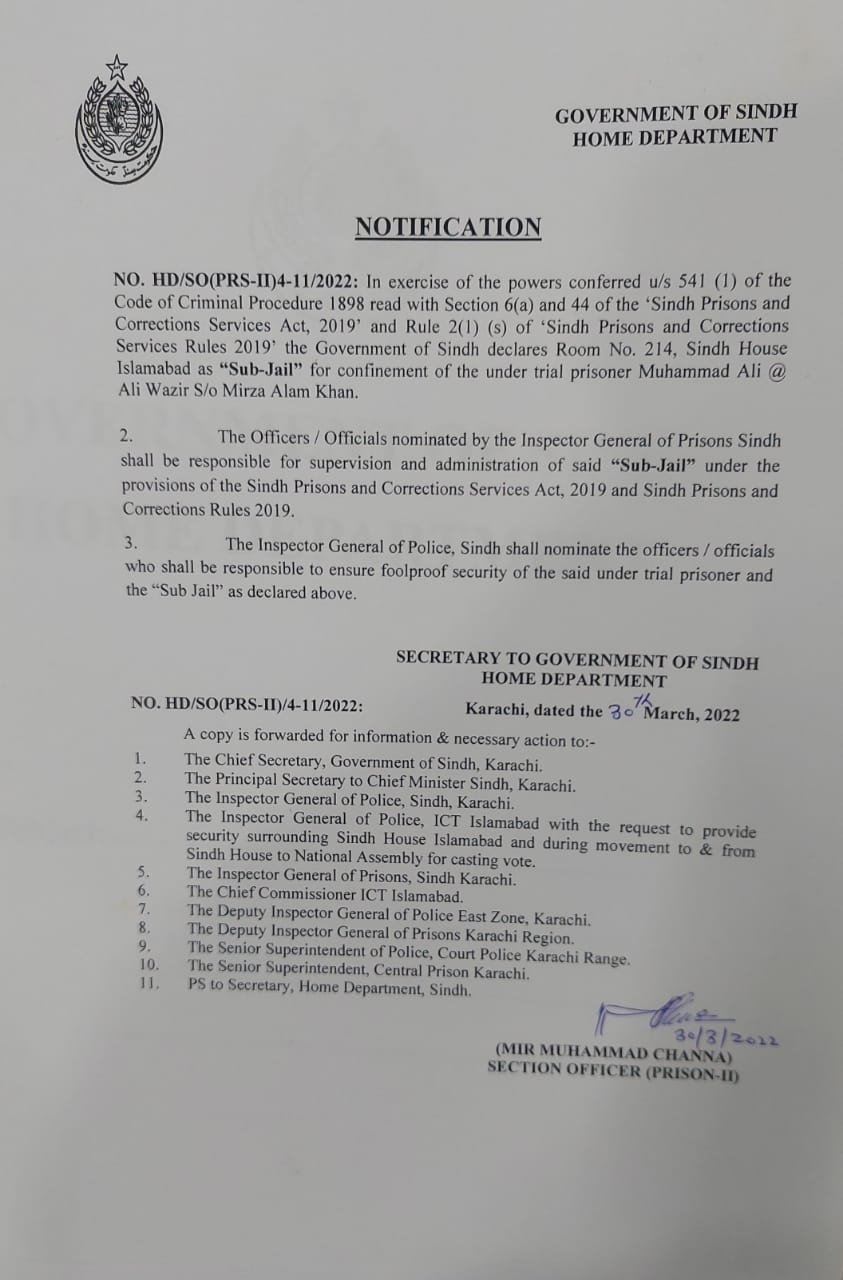
    Ali Wazir will be in Sindh House in Islamabad. A room in Sindh House has been declared as a sub-jail for Wazir.

    Pakistan People’s Party (PPP) MNA Jam Abdul Karim from Karachi has been granted protective bail against a surety bond of Rs100,000 by the Sindh High Court.

     The no-confidence motion against PM Khan will be discussed in the National Assembly during the Lower House session today (Thursday), scheduled to start at 4pm.

    The NA Secretariat issued the order of the day for today on Wednesday night, with a discussion on the no-trust move against the premier on the session’s agenda.

  • Bye Bye Buzdar?: No-trust motion submitted against Punjab CM Usman Buzdar

    Bye Bye Buzdar?: No-trust motion submitted against Punjab CM Usman Buzdar

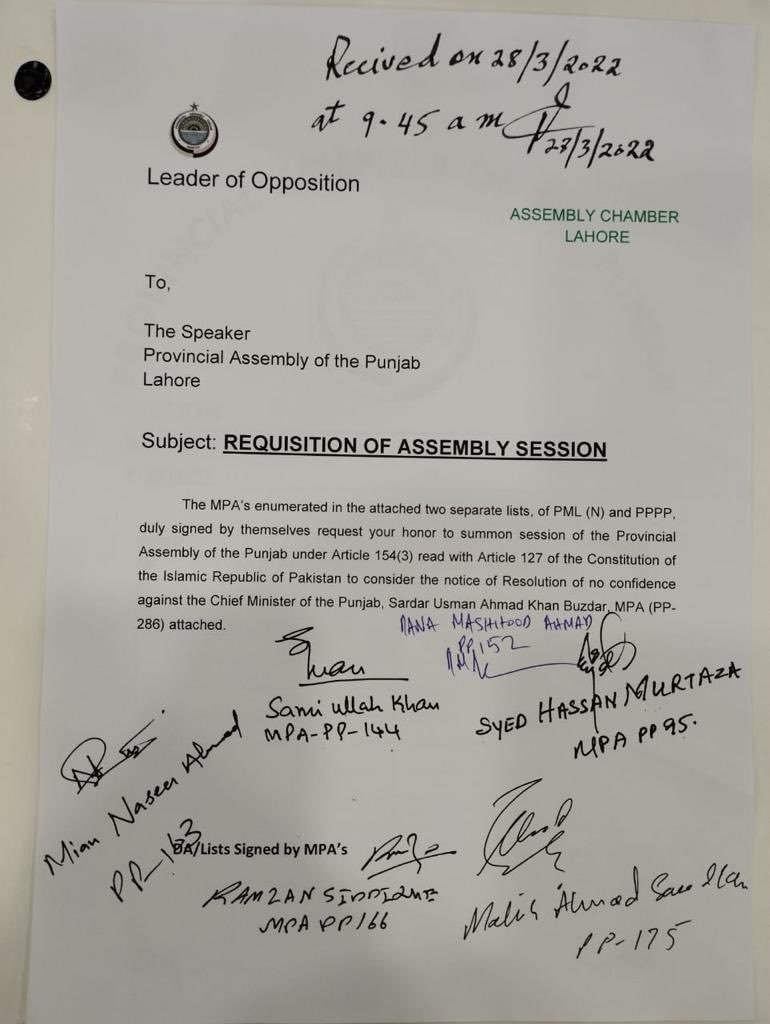
    The Opposition submitted a no-confidence motion against Chief Minister (CM) Punjab Usman Buzdar in the Punjab Assembly today (March 28).

    A total of 126 lawmakers from the Opposition parties have signed the no-confidence motion against Buzdar, said Pakistan Muslim League-Nawaz’s (PML-N) Rana Mashood, adding that 119 members signed the requisition for a session.

    Copy of the no-confidence motion against CM Buzdar

    The speaker is bound to summon a session within 14 days of the submission of the no-trust motion. CM Punjab can no longer dissolve the Assembly after the submission of a no-confidence motion against him.

    It is pertinent to mention here that on March 8, the Opposition submitted a no-trust motion against Prime Minister (PM) Imran Khan in National Assembly, which is likely to be tabled today in a crucial NA session.