The National Assembly (NA) on Monday passed seven bills, including one related to three recent amendments to the National Accountability Ordinance (NAO-1999) that gave extension in service to the incumbent NAB chairman, reports Dawn.
Among these bills was one related to the protection of journalists. The other five bills related to protection against harassment of women at workplaces, the National Commission on the Rights of Child, the juvenile justice system, and amendments to criminal laws.
Minister for Human Rights Dr Shireen Mazari took to Twitter and announced the passing of the bills.
Finally today NA passed our Journalist Protection Bill plus 5 other HR bills incl criminalizing Enforced Disappearances with section 514:2, added by SC on Int, removed thru amendment by me in NA. Also r Bill expanding def of harassment of women at workplace thru amend passed.
The bills presented by Mazari were Protection of Journalists and Media Professionals Bill 2021, Protection against Harassment of Women at Workplaces Bill 2021, National Commission on the Rights of Child (Amendment) Bill 2021, Juvenile Justice System (Amendment) Bill 2021, and Islamabad Capital Territory Child Protection (Amendment) Bill 2021.
The other two bills were Criminal Laws (Amendment) Bill 2021 and National Accountability (Amendment) Bill 2021.
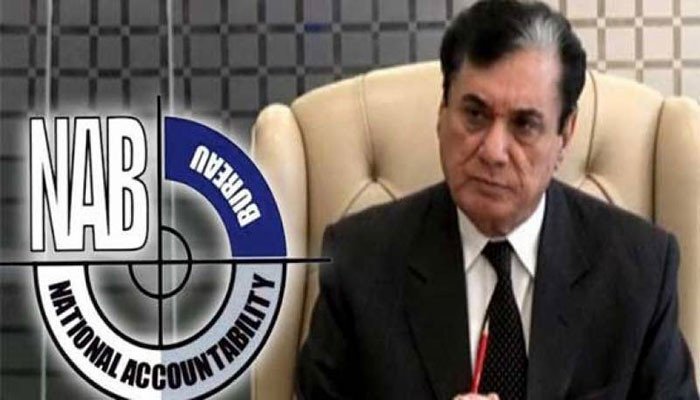
President Dr Arif Alvi on Wednesday signed an ordinance that sharply reduces the jurisdiction of the National Accountability Bureau (NAB) and enables the president to reappoint the incumbent NAB chairman or extend his tenure, reports Dawn.
Federal Law Minister Barrister Dr Farogh Naseem and Minister for Information and Broadcasting Chaudhry Fawad Hussain earlier held a press conference and explained that the law would enable NAB to focus on mega corruption cases.
The salient features of the ordinance, as reported by Dawn, are: the National Accountability Second Amendment Ordinance 2021 has amplified the Opposition’s role in the appointment of the NAB chairman.
“All matters pertaining to Federal, Provincial or Local taxation, other levies or imposts, including refunds, or loss of exchequer pertaining to taxation will be dealt with in accordance with the revenue or banking laws and will be transferred from the accountability courts to the courts of competent jurisdiction.”
“NAB cannot proceed against any person or entity who, or transaction in relation thereto, which are not directly or indirectly connected with the holder of a public office…procedural lapses in any public or governmental work, project or scheme, unless it is shown that a holder of public office or any other person has been conferred or has received any monetary or another material benefit from that particular public or governmental work.”
“The ordinance has amended Sub-section (b) of Section (6) of the National Accountability Ordinance (NAO) to grant extension in the tenure of the NAB chairman by excluding the word non-extendable from the statute.”
“However, it has retained the proviso that makes consultation between the Opposition leader and the leader of the house in the National Assembly on the appointment of NAB chairman but states that the president would consult both of them.”
“The ordinance has increased the role of the Opposition and enhanced the parliamentary oversight as it has provided a forum of a 12-member parliamentary committee in case the consultation between the Prime Minister and the Opposition leader proves futile.”
“The ordinance has enhanced the authority of prosecutor general of NAB empowering him to play a crucial role in advising the chairman to file or withdraw any reference from the court. It has also allowed the accountability court to grant bail to any accused.”
Former TV anchor Aamir Liaquat Husain has resigned from Pakistan Tehreek Insaf (PTI). “Resigned from the National Assembly. May Allah Almighty support Imran Khan and PTI. Good Bye,” Aamir said in a tweet.
قومی اسمبلی سے استعفی ارسال کردیا ہے اللہ تعالی عمران خان اور پی ٹی آئی کا حامی و نا صر ہو ۔ اللہ حافظ
Earlier, Aamir offered his resignation last year in July but Prime Minister Imran refused his resignation. He won on a PTI ticket from NA-245 in the 2018.
Aamir Liaquat has been criticised for being a controversial figure, especially while hosting Ramzan transmissions. This year, in January, Aamir made the news again for rumours surrounding his divorce with his second wife Syeda Tuba Aamir. Aamir denied the rumours but his wife Tuba has still not addressed the issue.
The Ministry of Information has decided to form a joint committee after consultations with representatives of all media institutions and organisations.
#BreakingNews وزارت اطلاعات نے تمام میڈیا اداروں اور تنظیموں کے نمائندوں کیساتھ طویل مشاورت کے بعد جوائنٹ کمیٹی تشکیل دینے کا فیصلہ، کمیٹی میڈیا ریگولیشن کے حوالے سے از سر نو جائزہ لے کر سفارشات پیش کرے گی۔ گویا مجوزہ ریگولیٹری اتھارٹی کا معاملہ فی الحال ٹل گیا۔۔
The committee will review the proposed media regulation and make recommendations. The Pakistan Media Development Authority (PMDA) has apparently been postponed for the time being.
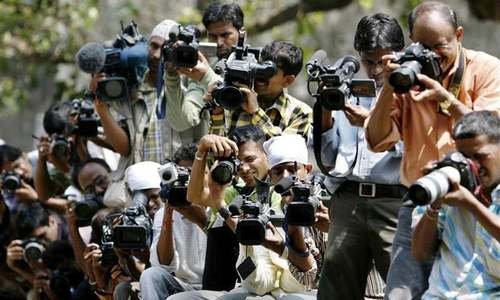
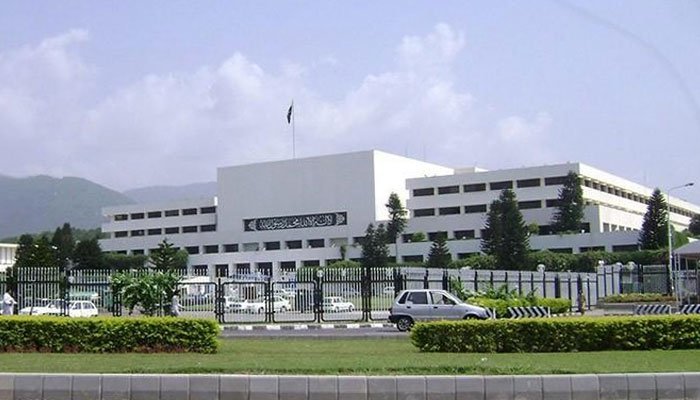
Journalists staged a protest in front of the Parliament House against the proposed PMDA, which aims to muzzle media freedom. The protest started on Sunday, September 12. Journalists marched from the National Press Club to the Parliament House and stayed overnight.
As journalists continued with sit-in outside of the Parliament House against the government’s proposed PMDA, prominent leaders from political parties, student unions, and members of the civil society also joined in to show solidarity.
In a first in Pakistan’s history, reporters were not allowed to enter a joint session of Parliament on Monday, September 13.
Parliamentary reporters were to be present in the press gallery for President Alvi’s address but entered the hallway to find that the door was locked. The press gallery was closed for the journalists.
The Parliamentary Reporters Association (PRA) strongly condemned the closure of the press gallery and said, “Closing the gallery is the worst dictatorship.”
The Speaker claimed that he made this decision after consulting the PRA.
“I couldn’t afford a fight between two groups in Parliament which could have resulted in the disrespect of media and the House,” Qaiser said adding, “however, there was some misunderstanding.”
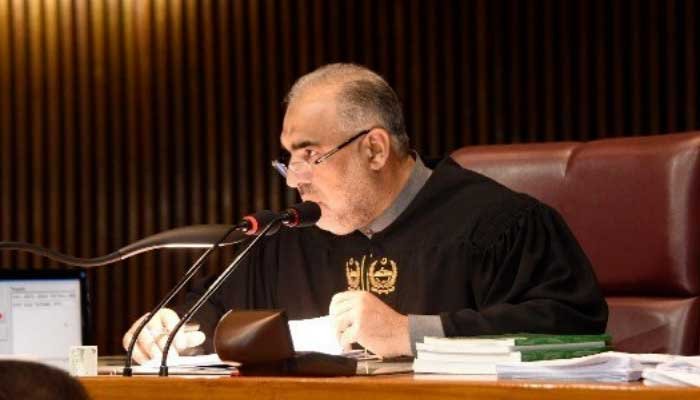
National Assembly Speaker Asad Qaiser said that he closed the doors of the press gallery during President Arif Alvi’s speech to a joint session of parliament after getting ‘reports’ that there was a possibility of a ruckus between two journalists’ groups.
The speaker while speaking to journalists, claimed that he made this decision after consulting the Parliamentary Reporters Association (PRA).
“I couldn’t afford a fight between two groups in Parliament which could have resulted in the disrespect of media and the House,” Qaiser said adding, “however, there was some misunderstanding.”
After Qaiser’s claims, the PRA categorically denied the speaker’s statement and challenged him to name the journalists who met him as PRA representatives, reported Dawn.
“PRA delegation has not met the Speaker National Assembly nor has the PRA been taken into confidence over the closure of the Press Gallery,” says the statement issued by PRA’s information secretary Malik Saeed Awan.
“PRA delegation has not met the Speaker National Assembly nor has the PRA been taken into confidence over the closure of the Press Gallery,” says the statement issued by PRA’s information secretary Malik Saeed Awan.
“PRA strongly condemns this black lie of the Speaker”. Awan demanded an inquiry to determine which delegation met with and misrepresented the journalist organisation.
In a first in Pakistan’s history, reporters were not allowed to enter a joint session of Parliament on Monday, September 13.
Parliamentary reporters were to be present in the press gallery for the president’s address but entered the hallway to find that the door was locked. The press gallery was closed for the journalists.
PRA strongly condemned the closure of the press gallery and said, “Closing the gallery is the worst dictatorship.”
Pakistani journalists protested in front of the Parliament House against the proposed Pakistan Media Development Authority (PMDA), which aims to muzzle media freedom. The protest started on Sunday, September 12, Journalists marched from the National Press Club to the Parliament House and stayed overnight.
The mystery shrouding the elusive proposed draft of the Pakistan Media Development Authority (PMDA) is quite intriguing. Some consultations have been held with journalists, civil society members, and parliamentarians but without a copy of the proposed draft. Members of the National Assembly (NA) Standing Committee on Information and Broadcasting on Thursday demanded that the draft be shared instead of verbal briefings by the Information Ministry. Chairman of the NA standing committee Mian Javed Latif then formed a sub-committee, which will be headed by Marriyum Aurangzeb with Nafisa Shah and Kanwal Shozab as its members. Let’s see if the proposed draft will now be shared with the sub-committee.
Last month, representatives of media organisations issued a joint statement that rejected the proposed media authority. They said that it was unconstitutional and deemed it as a draconian law. It seems that this is yet another tactic by the government to curb media freedom. Human Rights Watch (HRW) recently also issued a statement on the PMDA saying that the Pakistani government is “seeking broad new powers to control the media as part of its crackdown on freedom of expression. Journalists, human rights activists, and political leaders across that country have raised the alarm about proposed legislation that would bolster powers of the government to censor and restrict the media.” The government reacted to HRW’s statement by issuing a rejoinder through the Pakistan Embassy in the US challenging the human rights organisation’s assertions on PMDA. Patricia Gossman, HRW’s associate director for the Asia division, asked for a draft, which has so far not been shared with anyone.
It is quite worrying that in a country where media freedom is already quite curtailed, where interviews have been stopped from going on air or stopped mid-way, where anchors have been taken off-air, where there are now so many red lines that media organisations have to tread very carefully, where attacks on journalists have become frequent and culprits are still at large, where online trolling of journalists has become a norm, where the government issues reports of social media trends and hashtags it deems anti-state, where government officials keep on targeting journalists and media organisations without any shred of evidence, a new media authority with immense powers is being proposed without sharing the details of the proposed law and/or taking the main stakeholders on board.
We hope that the government will share the proposed draft with all stakeholders so that the mystery shrouding this media authority ends once and for all. There is already a lot of mistrust between the government and the media. We hope the government will listen to the legitimate concerns of media organisations and not dismiss them. A free and independent media is essential for any democracy. Pakistan is a democracy and we hope the government will not undermine it in any way.
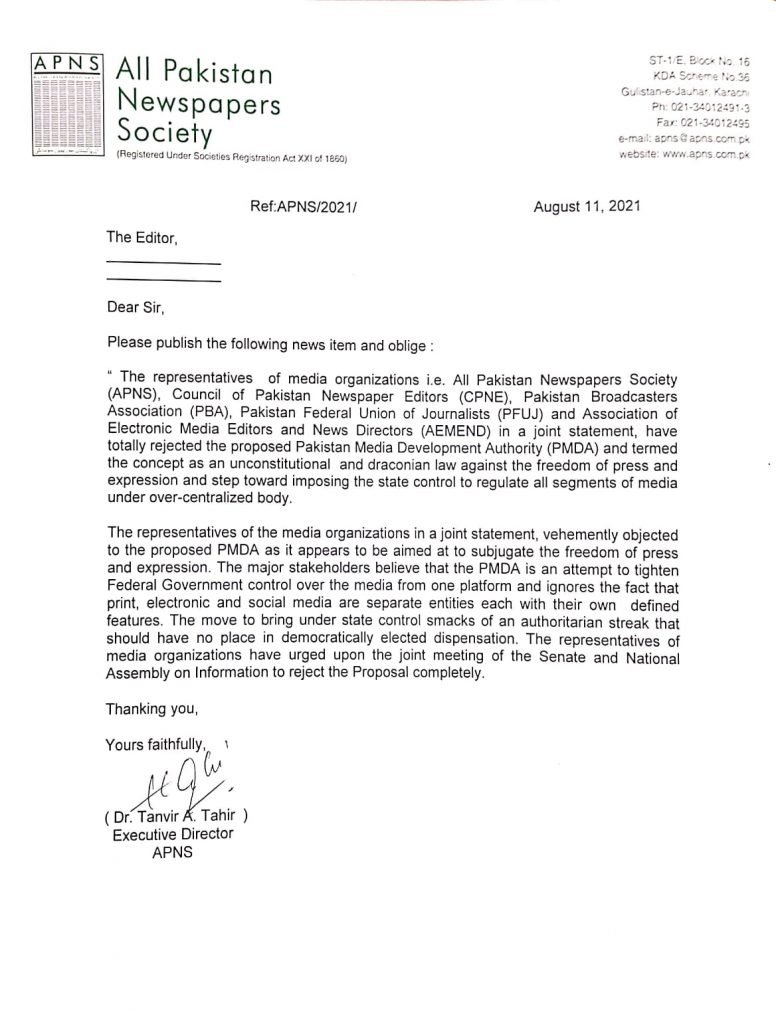
The representatives of media organisations have rejected the proposed Pakistan Media Development Authority (PMDA) and termed the concept as an unconstitutional and draconian law against the freedom of press and expression and a step toward imposing state control to regulate all segments of media under over-centralised body.
The major stakeholders believe that the proposed PMDA is an attempt to tighten the government’s control over the media from one platform and ignores the fact that print, electronic and social media are separate entities, each with their own defined features.
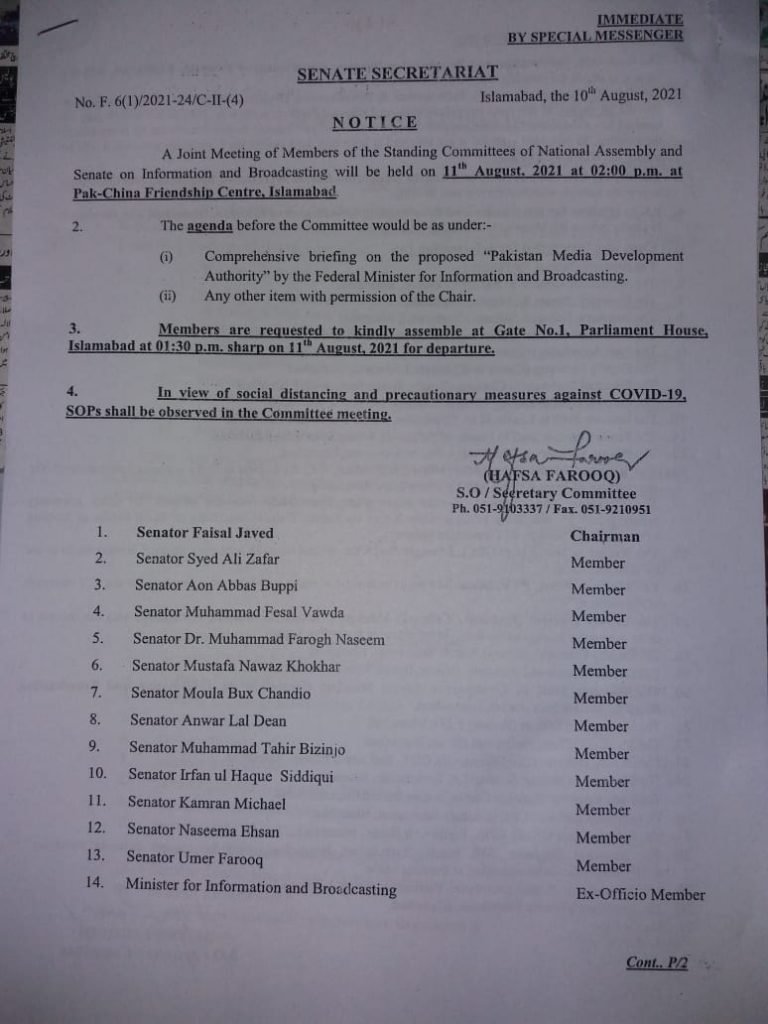
A joint meeting of the members of the Standing Committee of National Assembly and Senate on Information and Broadcasting was held on August 11.
Talking to The Current, Senator Mustafa Nawaz Khokhar said that a joint meeting of the Standing Committees on Information of both Houses — Senate and National Assembly— had been called by the Information Ministry to discuss the proposed media authority bill.
“PML-N had boycotted the meeting as it was being held at the Information Ministry instead of Parliament House. When I went to the meeting, I raised some legal and constitutional points regarding the meeting,” said Khokhar.
“I asked the government for signed permission by Chairman Senate and Speaker National Assembly as it is required by law if such meetings are called outside parliament. The government could only produce a permission letter from Chairman Senate but not Speaker National Assembly. So I raised the point that this meeting is illegal,” said Khokhar.
“I also pointed out that since Mian Javed Latif, who is the chair of the NA Standing Committee on Information, is not present due to PML-N’s boycott, the NA Standing Committee cannot be part of this meeting. I was overruled by the government. Thus, the PPP also decided to boycott the briefing,” added Senator Khokhar.
The agenda before the Committee was one of a comprehensive briefing on the proposed PMDA by the Federal Minister for Information and Broadcasting Fawad Chaudhry.
As per the last known draft, the PDMA has been described in the Ordinance as “an independent, efficient, effective and transparent” Authority, which will regulate all forms of media, including digital media.
Under the Ordinance, print and digital media will also need a license to establish and operate in the country.
The draft describes digital media as online newspapers, web TV channels, OTT content platforms, online news channels, video logs, and YouTube channels, Netflix, Amazon Prime.
As per the drafted Ordinance, the government could issue directives to the Authority on matters of policy, and such directives will be binding on the Authority.
For a media organisation to operate in the country, it will be required to not broadcast, distribute or make available online any programme inciting violence or hatred or any action prejudicial to maintenance of law and order or content which defames or brings into ridicule the Head of State, or members of the armed forces, or legislative or judicial organs of the state or is obscene or vulgar.
As per the draft, the president will set up media tribunals. An aggrieved person can file an appeal with the media tribunal within 30 days. Only the Supreme Court will have jurisdiction to question the legality of a decision taken by the media tribunals.
A female member of the National Assembly was bitten by a rat at the Parliament Lodges, ARY News reported.
National Assembly member from the Pakistan People’s Party, Shahida Rahmani, was reportedly bitten by a rat.
Shahida Rahmani said that she was sleeping when the rat bit her. She has gotten an injection after the rat bite.
After Shahida Rahmani informed the authorities about the incident, the Deputy Speaker of the National Assembly said that he would ask the CDA to ensure better arrangements.
The Parliamentary Committee on Legislative Business witnessed objections over a clause of the Electoral Reforms Bill, which calls for disclosing the number of wives with parliamentarians saying they will take it up in the relevant Senate Committee for necessary amendments, reports The Express Tribune.
Federal Minister for Planning and Development Asad Umar, who was part of the parliamentary meeting, questioned: “We are asked how many wives you have. What is this? What have wives got to do with this?”
Pakistan Muslim League-Nawaz’s (PML-N) Shahid Khaqan Abbasi, Ayaz Sadiq, and Pakistan People’s Party’s (PPP) Naveed Qamar, too, raised questions over the Electoral Reforms Bill.
Naveed Qamar said that the PPP was the most affected by the wives’ clause.
A committee had been set up by Deputy Speaker National Assembly Qasim Suri to approve the bills. A no-confidence motion against the deputy speaker was moved by the Opposition after which Speaker National Assembly Asad Qaiser formed a committee to review the bills.
Ayaz Sadiq said that if the House is to be run, the bills should be brought to the committee. “We should create terms of reference, important legislation should be made in this committee. If the minister or member has introduced the bill, he can withdraw it in the House.”
Abbasi said, “Twenty-one days have passed and according to the law, we cannot change it.”
“A meeting of the National Security Committee will be held today (Thursday). Army chief and heads of security institutions will participate in the meeting. A briefing on Kashmir, Afghanistan and internal security challenges will be discussed,” Minister for Information and Broadcasting Fawad Chaudhry tweeted on Thursday.
آج قومی دفاعی کمیٹی میٹنگ کا اجلاس ہو گا آرمی چیف اور سیکیورٹی اداروں کے سربراھان شرکت کریں گے، کشمیر، افغانستان اور اندرونی سیکیورٹی چیلنجز پر بریفنگ دی جائیگی۔
Speaker National Assembly (NA) Asad Qaiser had summoned a session of the Parliamentary Committee on National Security on July 1 for an in-camera briefing on the latest regional situation in light of the US withdrawal from Afghanistan. Director-General of the Inter-Services Intelligence (ISI) Lieutenant General Faiz Hameed will brief the lawmakers.
Leader of the Opposition in NA Shehbaz Sharif, Leader of the Opposition in the Senate Yousaf Raza Gillani, Pakistan People’s Party Chairman Bilawal Bhutto-Zardari, and other lawmakers will attend the meeting. According to reports, Interior Minister Sheikh Rasheed, Foreign Minister Shah Mahmood Qureshi, and Defence Minister Pervez Khattak will also be part of the in-camera meeting from the government’s side. Senate Chairman Sadiq Sanjrani will also attend the meeting as well as other parliamentarians.
Prime Minister Imran Khan will not attend the briefing.
Interior Minister Sheikh Rasheed said that Pakistan’s politics will change after today’s in-camera briefing on the situation in Afghanistan and other security issues. He said it will now centre on national security.