Tag: National Electric Power Regulatory Authority

  • NEPRA wants fixed charges on electricity bills from July

    NEPRA wants fixed charges on electricity bills from July

    The National Electric Power Regulatory Authority (NEPRA) has decided to impose a new electricity tariff by imposing monthly fixed charges for residential consumers from July 1, ARY News reported.

    NEPRA has proposed fixed charges of Rs200-1,000 a month in electricity bills, which the government has yet to approve.

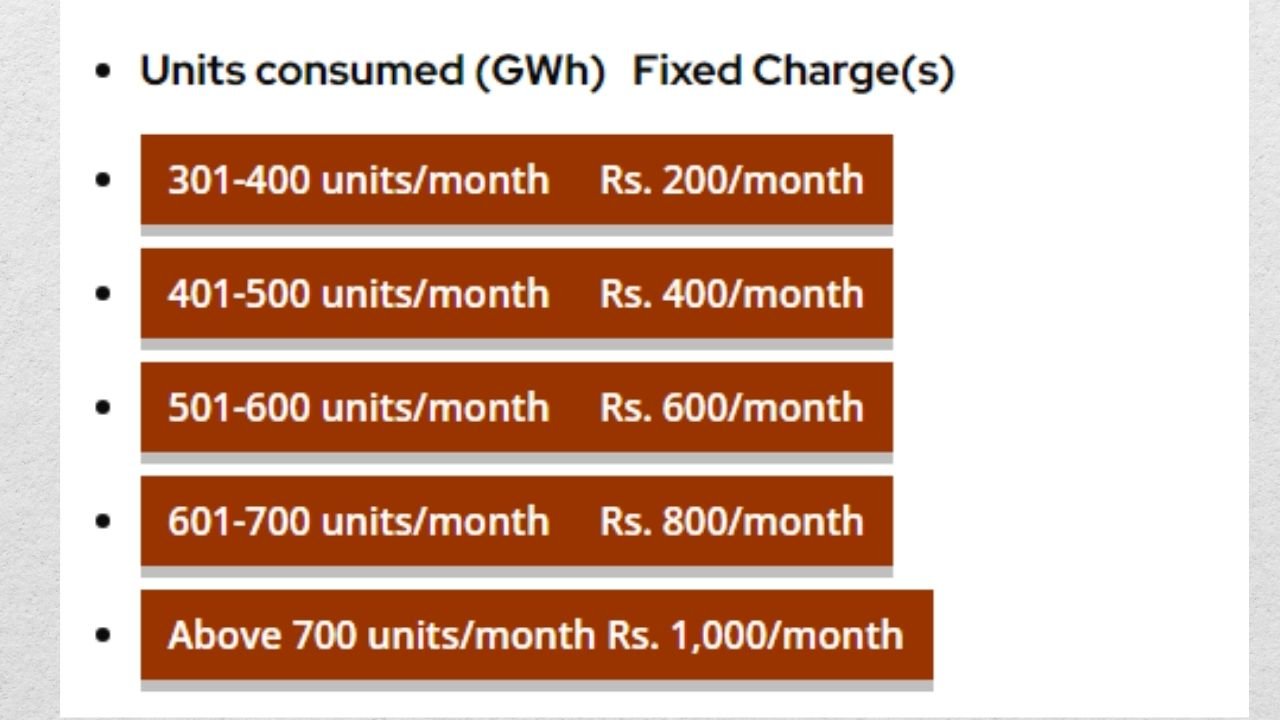
    As per the proposal, domestic consumers using 301-400 units a month will pay Rs 200 per month from July 1, 2024, while those using 401-500 units will pay Rs400, and end electricity consumers consuming 501-600 are to pay Rs600.

    The residential consumers who use the 601-700 units will pay Rs800 a month, and those who use above 700 units will pay Rs1,000 a month.

    Residential consumers using the ToU (time of use) meter will also pay Rs1,000 fixed charges a month.

    Commercial consumers having load less than five kilowatt will also pay Rs1,000 a month as fixed charges. However, users consuming loads of five kilowatt and above will now pay Rs. 2,000 from the existing Rs500, an increase of 300 percent.

    Currently, the total cost of electricity unit comprises 72 percent fixed charges and 28 percent variable charges, according to ARY News.

    After Budget 2024-25, the federal government added Rs. 5.72 per unit in power tariff.

    NEPRA had already announced that the average electricity tariff would rise to Rs. 35.50 per unit from the current Rs. 29.78.

  • PKR to USD: Pakistani rupee drops to Rs288.52 against US dollar

    PKR to USD: Pakistani rupee drops to Rs288.52 against US dollar

    The Pakistani rupee continued its downward trend for the eighth consecutive session, experiencing a depreciation of 0.21 per cent against the US dollar on Tuesday. According to the State Bank of Pakistan (SBP), the rupee closed at Rs288.52, marking a decrease of Re0.6.

    Over the past eight trading sessions, the currency has lost nearly 4.2 per cent or Rs12.02 against the US dollar. On the previous day, Monday, the rupee also suffered losses against the US dollar for the seventh successive session, depreciating 0.39 per cent and settling at 287.92 in the inter-bank market.

    In a significant development, the National Electric Power Regulatory Authority (NEPRA) approved an increase in the basic electricity tariff by Rs7.5 per unit from July 1, 2023, across the country. The chairman’s remarks indicated that this decision was influenced by the election year, and political choices were being made to alleviate the burden on 68 per cent protected consumers.

    On the international front, the US dollar gained strength ahead of three major central bank meetings scheduled for the week. Meanwhile, the euro faced challenges, hitting a two-week low on Tuesday due to a deteriorating economic situation in the eurozone, which complicated the bloc’s interest rate outlook despite the European Central Bank’s (ECB) hawkish stance.

  • Govt gives nod to massive power tariff hike to meet IMF demands

    Govt gives nod to massive power tariff hike to meet IMF demands

    In a recent late-night development, the federal cabinet of Pakistan has given its approval for a significant increase in the electricity base tariff. This decision comes as part of the country’s efforts to meet the conditions set by the International Monetary Fund (IMF).

    According to the information provided by insiders, the federal government has decided to raise the basic power tariff for various consumer categories, with the increase ranging from Rs3 to Rs7.5 per unit.

    The National Electric Power Regulatory Authority (Nepra) played a pivotal role in this decision, as the cabinet approved the tariff hike based on Nepra’s recommendation.

    For non-protected residential consumers who use 1 to 100 units, the proposed increase is Rs3 per unit, which will elevate the current cost from Rs13.48 per unit to Rs16.48 per unit.

    Similarly, residential consumers using above 700 units might see a significant increase of Rs7.5 per unit, raising the existing rate from Rs35.22 per unit to Rs42.72 per unit.

    The government has now referred the matter to Nepra, which will conduct a public hearing to gather input and make a final decision before releasing an official notification. If approved, the new tariff will take effect from July 1.

    It is noteworthy that Nepra had already granted the federal government an increase of Rs4.96 per unit in the base electricity tariff on July 14.

    This move aligns with Prime Minister Shehbaz Sharif’s commitment to IMF Managing Director Kristalina Georgieva, assuring full adherence to the agreement made with the global lender, leaving no room for any violation.

  • Govt implements Rs4.96 per unit power tariff hike, aims to collect Rs3.28 trillion from consumers

    Govt implements Rs4.96 per unit power tariff hike, aims to collect Rs3.28 trillion from consumers

    The National Electric Power Regulatory Authority (Nepra) announced a significant increase of Rs4.96 per unit in the electricity base tariff for the fiscal year 2024, in response to a demand from the International Monetary Fund (IMF). This adjustment will result in the government collecting Rs3.281 trillion from power consumers across all distribution companies.

    Additionally, the government is actively working on raising gas rates, as the Oil and Gas Regulatory Authority (OGRA) has already determined a 45-50 per cent increase in gas prices on June 2, 2023.

    The implementation of the power tariff hike is scheduled to commence on July 1, with the tariff rising to Rs29.78 per unit from the current rate of Rs24.82 per unit.

    Customers utilising time-of-use (ToU) meters will be charged up to Rs49.35 per unit. During peak hours from 5pm to 11pm, they will pay Rs49.35 per unit, while during non-peak hours, the charge will be Rs33.03 per unit.

    This decision has imposed an additional burden on the residents of Karachi, as Nepra has also raised the monthly fuel charges adjustment for the month of May by Rs1.44 per unit, which will be reflected in the billing for July.

    However, the increase in the base tariff will be implemented differently for various categories. Some categories will experience a lower increase, while for others, the increase may reach up to Rs6 per unit, depending on the government’s decision.

    The power regulator has determined an average increase in the base tariff of Rs4.96 per unit. Apart from the new base tariff of Rs29.78 per unit, end consumers will also be required to pay a financing cost surcharge of Rs3.23 per unit from July 1.

    This surcharge aims to generate Rs335 billion to address the power sector’s debt and liabilities, which currently amount to Rs2.6 trillion. Furthermore, consumers will continue to pay the Tariff Rationalisation Surcharge of Rs0.47 per unit.

    Within the base tariff increase of Rs4.96 per unit, the payment for capacity charges has risen to 70 per cent, equivalent to Rs3.472 per unit, while 30 per cent accounts for energy prices.

    The new base tariff increase has been calculated considering a dollar value of Rs287, an inflation rate of 17 per cent, and a 7 per cent growth in electricity generation. As a result, consumers will pay capacity charges totaling Rs1.874 trillion, compared to Rs1.251 trillion in 2022-23.

    Unfortunately, the end electricity consumer in Pakistan is being burdened with additional costs to compensate for ongoing inefficiencies in the power sector, in addition to paying for the actual cost of electricity. These costs include tariff rationalisation charges, financing cost surcharges, electricity duty, PTV license fee, GST, income tax, extra tax, further tax, and sales tax.

    In reality, consumers are paying 31 per cent above the actual cost of electricity in the form of surcharges, duties, and taxes. Electricity Duty, a provincial duty, is levied on all consumers, ranging from 1.0 per cent to 1.5 per cent of Variable Charges. General Sales Tax (GST) is charged at a rate of 17 per cent on all consumers under the Sale Tax Act 1990.

    Income Tax is applicable to non-taxpayer consumers at varying rates depending on the tariff and electricity bill amount, and commercial consumers pay 5 per cent on bills up to Rs20,000 and 7.5 per cent on bills exceeding Rs20,000. Further tax of 3 per cent is charged from all consumers without a Sales Tax Return Number (STRN), except for domestic, agriculture, bulk consumers, and street light connections.

    The increase in power tariffs was a necessary requirement imposed by the IMF to provide financial assistance to Pakistan. The IMF has consistently urged the government to raise tariffs and eliminate power subsidies as part of its efforts to reduce the country’s fiscal deficit.

    However, Nepra attributes the tariff increase to factors such as low sales growth, rupee devaluation, high inflation, exorbitant interest rates, and the addition of new capacities.