Tag: Naya Pakistan

  • ‘Set the record straight’: Jahangir Tareen responds to allegations of giving PM Khan pocket money

    ‘Set the record straight’: Jahangir Tareen responds to allegations of giving PM Khan pocket money

    Pakistan Tehreek-e-Insaf’s (PTI) disgruntled leader Jahangir Tareen, clears the air on the allegations levelled towards him of bearing the expenses for Bani Gala, the residential place of Prime Minister (PM) Imran Khan.

    Jahangir took to Twitter and wrote, “Regardless of the current status of my relationship with Imran Khan, the truth must be told. I did whatever was in my capacity to help PTI in the quest to build a new Pakistan.”

    “I never gave a penny for the household expenses of Bani Gala. Just want to set the record straight,” tweeted Jahangir.

    Earlier, former PTI leader, Justice (retd) Wajihuddin Ahmed, claimed that PM Khan’s monthly household expenses were once catered by Tareen.

    Wajihuddin revealed that Tareen initially gave funds worth Rs3 million per month for Imran Khan’s household expenses, which was later increased to Rs5 million per month.

    Speaking further about the honesty of the premier, Wajihuddin said that the notion about Imran Khan being an honest man is “completely wrong”.

    “This belief is entirely false that Imran Khan is a [financially] honest man,” Wajihuddin said. “His condition is such that he hasn’t been running his household himself for years.”

  • Pak embassy in Serbia tweets against PM Khan, say they have no other option

    Pak embassy in Serbia tweets against PM Khan, say they have no other option

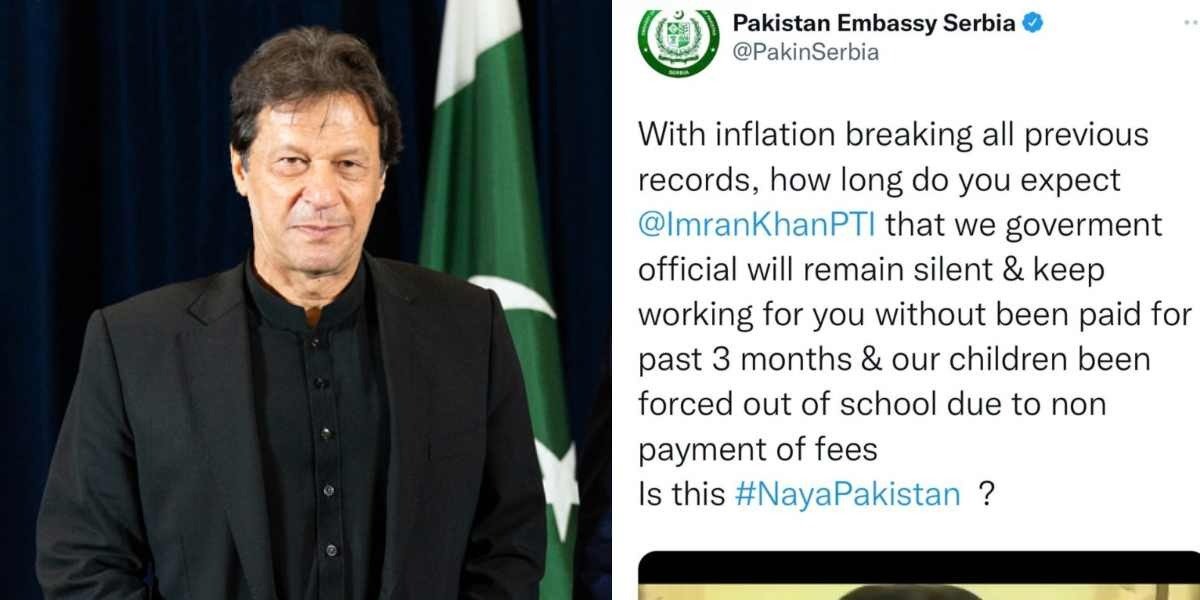
    With inflation crushing the economy of the country, the Pakistan embassy in Serbia tweeted a clip of Saad Alavi’s song, “Aap ne ghabrana nahi hai”.

    Taking to Twitter, the embassy’s official Twitter account tweeted, “With inflation breaking all previous records, how long do you expect @ImranKhanPTI that we government official will remain silent & keep working for you without been paid for past 3 months.”

    “Our children been forced out of school due to non-payment of fees Is this #NayaPakistan?” read the tweet.

    https://twitter.com/PakinSerbia/status/1466647603395928064

    Further stating their grievances with how the people are being treated, the embassy handle tweeted, “I am sorry @ImranKhanPTI, am not left with another option.”

    https://twitter.com/PakinSerbia/status/1466649039785668612

    However, Spokesperson Asim Iftikhar Ahmad for Foreign Affairs said that the “social media platforms have been hacked.”

  • Three-year report card: PTI’s quest to achieve Naya Pakistan

    Three-year report card: PTI’s quest to achieve Naya Pakistan

    As Pakistan Tehreek-e-Insaf (PTI) goes into its third year of being in power, it becomes imperative to review its scorecard and what they have accomplished so far.

    Prime Minister Imran Khan was voted into power based upon the idea of building a ‘Naya Pakistan’. The voters were inspired by a movement that calls for a more equitable approach to governance, particularly one built around the principles of Riyasat-e-Madina.

    Prior to being elected, PTI promised to carry out extensive reforms pertinent to the state’s welfare should they manage to establish a government.

    Governance:

    The PTI government struggled to define its vision and manifest it into an actionable policy based on clear ideas and directives. The party witnessed a continuous shuffle in its cabinet members and lawmakers, sometimes blaming these frequent reshuffles on lackluster performance and incompetence. Every reshuffle saw the party falling into instability which further weakened the overall party narrative of change and transparency.

    Despite having a majority, PTI failed to execute a much-needed face-lift at a provincial level. One of the ruling party’s promises before forming the government was to “spearhead the creation of a South Punjab province on administrative lines”, which is still a work in progress.

    “We want to make Karachi the urban jewel of Pakistan,” the PTI stated in its manifesto. But despite their promises, several projects have yet to be completed.

    PTI aimed to depoliticise the police by building upon Khyber Pakhtunkhwa’s successful police reform model, which was to be replicated nationally. In their own words, the PTI manifesto acknowledges that the police in Pakistan are ill-equipped, poorly trained, deeply politicised, and chronically corrupt. However, very little has been done to enforce the depoliticisation of law enforcement agencies in order to circumvent these deeply entrenched issues.

    Reforming the civil service through transparent and merit-based recruitment with regional representation was another one of the party’s ambitious objectives. Civil service reform also included performance-based promotions and compulsory training at all requisite levels, providing equal opportunities for career advancement. Work is still underway when it comes to reforming the civil service as well.

    Economy:

    Under PTI governance in its first year, the economic growth rate of the country was 5.5 percent, which proceeded to drop to 1.9 percent. During the party’s second year in power, the country witnessed negative growth due to Covid-19. Pakistan’s debt grew from Rs24 trillion to Rs38 trillion in three years.

    From a deficit of $8.56 billion in the calendar year 2019, the current account balance swung into a surplus of $245 million in 2020. But in the first three months of 2021 it swung back to a deficit of $274m, and then registered a further deficit of $188m in April and $632m in May.

    Health:

    A motion to change the name of Benazir Income Support Programme (BISP) faced resistance from the Opposition and was later abandoned. The party instead placed it under the umbrella of Ehsaas — the PTI’s flagship social safety programme.

    The World Bank has listed the Ehsaas Emergency Cash programme among the top four social protection interventions globally in terms of the number of people covered. The programme distributed cash among 15 million underprivileged families after they suffered financially due to Covid-19 related lockdowns.

    Prime Minister Imran Khan’s federal government expanded the Sehat Sahulat Programme on a nationwide scale.

    Over the past three years, the government has announced the extension of health care coverage to journalists, Islamabad police, the transgender community, overseas labourers, and people with disabilities.

    Covid-19:

    National Command and Operation Centre (NCOC) led by Federal Planning Minister Asad Umar did a commendable job combating the deadly virus. COVID-19 exposed the terrible state of the health sector but NCOC managed to prop up systems on a war-footing to cope with the emergency.

    Education:

    Prime Minister Imran Khan said that his focus will be centered on improving public sector education, including madrassas. He also discussed providing young persons with loans to cultivate and promote entrepreneurship.

    A uniform education system will be introduced in the country next year under the Prime Minister’s auspices. The Single National Curriculum (SNC) has been approved and made functional in the country for students from Grade 1 through 5. One system of Education for all, in terms of curriculum, medium of instruction, and a common platform of assessment so that all children have fair and equal opportunities when it comes to receiving a high-quality education.

    In May 2019, the Ministry for Federal Education started the registration process for madrassas in the country. In October of the same year, the Directorate General of Religious Education (DGRE) was set up.

    The party had promised to provide stipends for female secondary school students and to prioritize the upgrade and establishment of schools for girls.

    The Kamyab Jawan Programme (KJP) was launched in October 2019. It is a small-and-medium-enterprise lending scheme, aimed at stimulating job creation and economic empowerment for young persons.

    Furthermore, the Hunarmand Jawan programme is another PTI initiative that aims to promote economic emancipation amongst young people through high-quality training.

    Accountability:

    Prime Minister Imran Khan has been categorically saying that his government would not interfere with the process of accountability and that “every corrupt individual” would have to face justice irrespective of their status or party.

    The National Accountability Bureau (NAB) has seemingly been the most active throughout PTI’s tenure. The anti-graft body had recovered 484 billion PKR over a span of two years from 2018 to 2020. On the contrary, previous governments had managed to recover a mere 290 billion PKR from 1999 to 2017.

    However, the Supreme Court has criticised NAB for “selectively applying its law on individuals” and said that there is a widespread perception of the NAB laws “being employed as a tool for oppression and victimisation of political opponents by those in power”.

    Freedom of speech:

    The PTI government has been determined to control the media through new laws, which will eventually span electronic, print, and digital media platforms.

    Pakistan has recently been criticized both internally and externally for the issues surrounding freedom of speech within its borders.

    Pakistan ranks at 142 on the Reporters Without Borders (RSF) Press Freedom Index. According to the Pakistan Press Freedom Foundation’s report, Pakistan has witnessed the murders of 72 journalists since 2002. Most of these cases remain unsolved.

    Pakistan Media Development Authority (PMDA) has been described in the Ordinance as “an independent, efficient, effective and transparent authority, which will regulate all forms of media, including digital media”.

    Under the Ordinance, print and digital media organisations will also need a license to operate in the country.

    Media bodies and organisations have vehemently opposed the PMDA and criticised it.

    Electoral Reforms:

    PTI has worked towards electoral reforms with great vigor, stating that electronic voting is the only way to ensure transparency and prevent rigging.

    Electoral reforms, electronic voting, and the voting process for overseas Pakistanis have been major projects spearheaded by PTI. The party has successfully launched electronic voting to aid the process of having smooth and transparent elections.

    On June 10th, the National Assembly passed the Elections (Second Amendment) Bill which pertains to fair, free, and transparent elections through a more contemporary approach to technology.

    PTI sees overseas Pakistanis as an asset to the country and has worked to involve them in the election process.
  • PM likely to take your phone calls again on May 11

    Prime Minister Imran Khan is likely to restart his initiative of taking phone calls from the masses and giving them his response from May 11. The initiative is expected to restart when he returns from Saudi Arabia.

    Khan is scheduled to visit Saudi Arabia from May 7 to May 9. The issue of the release of Pakistani prisoners who are suffering in Saudi Arabia’s jails is likely to be highlighted by the PM.

    This is the third telethon series to be done by PM Khan. He launched the event on March 28, which was a telethon for the Naya Pakistan Housing Scheme and also took calls from the general public on April 4th.

    “It is the practical implementation of the promise made by the prime minister to the masses in his victory speech that he would be answerable before the people,” a PTI leader said.

  • No pension for new hirings at KP universities in ‘Naya Pakistan’: report

    In what appears to greatly contradict claims of the ruling Pakistan Tehreek-e-Insaf (PTI) for ‘Naya Pakistan [new Pakistan]’, Higher Education, Archives and Libraries Department of Khyber Pakhtunkhwa (KP) has issued a notification to the public sector universities directing it to implement “no pension liability” for all future initial recruitments in addition to other strict measures to overcome the rising deficit.

    According to a report by Express Tribune, the department has also directed delinking of the pay scales from the basic pay scale scheme and university pay scale, while further stating in a notification that government grant and other resources meant for higher education shall not be expended on meeting the shortfall of the schools run by the universities.

    “These schools should have separate Board of Governors (BoG),” it reportedly read.

    Furthermore, house subsidy and requisition should be paid to the employees on the provincial government rates.

    All medical allowances in their current form have been abolished and shall be paid at the provincial government rates, says the notification, adding that the maintenance cost including repair, security and other facilities’ costs should be fully recovered from the employees provided with accommodation by the universities.

    “The universities will be assisted in the process of exploring new avenues of financial resources, including renting out academic blocks to other institutions,” says the notification.

    The report also quoted a university official as saying that in the presence of the University Act 2012, amended in 2016, all the incentives provided to the employees by the universities had completely been protected and in the presence of an act, no notification could change it including abolishing of the pension, house rents and medical allowances.

  • Islamabad High Court requested to bar Imran from saying ‘Naya Pakistan’

    Islamabad High Court requested to bar Imran from saying ‘Naya Pakistan’

    A petition in the Islamabad High Court (IHC) has sought a ban on Prime Minister (PM) Imran Khan’s use of the term “Naya [new]” with Pakistan.

    “The word ‘Pakistan’ and the flag of Pakistan are protected by the constitution and any alteration to them is a clear violation of the same”, petitioner Tariq Asad, who is a lawyer of the Supreme Court (SC), has said seeking ban on what has become a trademark of the now ruling Pakistan Tehreek-e-Insaf (PTI).

    Members of the PTI, including Imran Khan, had widely used the term “Naya Pakistan” while seeking votes ahead of the 2013 and 2018 general elections, highlighting the party’s aim to revamp the system if handed reins of the country.

    According to Gulf News, the petitioner has maintained that the PM has frequently been referring to “Riasate Madina [State of Madina]” while sharing his vision of a welfare state that again is without context and in contrast to the unique history of Pakistan.

    Justice Amir Farooq of the IHC, in this regard, has issued notices and sought a reply from the respondents, including the Law Ministry secretary, principal secretary to the PM, information secretary and the chairperson of the Pakistan Electronic Media Regulatory Authority (PEMRA).

    Asad has maintained that PM Imran has disgraced the national integrity giving Pakistan a nickname as “Naya Pakistan”.

    “Imran Khan having altered and distorted the name of Pakistan as ‘Naya Pakistan’ is inter alia violation of Article 1 and Article 5 of the constitution and fundamental rights of the citizens of Pakistan guaranteed by Article 14 of the Constitution of Islamic Republic of Pakistan, 1973,” said the petitioner.

    The premier, as per the petition, has also made an insignia i.e. of a flag of Naya Pakistan Housing & Development Authority which is different from the national flag of Pakistan.

    The petitioner maintains that the new insignia of the Naya Pakistan Housing & Development Authority comprises green and red colours and there is no white colour that is a representation of minorities. Speaking to Gulf News, Advocate Asad said that by omitting the white colour from the housing authority’s insignia, the government authorities had implied the scheme was not meant for the non-Muslims.

    In his prayer, the petitioner has requested the court to restrain the government functionaries, including the members of parliament and cabinet as well as the PTI workers and opposition parties, from patching and using the word Naya with Pakistan or calling this state “Naya Pakistan”.

    The court has also been requested to issue orders to PEMRA to restrain television channels from airing the said word with Pakistan.

  • After hundreds of train accidents, casualties in two years, PM says ‘role of railways crucial for Naya Pakistan’

    After nearly 200 major and minor train accidents that have caused hundreds of casualties since the Pakistan Tehreek-e-Insaf (PTI) took reins of the country in 2018, Prime Minister (PM) Imran Khan has said that the role of Pakistan Railways is “crucial” in the journey to Naya Pakistan.

    Speaking at the inauguration of the Hassan Abdal Railway Station in Attock, the premier underlined that across the world, trains were a cheap and comfortable way to travel.

    “Railways are important because it’s a commute for the poor and common people of Pakistan,” he said.

    “Unfortunately, we did not develop the railway system provided by the British,” PM Imran said, adding that for the first time, the largest investment to Pakistan Railways was coming through the ML-1.

    ML-1 or Main Line 1 is one of the four main railway lines in Pakistan. The Karachi-Peshawar Railway Line begins from Karachi City station or Kiamari Station and ends at Peshawar Cantonment Station. The total length of this line is 1,687 kilometers with 184 railway stations.

    The line serves as the main passenger and freight line of the country as it is used by 75% of both sorts of rail traffic. It is currently undergoing a six-year Rs886.68 billion upgrade and renovation as part of the China-Pakistan Economic Corridor (CPEC) with average rail speeds expected to be doubled to 160 kilometers per hour upon completion.

    The premier said the journey from Karachi to Lahore through ML-1 would come down to seven hours, and the project “will be an important step towards self-reliance”.

    Railways would play an important role in Pakistan’s economic development, he remarked.

    RAILWAYS SINCE 2018:

    While the premier has highlighted the significance of railways for the materialisation of his dream of a new Pakistan, it merits a mention that a significant spike in train accidents over the past two years has further marred the department’s safety record.

    According to Dawn, over 100 train-related incidents, including some fatal accidents took place in 2019 besides 111 incidents of engine failure within the first five months of the year alone.

    These come on top of minor derailment incidents at least one of which is reported every week with the last reported three weeks ago near Ghotki in Sindh.

    Here’s a list of major untoward incidents involving trains since 2018…

    September 16, 2018:

    Nine bogies of the Peshawar-bound Khushal Khan Khattak Express from Karachi derailed near Attock. 20 passengers were injured.

    September 27, 2018:

    Another Peshawar-bound train derailed in which 11 bogies overturned in Sehwan, Sindh.

    December 18, 2018:

    At least 12 children were injured as a passenger train crashed into a school van near Narowal in Punjab. Local witnesses said the accident happened due to dense fog and because the gate at the crossing was left open.

    June 9, 2019:

    As many as 23 bogies of a Karachi-bound freight train derailed in Sukkur.

    June 20, 2019:

    Three people were killed when a passenger train collided with a stationary cargo train in Makli Shah near Hyderabad.

    July 11, 2019:

    A Quetta-bound train collided with a cargo train near Sadiqabad in Punjab, killing 24 people and injuring over 100 others. The accident was later found to be caused by a delay in switching the train tracks.

    October 31, 2019:

    Fire engulfed a train near Rahim Yar Khan in Punjab, killing 65 people. The cause of the incident was discovered to be a gas explosion. A canister had been carried by passengers to cook on the train amid the authorities’ failure to keep a check on the travellers’ luggage.

    February 28, 2020:

    At least 19 people were killed when a train collided with a passenger bus near Sindh’s Rohri.

    July 3, 2020:

    At least 20 people died and ten others were injured when Shah Hussain Express collided with a bus near Sachcha Sauda Railway Station in Sheikhupura. Most victims were members of the Pakistani Sikh community.

  • Funds worth Rs3 trillion misused in Naya Pakistan’s power division

    Funds worth Rs3 trillion misused in Naya Pakistan’s power division

    The Auditor General of Pakistan (AGP) has unearthed misappropriation of public funds worth around Rs3 trillion in the power division during the first year of the Pakistan Tehreek-e-Insaf (PTI) government.

    According to reports, the AGP has found huge irregularities, mismanagement, misappropriation and embezzlement, which it has highlighted in its report for the audit year 2019-20 that has been laid before the National Assembly after a delay of almost eight months.

    The AGP has also put question marks over sustainability of the power sector under the current state of affairs, governance shortcomings and weak financial and administrative controls.

    In particular, the country’s top auditor highlighted a total of 318 cases in the accounts of the power division and its associated entities in which Rs2.965tr worth of public funds had been misused. In its key findings, the AGP said 64 varied irregularities of more than Rs107 billion pertained to the procurement of electrical equipment, civil and electrical works, consultancy services and contractual mismanagement, Dawn reported.

    The AGP also highlighted recoveries of more than Rs2.5 trillion and pointed out 108 other cases of violation of internal rules and regulations of the audited entities involving Rs64 billion. In another 50 cases, violations of regulatory laws and regulations involving Rs184 billion were unearthed while a loss of more than Rs4 billion was reported due to fraud, embezzlement, misappropriation and theft in 21 cases.

    In four cases, irregularities of Rs1.2 billion were reported on account of the management of accounts with commercial banks and Rs263 million worth of 21 cases were highlighted pertaining to human resource regularities.

    On top of these major findings, the AGP also expressed dissatisfaction over the performance of power distribution companies (DISCOS) in reducing transmission and distribution (T&D) losses. It said the DISCOS suffered Rs240 billion losses on account of 18.3pc (at the rate of Rs13.06 per 1pc loss) T&D losses in FY2017-18, which increased to Rs276bn in 2018-19 on account of 17.7pc T&D loss at the rate of Rs15.18 per 1pc loss. This meant that even though a minor reduction of 0.6pc was achieved in technical loss that year, it was overturned by the tariff increase.

    Moreover, since the regulator had built the cost of 15.8pc losses to consumer tariff, the DISCOS still suffered losses worth Rs72 billion in these two years even after recovering the cost of such high losses from consumers.

    The audit noted that accounting of material was not being done by the field staff as per procedure and hence opportunities rose for leakage and loss. Many reports mentioned maintenance and monitoring of feeders which were not populated, resulting in poor management of feeder losses.

    Internal controls in the important areas of cash reconciliation and revenue collection were also found unsatisfactory and fraud in payment of pension in the DISCOS of Peshawar and Lahore and revenue fraud in the Islamabad Electric Supply Company (IESCO) were also highlighted. “Despite having an internal audit (in the power division), recurrence of frequent irregularities made its effectiveness questionable”, the AGP said.

    The Discos billed 93,887 million units to consumers in FY2018-19 worth Rs1.342tr and a recovery of Rs1.061tr was made, indicating a recovery rate of 79.06pc. The shortfall resulted in less receipt of recoveries by the DISCOS. “Revenue shortfall in the DISCOS showed managerial inefficiencies and policy bottlenecks constraining CPPA (Central Power Purchasing Agency) to pay-off its energy procurement liabilities”.

    The audit noted an improvement of one per cent in the revenue recovery in the previous fiscal 2017-18 but expressed concern that a recovery shortfall of 21pc posed significant operational challenges for the DISCOS, besides highlighting that total receivables from running and dead defaulters amounted to Rs572 billion in June 2019, which added to the financial crunch in the power sector.”

  • Naya Pakistan: Two years on, only one promise fulfilled, over 30 in progress, six in limbo

    Naya Pakistan: Two years on, only one promise fulfilled, over 30 in progress, six in limbo

    With two years passing since the oath-taking ceremony of Imran Khan as the country’s 22nd prime minister (PM), much has changed in line with his vision of formation of “Naya Pakistan”, his teammates say.

    Amid such claims by government members, Dawn has monitored progress on major promises from the ruling Pakistan Tehreek-e-Insaf’s (PTI) 2018 election manifesto, as well as any important pledges made in the course of its term.

    According to the report, while over 30 promises are reportedly in progress, six lie in limbo, only one has been fulfilled and five others are partially complete.

    As per details of the promises, that of tackling corruption has been completed by PM Imran’s team and those regarding affordable housing, facilitating overseas Pakistanis, minority rights, police reforms and crime control are partially complete.

    Another 37 promises are in progress whereas among those that lie in limbo are the ones pertaining to madrassah reforms, provision of housing units to persons with disabilities, strengthening of parliament, gender parity, elimination of water mafia and criminal justice reforms.

    Give PTI’s full manifesto a read here:

  • PTI’s Pakistan: ‘Govt to achieve Rs4,960 billion revenue target’

    PTI’s Pakistan: ‘Govt to achieve Rs4,960 billion revenue target’

    Federal Minister for Industries and Production Hammad Azhar has said that the government is confident of achieving the tax collection target of Rs4,960 billion set in the 2020-21 federal budget through Federal Board Revenue (FBR).

    Concluding discussion on the Finance Bill 2020-21 in the National Assembly, the minister on the floor of the House pointed out that the present government inherited a weak economy, but due to its concerted efforts, the government succeeded in stabilising it.

    He said that all the international financial institutions are praising Pakistan government’s performance on economic front.

    Hammad said that presenting a tax free budget while enhancing allocations for development shows the true leadership of Prime Minister Imran Khan. He said the government is trying to minimize the impact of Covid-19 on the economy by pursuing a prudent strategy.

    The minister categorically stated that the federal government has not withheld any funds of the provinces under the National Finance Commission (NFC). He said that the recommendations of the Senate for the Finance Bill 2020-21 would be given due consideration.

    Earlier, the National Assembly approved 96 demands for grants pertaining to different ministries, divisions and departments for the next fiscal year.

    Presented by Minister for Industries and Production Hammad Azhar, these demands were related to Climate Change, Commerce Division, Communications Division, Pakistan Post, Defense Division, Survey of Pakistan, Economic Affairs Division, Power Division, Petroleum Division,  Geological Survey of Pakistan, Foreign Affairs Division, Housing and Works Division, Human Rights Division, Information and Broadcasting Division, Information Technology and Telecommunication, Inter Provincial Coordination,  Kashmir Affairs and Gilgit-Baltistan Division,  Law and Justice Division, Federal Shariat Court, Council of Islamic Ideology, National Accountability Bureau, District Judiciary Islamabad Capital Territory, Maritime Affairs, Narcotics Control, National Assembly, The Senate, Overseas Pakistanis and Human Resource Development Division, Parliamentary Affairs Division, Planning Development and Special Initiatives Division, CPEC Authority, Privatization Division, Religious Affairs and Inter Faith Harmony Division, Science and Technology Division, States and Frontier Regions and Water Resources.

    No cut motions were moved on these demands for grants.