Tag: NEPRA

  • NEPRA approves Rs1.75 per unit tariff hike to recover Rs40 billion

    NEPRA approves Rs1.75 per unit tariff hike to recover Rs40 billion

    The National Electric Power Regulatory Authority (NEPRA) has approved an increase of Rs1.75 per unit in the electricity tariffs for distribution companies (Discos) and K-Electric (KE).

    This increase, aimed at recovering an additional Rs40 billion, will apply to the fourth quarter of FY2023-24 (April-June) under the Quarterly Tariff Adjustment (QTA) mechanism.

    The additional charges will be reflected in consumers’ electricity bills for September, October, and November 2024.

    However, due to the termination of a previous Rs0.93 per unit adjustment for the third quarter (January-March 2023-24), the net increase in bills during this period will effectively be Rs0.82 per unit.

    For KE customers, the federal government will cover the QTA increase through subsidies allocated for FY2024-25, meaning KE consumers will not directly bear this cost.

    In addition, NEPRA has approved a negative adjustment of Rs0.37 per unit under the Fuel Cost Adjustment (FCA) for Discos for the month of July 2024. This reduction will appear in September 2024 bills, except for domestic consumers using up to 300 units per month.

    According to Business Recorder, since an existing FCA charge of Rs2.56 per unit, applied in August 2024 bills, is set to expire, a combined relief of Rs2.93 per unit will be passed on to consumers in their September 2024 bills.

    According to NEPRA, when both adjustments are taken into account, consumers will experience a total relief of Rs2.11 per unit in their September bills.
  • Nepra approves up to 51% increase in electricity prices for residential consumers

    Nepra approves up to 51% increase in electricity prices for residential consumers

    The National Electric Power Regulatory Authority (Nepra) has approved a significant increase of up to 51 per cent in the base electricity rates for residential consumers. This adjustment is part of a new tariff schedule aimed at addressing rising energy costs.

    Under the revised rates, consumers using up to 200 units per month will see their tariffs remain unchanged until September 2024. However, from October 2024 onwards, substantial hikes will take effect, impacting millions of households across the country.

    For protected consumers using up to 100 units monthly, the tariff will rise from the current Rs7.74 to Rs11.69 per kilowatt-hour (kWh), representing a steep 51 per cent increase.

    Similarly, those consuming between 101 and 200 units will face a 41 per cent increase, with rates jumping from Rs10.06 to Rs14.16 per kWh. Notably, over 15.5 million consumers fall into this protected category.

    Non-protected consumers will also bear the brunt of these increases. For those using up to 100 units, the tariff will rise by 43 per cent, escalating from Rs16.48 to Rs23.59 per kWh. For consumption between 101 and 200 units, the rate will increase by 31 per cent, from Rs22.95 to Rs30.07 per kWh.

    For consumers exceeding 200 units, tariff increases will vary between 14 per cent and 26 per cent, effective from July 2024, with no additional changes expected for the rest of the fiscal year. Additionally, fixed charges ranging from Rs200 to Rs1,000 per kWh have been introduced for these categories.

    Nepra conducted a public hearing on 8 July to discuss government requests for an additional burden of over Rs700 billion to be passed on to electricity consumers through an average national tariff increase.

    In its final order, Nepra stated, “The authority has no objection in approving the motion along with the subsequent addendum of the federal government.”

    As a result of these changes, the average base electricity tariff will rise by Rs3.29 per unit, bringing it to Rs33.07—an 11 per cent increase compared to the fiscal year 2023-24. This decision marks a significant shift in the financial landscape for residential electricity consumers across Pakistan.

  • K-Electric seeks increase in base electricity tariff by Rs.10

    K-Electric seeks increase in base electricity tariff by Rs.10

    K-Electric has requested National Electric Power Regulatory Authority (NEPRA) to increase the base electricity tariff in Karachi by Rs 10, taking it from Rs 33 to Rs 44.

    The request is part of K-Electric’s comprehensive investment plan, which includes establishing fourteen new grid stations and laying 550 kilometers of transmission lines in Karachi over the next seven years, reports Samaa.

    An online public hearing on K-Electric’s application was conducted by Nepra on Thursday in which it was laid out that a $2 billion investment strategy for improving the city’s electricity transmission, distribution, and supply system.

    During the hearing, K-Electric’s Director of Communication, Imran Rana assured NEPRA that the increase in the base tariff would not impact Karachi’s electricity consumers due to the uniform electricity rate policy implemented across the country.

    K-Electric emphasised that approving this tariff is crucial for maintaining a stable electricity supply and demand balance in the city.

  • NEPRA wants fixed charges on electricity bills from July

    NEPRA wants fixed charges on electricity bills from July

    The National Electric Power Regulatory Authority (NEPRA) has decided to impose a new electricity tariff by imposing monthly fixed charges for residential consumers from July 1, ARY News reported.

    NEPRA has proposed fixed charges of Rs200-1,000 a month in electricity bills, which the government has yet to approve.

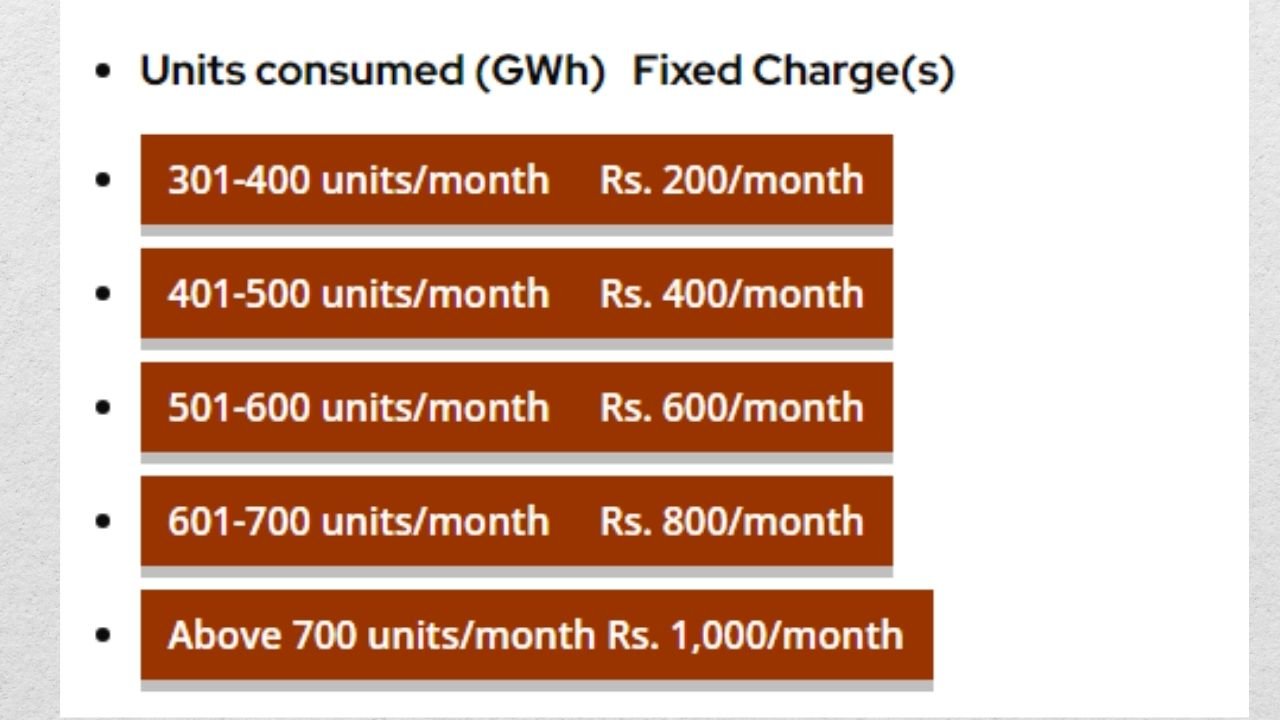
    As per the proposal, domestic consumers using 301-400 units a month will pay Rs 200 per month from July 1, 2024, while those using 401-500 units will pay Rs400, and end electricity consumers consuming 501-600 are to pay Rs600.

    The residential consumers who use the 601-700 units will pay Rs800 a month, and those who use above 700 units will pay Rs1,000 a month.

    Residential consumers using the ToU (time of use) meter will also pay Rs1,000 fixed charges a month.

    Commercial consumers having load less than five kilowatt will also pay Rs1,000 a month as fixed charges. However, users consuming loads of five kilowatt and above will now pay Rs. 2,000 from the existing Rs500, an increase of 300 percent.

    Currently, the total cost of electricity unit comprises 72 percent fixed charges and 28 percent variable charges, according to ARY News.

    After Budget 2024-25, the federal government added Rs. 5.72 per unit in power tariff.

    NEPRA had already announced that the average electricity tariff would rise to Rs. 35.50 per unit from the current Rs. 29.78.

  • NEPRA hikes basic electricity tariff by Rs5.72 to Rs35.50 per unit

    NEPRA hikes basic electricity tariff by Rs5.72 to Rs35.50 per unit

    The National Electric Power Regulatory Authority (NEPRA) has announced an increase in the basic electricity tariff by Rs5.72 per unit, effective from July 1, 2024. This hike will raise the current base tariff from Rs29.78 to Rs35.50 per unit.

    The capacity charges, which form a significant portion of the base price, amount to Rs18.10 per unit, constituting 51 per cent of the total cost. Consequently, the total capacity payment is projected to reach approximately Rs2.091 trillion for the fiscal year 2025.

    This proposal has been submitted to the federal government for final approval. The government will decide whether to implement the increase immediately or phase it in over time.

    It is important to note that in the current fiscal year (FY24), the electricity tariff was increased by Rs7.50 per unit, while in the previous fiscal year (FY23), the government implemented an increase of Rs7.91 per unit.

    In a contrasting move, Prime Minister Shehbaz Sharif announced on Friday a substantial reduction of Rs10.69 per unit in the electricity tariff for the industrial sector. This reduction is part of the Prime Minister’s historic power package aimed at bolstering the country’s industrial sector.

    Additionally, the petrol price has been reduced for the fourth consecutive time, decreasing by Rs10.20 to Rs258.16 per litre.

  • NEPRA announces tariff hike of Rs3.33 per unit for ex-Wapda distribution companies

    NEPRA announces tariff hike of Rs3.33 per unit for ex-Wapda distribution companies

    The National Electric Power Regulatory Authority (NEPRA) has sanctioned an increase of Rs3.3321 per kilowatt-hour (kWh) in the electricity tariff for ex-Wapda distribution companies (XWDISCOs), according to a notification issued on Thursday.

    This tariff adjustment is attributed to fluctuations in fuel charges for April 2024. The increased rate will be itemised separately on consumers’ bills based on the units consumed during that month.

    NEPRA clarified that the revised tariff will apply to all consumer categories except Electric Vehicle Charging Stations (EVCS) and lifeline consumers.

    Previously, the Central Power Purchasing Agency (CPPA), a subsidiary of the Power Division, had requested an additional Rs3.49 per unit to cover the higher fuel costs for April 2024.

    The CPPA-G reported that the actual pooled fuel cost for April 2024 was Rs8.9801/kWh, significantly higher than the reference fuel cost of Rs5.4918/kWh, resulting in a difference of Rs3.4883/kWh.

    “After incorporating the aforementioned adjustments, NEPRA reviewed and assessed a national average uniform increase of Rs3.3321/kWh in the applicable tariff for XWDISCOs on account of variations in the fuel charges for April 2024,” the notification stated.

    Consumers can expect to see this adjustment reflected in their upcoming bills as NEPRA continues to address the variations in fuel costs impacting the electricity sector.

  • K-Electric seeks Rs10.69 per unit hike in basic power tariff

    K-Electric seeks Rs10.69 per unit hike in basic power tariff

    K-Electric has proposed a substantial increase in its basic power tariff, seeking to raise the rate by Rs10.69 per unit to reach Rs44.69 per unit.

    This proposal has been made under the 7-year Multi-Year Tariff (MYT) framework.

    Currently, K-Electric’s average basic tariff stands at Rs34 per unit. The utility company has detailed its request, including specific components for the proposed increase. The Energy Purchase Price (EPP) component is to be set at Rs18.88 per unit.

    Additionally, transmission charges are projected to be Rs3.48 per unit, and distribution charges at Rs3.84 per unit. Operation and maintenance costs are requested to be Rs0.42 per unit, while the retail margin is sought to be Rs0.59 per unit.

    Furthermore, K-Electric has asked for the recovery of lost allocation at Rs2.88 per unit and working capital at Rs2.07 per unit.

    The National Electric Power Regulatory Authority (NEPRA) has invited stakeholders to submit their feedback on K-Electric’s request within the next seven days.

    A decision on the proposal is anticipated soon. If approved, the new tariff will impact millions of electricity consumers in Karachi and its surrounding areas.

    Last month, K-Electric submitted a request for a significant hike of Rs18.86 per unit in the power tariff. This adjustment was based on the Fuel Charge Adjustments (FCA) for seven months, submitted to NEPRA.

    Concurrently, K-Electric also requested a reduction in the power tariff by Rs0.29 per unit for a two-month period.

    In another development, the federal government has outlined a plan to privatise several profit-making power distribution companies (Discos). The companies slated for privatisation include Lahore Electric Supply Company (LESCO), Faisalabad Electric Supply Company (FESCO), Gujranwala Electric Power Company (GEPCO), Multan Electric Power Company (MEPCO), and Faisalabad Electric Supply Company (FESCO).

    These developments come at a critical time for Pakistan’s power sector, where tariff adjustments and privatisation efforts are expected to have significant implications for both the economy and consumers.

  • NEPRA approves power tariff increase of Rs2.8372 per unit

    NEPRA approves power tariff increase of Rs2.8372 per unit

    In a recent announcement, the National Electric Power Regulatory Authority (NEPRA) has approved a tariff increase of Rs2.8372 per kilowatt-hour (kWh) for all ex-Wapda distribution companies (XWDISCOs).

    This adjustment, reflected in a notification issued by NEPRA, is a result of fluctuations in fuel charges observed during March 2024.

    The tariff adjustment will be applied to consumer bills based on the units billed in March 2024. This increase will be listed separately in consumer billing statements to reflect the additional cost due to fuel charge variations.

    However, NEPRA clarified that this adjustment will not apply to certain categories of consumers, including Electric Vehicle Charging Stations (EVCS) and lifeline consumers, who benefit from lower electricity rates.

    This development follows a request made last month by the Central Power Purchasing Agency (CPPA), a subsidiary of the Power Division, which proposed an additional fuel charge of Rs2.94 per unit to cover the higher costs experienced in March 2024.

    The CPPA reported that the actual fuel cost for the month stood at Rs9.3819/kWh, significantly higher than the reference fuel cost component of Rs6.4417/kWh, leading to the proposed increase.

    After reviewing the CPPA’s request and the associated fuel cost variations, NEPRA concluded that an increase of Rs2.8372/kWh in the national average uniform tariff was justified.

    This adjustment is intended to balance the higher fuel costs incurred in March and ensure that the tariff structure remains aligned with the cost of energy production.

    Consumers are advised to review their electricity bills for March 2024 to understand how this adjustment will impact their total energy costs.

  • Nepra approves Rs7.056 per unit hike for power consumers

    Nepra approves Rs7.056 per unit hike for power consumers

    In a setback for the already burdened public grappling with inflation, the National Electric Power Regulatory Authority (Nepra) has greenlit a fuel cost adjustment, paving the way for a Rs7.0562 per unit increase in tariffs for March 2024.

    This decision grants state-run power distribution companies the authority to impose additional charges, projecting a staggering financial burden of around Rs56 billion on consumers.

    This figure could potentially soar to nearly Rs66 billion, taking into account the 18 per cent general sales tax (GST).

    It’s important to note that this tariff adjustment is applicable across all consumer categories, except for electric vehicle charging stations (EVCS) and lifeline consumers.

    The Central Power Purchasing Agency (CPPA), representing the distribution companies, had initially sought Rs7.13 per unit in its petition.

    Earlier this month, The News highlighted the plea from ex-Wapda distribution companies (XWDiscos) seeking Nepra’s approval for the Rs7.13 per unit increase.

    This was attributed to a significant drop in hydropower production and systemic constraints, such as the incapacity of the high-voltage direct current (HVDC) transmission line to efficiently transport economically viable power from southern producers to the north.

    Amidst these developments, commentators express concern over the substantial surge in fuel costs, reaching Rs14.6206/kWh for January 2024.

    In response, Nepra has taken decisive action, initiating an investigation under Section 27-A of the NEPRA Act to uncover the reasons behind this significant fuel cost, as claimed by CPPA-G for January 2024.

  • Economic challenges await next govt as Pakistan votes

    Economic challenges await next govt as Pakistan votes

    Pakistan is set to hold its national elections on Thursday, a crucial event for the country grappling with multiple crises.

    As the new government prepares to take charge, it faces daunting challenges in stabilising the economy.

    Last summer, Pakistan narrowly avoided a sovereign default through a last-minute $3 billion bailout from the International Monetary Fund (IMF).

    However, this lifeline is set to end in March, and officials anticipate the need for a new, extended programme.

    Negotiating this program swiftly is imperative for the incoming government, as the economy is burdened by record-high inflation and slow growth resulting from stringent reforms.

    The country’s headline inflation stood at 28.3 per cent year-on-year in January, slightly lower than December’s 29.7 per cent. Despite government expectations, citizens are anxious for the new administration to address the soaring inflation that has significantly impacted their daily lives.

    Moreover, recent increases in gas prices, with a 35.13 per cent hike for Sui Northern Gas Pipelines Limited (SNGPL) and 8.57 per cent for Sui Southern Gas Company Limited (SSGC), add to the economic challenges. The move, effective from January 1, 2024, is the second increase in gas prices this fiscal year.

    In addition to rising gas prices, the cost of petrol and diesel has surged, with a notable increase of Rs13.55 per litre announced on February 1, 2024. This hike is attributed to the ongoing tensions in the Middle East, including Israel’s conflict with Gaza and Houthi attacks in the Red Sea.

    Amid these economic hardships, the National Electric Power Regulatory Authority (NEPRA) has approved an increase in electricity tariffs for distribution companies (Discos) by Rs4.57 per unit for December 2023. This adjustment addresses the escalating fuel costs impacting the power sector.

    The new government is also expected to address the exchange rate concerns as the Pakistani rupee struggles against the US dollar, currently standing at around Rs279.

    The disparity has led to increased prices for essential commodities, further straining the population.

    Adding to the complexity of the upcoming elections is the high political tension, with former prime minister Imran Khan describing a crackdown on him and his party.

    Khan, who has been in jail since August, faces pending cases, including accusations of ordering violent attacks on military installations.

    Despite his imprisonment, Khan maintains substantial popular support, and continued political unrest could jeopardise the stability needed for economic recovery and foreign investment.

    As Pakistan stands at a critical juncture, the incoming government’s ability to navigate these challenges will determine the nation’s economic trajectory in the coming years.