Tag: Nestle

  • Food watchdog lodges complaint over Nestle mineral water ‘fraud’

    Food watchdog lodges complaint over Nestle mineral water ‘fraud’

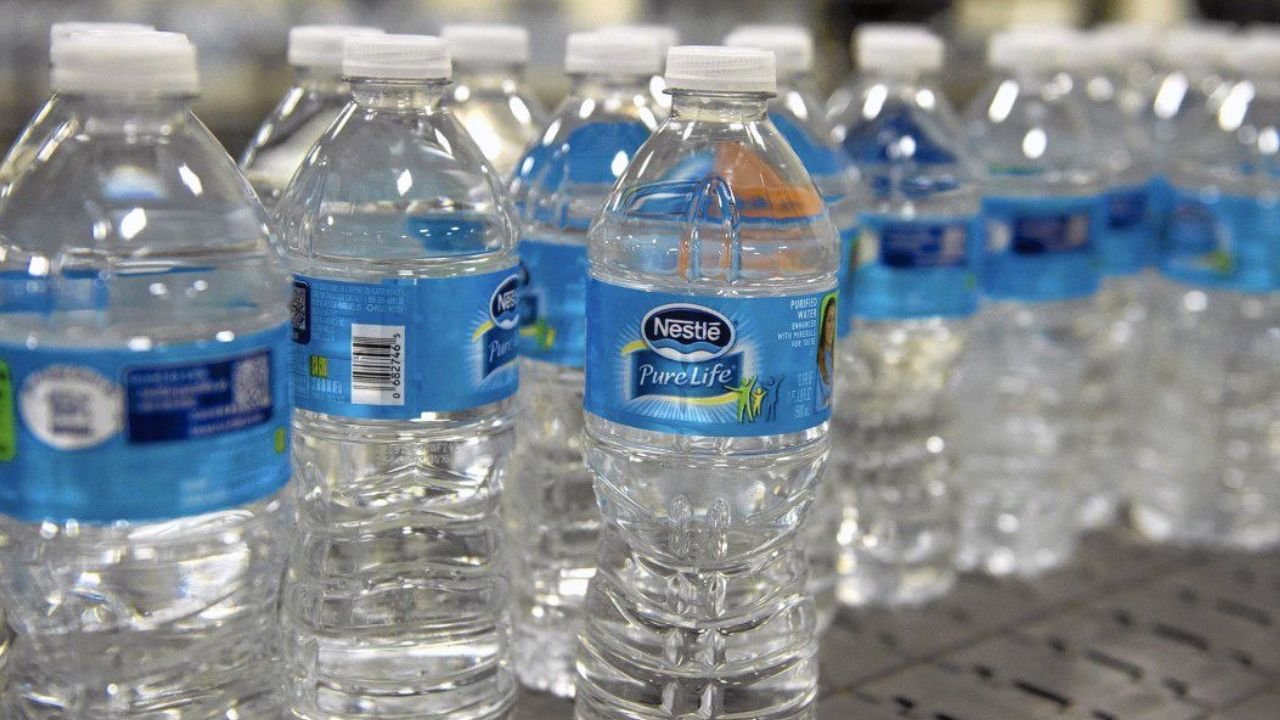
    Paris, France – Consumer watchdog Foodwatch said it was filing a legal complaint Wednesday against food giant Nestle and another group over them allegedly fraudulently treating water for their top mineral water brands.

    A government probe reported by media last month said about 30 percent of mineral water sold in France had undergone purification treatment only meant to be used on tap water.

    Foodwatch said it was lodging its complaint with a Paris court against Nestle Waters, behind brands such as Perrier and Vittel, and the Sources Alma group, which also owns several water labels.

    “This is a massive fraud for which Nestle Waters, the Sources Alma group and the French government must answer,” the European watchdog said.

    “Nobody, not even a multinational like Nestle, is above the law,” Foodwatch spokeswoman Ingrid Kragl said.

    The NGO claimed Nestle Waters and Sources Alma had “illegally processed their bottled waters and then sold them without informing consumers”.

    French law, based on a European Union directive, forbids such purification of mineral water, which is supposed to be of naturally high quality before bottling.

    French prosecutors last month said they had opened an investigation into suspected fraud by Nestle Waters after a complaint by France’s ARS health regulator.

    They spoke after Le Monde and Radio France reported that a government investigation had concluded in 2022 that “almost 30 percent of commercial brands undergo non-compliant treatments”.

    Nestle Waters said it put some top brands, such as Perrier and Vittel, through ultraviolet light and active carbon filters “to guarantee food safety”, and had informed French authorities about this in 2021.

    A government source told AFP that authorities had found “no health risk” linked to the bottled water.

    Foodwatch said it had also written to the European Commission, denouncing “the complacency of France, which… should have alerted European authorities and the other member states importing these waters”.

    max/spb/ah/rl

    © Agence France-Presse

  • Making a difference – Nestlè Water Pledge

    Making a difference – Nestlè Water Pledge

    Water is one of the most critical resources on earth. There have been growing concerns about climate change and the impact it has on water resources around the world. Water is life – it is the backbone of our ecosystem, and the current trend of water wastage will have serious effects on our way of life. Nestlé recognises the importance of using water as efficiently as possible. We have been working with our partners to steward water resources for a sustainable future.

    Nestlé has pioneered water stewardship for years, and its Water Business has been at the forefront of water preservation at every stage of its value chain. This year, they want to take a step forward in their efforts towards preserving water through business-specific commitments called the Water Pledge.

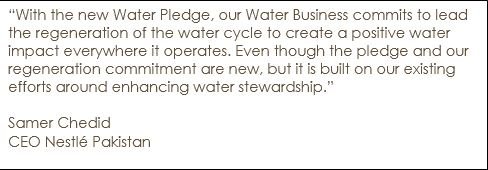
    Nestlé’s Water Business pledges to lead the regeneration of the water cycle to create a positive water impact everywhere it operates by 2025.

    Over the years, we have seen that to tackle the environmental challenges, we have to do more than just solving the issue on our own. Water is a shared resource. Through collaboration and shared efforts, Nestlé stands a better chance to navigate through the challenges through collective action.

    That is why Nestlé formally shaped up and launched their water stewardship efforts under the umbrella of the Caring for Water-Pakistan (C4W-Pakistan) initiative in 2017.

    The Caring for Water – Pakistan initiative targets three focus areas – Factories, Communities, and Agriculture.

    Here are some of Nestlé’s most celebrated projects under each one of the categories:

    • Nestlé Pakistan has collaborated with the Agriculture Department, Government of Punjab, and Pakistan Agricultural Research Council (PARC) to reduce water consumption in the agriculture sector which currently stands at 90% with accompanied wastage of 50%. Through establishing lighthouses across parts of Punjab and Islamabad, Nestlé aims to encourage local farmers to take up drip irrigation. This irrigation method aims to save 40% – 60% water in comparison to conventional flood irrigation. This is a major step towards water preservation in the agricultural sector. 
    • Nestlé’s Smart Soil Sensors Project is another step towards using technology to reduce the wastage of water in the agriculture sector. Nestlé has developed smart soil moisture sensors that read the moisture level of the soil. These readings are stored in the cloud which is then used by farmers to efficiently water to irrigate the soil. This saves about 12%-17% water using precision technology. Through their collaboration with Lahore University of Management Sciences (LUMS) and an Italian organization called Waziup, software has been developed that enables the farmers and researchers to see the soil moisture level remotely on their computer screens.
    • The Alliance for Water Stewardship (AWS) is an international standard, which guides companies and organizations to manage freshwater resources by taking site and catchment initiatives through a stakeholder-inclusive process. Nestlé Pakistan’s Sheikhupura Factory became the first Pakistani site and the first Nestlé site worldwide to be awarded the AWS Certification. And in 2020, all Nestle’s sites were awarded the Alliance for Water Stewardship (AWS) certificate.
    • Nestlé has also installed 6 Safe and Clean Drinking Water Facilities around its operational areas. Nestlé is maintaining these facilities with strict quality control and checks. These water facilities collectively save around 177 tons of water every day.

    The ‘Nestlé Water Pledge’ is an opportunity for the company to reconfirm its position on water stewardship or C4W-Pakistan, to lay out its vision and set an ambition. The launch focuses on the Waters Business itself, but there will be more to come in the future.

    All Nestlé’s initiatives are aligned with the United Nations Development Goals, SDG 6 on Clean Water and Sanitation and SDG 17 on Partnerships for the Goals.

    This article has been sponsored by Nestle Pakistan