The Pakistani rupee (PKR) experienced a slight decline against the US dollar on Thursday, depreciating by 0.05 per cent in the inter-bank market.
The currency closed at Rs278.67, marking a decrease of Rs0.15 from the previous day’s rate of Rs278.52, according to the State Bank of Pakistan (SBP).
In comparison with other major currencies, the rupee faced mixed outcomes today:
| Currency | Previous rate | Today’s rate | Change (PKR) |
| Euro | 309.59 | 310.65 | 1.05 |
| British Pound | 362.60 | 365.10 | 2.50 |
| Swiss Franc | 325.44 | 328.04 | 2.60 |
| South Korean Won | — | 0.21 | — |
| Japanese Yen | 1.9063 | 1.9165 | 1.02 paisa |
| Chinese Yuan | 39.03 | 39.06 | 3.1 paisa |
| Saudi Riyal | 74.23 | 74.27 | 3.87 paisa |
| UAE Dirham | 75.87 | 75.83 | 4.06 paisa |
Euro to PKR: The rupee lost Rs1.05, closing at Rs310.65, compared to the previous rate of Rs309.59.
British Pound to PKR: The rupee depreciated by Rs2.50, ending the day at Rs365.10, up from Rs362.60.
Swiss Franc to PKR: The rupee fell by Rs2.60, closing at Rs328.04, compared to Rs325.44 from the previous session.
Won to PKR: The Pakistani rupee was reportedly trading at Rs0.21 paisa against Won
Japanese Yen to PKR: The rupee saw a slight decline of 1.02 paisa, closing at Rs1.9165 versus Rs1.9063.
Chinese Yuan to PKR: The rupee gained 3.1 paisa, closing at Rs39.06, up from Rs39.03.
Saudi Riyal to PKR: The rupee increased by 3.87 paisa, closing at Rs74.27, compared to Rs74.23.
UAE Dirham to PKR: The rupee appreciated by 4.06 paisa, closing at Rs75.83, up from Rs75.87.
Over the current financial year, the rupee has depreciated by 32.82 paisa or 0.12 per cent against the US dollar, while it has appreciated by Rs3.19 or 1.15 per cent since the beginning of the calendar year.
In the money market, the benchmark 6-month Karachi Interbank Bid and Offer rates fell by 63 basis points to 17.69 per cent and 17.94 per cent, respectively.
The domestic currency has remained relatively stable in recent months, hovering around the Rs277-279 range against the dollar, as traders monitor positive economic indicators and await the approval of a new $7 billion Extended Fund Facility from the International Monetary Fund (IMF).
On Wednesday, Pakistan’s Finance Minister, Muhammad Aurangzeb, stated that the IMF Executive Board meeting on Pakistan is scheduled for September, noting that “good progress” is being made with the IMF.
It is worth noting that this is the third consecutive decline witnessed in the ongoing week.
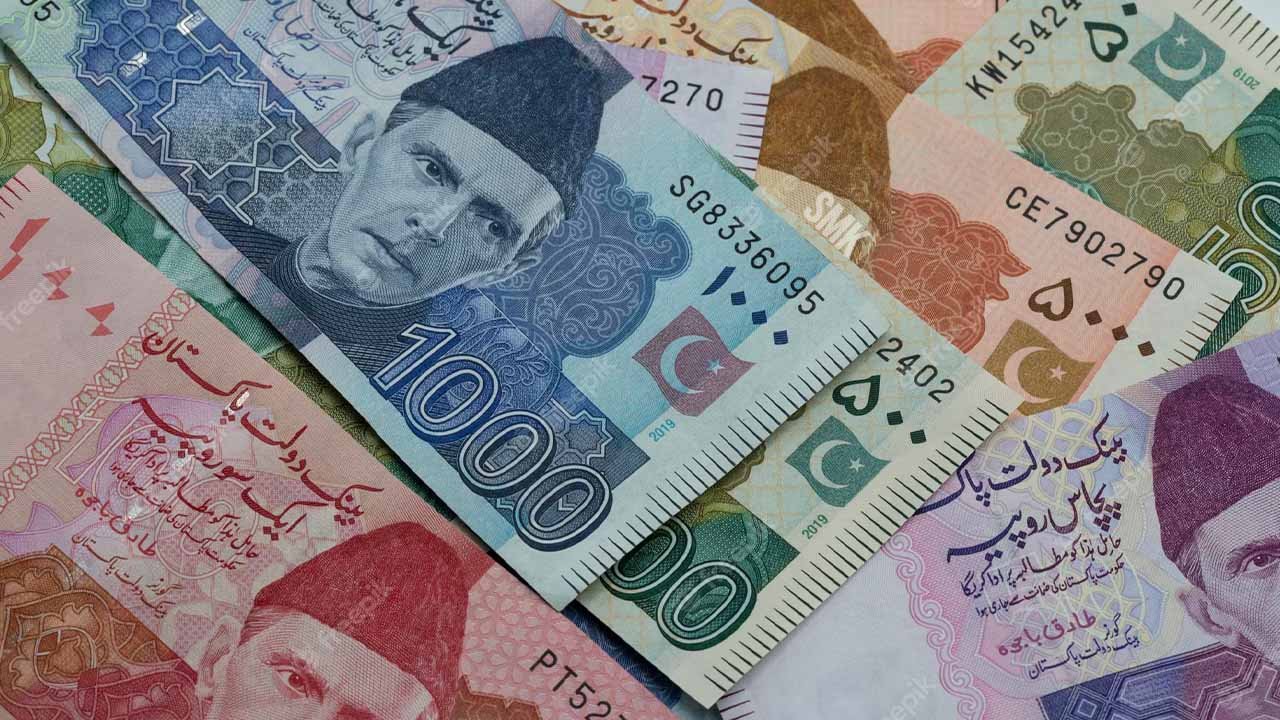
Additionally, regarding the Pakistani currency, the central bank plans to introduce newly designed currency notes across all denominations next year to enhance security features, according to SBP Governor Jameel Ahmad.
Speaking to a parliamentary body in Islamabad on Wednesday, Ahmad stated that the central bank aims to finalise the new designs by December, with the notes to be issued in phases. Notably, one of the denominations will be a polymer note, he added.