Tag: Nobel Prize winner

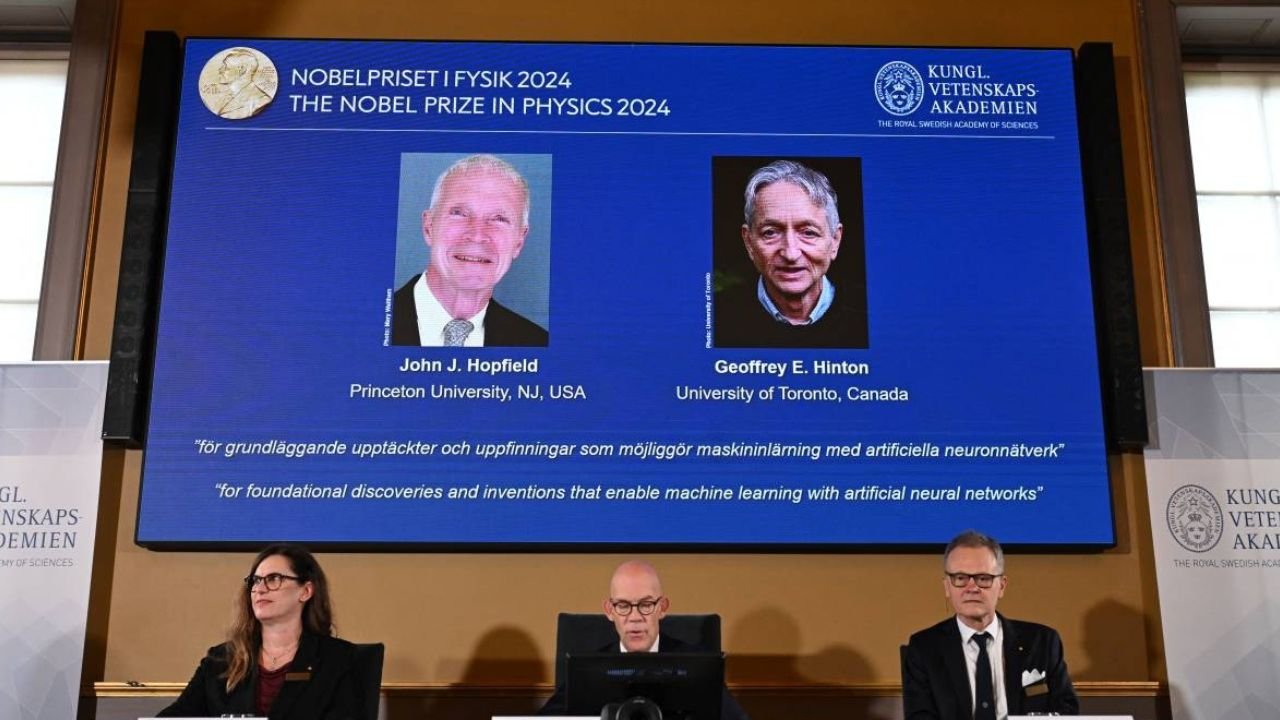
  • Duo wins Physics Nobel for key breakthroughs in AI

    Duo wins Physics Nobel for key breakthroughs in AI

    American John Hopfield and British-Canadian Geoffrey Hinton won the Nobel Prize in Physics on Tuesday for pioneering work in the development of artificial intelligence.

    The pair were honored “for foundational discoveries and inventions that enable machine learning with artificial neural networks,” the jury said.

    “This year’s two Nobel Laureates in Physics have used tools from physics to develop methods that are the foundation of today’s powerful machine learning,” the Swedish Royal Academy of Sciences said in a statement.

    Hopfield, 91, a professor at Princeton University, was spotlighted for having created “an associative memory that can store and reconstruct images and other types of patterns in data.”

    The jury said Hinton, a 76-year-old professor at the University of Toronto, “invented a method that can autonomously find properties in data, and so perform tasks such as identifying specific elements in pictures.”

    “I’m flabbergasted… I had no idea that could happen,” Hinton told reporters via a phone interview as the winners of the award were announced in Stockholm.
    The pair will receive their prize, consisting of a diploma, a gold medal and a $1 million cheque, from King Carl XVI Gustaf in Stockholm on December 10, the anniversary of the 1896 death of scientist Alfred Nobel who created the prizes in his last will and testament.

    Last year, the Nobel Prize in Physics went to France’s Pierre Agostini, Hungarian-Austrian Ferenc Krausz and Franco-Swede Anne L’Huillier for research using ultra quick light flashes that enable the study of electrons inside atoms and molecules.

    The Nobel season continues this week with the announcement of the winner, or winners, of the chemistry prize on Wednesday — followed by the much-anticipated prizes for literature on Thursday and peace on Friday.

    The Economics Prize winds things up on Monday, October 14.

    Awarded since 1901, the Nobel Prizes honor those who have, in the words of prize creator and scientist Alfred Nobel, “conferred the greatest benefit on humankind.”

  • Blue plaque unveiled at London home of Abdus Salam

    A blue plaque has been unveiled by English Heritage to mark the home of Professor Abdus Salam in Putney, London, where he used to live from 1957 to 1996, until his death.

    Blue plaque – a symbol of English Heritage pride – is placed outside the historically significant building to honour the people and organizations who have lived or worked there. Salam joins Charles Darwin, Rosalind Franklin and Alan Turing among the scientists with blue plaques.

    Salam was awarded the Nobel Prize for Physics in 1979, alongside Sheldon Glashow and Steven Weinberg, for his contribution to the electroweak unification theory. Additionally, he founded the Theoretical Physics Department at Imperial College London, with the late Professor Paul T Matthews.

    “A blue plaque on the house in Putney where he lived for 40 years is a fitting tribute to Nobel Laureate Abdus Salam, who was not only one of the finest scientists of the twentieth century, having unified two of the four fundamental forces of nature, but who also dedicated his life to the betterment of science and education in the developing world,” said a professor at the Physics Department of Imperial College, Michael Duff, who completed his Ph.D. under the supervision of Salam in 1972.

    When he won the Nobel prize in 1979, Salam became the very first Pakistani to achieve this distinction and only the fourth from the subcontinent. His contributions to science are undeniable and they have been recognised and hailed by the world and especially the state of Pakistan.

    However, he is criticised back home because of his faith. Two months ago, a group of youngsters smeared his portrait, outside Gujranwala’s National Science College.

    The viral video showed the group, allegedly consisting of State Youth Parliament Pakistan members, painting Salam’s portrait black while raising slogans against the minority Ahmadiyya community, of which Salam was a member.