Tag: online classes

  • Foreign students will not be allowed to stay in the US if their classes move online

    Foreign students will not be allowed to stay in the US if their classes move online

    The United States said on Monday it would not allow foreign students to remain in the country if all of their classes are moved online in the fall because of the coronavirus crisis.

    “Nonimmigrant F-1 and M-1 students attending schools operating entirely online may not take a full online course load and remain in the United States,” US Immigration and Custom Enforcement said in a statement.

    “Active students currently in the United States enrolled in such programmes must depart the country or take other measures, such as transferring to a school with in-person instruction to remain in lawful status,” ICE said.

    “If not, they may face immigration consequences including, but not limited to, the initiation of removal proceedings.” ICE said the State Department “will not issue visas to students enrolled in schools and/or programmes that are fully online for the fall semester nor will US Customs and Border Protection permit these students to enter the United States.”

    F-1 students pursue academic coursework and M-1 students pursue “vocational coursework,” according to ICE.

    Universities with a hybrid system of in-person and online classes will have to show that foreign students are taking as many in-person classes as possible, to maintain their status.

    Read more – University student expelled for protesting against online classes

    The decision was met with widespread criticism.

    “The cruelty of this White House knows no bounds,” tweeted Senator Bernie Sanders. “Foreign students are being threatened with a choice: risk your life going to class-in person or get deported.”

    Most US colleges and universities have not yet announced their plans for the fall semester.

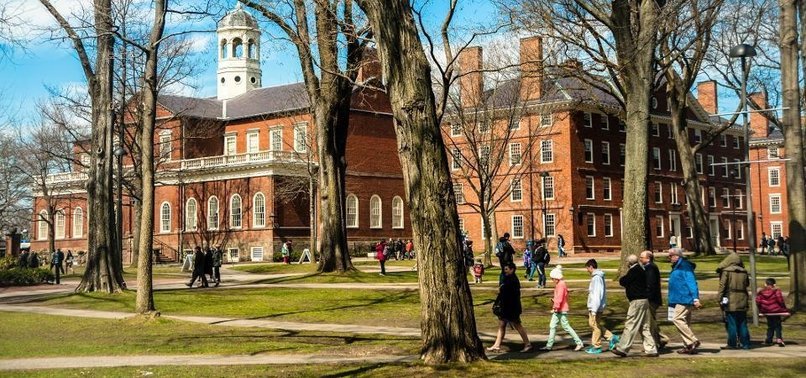
    A number of schools are looking at a hybrid model of in-person and online instruction but some, including Harvard University, have said all classes will be conducted online. Harvard said 40 per cent of undergraduates would be allowed to return to campus — but their instruction would be conducted remotely. On the local front, the Lahore University of Management Sciences (LUMS) has also announced that it would be conducting its fall semester online.

    There were more than one million international students in the US for the 2018-19 academic year, according to the Institute of International Education (IIE).

    The largest number of international students came from China, followed by India, South Korea, Saudi Arabia and Canada.

    President Donald Trump, who is campaigning for reelection in November, has taken a bullish approach to reopening the country even as virus infections continue to spike in parts of the country, particularly the south and west.

    With more than 130,000 deaths linked to the novel coronavirus, the US is the hardest-hit country in the global pandemic.

    While cracking down on immigration is one of his key issues, Trump has taken a particularly hard stance on foreigners since the health crisis began. In June, he froze until 2021 the issuing of green cards — which offer permanent US resident status — and some work visas, particularly those used in the technology sector, with the stated goal of reserving jobs for Americans.
  • Girl climbs rooftop to get better signals to attend online classes

    Girl climbs rooftop to get better signals to attend online classes

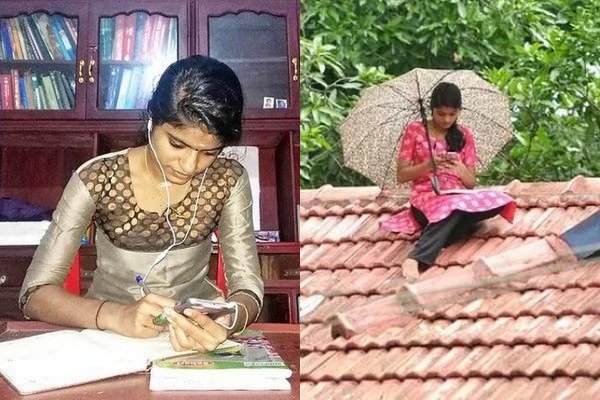
    A girl in Kerala, India broke the internet for her tireless dedication to studies against all odds. Namitha who is taking online classes during lockdown could only found find manageable signal strength for mobile data on the rooftop. She climbed the rooftop to get better signals to attend her online classes.

    As per reports, Namitha is a student of fifth semester BA English. Namitha Narayana was seeking better connectivity at her home near Kottakkal, Kerala, to attend online classes. Due to poor signal in her room, she climbed up and sat on the tiled rooftop of her house to study without a disturbance.

    Explaining why she chose the rooftop space for study, Namitha said, “We tried all places in my house, including verandas and roofs. And finally, I got fairly good signal strength on the top of our two-storey house.”

    After the pictures did rounds on social media the technical staff of the company came to her home and installed a better internet connection.

    “I am happy I can now learn from the comforts of my house,” said Namitha.

    Her elder sister Nayana too praised the positive response from the network operators and how quickly they worked it out.

    Syed Abid Husain Thangal, MLA of Kottakkal reached out to the family and said, “Namitha’s photo studying from the rooftop has become a symbol of the state’s connectivity. She is also a symbol of the perseverance displayed by the state’s student community. By setting herself an example, Namitha has become an inspiration for others.”

  • HEC orders universities to resume online classes

    The Higher Education Commission (HEC) has directed all universities and accredited institutions with sufficient resources to resume online classes as the government-ordered closure of schools, colleges and universities remains in place amid the spread of new coronavirus — COVID-19 — across Pakistan.

    In an official notification, HEC has reportedly asked all universities which have well-built learning management systems (LMS) to initiate online classes. However, universities facing technological, technical or spatial limitations can remain closed for academic activities till May 31 and mark the said period as summer vacations.

    In the meantime, these universities should make arrangements for conducting online classes in case the closure is extended because of the global pandemic, the notification read further.

    “Such universities shall plan, acquire, train and shall be able to execute an LMS from June 1 so that [the] ongoing semester could resume even in an eventuality of the extended closure of universities.”

    On Thursday, the federal government announced that education institutions across Pakistan would remain closed till May 31. The government also announced that the closure would be treated as summer vacations and if the coronavirus outbreak was dealt with in the meantime, the institutions would reopen in June.

    At a time when higher education institutions in Pakistan and elsewhere in the world are fast shifting to online learning in the wake of closures to contain the spread of coronavirus, Pakistani students took to social media last week and demanded the authorities converted closures into semester break.

    “We reject online education” popped up as one of the top trends in Pakistan on the microblogging website Twitter and the hash tag remained on the top for quite some time with most of the tweeters expressing concerns over no or poor internet connectivity and lack of, what they termed, “effectiveness” of the online education.

    They demanded that the institutions instead of shifting to online education should convert closures in semester breaks and hold on-campuses classes when campuses reopen in summer.

    According to The News, there are around 40 million students enrolled in public and private sector schools, colleges and universities of Pakistan. Of these, 24 million students are enrolled in primary schools, 7.6 million in middle schools, 4 million and over 1.5 million at secondary and higher secondary levels, respectively.

    Punjab alone has around 13 million students enrolled in government schools. This shows that in terms of numbers the real affectees are particularly the schoolchildren for whom there is no online education facility during the current countrywide closures.