Tag: Pakistan China

  • China urges Pakistan to allow its own security for their workers in Pakistan: report

    China urges Pakistan to allow its own security for their workers in Pakistan: report

    China is pushing Islamabad to permit its security staff to protect thousands of its citizens working in the country, sources have told Reuters.

    On October 6, an explosion near Karachi Airport killed two Chinese engineers and injured 11 people, an attack that was seen as a major security breach.

    The banned outfit Balochistan Liberation Army (BLA) had taken responsibility for the blast. 

    Recent attacks and security failures have reportedly angered China, prompting Pakistan to initiate formal negotiations for a joint security management system.

    Reuters spoke to five Pakistani security and government sources with direct knowledge of the previously unreported negotiations and demands on condition of anonymity, as the talks are sensitive, and reviewed a written proposal sent by China to Pakistan.

    One official stated: “They (Chinese) want to bring in their own security,” adding that Pakistan had not agreed so far.

    The source and two other officials said there was a consensus on setting up a joint security management system and that Pakistan was amenable to Chinese officials sitting in on security meetings and coordination.

    However, neither China nor Pakistan officially confirmed the off-record talks.

    Privately, Beijing has expressed frustration. At one recent meeting, the Chinese side provided evidence that Pakistan had failed to follow security protocols agreed on twice in recent months, three officials told Reuters.


    “It was a grave security breach,” admitted one of the officials investigating the bombing.

    Speaking at a press conference on November 11, Sindh Home Minister Ziaul Hassan Lanjar confirmed that during an intelligence-based operation, one of the masterminds of the suicide bombing, Javed alias Sameer, and his accomplice Gul Nisa, were arrested at CD Highway near Umar Goth Chowk, Karachi, while riding a bike. The two had entered Karachi via Hub.

    “An investigation revealed Javed’s direct involvement in the suicide bombing, while Gul Nisa had facilitated [him],” Lanjar added.

    “On Oct 6, the terrorist checked out of the hotel. He later picked up his other accomplices near Jail Chowrangi in the vehicle that would be used in the attack. They circled the airport and then returned to a park near the Marriott Hotel.”

    “From there, they recorded the suicide attacker’s final video on a mobile phone and sent it to their BLA commander. At around 9:30 pm, they reached Karachi Airport. The suicide attacker and one of his accomplices remained in the vehicle while the third accomplice entered Karachi Airport,” Sindh Home Minister said.
  • Chinese loan negotiations may give Pakistani businesses a reality check

    Chinese loan negotiations may give Pakistani businesses a reality check

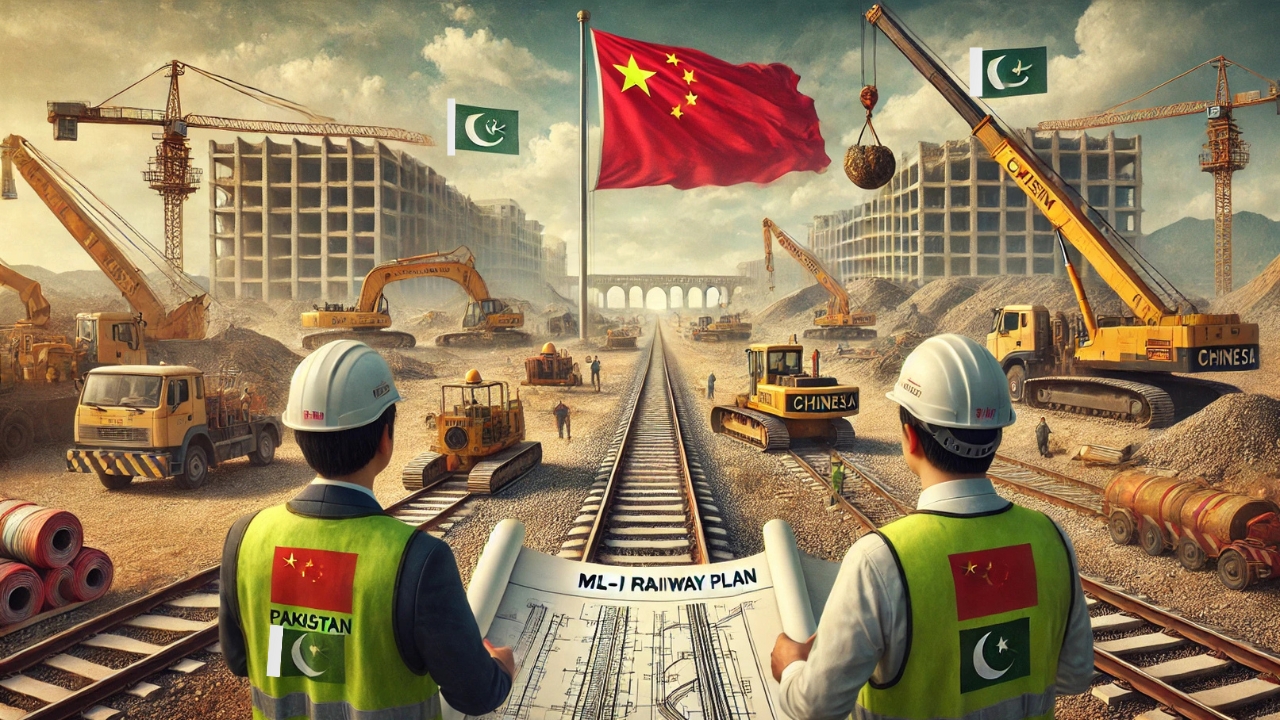
    As Pakistan and Chinese officials discuss the terms of the loan for the ML-I railway project, local businesses grow worried. While there are many supposed benefits on the surface of the loan deal, there are many ominous conditions that may soon reveal themselves. 

    As for the benefits, the construction of the Karachi-Hyderabad segment of ML-I will help reduce transport times and fuel costs for businesses in the long run. As a result, businesses will be able to reduce the costs of their goods and services, resulting in greater demand for these products. This is likely to increase the profit margins of many businesses, especially those transporting goods around Karachi and Hyderabad.

    Hyderabad, known for its export of textiles and agricultural produce, will benefit from the construction of the railway, which will allow goods to flow freely to the port city of Karachi. This will allow for exporters to guarantee shorter delivery times to international buyers along with lower costs thanks to the railway.

    However, local construction companies should not be delighted as they may not even get the contracts to work on the railway to begin with. Historically, Chinese loans often come with clauses to employ Chinese companies or the contract is already pre-awarded to a Chinese firm.

    So, while on paper, the influx of a billion dollars looks great, the reality of the matter is that the loan only employs Chinese firms that bring in its nationals to work on the projects. While these Chinese employees may spend part of their earnings here in Pakistan, the majority of the proceeds of projects are repatriated back to China. 

    Moreover, the materials to be utilised are also often sourced from China. As a result, Pakistani businesses do not benefit meaningfully from these loans. An example of such loans can be seen primarily in Africa and Eastern Europe, which rely on Chinese loans.

    Moreover, Chinese officials are trying to get Pakistan to sign the loan agreement at an interest rate of 2.3 per cent, while the Pakistani side is making huge efforts for the interest rate to be 1 per cent. If Chinese loan conditions are agreed upon, the government will have to foot higher interest payments on the loan – A loan where their own companies and businesses are not the primary beneficiaries.

    While Pakistan relies on loans to finance the majority of its large-scale projects, it might not sound like a great deal to secure them at unfavourable terms. However, the loan deal will most probably be secured by Pakistan regardless. Will this be a gift to the economy or a curse? Time shall tell.

  • Pak-Cheen dosti Zindabad? Billions in investment hang in the balance

    Shockwaves from the blast that claimed the lives of two Chinese engineers, in Karachi last night were felt by political leaders and investors alike in Beijing.

    With just a week remaining for the Chinese Prime minister’s official tour of Pakistan on October 14th, lawmakers in Islamabad scramble to protect economic ties with China to ensure the continuous flow of Yuan into CPEC projects. The initial budget that was allocated towards CPEC-related projects was $62 billion, of which $35 billion in investments remain – A sum Pakistan can’t afford to lose.

    However, the damage has already been done. China strongly condemned the lethal attack on its civilians and urged its citizens to remain cautious, noting that local security measures should be strengthened.

    This has hurt the confidence of already weary Chinese investors looking to invest in Pakistan as they now explore safer destinations for their investments. Somewhere, Chinese workers can safely work.

    China has remained the largest single foreign direct investor in the Pakistani economy, amounting to $568 million in FY 2024 alone. In fact, China is responsible for 30% of all foreign investments in Pakistan. 

    With Pakistan struggling to attract foreign direct investment and with the recent attack, it can be safely said Pakistan is not moving in the right direction.

    It is in the interests of the local business community to see increased collaboration with international investors. Lapses in security need to be remedied to ensure that Pakistan stops biting the metaphorical hand that feeds it.

  • We have not invested enough in education, health and infrastructure: PM Shehbaz

    In an interview to The Economist on Pakistan’s Independence Day, Prime Minister (PM) Shehbaz Sharif highlighted the root problems of the economic crisis gripping the nation nowadays.

    Titled “Pakistan’s prime minister on his drive to modernise the country“, PM Shehbaz mainly talked about critical structural flaws that hindered the state’s economy. According to him, the first reason is that Pakistan’s political environment has become increasingly polarised.

    “Instead of debating how to run Pakistan better and rid the country of poverty, political parties have been at each other’s throats,” he pointed out.

    “We have not invested enough in the nuts and bolts of development: education, health and infrastructure. This is in part due to an abysmally low tax take, but it also reflects our priorities in public spending.”

    PM Shehbaz further highlighted the fact that Pakistan has not enjoyed the benefits of globalisation.

    “Today, we hardly make anything that the world wants and our companies remain very comfortable only operating within our borders, often protected by barriers to competition,” he stressed.

    He pointed out that Pakistan’s exports are just 10 per cent. Shehbaz said that where “two out of every three people are below the age of 30 and full of aspirations and where every third person lives on less than $3.20 a day and less than a quarter of our women work outside the home,” it is a moment that merits “serious introspection”.

    Pakistan was one of the biggest victims of state-sponsored terrorism’: PM Shehbaz

    In an interview with Newsweek’s senior foreign policy writer Tom O’Connor, PM Shehbaz said it was no secret that Pakistan was “one of the biggest victims of state-sponsored terrorism that is planned, supported and financed by hostile intelligence agencies”.

    He went on to say that terrorist attacks against Chinese nationals were “aided and abetted by forces inimical to the Pakistan-China strategic partnership”.

    Talking about friction between the US and China, the premier said: “While the Pakistan-China relationship is very special, Pakistan and the US have also maintained a long-standing historic bilateral relationship which covers all issues of mutual interest.”

    He was of the view that the world cannot afford to go back into another “era of Cold War or bloc politics”.

    The premier called for all parties to agree to the “minimum rules of the game in which the welfare of the people remains paramount”.

    “Systematic problems can be fixed through engagement and consultations among all political stakeholders. This course may take time, but is the only way forward for the system to become strong, resilient and efficient.”