Tag: Pakistan Stock Exchange

  • Pakistan Stock Exchange breaks six-year record, surpasses 50,000 points 

    Pakistan Stock Exchange breaks six-year record, surpasses 50,000 points 

    The recent surge in the performance of the benchmark KSE-100 Index at the Pakistan Stock Exchange (PSX) can be attributed to the combination of a positive earnings season and notable economic improvements. 

    On Tuesday, the index breached the significant 50,000-point threshold, marking the first time in over six years since June 7, 2017.

    Around 11 am, the benchmark index was trading at 50,017 points, reflecting a gain of 286 points, equivalent to a 0.58 per cent increase. However, it later retracted from this milestone. 

    This momentous achievement was supported by multiple factors, including an enduring upward trend observed in various sectors, such as automobile assemblers, commercial banks, cement, chemical, oil marketing companies, and oil and gas exploration firms.

    The bullish momentum on the Pakistan Stock Exchange has been a consistent theme, extending through 11 consecutive trading sessions. Intra-day trading on Monday nearly brought the KSE-100 Index to the 50,000 level, closing at 49,731.35 points. 

    One significant driver behind this surge has been the strengthening of the Pakistani rupee against the US dollar, with the exchange rate holding steady at around Rs275 in the inter-bank market.

    Additionally, the ongoing earnings season has instilled confidence in the market, with high expectations, especially in the banking sector, for positive financial results. These factors collectively contribute to the robust performance witnessed in the Pakistani stock market.

  • Pakistan Stock Exchange crosses 47,000-mark after five weeks

    Pakistan Stock Exchange crosses 47,000-mark after five weeks

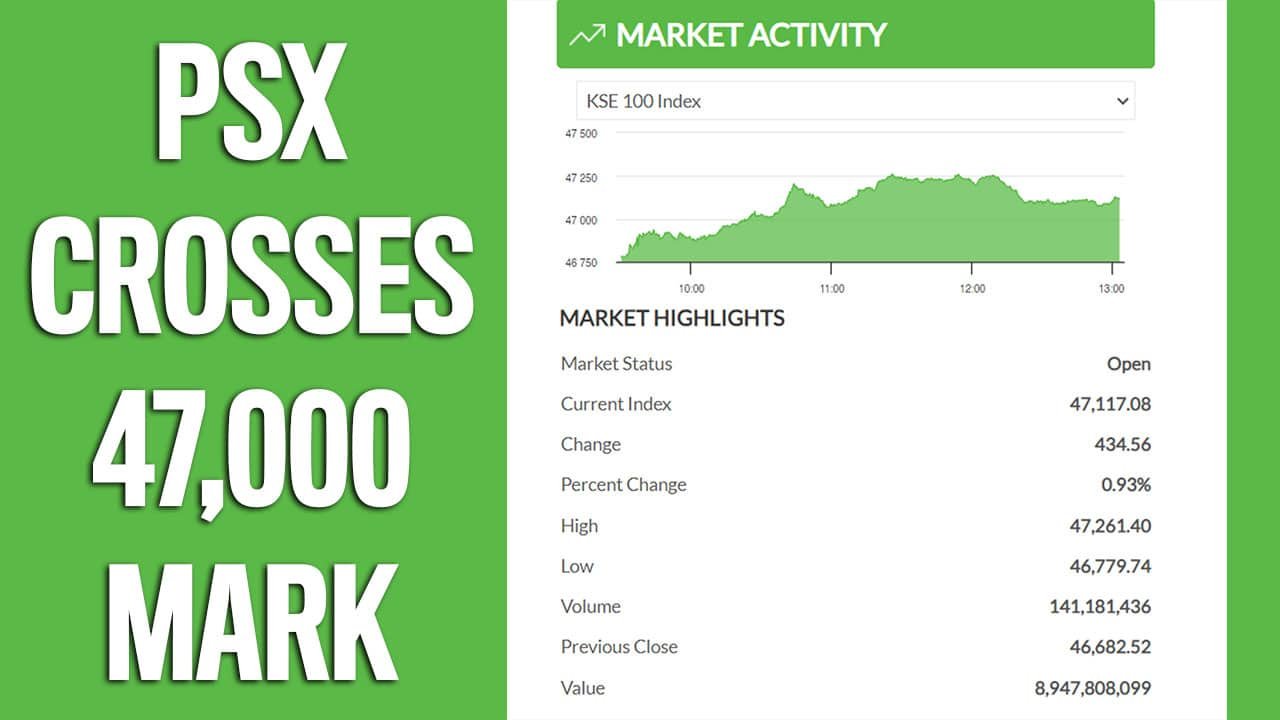
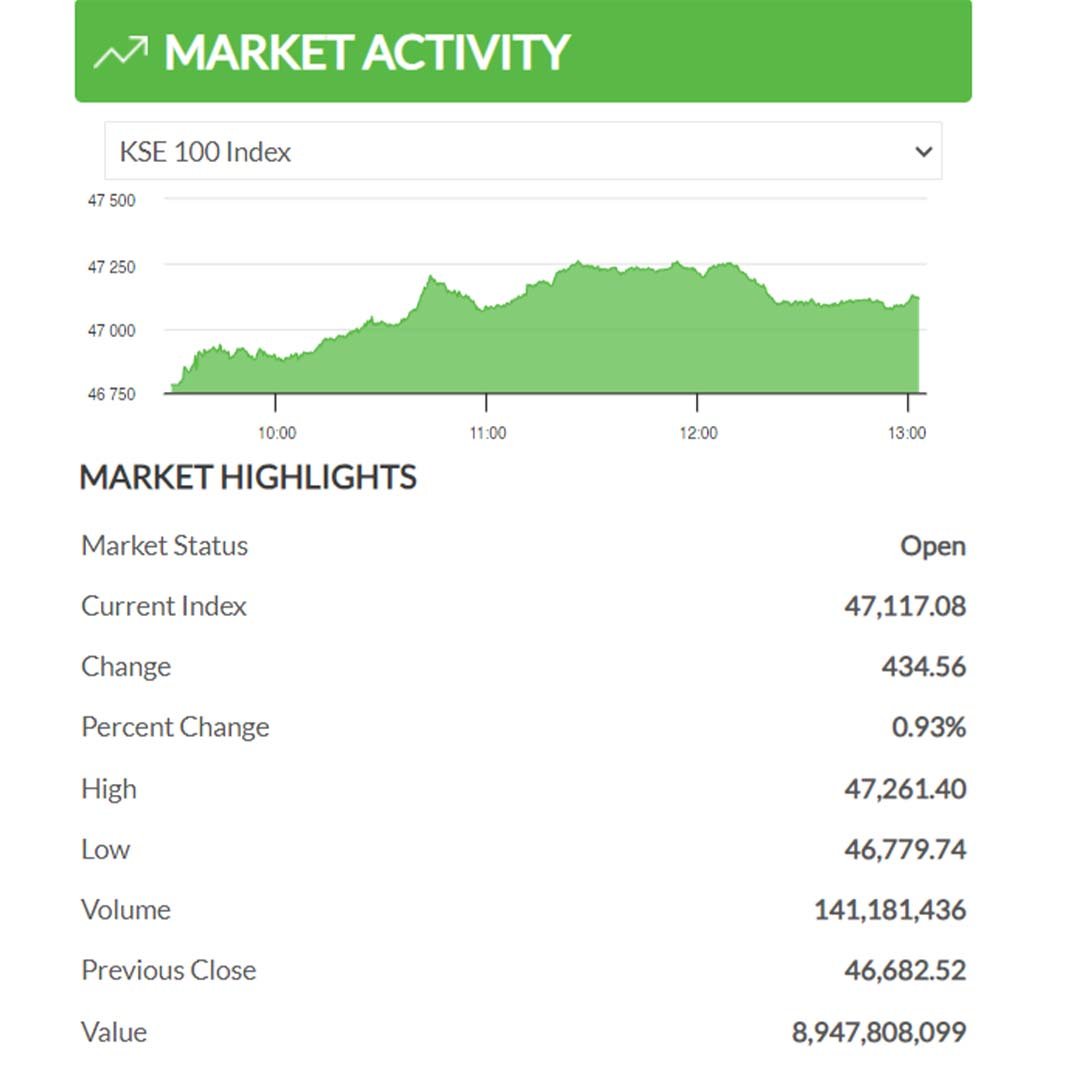
    The Pakistan Stock Exchange (PSX) enjoyed a favourable trading session on Wednesday, with its key KSE-100 Index surging above the 47,000 level for the first time in five weeks. This uptrend was primarily driven by the robust performance of the banking sector.

    Throughout the trading session, the KSE-100 Index remained firmly in positive territory, ultimately settling at 47,079.83. This represented a notable gain of 323.03 points, or 0.69 per cent. The last instance the benchmark index closed above the 47,000 mark was on August 28.

    In a post-market report, Ismail Securities, a prominent brokerage house, attributed the positive momentum in the equity market to increased liquidity, particularly within the banking sector.

    On the preceding day, Tuesday, the KSE-100 Index managed to eke out a 0.28 per cent gain in a session characterised by a relatively narrow trading range.

    Shares of 342 companies were traded, with 172 witnessing an increase, 134 recording a decline, and 36 remaining unchanged.

    Topline Securities, another respected brokerage house, envisions the KSE-100 Index approaching the 50,000 level in a potential “pre-election rally.” They expressed their belief that the Pakistani market could experience an 8–10 per cent surge in the lead-up to the elections, assuming a smooth election process and the approval of the IMF tranche in November, stating this in an earlier note.

    Simultaneously, the Pakistani rupee continued its strengthening trend against the US dollar, registering a 0.37 per cent gain in the interbank market on Wednesday. According to the State Bank of Pakistan, the rupee settled at 284.68 after an increase of Rs1.04, marking the 20th consecutive appreciation against the greenback.

    Trading activity also saw an uptick, with the all-share index volume rising to 330.2 million shares from Tuesday’s 213.2 million. The value of traded shares also increased, reaching Rs7.3 billion compared to Rs6.1 billion in the previous session.

  • Inventory challenges lead Indus Motor Company to halt Toyota car production in Pakistan

    Inventory challenges lead Indus Motor Company to halt Toyota car production in Pakistan

    Indus Motor Company Limited, the firm responsible for the assembly of Toyota vehicles in Pakistan, has recently announced a temporary suspension of its production operations until October 9. This significant decision was formally communicated through a notice submitted to the Pakistan Stock Exchange (PSX).

    The rationale behind this temporary cessation of production is primarily linked to the company’s current vehicle inventory status. Indus Motor Company Limited has set the production plant’s closure period from September 28 through October 9 to address these concerns.

    This pause in production is the latest in a series of similar actions undertaken by the company. Previously, Indus Motor Company Limited had temporarily halted production from August 25 to September 6, attributing it to reduced demand and inventory challenges. Additionally, the company faced a production plant shutdown from July 21 to August 3, driven by complications in the importation of raw materials, logistical hurdles in clearing consignments, and disruptions in the supply chain from select international vendors.

    These issues collectively hampered the company’s supply chain, leading to insufficient inventory levels to sustain uninterrupted production. Furthermore, a similar production hiatus had occurred earlier, from June 26 to June 27, with the same underlying reasons.

  • Pak Suzuki halts motorcycle production amidst raw material shortage

    In response to an acute shortage of raw materials, Pak Suzuki Motor Company (PSMC) has once again announced the suspension of its motorcycle production. This marks the third production halt in the current fiscal year, underscoring the challenges faced by Pakistan’s automotive industry.

    According to a report by The News, the automobile manufacturer formally communicated its decision through a notice to the Pakistan Stock Exchange (PSX). The production halt will extend for 12 days, commencing on September 1 and concluding on September 12, 2023. This move follows previous shutdowns from August 18 to 31 and from July 31 to August 15, 2023, due to inventory constraints, as reported by the company’s secretary.

    It’s worth noting that while production may be on hold, regular operations will persist at the vehicle manufacturing plant, as clarified in the bourse filing.

    Pak Suzuki’s ongoing struggle with raw material shortages can be traced back to July of the preceding year, primarily resulting from challenges in importing essential components. The nation’s dwindling foreign exchange reserves have further exacerbated these import disruptions.

    Sunny Kumar, an analyst at Topline Securities, provided insight into the impact of these disruptions: “PSMC produced 19,293 units with capacity utilisation of 26% in 1H2023 compared to 76,325 units produced with capacity utilisation of 102% in 1H2022.”

    In a glimmer of hope, the company’s management anticipates an economic rebound in FY24, driven by an upturn in agriculture output and eased import restrictions, with expected improvements in manufacturing and construction activities.

    Pak Suzuki’s predicament is not unique, as other prominent automakers such as Honda Atlas and Indus Motor Company, the local manufacturer of Toyota vehicles, have also faced repeated production stoppages due to raw material shortages. This scarcity has had a cascading effect, impacting the automobile parts industry and causing intermittent production halts.

    In a related development, Agriauto Industries Limited, a prominent automotive parts manufacturer, has announced a partial plant closure in September due to decreased production. Furthermore, Agriauto Stamping Company Pvt. Ltd., a wholly-owned subsidiary of the company, will also undergo a partial shutdown during the same period, as confirmed by the company secretary.

    The announcement of Pak Suzuki’s latest production halt has raised concerns among employees, stakeholders, and the general public. The motorcycle plant, a significant division within the company, plays a pivotal role in employment generation in the country.

    This situation has far-reaching implications, as experts anticipate that the closure will not only impact the company’s workforce but also reverberate through the broader economy. An industry observer emphasised the need for coordinated efforts between stakeholders and government bodies to address the root causes of raw material shortages and prevent further disruptions in Pakistan’s automotive sector.


  • Dramatic drop: Pakistan Stock Exchange crashes over 1,700 points amid economic concerns

    Dramatic drop: Pakistan Stock Exchange crashes over 1,700 points amid economic concerns

    On Thursday, the Pakistan Stock Exchange (PSX) encountered a challenging session as the primary index witnessed a substantial decline of 3.86 per cent, reflecting a loss of 1,784 points by 2:53 pm. This notable downturn was attributed to growing concerns pertaining to the nation’s economic landscape.

    Investors were worried about the rupee losing value against the dollar. This concern led them to sell off their shares, fearing that the economy could face trouble ahead.

    Right from the start of the trading day, the KSE-100 index saw a big fall of over 1,100 points, taking it below the 46,000 mark. Unfortunately, the index couldn’t bounce back due to low investor confidence.

    By 2:14 PM, the PSX had fallen to 45,139.34 points, a drop of 1,105.21 points compared to the previous day’s close of 46,244.55 points.

    Investors are also keeping an eye on the rupee’s decline, especially since the International Monetary Fund (IMF) won’t review the situation for a few more months. Additionally, there’s uncertainty about investments from the Gulf Cooperation Council (GCC).

    If the market keeps falling, some buyers might return, as the index is currently down 8 per cent from its recent high. But a real recovery would need clear information about politics and the economy.

    According to experts, the PSX is under pressure due to the rupee’s continuous slide.

    This could cause inflation to rise, which could affect the next Monetary Policy Committee (MPC) meeting in September. During that meeting, the central bank might consider raising interest rates again.

    The financial market is worried about public protests against higher power tariffs. If the government tries to please the public with short-term measures, it could complicate talks with the IMF.

    This report serves as an intraday update on the developments in the Pakistan Stock Exchange as of 2:53 pm.

  • Pakistan Stock Exchange surpasses 49,000 points, reaches new high since 2017

    Pakistan Stock Exchange surpasses 49,000 points, reaches new high since 2017

    The Pakistan Stock Exchange (PSX) witnessed a remarkable surge on Thursday as it extended its bullish momentum, crossing the 49,000 level and reaching its highest point in six years. This impressive rally was fueled by positive economic data and a series of favourable factors contributing to investor confidence.

    During the intraday trade, the PSX’s benchmark KSE 100-share Index experienced a significant gain of 560.20 points, amounting to a 1.15 per cent increase, ultimately settling at an impressive 49,324.50 points. This milestone represents the index’s highest level since June 9, 2017, marking a notable achievement for Pakistan’s financial markets.

    The impressive growth of the benchmark index has been sustained since Pakistan signed a staff-level agreement with the International Monetary Fund (IMF) for a substantial $3 billion Standby Agreement. Since the agreement’s signing, the market has witnessed an extraordinary upswing, with the benchmark index having gained an impressive 7,871 points.

    Market analysts and experts have identified multiple reasons behind the consistent surge in the market. Among these factors is the State Bank of Pakistan’s (SBP) decision to maintain the policy rate, effectively keeping the status quo. The SBP’s prudent approach to monetary policy has contributed to stability and encouraged investors to take bullish positions in the market.

    Furthermore, the positive economic data, both from domestic and international sources, has also played a pivotal role in bolstering investor confidence. With indicators pointing towards a strengthening economy, investors have been encouraged to increase their stakes in the market, resulting in the record-breaking performance of the Pakistan Stock Exchange.

    As the market continues to show resilience and upward momentum, financial experts and policymakers are cautiously optimistic about the future outlook. They emphasise the importance of sustaining a positive economic trajectory through sound policy measures and a vigilant approach to market dynamics.

    Market participants and investors are closely monitoring the developments and will likely adjust their strategies in response to any shifts in economic indicators and policy decisions. The surge in the Pakistan Stock Exchange serves as a testament to the country’s economic potential and its ability to attract local and foreign investors to participate in its thriving financial markets.

  • Pak Suzuki halts motorcycle production amidst ongoing inventory shortage

    The Pak Suzuki Motor Company (PSMC) is once again grappling with the repercussions of the ongoing raw material shortage, which has forced the company to halt production at its motorcycle plant for at least 15 days. The decision, announced in a statement released to the Pakistan Stock Exchange (PSX), comes as the company struggles to maintain adequate inventory levels due to the scarcity of essential components.

    The company secretary revealed that the motorcycle plant will remain non-operational from July 31, 2023, to August 15, 2023. This recent shutdown follows a previous closure earlier in July when both the motorcycle and automobile plants were shut down until July 19, which was subsequently extended. The persistent lack of raw materials has been plaguing Pak Suzuki since July of the previous year, primarily due to difficulties in importing these crucial components caused by a reduction in the nation’s foreign exchange reserves.

    Unfortunately, Pak Suzuki is not the only automaker facing such challenges. Honda Atlas Cars and Indus Motor Company, responsible for manufacturing Toyota cars in Pakistan, have also experienced several shutdowns due to the shortage of essential raw materials. Furthermore, automotive parts manufacturers have been compelled to temporarily halt their production lines, exacerbating the crisis across the entire automotive industry.

    The repercussions of these closures extend beyond the affected businesses, as the entire automotive industry faces unproductive days due to interrupted raw material imports arising from postponed credit letter openings. This situation has led to reduced operational capacities and an overall decrease in productivity across multiple sectors of the economy.

    The recent shutdown of Pak Suzuki’s motorcycle manufacturing plant has raised concerns among employees, stakeholders, and the general public alike. The motorcycle plant is a significant division within the company and serves as a major employer in the country. As a result, the closure is expected to have a considerable impact on both the company’s workforce and the overall economy.

    An analyst specialising in Pakistan’s automotive sector highlighted that the closure of the motorcycle plant serves as a stark reminder of the larger problems plaguing the industry. Addressing the underlying causes of the raw material scarcity requires a collaborative effort from stakeholders and the government to implement permanent solutions and avert further disruptions.

  • Pakistan Stock Exchange surges to 21-month high as KSE-100 index crosses 47,000 mark

    Pakistan Stock Exchange surges to 21-month high as KSE-100 index crosses 47,000 mark

    The Pakistan Stock Exchange witnessed a significant surge as the benchmark KSE-100 index surpassed the 47,000 milestone on Thursday, reaching its highest point in 21 months. This remarkable upswing was fueled by positive market sentiment following the recent International Monetary Fund (IMF) deal.

    Notably, the bullish position was further fortified by impressive corporate performance, particularly within the index-heavy sectors. At 12:10 pm, the benchmark index surged by 560 points, settling at 47,242.9 points, marking its peak since November 8, 2021, as reported by Arif Habib Limited (AHL), a prominent brokerage firm.

    AHL emphasized that the market had recorded a noteworthy gain of 5,751 points (13.9 per cent) since the staff-level agreement with the IMF for the $3 billion Standby Agreement (SBA).

    This positive momentum was attributed to increased valuations after securing the IMF SBA facility, as explained by Tahir Abbas, AHL’s Head of Research, in an interview with Geo.tv. He highlighted that the current Price-Earnings Ratio (PER) of the KSE-100 stands at 3.7x, which is relatively lower compared to the lowest recorded during the previous financial crisis in 2008 (3.9x).

    Abbas asserted that the market remains attractive, and as a result, the positive momentum is expected to continue. Analyst Saad Ali, an expert in the capital market, attributed the market’s favorable performance to the combination of IMF optimism and the outlook for enhanced macro stability, which has been complemented by strong corporate results during the present result season. Despite facing challenging macroeconomic conditions, several banks and companies have managed to surpass expectations in terms of earnings and payouts.

    Last month, Pakistan signed a short-term deal with the IMF, a crucial step that helped the country avert a potential default and bolster its foreign exchange reserves. This move has played a pivotal role in supporting the current bullish trend in the stock market.

    In conclusion, with the positive impact of the IMF deal and encouraging corporate results, the Pakistan Stock Exchange’s benchmark KSE-100 index has achieved substantial growth, positioning itself at a 21-month high. The market outlook remains promising, and experts predict further gains ahead.

  • Pakistan Stock Exchange surpasses 46,000 mark for the first time in 15 months

    Pakistan Stock Exchange surpasses 46,000 mark for the first time in 15 months

    The Pakistan Stock Exchange’s (PSX) benchmark KSE-100 index experienced significant gains on Friday, rising by over 500 points and closing just below the 46,000 mark.

    The index reached 46,073.61 points at 3:47 pm, showing a notable increase of 675.30 points from the previous day’s closing of 45,398.31. However, by the end of the day, it closed at 45,920.73, up by 522.42 points or 1.15 per cent.

    According to Dawn, Ahsan Mehanti, the Director of Arif Habib Corporation, mentioned that foreign capital was actively buying shares in the energy sector. He attributed the stock market rally to favorable financial results, the Islamabad High Court’s ruling declaring the imposition of a super tax on various companies unlawful, and reports indicating the policy rate would remain unchanged.

    As a result of these factors, the index reached the 46,000 mark after a gap of 15 months, signaling an overall improvement in all sectors. Mehanti also pointed out the positive impact of the recently announced standby agreement with the International Monetary Fund (IMF).

    Looking ahead, if the market continues to close above 46,000, it is expected to see further growth. Amir Shehzad, Director of First National Equities Limited, referred to the recent market fluctuations as a “technical correction” and expressed optimism that the market could surpass the 47,000 point barrier in the coming week. He believed that maintaining an unchanged monetary policy by the central bank would likely have a positive effect on the market, possibly leading to new record levels.

  • Toyota Indus Motor Company suspends car production until August 3

    Toyota Indus Motor Company suspends car production until August 3

    Indus Motor Company Limited has recently made the difficult decision to close its production plant temporarily. The interruption is set to last for two weeks, as the company faces significant challenges in importing essential raw materials, leading to disruptions in its supply chain.

    The root of the problem lies in the difficulties the company and its vendors are encountering in importing raw materials and clearing consignments. These issues are primarily attributed to the struggles with opening letters of credit (LCs) and supply chain problems from certain foreign vendors. Unfortunately, this has left the company with insufficient inventory levels to maintain its production activities.

    The company’s secretary addressed these concerns in a statement released to the Pakistan Stock Exchange, outlining the seriousness of the situation. Indus Motor’s production plant experienced a brief shutdown the previous month due to similar issues with raw material imports. However, the current circumstances have exacerbated the problem, forcing the company to take this temporary production halt.

    Commencing from July 21, 2023, and extending until August 3, 2023, the plant’s complete shutdown is expected to have implications beyond Indus Motors itself. Other major players in the automotive sector, such as Pak Suzuki Motors and Honda Cars, have also faced similar challenges and implemented several shutdown days in recent months.

    The automotive industry, along with other sectors dependent on imported raw materials, has been struggling due to a shortage of foreign exchange reserves in Pakistan. The complications surrounding LCs have severely impacted the supply chain’s seamless functioning, leading to significant disruptions in production activities.

    Indus Motors holds a significant position in Pakistan’s automobile industry and has notably invested $100 million in local production of hybrid electric vehicles (HEVs). Furthermore, the company plays a crucial role in the local automotive ecosystem, with over 50 part manufacturers contributing to the value chain by producing parts worth over Rs250 million every working day.

    Additionally, the company has established 53 independently owned authorised dealerships that provide aftersales service, generating substantial employment opportunities for over 450,000 people directly and indirectly across the country.

    The temporary closure of the production plant presents various challenges for Indus Motors, its employees, and the overall automobile industry. The company’s management is likely to be exploring potential solutions to address the scarcity of raw materials and resume operations as soon as the situation allows.

    As analysts point out, finding lasting solutions may require collaboration between the government and relevant stakeholders to ensure a stable supply of raw materials for the automotive industry and other affected sectors. Swift action and strategic measures will be vital to mitigate the economic impact of these closures and preserve the growth trajectory of Pakistan’s automotive sector.