Tag: Pakistan Stock Exchange

  • Pak Suzuki’s auto and motorcycle plant to stay closed till July 19

    Pak Suzuki’s auto and motorcycle plant to stay closed till July 19

    Pak Suzuki Motor Company Ltd (PSMCL), Pakistan’s leading car manufacturer in terms of production and sales, has announced an extension of its plant shutdown due to an ongoing shortage of inventory. The decision was conveyed to the Pakistan Stock Exchange (PSX) through an official notice on Friday.

    In the notice, the automaker explained that the management had decided to prolong the closure of its motorcycle and automobile plant until July 19, 2023, citing the persistent inventory shortage. Previously, PSMCL had already suspended operations until July 15, 2023, and had also experienced a shutdown from May 2 to May 9 due to a scarcity of raw materials.

    It is important to note that the auto industry in Pakistan is facing multiple challenges, leading several automakers to announce temporary or partial closures in recent months, citing various reasons.

    In April, Pak Suzuki reported its highest quarterly loss to date, amounting to Rs12.9 billion in the first quarter of 2023. This decline in profitability was attributed to a decrease in sales and substantial finance costs. In comparison, the company had incurred a loss of Rs460.227 million during the same period the previous year.

    Earlier, Pak Suzuki had appealed to Prime Minister Shehbaz Sharif not to introduce additional duties and taxes in the upcoming 2023-24 budget. The company emphasised the economic uncertainties it was facing and the resulting struggles and losses.
  • Pakistan Stock Exchange rises above 44,000 points after 14 months

    Pakistan Stock Exchange rises above 44,000 points after 14 months

    On Thursday, the Pakistan Stock Exchange (PSX) benchmark index surpassed the 44,000 milestone after 14 months, experiencing a substantial surge of over 600 points after a two-day decline. The PSX website reported the KSE-100 index closing at 44,178.85 points, reflecting a commendable rise of 1.44 per cent or 626.02 points.

    Market analysts attribute this rally to several pivotal factors. Firstly, the standby agreement reached with the International Monetary Fund (IMF) played a crucial role in bolstering investor confidence. This agreement significantly alleviated uncertainties, particularly the risk of default, providing Pakistan with the opportunity to focus on its fiscal policies.

    Additionally, the disbursement of payments to independent power producers (IPP) contributed to the positive momentum in the market. The government allocated around Rs140 billion to the IPPs, allowing them to distribute higher dividends. Consequently, this development led to a surge in the shares of these companies.

    Moreover, the cement sector experienced a notable upturn due to a decline in international coal prices. Lower coal prices benefit the cement industry as coal is a primary fuel for cement production.

    Prominent market experts, such as Salman Naqvi, the head of research at Aba Ali Habib Securities, express optimism about the market’s potential. Naqvi anticipates that the index could potentially reach a range of 45,000 to 46,000 points. However, he cautions that the rise may not be consistently linear, considering the recent slump following a historic bull run on Monday.

    On Monday, the stock market witnessed significant gains as Pakistan secured a $3 billion short-term financial package from the IMF. This package provided significant relief to the struggling economy, which was facing a severe balance of payments crisis and diminishing foreign exchange reserves.

    The funding, allocated over nine months, surpassed expectations and provided respite as Pakistan awaited the release of the remaining funds from a previous bailout package agreed upon in 2019. The IMF board is scheduled to approve the deal in July.

  • Pakistani rupee closes at Rs277.41 as US dollar recovers by nearly Rs2 in interbank trade

    Pakistani rupee closes at Rs277.41 as US dollar recovers by nearly Rs2 in interbank trade

    The US dollar appears to have bounced back on Wednesday at the opening of interbank trade, as it gained 31 paisas. The American currency closed at Rs277.41 after gaining Rs1.97 against the local unit. The dollar was exchanged for Rs275.75 at the start of the trading session on Wednesday.

    However, later the greenback gained even more value with Rs1.31 in interbank trade and was being traded at Rs276.75. In just a short while, the currency gained even more strength with Rs1.56 and was traded at Rs277.

    Owing to the strengthening of the dollar in the interbank trade, the currency’s value stopped falling in the open market also. Its value remained stable at Rs280 in the open market. On Tuesday, the greenback had lost a massive Rs10 in the interbank market.

    On the other hand, the Pakistan Stock Exchange continued its bullish trend. The shares of energy, oil and gas, and refinery companies were shared in the market.

    The stock exchange retained its limit of 44,000 points on Wednesday morning. The KSE-100 index rose with 472 points to 44,030 points. At the start of the trading session, the index gained 200 points to reach 43,770 points.

  • Pakistan Stock Exchange gains over 2,300 points on revived investor confidence after signing IMF agreement

    Pakistan Stock Exchange gains over 2,300 points on revived investor confidence after signing IMF agreement

    The Pakistan Stock Exchange (PSX) experienced a substantial increase of over 2,300 points on Monday, fueled by renewed investor confidence after the signing of a staff-level agreement between Pakistan and the International Monetary Fund (IMF) on Friday.

    At 12:00 pm, the benchmark KSE-100 index of the Pakistan Stock Exchange surged by 2,381 points, currently trading at 43,833 points.

    Market experts attribute this bullish trend in the PSX to the revival of the loan programme with the international lender.

    Last week, Pakistan officially signed a staff-level agreement worth $3 billion with the International Monetary Fund (IMF). The signing ceremony took place in Lahore and was attended by Prime Minister Shehbaz Sharif, Finance Minister Ishaq Dar, and Information Minister Marriyum Aurangzeb.

    The International Monetary Fund (IMF) announced the successful completion of a “Stand-By Arrangement” between the global financial institution and Pakistan.

    The staff-level agreement, valued at $3 billion for a duration of 9 months, was reached through virtual negotiations conducted by IMF Mission Chief Nathan Porter and his team, who maintained continuous communication with Pakistani authorities.

    The final approval of this agreement will be granted by the IMF’s executive board, expected to occur in mid-July. Once approved, Pakistan will be eligible to receive the $3 billion loan.

  • Toyota IMC announces shutdown of production plant once again due to parts shortage

    Toyota IMC announces shutdown of production plant once again due to parts shortage

    Indus Motor Company Limited (INDU), the company known for assembling and selling Toyota-brand vehicles in Pakistan, has announced the temporary shutdown of its production plant from March 24 to March 27 due to raw material and component shortages.

    In a notice to the Pakistan Stock Exchange (PSX), Indus Motor cited difficulties in opening Letters of Credit (LCs) for raw materials by banks, which have caused a disruption in the supply chain of the company and its vendors.

    As a result, the company is unable to continue its production activities due to insufficient inventory levels. This is the second time this year that Indus Motor has announced the shutdown of its plant, with the first being from February 1 to February 14 due to an inventory shortage.

    The CEO of Indus Motor, Ali Asghar Jamali, had previously acknowledged the challenges facing the local auto industry, including the restrictions on Completely Knocked Down (CKD) kits, which have resulted in manufacturers operating at only 40-45 per cent of their capacity.

    The auto industry in Pakistan is heavily reliant on imports and has been affected by the State Bank of Pakistan’s (SBP) restrictions on the opening of LCs, following a sharp depreciation of the rupee.

    The SBP has imposed restrictions on imports due to the country’s low foreign exchange reserves, which has resulted in operational hindrances for many industries, including the auto sector.

    Although the SBP withdrew import restrictions in January, many industries are still struggling due to the dollar shortage.

  • Pakistan stocks lose more than 1,400 points due to political uncertainty

    Pakistan stocks lose more than 1,400 points due to political uncertainty

    Political unrest caused significant selling pressure on the Pakistan Stock Exchange (PSX), which saw the benchmark KSE-100 Index lose more than 1,400 points on Tuesday during trading.

    The KSE-100 Index was down 1,432.25 points, or 3.5 per cent, at 39,538.57 around 3 o’clock, below the 40,000-mark, according to the PSX website.

    Investors were under pressure to sell their shares across the board due to Pakistan’s escalating political unpredictability and economic uncertainties.

    For a while now, there has been pressure on the market. Just last week, the benchmark KSE-100 Index dropped nearly 550 points due to domestic and global events, and the PSX experienced intense selling pressure. On Friday, it increased to close higher, but this week started off negatively once more.

    Experts claim that market pressure is resulting from the Pakistan Tehreek-e-(PTI) Insaf’s announcement that it will dissolve the Punjab and Khyber Pakhtunkhwa assemblies, according to Brecorder.

    In particular, the pressure has intensified since Monday’s event.

    A worsening economic crisis is accompanied by louder political clamour as foreign exchange reserves drop to dangerously low levels and negotiations with the International Monetary Fund (IMF) keep getting postponed.

    Analysts have also stated that although the World Bank’s approval of $1.692 billion for flood relief efforts in Sindh should have had a positive effect, political commotion is also obscuring this good news.

    Pakistan’s stock market is expected to remain under pressure till Friday until clarity is achieved on the political front.

  • PSX surpasses 43,000-mark on hopes of inflows from friendly countries

    PSX surpasses 43,000-mark on hopes of inflows from friendly countries

    The news that the country will get a financial package from friendly countries led to another bullish session at the Pakistan Stock Exchange on Friday.

    The benchmark index started the pre-Friday prayer session in the green, according to Arif Habib Ltd, but lacklustre activity caused the index to drop 96.39 points at the end of the session.

    However, as trading started again, the benchmark recovered. Following Finance Minister Ishaq Dar’s announcement of a $13 billion package from China and Saudi Arabia, investors started looking for equities. While significant activity was seen in the oil and exploration sector, volumes overall remained stable.

    The KSE-100 index settled at 43,092.95 points, up 191.68 points or 0.45 per cent from the preceding session.

    The trading volume decre­ased 20.8 per cent to 232.8m shares while the traded value went down 25.4 per cent to $34.4m on a day-on-day basis.

    Stocks contributing significantly to the traded volume included Cnergyico PK Ltd (21.1m shares), WorldCall Telecom Ltd (17.9m shares), TPL Properties Ltd (15.1m shares), Pakistan Refinery Ltd (14.8m shares) and Oil and Gas Development Company Ltd (12.5m shares).

    Sectors that contributed to the index performance were exploration and production (129.3 points), technology and communication (98.4 points), oil marketing (22.8 points), tobacco (13.1 points) and food and personal care products (12.8 points).

  • PSX witnesses recovery as KSE-100 index surpasses 41,000-mark

    PSX witnesses recovery as KSE-100 index surpasses 41,000-mark

    The week started off well for shares at the Pakistan Stock Exchange (PSX), with analysts attributing the rise to the Pakistani rupee’s robust rebound, which was supported by a drop in global oil prices.

    By 10:45 AM, the benchmark KSE-100 index had risen 411 points, or 1.01 per cent, to 41,031 points.

    The PSX had optimistic activity in early trade, according to Ahsan Mehanti of Arif Habib Corporation, as a result of a higher rupee and the impending appointment of a new finance minister, which is expected to stabilise economic uncertainties.

    At 10 AM, the Pakistani rupee was trading at Rs235.5 per US dollar, up Rs4.15 from earlier today.

    Furthermore, Ishaq Dar is scheduled to return to Pakistan today and take charge as Pakistan’s finance minister. Senior PML-N officials met Miftah Ismail on Sunday after he submitted his resignation. Dar’s appointment as finance minister was announced by Nawaz Sharif and PM Shehbaz, according to a statement issued following the meeting.

    Amir Shehzad, the director at First National Equities Limited, concurred with Mehanti’s assessment, stating that the sentiment that built in anticipation of Dar’s return and the optimism that the situation would get under control was the main driver of the index’s advances and a reason for increased investor confidence.

    The industry with the greatest potential to raise the index’s point total, according to Shehzad, is cement.

    Raza Jafri, Head of Research at Intermarket Securities, stated that the KSE-100 was recovering as a result of a number of factors, including lower oil prices, the West’s apparent willingness to consider Pakistan’s requests for debt restructuring, and the belief that Senator Dar might be able to control the PKR.

    No negative political developments over the weekend are also fostering positive sentiments, he continued.

    In light of the terrible floods, which are estimated to have cost $30 billion in losses, PM Shehbaz had last week made a plea to the globe and wealthy nations for an immediate debt relief.

  • Pakistani rupee continues to recover, PSX witnesses bullish trend

    Pakistani rupee continues to recover, PSX witnesses bullish trend

    The dollar was trading at Rs223 on Thursday, as the Pakistani rupee (PKR) increased by Rs5.79 in interbank trade to extend its winning streak versus the dollar to five days.

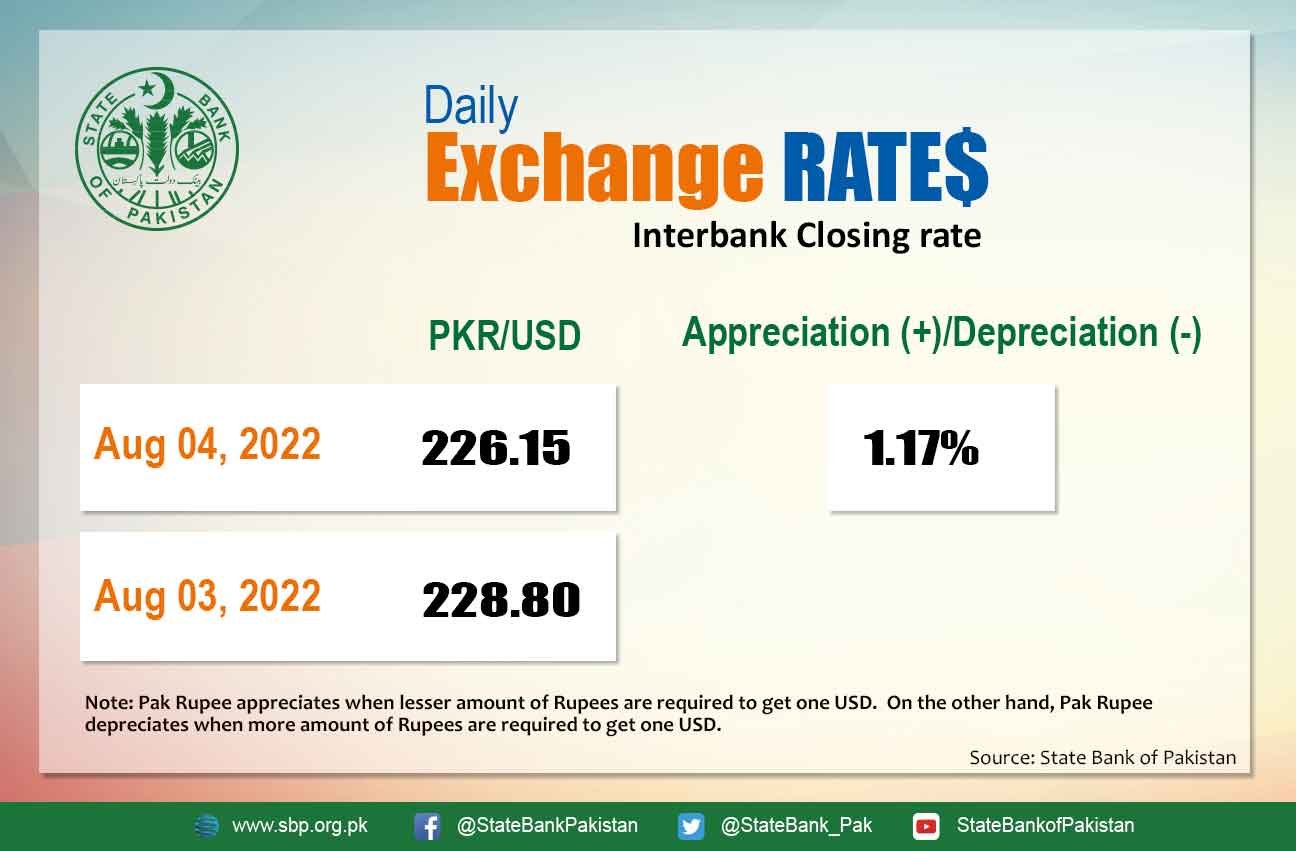
    The Pakistani rupee increased against the US dollar for the fifth day in a row, rising Rs2.65 to close at Rs226.15.

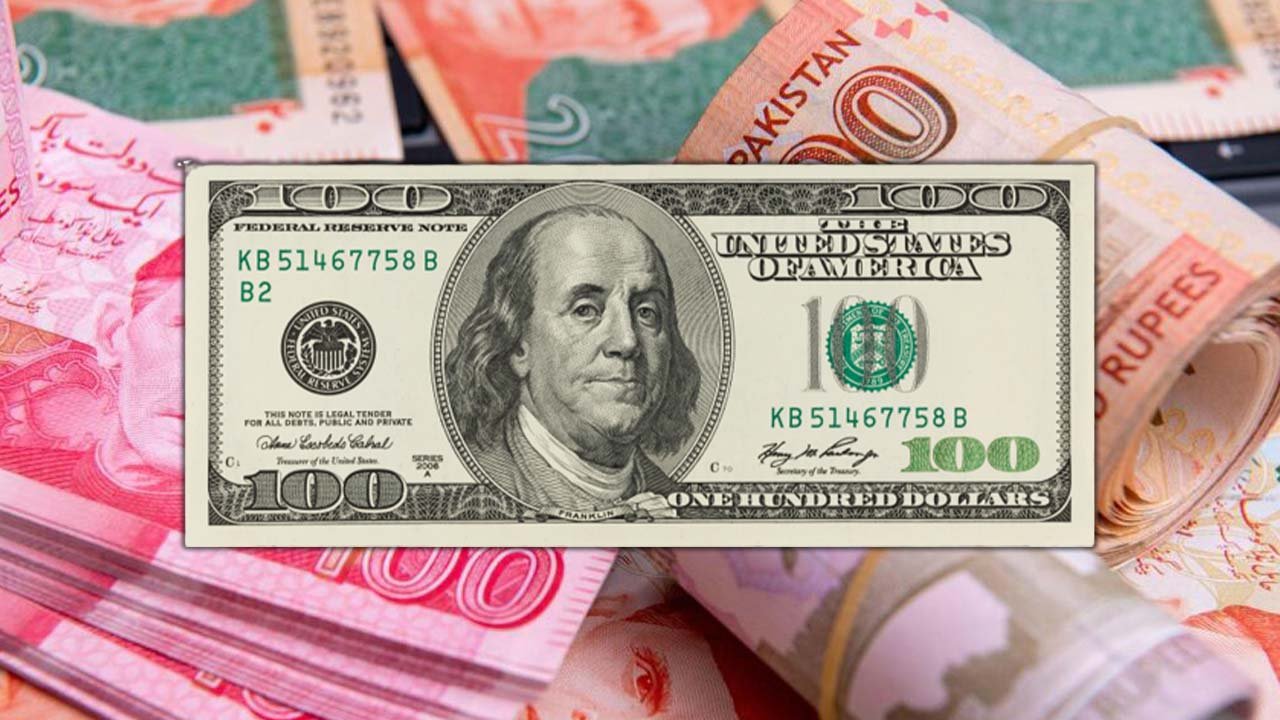
    US dollar to Pakistani rupee rate – 4 August 2022

    As the market opened on a good note and remained optimistic with heavy volumes in nearly all sectors for a while, the benchmark KSE-100 likewise rose up to 500 points before 12:00 pm. However, as of 1:40 pm, the market fell by 290 points.

    On Wednesday, the rupee gained the most against foreign currencies in a single day, ending the day at Rs228.80. The dollar’s decline versus the rupee reached its biggest level since November 2, 1998, when it dropped by Rs5.10.

    The local currency is strengthening as a result of increased export inflows and reduced import expenditures, with optimism that the cash-strapped nation was getting closer to winning an IMF bailout bolstering confidence.

    A board meeting is provisionally scheduled for late August after sufficient finance assurances are secured, according to a statement released on Tuesday by Esther Perez Ruiz, the IMF’s Resident Representative for Pakistan.

    Read more: Pakistan rupee appreciates Rs9.58 against US dollar, closes at Rs228.8

    The dollar may devalue between Rs180 and Rs190 against the Pakistani rupee if the IMF releases the $1.2 billion tranche in August, according to Malik Bostan, chairman of the Exchange Companies Association of Pakistan (ECAP).

  • Pakistan rupee appreciates Rs9.58 against US dollar, closes at Rs228.8

    Pakistan rupee appreciates Rs9.58 against US dollar, closes at Rs228.8

    The US dollar dropped Rs9.58 during Wednesday’s session, closing at Rs228.80 versus the rupee, down from Rs238.38 at Tuesday’s interbank close.

    On the other hand, the greenback depreciated Rs14.50 in the open market, closing at Rs226, according to the Forex Association of Pakistan.

    Following comments from an IMF official that Pakistan has met its final requirement by raising the tax on fuel prices on July 31, the Pakistan Stock Exchange (PSX) on Wednesday also experienced a bullish trend as the KSE-100 index rose 1016 points.

    The KSE-100 index increased by 1016 points to trade at 41,208. Experts claim that the rupee’s progressive strengthening was also responsible for the market’s increased confidence.

    Pakistan had raised the petroleum development levy (PDL), according to Esther Perez Ruiz, the IMF’s resident representative in Islamabad, completing the final previous action needed for the Fund’s combined seventh and eighth assessment.

    “With the increase in PDL on July 31, the last prior action for the combined seventh and eighth review has been met. The [Executive Board] meeting is tentatively planned for late August once adequate financing assurances are confirmed,” she said in a statement.

    Read more: Intraday trade: US dollar sheds Rs7.38 against Pakistani rupee

    The $6 billion agreement, known as the Extended Fund Facility (EFF), was signed by Pakistan and the IMF in 2019.

    However, since the IMF voiced concerns about Pakistan’s adherence to the agreement early this year, the disbursement of the combined seventh and eighth tranche has been put on hold.