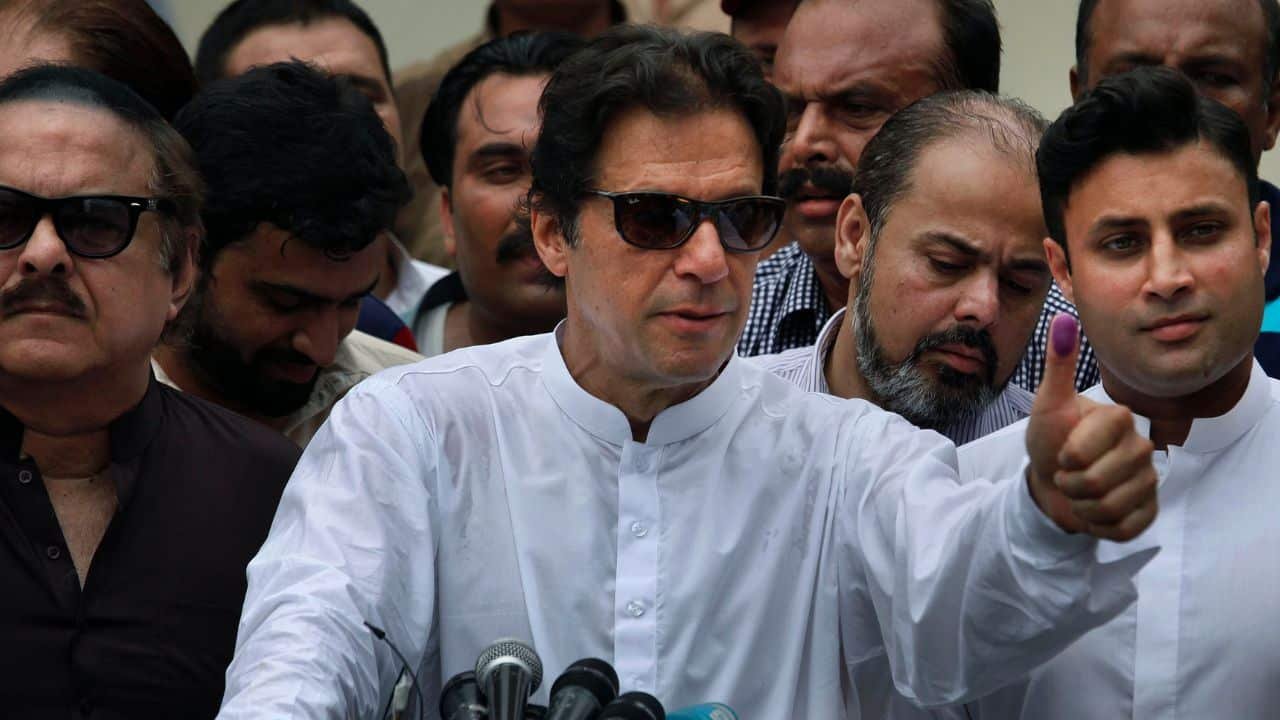
Tag: Pakistan Tehreek e insaf

  • PML-N will emerge as the biggest party in election, government survey

    PML-N will emerge as the biggest party in election, government survey

    A review report of a government organization has revealed that in the general elections to be held on February 8, Pakistan Muslim League-Nawaz (PML-N) will emerge as the largest party, followed by the Pakistan Peoples Party (PPP). The third in line is Pakistan Tehreek-e-Insaf (PTI) while other parties will follow.

    Geo’s Umar Cheema reported an official who spoke to The News on the condition of anonymity and said that the government body came up with the analysis based on information gathered through interviews with police sources, revenue department, labor unions and professionals in various sectors.

    He explained that the review has been carried out at the police station and union council level. The survey has been done scientifically to remove the possibility of wrong estimates, although the popularity rate of PML-N has been lower in the surveys conducted so far. An optimistic estimate has been made as the party has recorded an increase in popularity since the return of Nawaz Sharif, but no one has so far given an estimate of how many seats the party can win.

    International media has also presented Nawaz Sharif as the future prime minister, but whether he will be able to get a simple majority or not is not clear. According to this official assessment, the PML-N will bag between 115 and 132 seats in the National Assembly.

    The inclusion of reserved seats for women and minorities would mean that the party would have a chance to form a government alone with a simple majority. It can get close seats, which means PML-N can get a complete majority in the provincial assembly.

    PML-N can make a clean sweep in Punjab except for a few districts, says the survey.

    According to the estimate, PML-N will form a government with a possible two-thirds majority in Punjab, PML-N will succeed in forming coalition governments in Khyber Pakhtunkhwa and Balochistan, while the PPP has the possibility of forming a government only in Sindh.

    The review report says that PPP can get 35 to 40 seats at the center while the independent candidates of PTI can get between 23 to 29 seats. MQM may get 12 to 14 seats, JUI six to eight seats, Q-League and Satwat Pakistan Party are expected to get two to three seats in the National Assembly.

  • Bushra Bibi doesn’t want to live in Bani Gala

    Bushra Bibi doesn’t want to live in Bani Gala

    Bushra Bibi, the wife of Pakistan Tehreek e Insaf (PTI) founder chairman Imran Khan, has lodged a challenge against the authorities’ decision to confine her to her Bani Gala residence to serve a 14-year sentence in the Toshakhana case.

    Previously detained at the sprawling residence, Bushra Bibi was imprisoned last month following an accountability court’s ruling that sentenced the couple to 14 years in jail in connection with the Toshakhana case.

    In response to a request from the Adiala jail superintendent, authorities designated the Bani Gala house as a sub-jail for the former first lady’s confinement.

    Both Bushra Bibi and Imran Khan were handed a 14-year jail term by Judge Muhammad Bashir in the Toshakhana case, which pertains to the illegal sale of state gifts.

    In a recent petition, Bushra Bibi expressed her willingness to serve her sentence in ordinary jail premises at Adiala rather than the declared sub-jail at her residence, emphasizing her readiness to undergo punishment like any other political worker of the party.

    Furthermore, she cited concerns about her safety in the solitary confinement of the sub-jail premises, highlighting potential security issues for preferring the ordinary jail premises.

    “While the petitioner is in good health currently, however, there has been a movement of unidentified people in her house declared as a sub-jail by the Government thereby contributing to her sense of insecurity,” the application claimed.

    Bushra Bibi said the “special treatment” afforded to her goes against the spirit of equality guaranteed under the Constitution and is consequently discriminatory.

    Given the stated reasons, the petitioner pleaded with the court to set aside notification to declare her house sub-jail and shift her to Adiala Jail in the “interest of justice”.

  • PPP claims police detained Bilawal Bhutto’s supporters in NA-127 Lahore

    PPP claims police detained Bilawal Bhutto’s supporters in NA-127 Lahore

    The Pakistan People’s Party (PPP) has written a letter to Chief Election Commissioner (CEC) Sikandar Sultan Raja, claiming that police are arresting their supporters in Lahore’s NA-127 constituency, where party Chairman Bilawal Bhutto Zardari is contesting in the February 8 elections.

    PPP Secretary General Taj Haider wrote a letter to ECP claiming that detention of PPP supporters by the police has instilled fear in the constituency.

    The letter mentioned that the police arrested Shahbaz and Shahzad, workers of the Pakistan Tehreek-e-Insaf (PTI), for joining the PPP. They also arrested Khalida Parveen, a former counsellor of the Pakistan Muslim League-Nawaz (PML-N), for supporting the PPP. When they reached out to the police, they were told that Parveen had been arrested in a case filed against her four months ago.

    Haider said PPP’s Zulfiqar Badar contacted high officials for the release of the party activists, but to no avail. He feared that the fascist measures would multiply if police were not stopped.

    The PPP leader requested that the CEC issue an order for releasing PPP workers and take action against the culprits.

    The PPP chairman is contesting elections from the same constituency against PML-N’s Atta Tarar.

  • Government says hundreds of social media accounts involved in anti-judiciary campaign

    Caretaker Information Minister Murtaza Solangi stated on Monday that the government has identified over 500 social media accounts involved in a campaign against the judiciary.

    “Action will be taken against those involved in the recent malicious campaign against Supreme Court (SC) judges, in accordance with the law and constitution,” he said, talking to media in Islamabad while he was flanked by the Pakistan Telecommunication Authority (PTA) and Federal Investigation Agency (FIA) officials.

    Solangi said that after the decision of the SC on the electoral symbol “bat” of Pakistan Tehreek-e-Insaf (PTI), a vicious campaign was started against the judiciary.

    “Article 19 of the Constitution marks a boundary for freedom of speech,” he stated.

    On the other hand, PTA officials said that it has the authority to remove objectionable content from social media. He also said that awareness regarding the use of social media is essential, as most people spread lies on social media platforms without any authentic information.

    “Social media’s outreach is enormous and easy, but people are not aware of its utility,” he said.

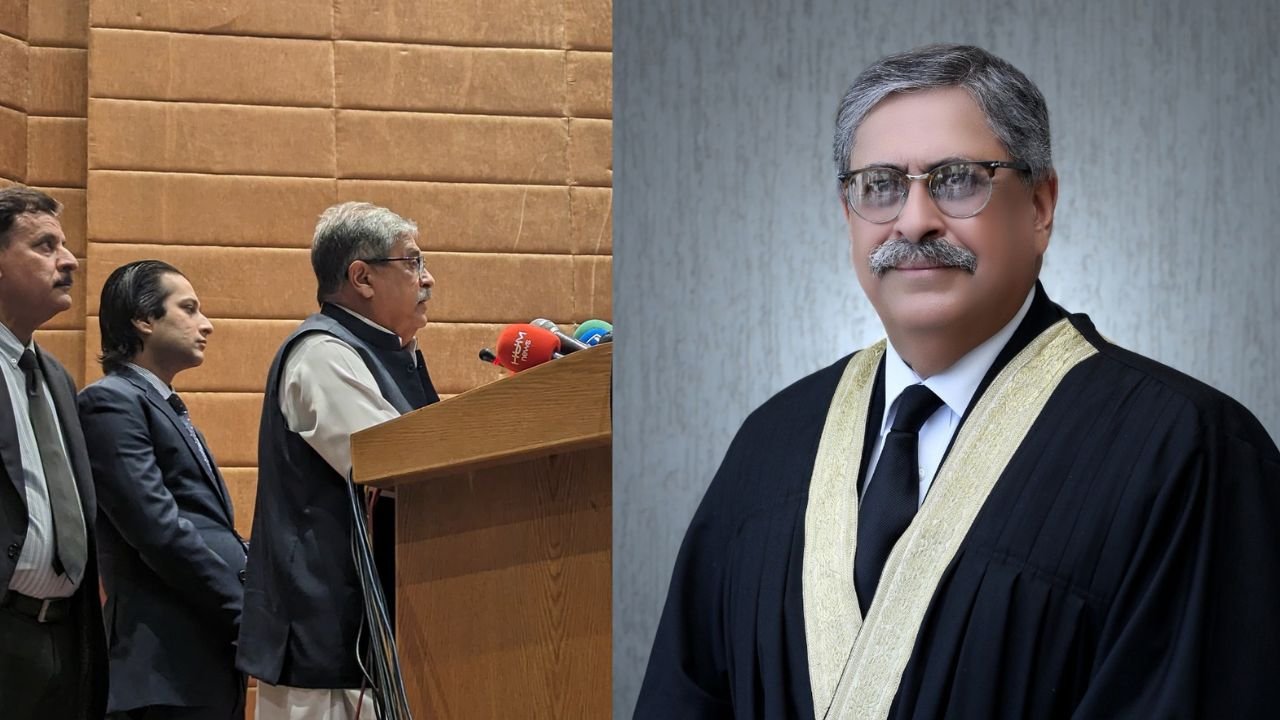
  • ‘Judge who is affected by criticism on social media violates his oath’: Justice Athar Minallah

    ‘Judge who is affected by criticism on social media violates his oath’: Justice Athar Minallah

    Supreme Court Justice Athar Minallah, addressed a seminar on the significance of freedom of expression on Saturday, shedding light on its historical context and impact on Pakistan’s trajectory.

    The seminar, a part of the second law bridge workshop on superior court reporting, provided a platform for Justice Minallah to share his insights on the intersection of freedom of expression and judicial independence.

    Expressing his concern over the potential influence of social media on judicial decision-making, Justice Minallah asserted the importance of maintaining judicial independence, stating that any judge swayed by social media violates his/her oath and called upon fellow jurists to remain resolute in upholding justice despite external pressures.

    Addressing the delicate balance between constructive criticism and trust in the judiciary, Justice Minallah emphasized that critics should retain faith in the legal system, considering it a litmus test for its strength.

    He welcomed constructive criticism while underscoring the need to strike a balance in fostering trust in the judiciary.

    Reflecting on the challenges of freedom of speech in the country, the Chief Justice traced the roots of censorship to historical actions following Quaid-e-Azam Muhammad Ali Jinnah’s speech on August 11, 1947. He stressed the necessity of balancing freedom of expression with responsible reporting to navigate these challenges.

    Sharing a personal anecdote from his early days as a judge, Justice Minallah recounted a case involving a 16-year-old accused of displaying a banner against a senior apex court judge.

    He highlighted the importance of judiciously addressing such incidents and cautioned against making blanket judgments without thorough investigations.

    “When the matter of the 18th constitutional amendment was raised, many forces were against it. A reporter asked me, what will the Supreme Court do about the 18th Amendment. I replied ‘In my opinion, the SC should not interfere in the constitutional amendment’,” he said.

    The apex court judge said he had said he would resign if the 18th amendment was annulled and the next day news was published that “Athar Minallah has threatened the court”.

    Citing former Ugandan president and the modern world history’s most brutal dictator, Idi Amin, Justice Minallah said, “A society is ruined, if someone gags freedom of expression like Idi Amin.”

  • PTI’s “Baingan Campaign” is ruling Twitter like no other

    Pakistan Tehreek-e-Insaf (PTI) has always remained ahead of others when it comes to the use of social media in Pakistan’s political landscape. As for elections 2024, the party has not been given one symbol, in fact, candidates have different symbols now. Making the best of bad circumstances, the party has come up with entertaining campaigns that are enthralling Twitter (now X).

    Baingan (desi name for eggplant) is ruling the internet, surpassing all levels of creativity with this campaign. The symbol has been allotted to Alamgir Khan in Karachi and Amir Mughal from Islamabad. The constituency of the former is NA 236 and that of the latter is NA 46.

    The chant they have invented is “Ab zulm ka badla baingan se, ab sitam ka badla baingan se.”

    The candidates have designed posters of an eggplant in varying ways. Alamgir Khan shared a video of an Indian animated film of a farmer and his wife getting rich by cultivating eggplant in their farm. That has people in fits.

    Alamgir also posted a funny video from a Bollywood film where he showed how the opposition (previously PDM) was seen beaten up by PTI.

    Amir Mughal also posted about how baingan will be seen everywhere as he posted a picture of a baingan being placed among flowers.

    An internet user even used a clip of the army chief along with ex-Prime Minister Shehbaz Sharif to promote Baingan.

    Another user showed his appreciation for baingan by making it a part of his salad with PTI engraved in it.

    Netizens used a clip of the Pakistani drama where a mother was telling her daughter about the benefits of baingan from making the skin glow to bone strength.

    Arsalan Khan, a twitter user, incorporated all the symbols including vegetables in a video of a man relating his recipe of making eggplants.

    A user even shared the picture of a baingan and rhymed his chant as, Baingan stands tall, a symbol for all.

    Twitter is enjoying the new trend of #voteforbaingan as a user commented: “I bet they’re regretting giving him the baingan symbol. This is hilarious.”

    A user even tagged Alamgir Khan and said he better has a feast of dishes having baingan at his constituency.

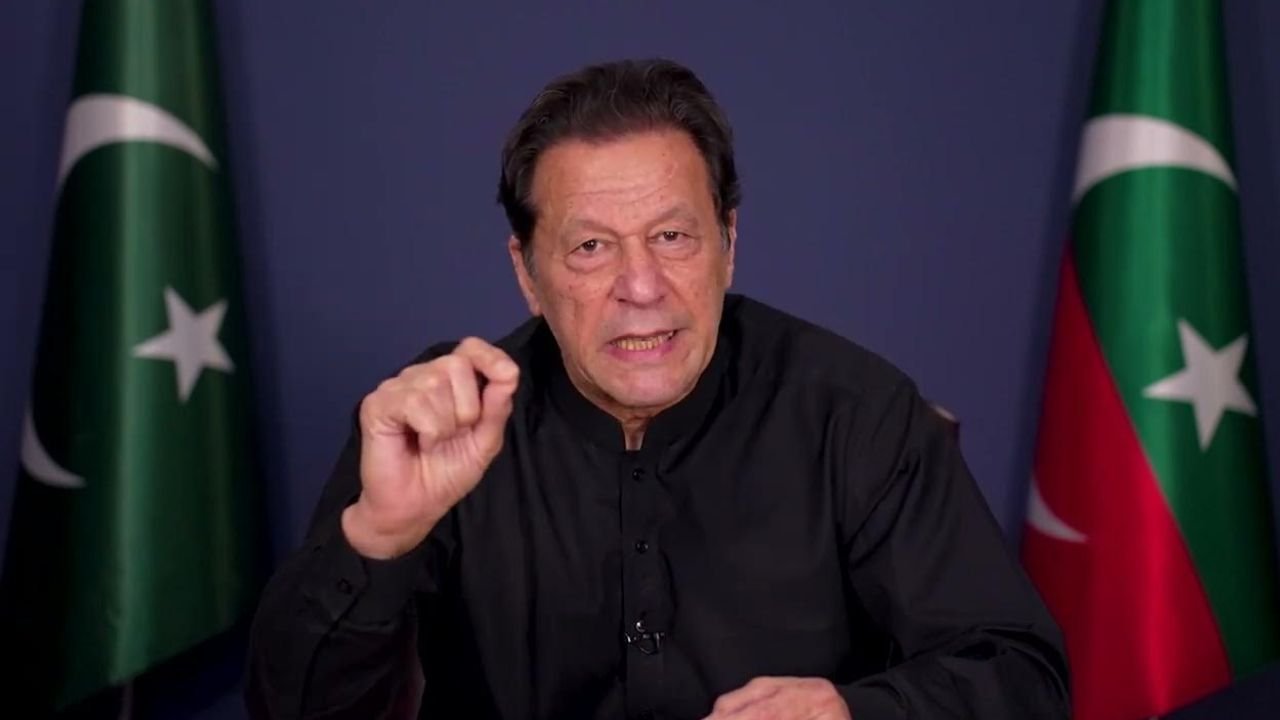
  • Imran Khan’s message to the nation from Adiala Jail

    Imran Khan’s message to the nation from Adiala Jail

    In a message to the nation released from Adiala Jail, the Founder Chairman of Pakistan Tehreek-e-Insaf (PTI), Imran Khan, talked passionately about the upcoming general elections, highlighting the significance of February 8 as a day that symbolizes the dichotomy between freedom and slavery.

    Expressing confidence in the resilience of the nation, Khan stated, “I believe that my people stand united with the cause of freedom. Through their votes, they will safeguard Pakistan’s liberty.”

    Drawing attention to electoral manipulation on February 8, the Chairman voiced concern that a faction seeks to shackle the nation in chains of slavery.

    He pointed out that under what he calls the London Plan, a certified criminal was brought back to the country unjustly, wreaking havoc on the judicial system and trampling on the principles of justice and the constitution.

    Khan emphasized that efforts to manipulate the electoral process and undermine the rule of law have jeopardized the nation’s democratic foundations.

    Khan lamented that despite snatching the ‘bat’ from PTI to accommodate rivals, worst rigging is happening.

    Acknowledging the resilience and courage displayed by mothers, sisters, daughters, and party workers in facing injustice, the Chairman pledged to defeat all criminals within the bounds of the law and constitution, with the support of Allah and the nation.

    From his jail cell, the Chairman asserted that, with the blessings of Allah and the support of the people, all these criminals would be defeated, maintaining the integrity of the legal system.

    He urged citizens to exercise their right to vote on February 8, endorsing the movement for governance by law, supremacy of the constitution, and the restoration of democracy.

    The former Premier cautioned against unconstitutional forces attempting to subjugate the nation, warning that if these anti-constitutional powers succeed on February 8, they will establish a regime of theft and plunge the country further into turmoil.

    He called upon the people to exercise their voting power on February 8, making a decisive choice between freedom and slavery.

    “I want every individual in the nation to prepare, cast their votes, and ensure the protection of their votes, securing Pakistan’s path to constitutional governance on February 8,” Khan said.

  • Why are electoral symbols important, and how does ECP allot them to candidates?

    Why are electoral symbols important, and how does ECP allot them to candidates?

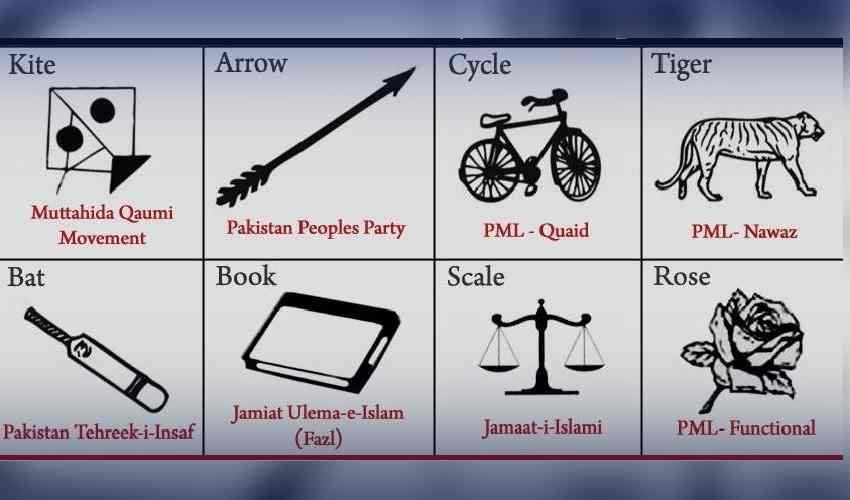
    Electoral symbols are allocated by the Election Commission of Pakistan (ECP) to political parties and independent candidates participating in general elections.

    Major political parties in the country have established electoral symbols, including a bat for Pakistan Tehreek-e-Insaf (PTI), an arrow for Pakistan People’s Party (PPP), and a tiger for Pakistan Muslim League-Nawaz (PML-N).

    All the electoral symbols appear on the ballot paper, giving the voters the choice to stamp the symbol of their choice. The ballot paper also has names, but 40% of the country’s 241 million population is illiterate, so symbols can be easier to identify.

    Thousands of candidates participate in elections, as do dozens of political parties and millions of voters. A single ballot paper offers voters a wide range of choices.

    How does the ECP allot electoral symbols?

    According to Section 216, political parties can submit an application to the election commission to apply for electoral symbols.

    Registered political parties can claim the same election symbol as allocated to them in the previous polls.

    On the other hand, an independent candidate can apply for allotment of an election symbol from the symbol list published by the ECP.

    If the two independent candidates want the same electoral symbol, then priority will be given to the candidate who has previously taken part in elections.

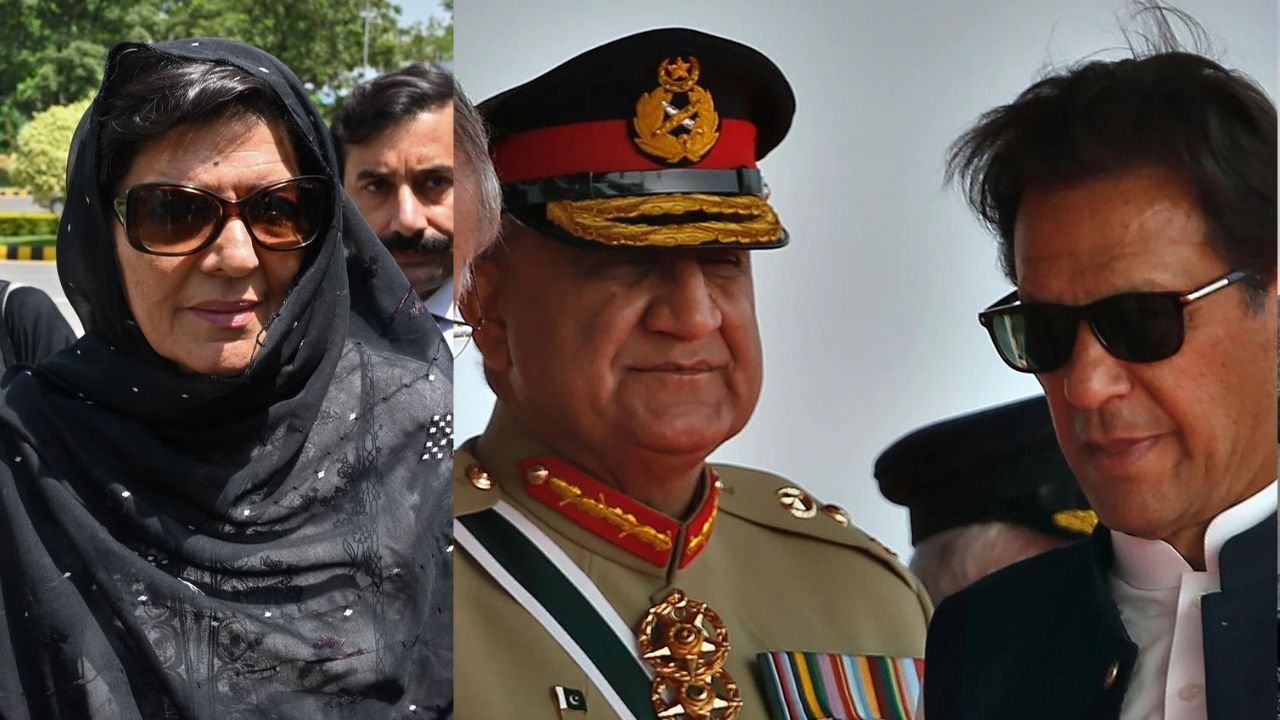
  • ‘Imran Khan was offered a two-third majority by Bajwa to end protests in August 2022’, Aleema Khan

    ‘Imran Khan was offered a two-third majority by Bajwa to end protests in August 2022’, Aleema Khan

    Aleema Khan, the sister of former Prime Minister Imran Khan disclosed on Wednesday that her brother had once previously, received a message from the then Chief of Army Staff (COAS), General (retd) Qamar Javed Bajwa.

    The message reportedly offered a two-thirds majority in the National Assembly to Imran’s political party, Pakistan Tehreek-e-Insaf (PTI), if he agreed to end the nationwide protest he initiated after his ouster from the Prime Minister’s Office.

    PTI USA’s official account on X (former Twitter) posted, “In August 2022, General Bajwa, who was the COAS at the time, asked Imran Khan that if he stops talking about the conspiracy of regime change operation, which overthrew Khan’s government in April 2022, then PTI will be “allowed” to form a majority government in the upcoming elections. However, if Imran Khan doesn’t agree to stay quiet, then PTI will be reduced to only 30 seats.”

    Imran Khan launched a countrywide protest in April 2023, becoming the first prime minister in Pakistan’s history to be removed through a no-confidence vote.

    Despite governing the country for over three-and-a-half years, PTI faced challenges as allies defected, aligning with opposition parties that collectively sought to overthrow the PTI government.

    The former PTI chief had previously asserted that the conspiracy against his government originated within Pakistan, a departure from his earlier stance in which he had blamed the United States for his removal.

    During a media interaction after meeting Imran Khan at Adiala Jail, Aleema Khan shared the details of the alleged offer. She quoted her brother, saying, “In August 2022, General Bajwa approached me with an offer that if PTI ceased protests against regime change, a two-thirds majority for the party would be ensured in the National Assembly.”

    Imran Khan, according to Aleema Khan, expressed his unwavering commitment to principles, stating, “Our parents were born in a slave country; we are free, and I will not bow before anyone except God. We should face death than to accept slavery in a free country.”

    Aleema Khan also shed light on the challenges Imran faces in jail. She criticized the lack of an open trial in Adiala Jail, asserting that the cases against Imran Khan lacked substance. She further claimed that new cases are being brought up whenever he secures bail in an old case, suggesting a deliberate effort to keep the former prime minister incarcerated.

  • Imran Khan casts doubt on election legitimacy in an article written from jail

    Imran Khan casts doubt on election legitimacy in an article written from jail

    In a recent article for The Economist, Imran Khan, the founder and former chairman of Pakistan Tehreek-e-Insaf (PTI), currently incarcerated, has expressed apprehensions about the legitimacy of the upcoming elections in Pakistan.

    Khan argues that the caretaker governments in place at both the federal and provincial levels are constitutionally illegal due to their failure to hold elections within 90 days of dissolving parliamentary assemblies.

    While the public is anticipating elections on February 8, Khan, who has faced various challenges since a vote of no confidence in April 2022, raises skepticism about the electoral process.

    He points to the election commission’s actions, which he claims include defying the Supreme Court, rejecting PTI nominations, hindering internal party elections, and initiating contempt cases against PTI leaders for criticizing the commission.

    “The country’s election commission has been tainted by its bizarre actions. Not only has it defied the top court but it has also rejected my Pakistan Tehreek-e-Insaf (PTI) party’s nominations for first-choice candidates, hindered the party’s internal elections and launched contempt cases against me and other PTI leaders for simply criticising the commission,” he wrote.

    Khan contends that since his government’s removal, orchestrated by what he terms as “the establishment”—comprising the army, security agencies, and civil bureaucracy—the playing field for PTI has been anything but level. He alleges external interference, specifically from the United States, citing a State Department message urging his removal from the prime minister’s seat.

    Despite subsequent protests and electoral victories in by-elections, Khan argues that the administration that replaced his government led to economic downturns, inflation, and currency devaluation within 18 months. He emphasizes the contrast between PTI’s governance, which garnered international praise, and the subsequent administration’s economic performance.

    Khan claims that various measures have been taken to sideline him politically, including assassination attempts, abductions of party members, and legal harassment. Despite facing nearly 200 legal cases and being denied a normal trial, Khan states that PTI remains popular, with a 66 per cent approval rating, according to a recent poll.

    The former prime minister also raises concerns about the return of Nawaz Sharif, a convicted former prime minister, speculating that Sharif may have struck a deal with the establishment for support in the upcoming elections.

    Khan, who remains incarcerated on charges including treason, expresses doubt about the fairness of the electoral process, claiming that PTI is being denied its basic right to campaign.

    He concludes by advocating for fair and free elections, “The only viable way forward for Pakistan is fair and free elections, which would bring back political stability and rule of law, as well as ushering in desperately needed reforms by a democratic government with a popular mandate. There is no other way for Pakistan to disentangle itself from the crises confronting it. Unfortunately, with democracy under siege, we are heading in the opposite direction on all these fronts.”

    The Economist added an Editor’s Note stating, “The Pakistani government and the U.S. State Department deny Khan’s allegations of American interference, and Khan faces charges under the Official Secrets Act.”