Tag: Pakistan

  • 13 years later, Hassan and Bano’s tragic love story in ‘Dastaan’ is still a fan favourite

    Television in Pakistan went through a seismic shift when 13 years ago, the drama ‘Dastaan’ debuted on our screens. Featuring a star-studded cast like Fawad Khan, Sanam Baloch, Saba Qamar and Ahsan Khan, the series was an adaptation of the novel ‘Bano’ by Razia Butt, an exploration of the aftermath of the subcontinent’s partition.

    The main leads, Hassan (played by Khan) and Bano (played by Baloch), are two lovers who meet when their relatives Suraiya and Salim get married. At first Hassan tries to befriend Bano, but Salim refuses to let them marry because he wants to marry her off to another man. However, just as their families approve and both are engaged, Hassan has to leave for University, and then the partition of 1947 takes place after which their lives are completely changed.

    Pakistani dramas today can’t seem to move on from saas-bahu kay jhagray and toxic love stories where women are nothing but a prop for men, so many remember the magic of ‘Dastaan’ especially the tragedy of the love story between Hassan and Bano.

    A viral tweet on Twitter had asked about a couple from a drama series that had devastated them, and the most popular reply in the Pakistani context had to be Hassan and Bano’s tragedy from ‘Dastaan’.

    https://twitter.com/MaryamAmir59627/status/1647221392369147906?s=20

  • After ‘Kuch Ankahi’, ‘Fairy Tale’, Is 2023 the year we’re finally not glorifying toxic masculinity?

    We have been wasting our breath for years, criticising the entertainment industry and asking it to stop scraping the bottom of the barrel to give us another done-to-dust drama about saas-bahu jhagray. It seems like somebody has been listening to our laments. Recent serials, starring the likes of actors such as Mira Sethi, Ali Safina and Wahaj Ali, have us wondering whether the industry has finally begun to understand that toxic masculinity is not something to glorify or even a trait that women think is swoon worthy?

    In the disastrous year that was 2022, we got drama after drama with the same topic: bad boy meets good girl, he’s broken and needs fixing which apparently no therapist can do, his severe mommy issues need to be resolved by some naïve girl who has lived under a bunker all her life and is now the saviour she never signed up to be.

    However, this year with dramas like ‘Kuch Ankahi’, the popular Ramzan show ‘Fairy Tale’ and even Wahaj Ali’s hit ‘Mujhe Pyaar Hua Tha’, main leads are stepping away from toxic characteristics that symbolized what patriarchy thinks an ideal man must be like. Instead, men in these dramas are gentler, caring about the women they love and showcasing that being a man is not about being loud and brash, but infact it is about how attentive you are to the people around you.

    ‘Kuch Ankahi’ was like a breath of fresh air for audiences who were nostalgic for the days of Haseena Moin dramas, where the women were fearless and outspoken, not props to the men around them. The women in ‘Kuch Ankahi’ come in different shades of femininity: Samia is a shy homebody who wants to fulfil her parents wishes and get married to the man they pick, while Aliya is the complete opposite because she’s a headstrong, career-obsessed woman who wants to succeed in her retail-estate business. Their differences don’t prevent the siblings from bonding with each other or from standing up for their families. Many have praised the series for depicting a healthy relationship between siblings and called it the desi version of ‘Little Women’.

    https://twitter.com/decalsajal/status/1614558374787432456?s=20

    But what is also heartening to witness in ‘Kuch Ankahi’ is how all the men in the dramas are gentle and actively work around the family, rather than the typical men who lounge around, while the women cook. Agha Ji, the patriarch, champions his daughters, refrains from asking them to do his chores and continuously encourages the girls to pursue their dreams.

    Bilal Abbas’ character, Salman, Aliya’s professional rival in the drama, is also a fan favourite. He’s ambitious but he never resorts to sexist or demeaning jokes to push her out of the game. He is also respective and caring to his mother and even pulls his weight by helping around the house.

    Among the current on-going Ramzan dramas, ‘Fairy Tale’ has been winning hearts across Pakistan because of how it has re-written the grumpy x sunshine trope in a humorous, addictive story where the women lead the show and where the male lead treats women with respect.

    If audiences were left horrified when the male lead from last year’s ‘Kaisi Teri Khudgarzi’ forced the female lead to keep repeating his name in exchange for her dad’s release, this time they have better content to cheer on. Many Twitter users have found Farjaad’s dedication to Umeed quite moving as he keeps coming back to her despite convincing himself that they’re too different.

    We can not say that we’re okay with the current pacing of ‘Mujhe Pyaar Hua Tha’ and how the storyline features the trope of the selfish female lead and the money-obsessed mother-in-law, but credit to Wahaj Ali’s character Saad, the anti-thesis of the typical misogynist Pakistani male lead, if ever there was one. He refuses to engage in abuse or violence to pressurize the woman he likes to be with him, instead supporting Maheer in all of her decisions.

    Might we be witnessing the rebirth of the golden age of Pakistani dramas? Fingers crossed .

  • ‘Ill-informed, ignorant, wanted to blame Pakistan for Pulwama’: Former Indian Governor on Modi

    ‘Ill-informed, ignorant, wanted to blame Pakistan for Pulwama’: Former Indian Governor on Modi

    Satya Pal Malik, the last governor of the now Indian Illegally Occupied Jammu and Kashmir (IIOJK) before it was divided has claimed that Indian Prime Minister (PM) Narendra Modi is extremely “ill-informed’.

    Malik, who was governor during the Pulwama terror attack of February 2019 and during the scrapping of Article 370 in August the same year, said that Modi is “ignorant” about Kashmir and told him [Malik] not to speak about the Union home ministry’s lapses which led to the killing of dozens of paramilitary troops in India-held Jammu and Kashmir.

    He said removing Jammu and Kashmir’s statehood was a mistake and it should be restored immediately. He said, “Modi mast hain apne mein – to hell with it! This is his attitude.”

    Conversing with acclaimed Indian journalist Karan Thapar, Malik said during the interview with The Wire, that he immediately realised that Modi wanted to use the Pulwama attack to blame Pakis­tan for the benefit of his government and the Bharatiya Janata Party (BJP).

    The former Indian governor said, “Mein safely keh sakta hoon Prime Minister ko corruption se bahut nafrat nahin hain” (‘I can safely say the PM has no real problem with corruption’). 

    He further revealed that the attack on the Central Reserve Police Force (CRPF) convoy in Pulwama was a result of “incompetence” and “carelessness” by the Indian system, specifically the CRPF and the home min­i­­stry. Malik gave details of how the CRPF had asked for aircraft to transport its personnel, but was refused by the home ministry.

    He said all of these lapses were raised by him directly when Modi called him from outside Corbett Park, shortly after the Pulwama attack. He said the prime minister told him to keep quiet about this and not tell anyone.

  • No more deals with TTP; army determined to get rid of terrorism

    The army’s top brass has vowed to eliminate terrorism, extremism and instability in Pakistan by following a “whole-of-the-system” approach which was approved by the government on Friday.

    In a Corps Commanders’ Conference held in Rawalpindi, Chief of Army Staff (COAS) General Asim Munir said that military leadership is cognizant of the full spectrum of the challenges posed by terrorism and it “resolves to shoulder its constitutionally mandated responsibilities with the support of the resilient people of Pakistan”.

    The top tier of the army reiterated the commitment of military forces to fully support national responses against internal and external threats. 

    A day earlier, in a briefing given to the members of the National Assembly (NA), COAS Munir said that negotiations with militants in the past helped terrorists regroup in the country, referring to the Imran Khan government that signed a ceasefire with Tehreek-e-Taliban Pakistan (TTP).

    Earlier, National Security Committee (NSC) also decided to kickstart an all-out comprehensive operation against militant outfits. 

    Since government talks with the TTP broke down in November, the militant group has intensified its attacks across Pakistan including attacks on the police.

  • Shaheens blows away Kiwis in opener of T20 series

    Shaheens blows away Kiwis in opener of T20 series

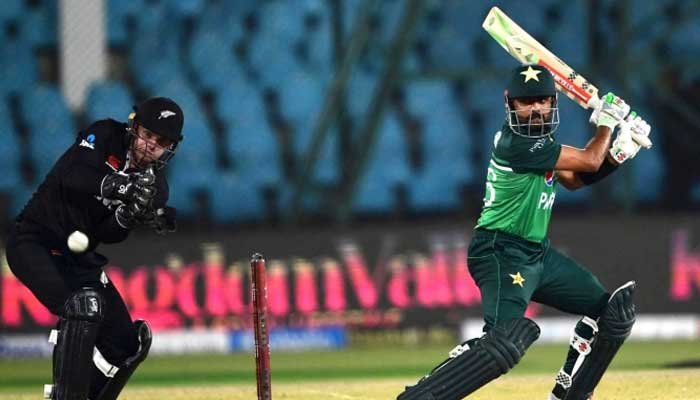
    Pakistan bowled out New Zealand for just 94 runs while celebrating skipper Babar Azam’s 100th match with a boombastic win in the first match of the T20 series.

    The Shaheens set a target of 184 before blowing away the Kiwis with a thumping 88 runs victory.

    Captain Babar Azam scored only nine runs but Fakhar Zaman and Saim Ayub stabilised the team, scoring 47 runs each while putting up a 79-run partnership for the third wicket to anchor Pakistan to 182 all out in 19.5 overs.

    Fast bowler Haris Rauf, one of five players who returned after being rested in Pakistan’s last series against Afghanistan, took career best figures of 4-18 as New Zealand were 94 all out in 15.3 overs.

    Left-arm spinner Imad Wasim finished with 2-2 in his only over — taking both his wickets off successive deliveries.

    Mark Chapman top-scored for the Kiwis with a 27-ball 34, inclusive of four boundaries and a six, while skipper Tom Latham made a 24-ball 20.

    Rauf’s previous best T20 figures of 4-22 had also come against New Zealand in Sharjah in 2021.

    Azam heaped praise on his bowling unit for sending the Kiwis back to the pavilion.

    “The pitch was assisting the bowlers so it was a good batting performance to get that total and then our complete bowling unit was excellent,” said Azam, happy at reaching the personal landmark of 100 T20 matches.

    “I had never expected this. I still remember the journey of starting off here as a ball-boy on the side-lines, and to now be here, it is a huge honour,” said Azam of serving as a ball-boy during the 2007 series against South Africa.

    Latham said his team did not adapt to the different conditions.

    “We did not quite adapt to the conditions early enough,” said Latham whose team are missing top eight players due to the Indian Premier League.

    “On that surface, the score was slightly above-par. We did not build partnerships with the bat.”

    Earlier, Zaman and Ayub lifted Pakistan from a poor start after they won the toss and chose to bat.

    Pakistan lost both their openers — Mohammad Rizwan leg-before for eight and then Azam bowled at 9– to pacer Adam Milne by the fifth over for just 30.

    Ayub lifted the tempo with two boundaries each off Milne and Ben Lister before he and Zaman hit a six each off spinner Ish Sodhi in the tenth over.

    Zaman struck four boundaries and two sixes in his 34-ball knock while Ayub’s rapid 28-ball innings featured two sixes and six fours.

    Ayub was run out while taking a second run before Zaman was caught at deep square-leg off Sodhi.

    Faheem Ashraf hit a 16-ball 22 while Wasim scored 16 off 13 balls to help Pakistan add 47 runs in the last five overs.

    New Zealand pacer Matt Henry took a hat trick in his figures of 3-32.

    Henry dismissed Shadab Khan (five) and Iftikhar Ahmed (nought) off the last two deliveries of his third over and then Shaheen Shah Afridi with the first of his fourth.

    Lister had figures of 2-30 while Milne finished with 2-51.

    The remaining four matches are in Lahore on April 15 and April 17 and Rawalpindi on April 20 and 24.
  • Pakistan to receive $2 billion deposit from Saudi Arabia in State Bank within next few days

    Pakistan to receive $2 billion deposit from Saudi Arabia in State Bank within next few days

    Muhammad Jawad Sohrab Malik, the Special Assistant to the Prime Minister, had a meeting with Nawaf bin Said Al-Malki, the Ambassador of the Kingdom of Saudi Arabia to Pakistan, in Islamabad. The objective of the meeting was to discuss the ways to enhance bilateral collaboration between the two countries.

    During the meeting, Jawad expressed gratitude for Saudi Arabia’s consistent support for Pakistan. He thanked the ambassador for confirming that the $2 billion pledged by the Kingdom would be deposited within the next seven working days in the SBP account. Both parties showed a commitment to strengthening bilateral ties between Pakistan and Saudi Arabia.

    The SAPM highlighted the significance of Saudi Arabia’s assistance and stated that the $2 billion loan would help Pakistan overcome the current financial crisis. He further explained that this would pave the way for securing similar assurances not only from the IMF but also from other friendly countries such as the United Arab Emirates, Qatar, and others, which would lead to the much-awaited staff-level agreement (SLA) with the IMF and unlock multilateral disbursements.

    Nawaf bin Said Al-Malki emphasized the Kingdom’s commitment to building long-term, sustainable investment transactions between Saudi Arabia and Pakistan. He reiterated Saudi Crown Prince Mohammed bin Salman’s pledge to increase Saudi Arabian investments in Pakistan’s energy and IT sectors to $10 billion within the next few years.

    The Saudi envoy expressed keen interest on behalf of the Saudi government in recruiting more manpower from Pakistan during the current and next year for various sectors of the kingdom. He stated that the Saudi labor market is continuing to expand, mainly due to the launch of several mega projects under Saudi Vision 2030.

    While highlighting the diverse business landscape in Pakistan, the SAPM expressed that Pakistan has a lot to offer in both the goods and services sectors. He commended the Kingdom’s commitment to providing enhanced employment opportunities for the Pakistani workforce in its future development ventures, as well as the valuable contributions of Saudi FDI in boosting the country’s economic outlook.

    During the meeting, both dignitaries engaged in fruitful discussions on the further strengthening of bilateral business relations, recruitment of more workforce from Pakistan, and enhancing FDI in potential sectors of the economy. Both the Saudi Ambassador and SAPM Jawad Sohrab Malik expressed confidence that their discussions would pave the way for a new era of deeper and more meaningful collaboration between Pakistan and Saudi Arabia.

  • IMF seeks further assurances from Pakistan despite Saudi Arabia and UAE confirmation

    IMF seeks further assurances from Pakistan despite Saudi Arabia and UAE confirmation

    The International Monetary Fund (IMF) is seeking further assurances from Pakistan, despite confirmation of financial assistance from Saudi Arabia and the United Arab Emirates (UAE), to ensure that Pakistan has met the condition of arranging $6 billion financing in order to reach a staff-level agreement.

    Nathan Porter, the IMF’s Mission Chief to Pakistan, welcomed the announcement of financial assistance from the two “key” friendly countries, stating that the IMF supports the efforts of the Pakistani authorities. A Pakistani delegation is currently in Washington attending the Spring meetings of the IMF to discuss the revival of the loan programme. Pakistan’s Finance Minister Ishaq Dar was unable to attend due to domestic issues.

    Pakistan had been asked to arrange $6 billion in external financing, which it needed from now until June to avoid default. Saudi Arabia has pledged $2 billion, while the UAE has committed $1 billion, thus reducing the now-required amount to $3 billion. Pakistan’s foreign exchange reserves have fallen to cover barely a month of imports after the IMF funding stalled in November, hit by snags over fiscal policy adjustments after officials of the lender visited Islamabad in February for talks. The IMF programme will disburse another tranche of over $1 billion to Pakistan before it concludes in June.

    IMF’s Director of the Middle East and Central Asia Department, Jihad Azour, during a press conference, briefed the media about the current status of the $6.5 billion programme with Pakistan, saying that Pakistan is at a critical juncture and decisive actions are required to stabilise the economy. Azour emphasized the need for Pakistan to address inflation, reduce the constraints on trade and export, and maintain macroeconomic stability. He also stated that financing is required, and the financing needs are about what is currently in the programme, and the IMF is working with the authorities and bilateral supporters of Pakistan to ensure that the financing needs for the programme and beyond are assured.

    Central bank governor Jameel Ahmad told investors in Washington at the spring meetings of the lender and the World Bank that programme loans from other multilateral agencies await completion of the IMF review. Pakistan is at a critical juncture, and decisive actions are required to stabilise the economy.

  • ‘Imran Khan wanted to stay in power till 2035’: Asif Zardari

    ‘Imran Khan wanted to stay in power till 2035’: Asif Zardari

    Former president and Pakistan Peoples Party (PPP) co-chairman Asif Ali Zardari on Friday alleged that former Prime Minister Imran Khan had wanted to stay in power till 2035 and was planning on doing so.

    Speaking on Geo News’ programme “Capital Talk”, Zardari told Hamid Mir, “They had very different planning. They wanted him to stay in power till 2035. And to counter this move, we [Pakistan Democratic Movement (PDM)] brought in the no-confidence motion against him [Khan].”

    Recalling a conversation with the then Chief of Army Staff, General (retd) Qamar Javed Bajwa, the PPP leader said that he wanted the opposition to go for elections while he will convince Khan to resign. “But amidst this conversation, he kept giving us hints that he would impose martial law. Bajwa sahab said that he can impose martial law in five minutes,” revealed Zardari.

    The PPP leader went on to say that it is easy to climb onto a lion’s back but getting off is very difficult. “We told Gen Bajwa to go ahead with it, you run the country and we will go and continue with agriculture, that’s when he backed off.”

    Talking about general elections, Zardari said that they should be held at the same time across the country, as the federal government and Supreme Court are in a virtual standoff over holding the polls in Punjab and Khyber Pakhtunkhwa.

    “The problem is not that we are afraid of elections,” he said, adding that his party did not have an objection to the poll but its “timing”. The PPP leader maintained that his party had joined the National Assembly with just 14 seats in the past.

    Slamming Khan, the PPP leader said that the political workers stage protests but they do not pick up weapons. He claimed that Khan was not a popular leader, saying that he paid the people.

    The PPP leader revealed that he and PDM chief Maulana Fazlur Rehman had asked Bajwa not to seek resignation from Khan.

  • Maya Ali’s favourite scene from ‘Yunhi’ is a replay of sexist ‘beti ka ghar na raha’

    It’s Friday, Mercury has stopped going in retrograde and everything is going back to normal, except for Pakistani dramas, which will keep scraping the bottom of the barrel to search for sexist content.

    It’s hilarious and yet quite terrifying how dedicated Pakistani dramas are to not provide what their audiences actually want: progressive storylines that recognise women as equals, rather than as props. But what currently popular trending dramas like ‘Yunhi’ prove, the best way to get ratings and to keep eyes glued to screens is to keep peddling the same sexist tropes over and over again and proclaim it as the standard content everyone should watch.

    ‘Yunhi’ began trending on social media this week when the actor playing the female lead on the show, Maya Ali, shared a clip from the latest episode. In it, her character is having an emotional, heart-to-heart with her father (played by fashion designer Deepak Perwani). Judged on performance alone, the scene is definitely tearjerking. However, we made the mistake of unmuting the video and heard the female character discuss how tragic it is for her to leave her father and how happy she is that her mother isn’t alive to see her wedding day.

    We should clarify here that Maya’s character is not heading off to war or to a distant land, but is actually getting married and leaving for her new home.

    Exactly what magical powers does a yellow mayun joraa hold, we want to ask Deepak Perwani, because of which a woman suddenly becomes a shadow of her past self and leaves behind her old family and friends? Does signing a marriage pact suddenly mean that over night, no woman can come back to her old home, and is now just the wife of the man that she has married?

    And most importantly, how is this supposedly tear jerking scene suppose to sit well in a country where women are taught that once they are married, they can never freely visit their families nor can they wear what they want or go where they want? They are not even allowed to escape domestic abuse.

    The message that Maya Ali likes, is once more, a terrifying reminder that for Pakistani families, marriages are basically equivalent to exiling women from their parents’ homes. And that for parents, including the dead mother who Maya is glad isn’t alive to watch her get married, the sole emotional and fundamentally important moment is their daughter getting married, nothing else.

    If these drama creators need any advice to show a rukhsati that actually makes the audience sob, take notes from ‘Kuch Ankahi’. That drama serial included a wedding scene where the phupoo (aunt) passionately defended women’s right to include protective clauses in the nikkahnama, and prove that women do not become strangers to their own families once they get married. They are still individuals with a personality, and definitely more than just the wives of the men they are getting married to.

    https://twitter.com/sunflowermochii/status/1637183811300601858?s=20
  • ‘She’s Pakistani, due respect,’ Adnan Siddiqui schools Priyanka for ignoring Sharmeen Obaid’s nationality

    Pakistani filmmaker Sharmeen Obaid-Chinoy has gone from strength to strength, initially by becoming the first Pakistani and woman of color to first win two Oscars, then to helming Marvel projects and now to taking on the mantle of the first female director to take on the iconic franchise ‘Star Wars’.

    Chinoy’s remarkable achievements have made Pakistanis incredibly proud, putting the country on the global map of the entertainment industry.

    The ‘Star Wars’ announcement has prompted a lot of people to congratulate Chinoy, including local and international stars. However, Hollywood actress Priyanka Chopra’s sentimental note about the director irked a lot of people, including actor Adnan Siddiqui.

    Chopra has shared a note for Chinoy on Instagram, calling her the first ‘South Asian’ woman to achieve such monumental heights.

    Adnan Siddiqui then schooled her in a tweet, reminding her that Chinoy was a Pakistani first, then a South Asian

    “With due respect, @priyankachopra . Sharmeen Obaid Chinoy is a Pakistani first just to brush up your knowledge. Much like the way you flaunt your Indian nationality whenever you get the opportunity before claiming to be a South Asian.”

    Siddiqui’s savage response earned him praises from Twitter.