Tag: Pakistan

  • PTI’s Asad Umar responds to DG ISPR’s recent interview

    PTI’s Asad Umar responds to DG ISPR’s recent interview

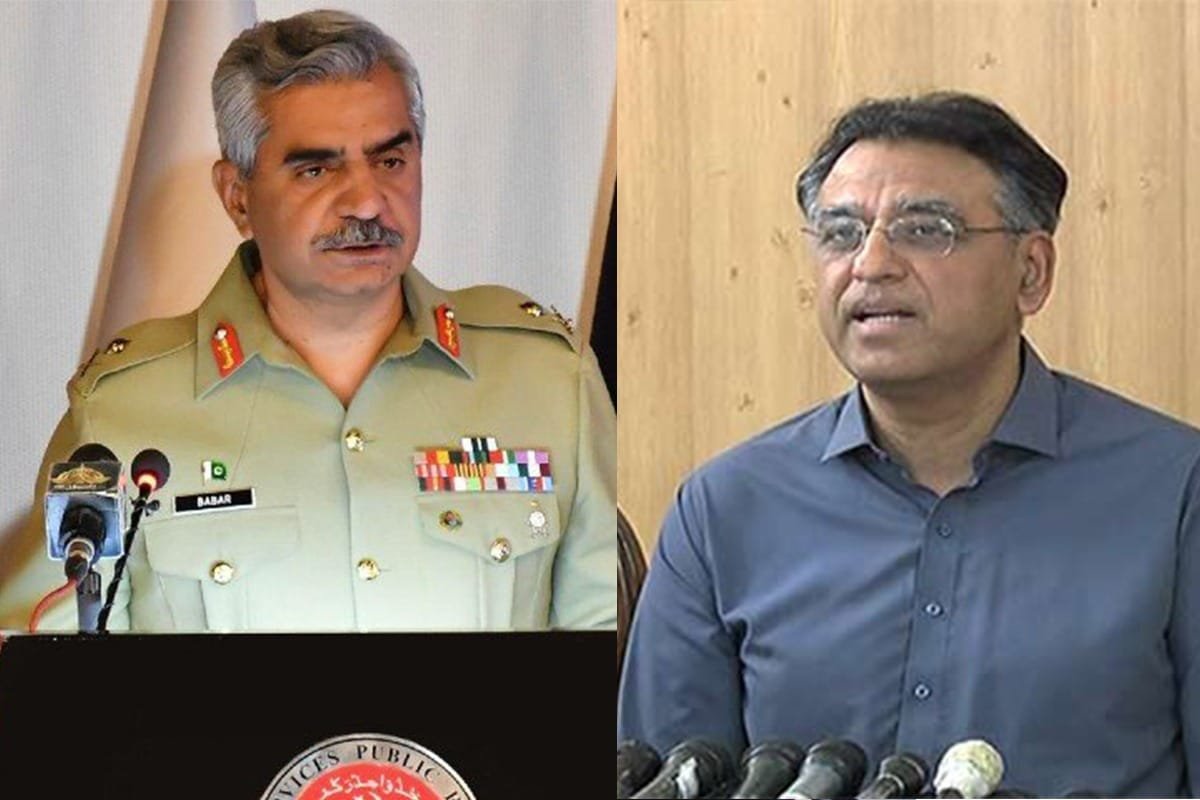
    Pakistan Tehreek-e-Insaf (PTI) General-Secretary Asad Umar in a press conference along with former Human Rights Minister Shireen Mazari demanded the formation of a judicial commission on the alleged “foreign conspiracy” to oust former Prime Minister (PM) Imran Khan from power.

    Umar said that it would be better for the army and the country if the Inter-services Public Relations (ISPR) Director-General (DG) Major-General Babar Iftikhar doesn’t find it necessary to interpret political affairs again and again.

    Umar said Khan will again write to Chief Justice of Pakistan Umar Ata Bandial to constitute a judicial panel and hold a transparent inquiry into the matter.

    “It was a clear threat. It was written that if the no-confidence motion fails, Pakistan would have to pay the price and if Imran Khan is shown the door, then Pakistan will be forgiven.”

    He said that it is the people’s right to know the facts and who was behind the move.

    Umar said that the party still wants this to be investigated by a judicial panel and an open hearing conducted.

    “[The] DG ISPR is right in saying that some of the military leadership representatives actually said that they cannot see any evidence of a conspiracy. Most of the civilian leadership said there was a conspiracy,” Umar said.

    Ever since Imran Khan said ‘absolutely not’ to the air bases, the conspiracy started: Mazari

    Meanwhile, Mazari said, “Ever since Imran Khan said ‘absolutely not’ to the air bases, the conspiracy started.”

    Mazari asked why the US diplomats met PTI MNA Noor Alam Khan.

    “We are compiling a list of who the US envoy met in Pakistan. Why did the ambassador meet Raja Riaz? Was it to discuss foreign affairs?”

    Military’s opinion on national security issues is not final word: Asad Umar

    Umar on Tuesday while speaking on Hum News political talk show with anchorperson Meher Bokhari said, “At the outset, you were asking me a question that since it is a matter of national security so the army has a final word on the issue, [but] with due respect, I don’t agree with this.”

    Umar’s comments were relevant to DG ISPR’s statement that no conspiracy was hatched to oust Khan. He said that the military leadership was present in the National Security Council (NSC) meeting and the participants were clearly briefed by the intelligence agencies.

    “[They were] briefed that there was no conspiracy or evidence of any kind [against the then government], nothing like that happened. Participants were told in detail that there was no evidence of any conspiracy,” said the DG ISPR.

  • Pre-monsoon rains to begin from today: Met Department

    Pre-monsoon rains to begin from today: Met Department

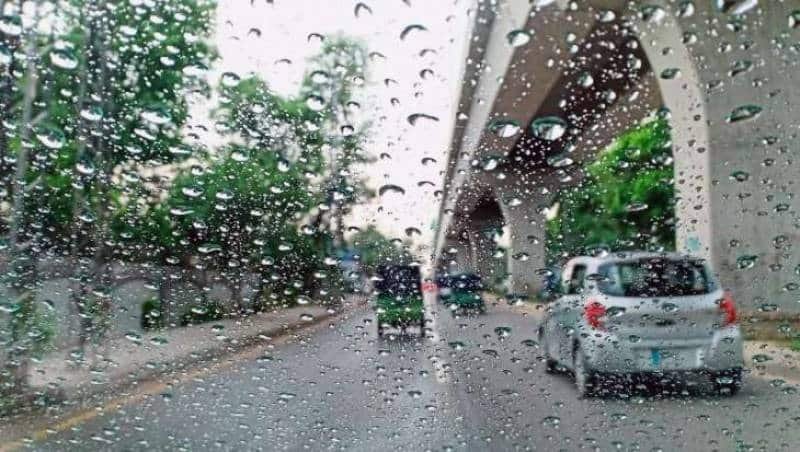
    Pre-monsoon rain-wind/thundershowers are expected in most parts of Pakistan starting from Wednesday (June 15), according to the Pakistan Meteorological Department (PMD).

    Heavy rainfall is expected in Rawalpindi, Islamabad, Jhelum, Gujranwala, Sialkot, Lahore, Kasur and Sheikhupura on June 16 and June 17. It may cause urban flooding in Rawalpindi and Lahore.

    Heavy rainfall is also expected in Kashmir and Gilgit Baltistan from June 14 to June 23.

    Rain-wind/thundershowers (with isolated heavy falls) are expected in Chitral, Dir, Swat, Mansehra, Kohistan, Abbottabad, Haripur, Peshawar, Swabi, Nowshera, Kurram, Kohat, Waziristan, Lakki Marwat, Bannu, Dera Ismail Khan from June 15 to June 22 with occasional gaps.

    Rain-wind/thundershowers with isolated heavy falls are expected in Sibbi, Bolan, Naseerabad, Jhal Magsi, Mastung, Barkhan, Ziarat, Zhob, Quetta, Kalat, Khuzdar, Chaman and Harnai from June 17 (evening/night) to June 20.

    Hot and dry weather in most parts of Sindh with chances of dust-thunderstorm/rain in Sukkur, Jacobabad and Larkana from June 17 to June 19.

  • Pakistan pushed into darkness due to Europe’s decision to cut off Russian fuel

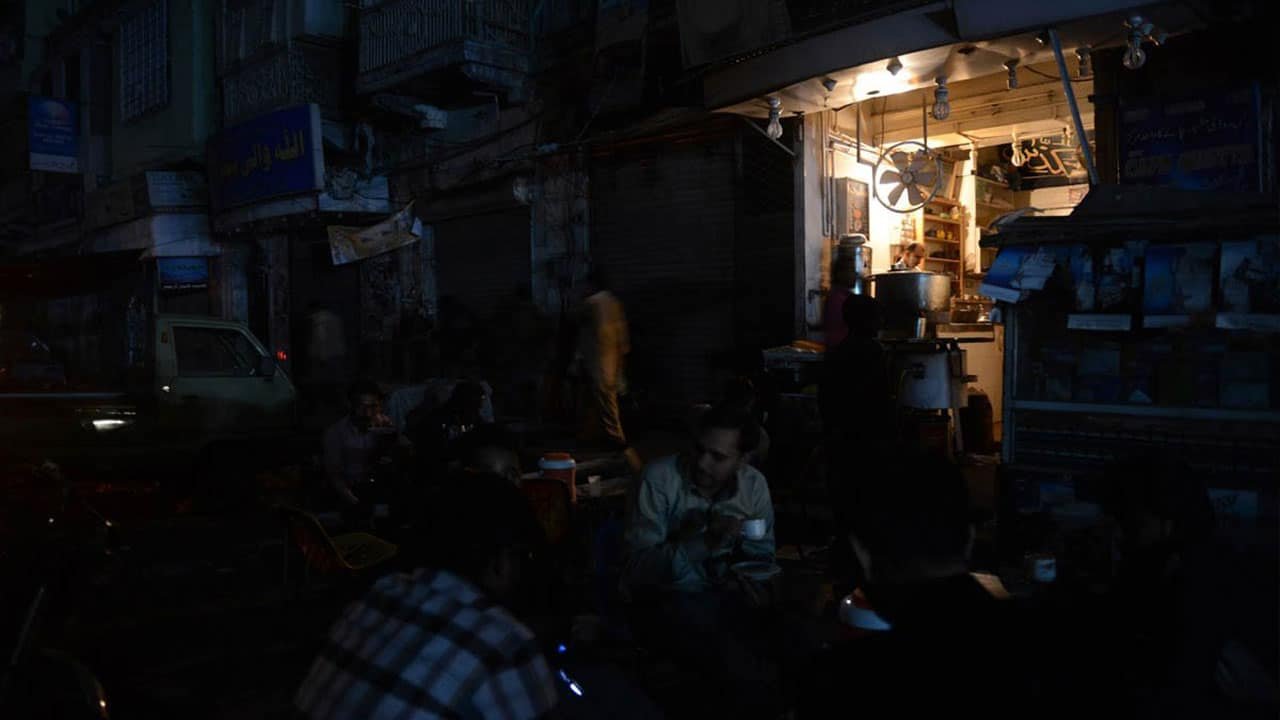
    Pakistan pushed into darkness due to Europe’s decision to cut off Russian fuel

    The European attempt to abandon Russian oil is intended to punish Moscow for its invasion of Ukraine. It’s also wreaking havoc thousands of miles away, throwing Pakistan into darkness, destabilising one regime, and jeopardising the country’s new leadership’s stability.

    According to Bloomberg, Pakistan invested heavily in liquefied natural gas and inked long-term contracts with Italian and Qatari suppliers. Some of those suppliers have now defaulted, although continuing to sell into the more lucrative European market, putting Pakistan in the very situation it hoped to avoid.

    The country took particular precautions a decade ago to protect itself from the sorts of price increases that are currently shaking the market.

    Last month, the government spent about $100 million on a single LNG shipment from the spot market to avert outages during the Eid holiday, a record for the cash-strapped country.

    The country’s LNG costs could reach $5 billion in the fiscal year ending in July, more than double what they were a year ago. Even still, the government is powerless to protect its citizens: the IMF is in talks to bail out the country on the condition that it reduces fuel and energy subsidies.

    Outages lasting more than 12 hours

    Parts of Pakistan are currently suffering scheduled blackouts lasting more than 12 hours, reducing the ability of air conditioning to provide respite during the current heat wave. The former prime minister continues to gather enormous audiences to demonstrations and marches, exacerbating voters’ discontent with 13.8 per cent inflation. The hosts of prime-time talk shows frequently discuss how Pakistan will obtain the petroleum it requires and how much it would have to spend.

    The administration introduced a fresh set of energy-saving measures last week. Civil servants were relieved of their normal Saturday shifts, and the security budget was slashed by half.

    Prime Minister (PM) Shehbaz Sharif remarked in an April tweet before of the Eid holiday, “I am acutely aware of the sufferings people are facing”. That same week, he ordered his government to resume purchasing costly overseas natural gas shipments.

    He also warned earlier this month that they don’t have the money to keep importing gas from other countries.

    Rerouted supply to power plants

    There will be more than just outages as a result of the supply shortage. The government has rerouted existing natural gas supply to power plants, causing fertiliser manufacturers to be shortchanged. This approach could jeopardise the next harvest, resulting in even higher food prices the following year. Backup generators are being used by cellphone towers to keep service going during the blackouts, but they, too, are running out of fuel.

    There’s not much hope in the future. LNG prices have risen by over 1,000 per cent in the previous two years, first due to post-pandemic demand and subsequently due to Russia’s invasion of Ukraine. Russia is Europe’s largest natural gas supplier, and the possibility of supply disruptions pushed spot rates to an all-time high in March.

    Increasing LNG demand in Europe

    Meanwhile, Europe is increasing its need for LNG. Europe’s LNG imports have increased by 50 per cent so far this year compared to the same period last year, and show no signs of slowing down. As they cut ties with President Vladimir Putin’s regime over the crisis in Ukraine, European Union policymakers created a plan to considerably increase LNG deliveries as an alternative to Russian gas.

    Floating import terminals are being built at a breakneck pace in countries like Germany and the Netherlands, with the first ones set to open in the next six months.

    “Europe is draining LNG from the rest of the globe,” according to Steve Hill, executive vice president of Shell Plc, the world’s largest LNG trader. “However, this means that less LNG will be sent to developing markets”.

    Pakistan was formerly thought to be the LNG industry’s bright future. Demand for the fuel had peaked in developed markets by the mid-2010s. However, technological developments had reduced the costs and time it took to build import terminals, and new gas sources had reduced the cost of the fuel itself.

    Poor nations could finally contemplate the gasoline at the new, lower prices. Suppliers flocked to these new markets, and when Pakistan published a request for long-term LNG supply, over a dozen businesses competed for the contract.

    Pakistan chose Italy’s Gunvor Group Ltd to sell LNG to the country for the next decade in 2017. The terms were favourable at the time, and the prices were lower than those of a comparable arrangement struck with Qatar the previous year.

    Delay in supplies

    However, due to the rise in European gas prices, the two suppliers have postponed more than a dozen shipments slated for delivery between October 2021 and June 2022.

    According to Bruce Robertson, an expert at the Institute for Energy Economics and Financial Analysis, such defaults are nearly unheard of in the LNG market. Bloomberg spoke with traders and industry insiders who couldn’t recall the last time so many cargoes were rejected without being linked to a big outage at an export terminal.

    Eni and Gunvor stated they had to cancel because they were experiencing their own supply problems and didn’t have enough LNG to export to Pakistan. When exporters confront such difficulties, they typically replace deliveries by purchasing a consignment on the spot market, but Eni and Gunvor have not done so.

    Vendors are generally averse to cancelling orders. It harms the company connection and is often extremely costly. In established markets, fines for “failure to deliver” might be as high as 100 per cent.

    “It’s quite rare for LNG suppliers to renege on long-term contracts beyond force majeure occurrences,” says Valery Chow, an analyst at Wood Mackenzie Ltd.

    Pakistan’s contracts stipulated a lower cancellation penalty of 30 per cent, most probably in exchange for cheaper overall costs. The European spot market prices are currently high enough to more than compensate for the penalties.

    Pakistan’s $12 million LNG supply contract

    As per sources, an LNG supply to Pakistan for delivery in May under a long-term contract would cost $12 per million British thermal units. In comparison, spot cargoes to Europe for May delivery were trading for more than $30. Eni and Gunvor have kept their promises to customers in the region.

    As a result, Pakistan is back to square one, in a weaker negotiation position than before. After a dispute with Pakistan’s army over a variety of problems, including his management of energy supply and the greater economy, Prime Minister Imran Khan was deposed in April.

    Shehbaz Sharif, the new prime minister, has directed the state-owned importer to obtain the petroleum at any cost in order to end the debilitating blackouts. It’s also attempting to reach new long-term LNG purchase agreements, albeit the conditions will almost probably be harsher than six years ago.

    High risk of default

    The cost is having its own cascading repercussions. The government is now “at high risk of default,” according to a paper published last month by the Institute for Energy Economics and Financial Analysis. Moody’s Investors Service reduced Pakistan’s outlook from stable to negative, citing financial worries including a potential IMF bailout delay.

    Pakistan’s dependency on LNG, as well as its suppliers’ tendency to default, has exacerbated the country’s energy dilemma. Pakistan isn’t alone in this regard. Emerging economies all around the world are trying to meet their residents’ requirements while staying within their budget restrictions.

    It has also prompted them to purchase electricity from Russia, reducing the impact of Europe’s attempts to isolate them.

    Pakistan seeks LNG supply contract with Russian companies

    According to reports, Pakistan is also looking at long-term LNG supply agreements with Russian companies. India has already increased its purchases from Russia, and this trend is likely to continue. The government has directed power plants to purchase fuel from overseas in response to the scorching summer heat.

    Other cash-strapped importers, such as Bangladesh and Myanmar, are likely to suffer as a result of Pakistan’s problems. Bangladesh’s state-owned utility recently purchased the country’s most expensive LNG shipments on the spot market to keep the grids functioning and industry stocked, while Myanmar has stopped importing LNG for the past year owing to price increases.

    Other nations, such as India and Ghana, may be prompted to reconsider long-held plans to increase their reliance on super-chilled fuel as a result of Europe’s major change. Instead, governments would increase their reliance on polluting coal or oil, thwarting efforts to meet ambitious emission reduction objectives this decade.
  • Pakistani startup Dastgyr raises $37 million in series A round

    Pakistani startup Dastgyr raises $37 million in series A round

    Dastgyr Technologies Pvt. has raised $37 million in Pakistan’s largest-ever Series A round. The company seeks to build an e-commerce platform for emerging economies comparable to Alibaba Group Holding Ltd.

    The funding was spearheaded by Veon Ltd.’s venture arm, which put up about 40 per cent of the money. Zinal Growth Fund, DEG, Khwarizmi Ventures, Oman Technology Fund, Cedar Mundi Ventures, Reflect Ventures, Century Oak Capital, Haitou Global, GoingVC, Astir Ventures, K3 Ventures, Chandaria Capital, SOSV, Edgebrook Partners, and EquiTie were among the others who contributed, according to Bloomberg.

    Veon’s evolution outside traditional telecom services continues with this round. In Pakistan, it has asked for a licence to operate as a digital bank.

    Pakistan’s economy is mostly centred on cash, but innovators are working to change that. Dastgyr is a one-stop platform that connects retailers like grocery stores with different suppliers including Nestle SA and Reckitt Benckiser Group Plc. Currently, most conventional retailers meet 100 vendors per week or physically peruse different markets to stock their shelves.

    Veon Ventures’ Chief Executive, Mohammad Khairil Abdullah, said, “As part of Veon’s transformation into a digital operator that delivers a growing range of services to our customers we are investing in leading digital companies like Dastgyr in the countries where we operate. These investments are the building blocks of the digital ecosystem that will enable us to deliver on our strategy”.

    “Pakistan’s start-up ecosystem is at a critical juncture and only startups focused on addressing key challenges and adopting localized solutions will survive and thrive,” added Aamir Ibrahim, CEO of Jazz.

    “This investment highlights VEON’s commitment to scaling up Pakistan’s digital economy and provides Dastgyr with a platform to build synergies with Jazz’s subscriber base of around 75 million and with JazzCash, further integrating the startup into Pakistan’s fintech ecosystem”.

    Zohaib Ali, a co-founder of Dastgyr, stated that the company is dedicated to “working persistently toward our ambition of developing an Alibaba for emerging countries worldwide.”

    Another co-founder, Muhammad Owais, stated that the company aspires to become a unicorn in the next years. He stated that the company is now growing into new business-to-business areas such as cement, steel, and other construction materials, as well as looking into the electronics, pharmaceutical, and other retail industries.

    Dastgyr, which has been in use for less than two years, is used by roughly 100,000 stores in five cities. It attempts to save money by connecting buyers and sellers through a digital platform instead of purchasing and storing everything in physical warehouses.

    Within this year, it plans to expand into 15 additional markets in Pakistan and expand internationally.

  • ‘No MoU on wheat and oil with Khan’s govt’: Russian ambassador to Pak

    ‘No MoU on wheat and oil with Khan’s govt’: Russian ambassador to Pak

    Danila Ganich, Russia’s ambassador to Pakistan, has said that in his opinion the Russian visit could have been “one of the factors” for the removal of former Prime Minister (PM) Imran Khan from power but added that it was a sheer coincidence that Khan happened to be in Russia the day the Ukraine war broke out.

    “I think that was one of the factors but I also know that it was a sheer coincidence that he happened to be in Moscow on that very day,” said Ganich when asked if Khan’s government was removed from power because of his visit to Russia in an interview with Aaj News‘ senior anchorperson Shaukat Piracha.

    “The proof of that is just the fact that he was in Moscow on that very day, had he known that the operation would start on that very day, definitely he would have tried to refrain from being there on that very day. So that was a coincidence.”

    “As an ambassador of a foreign country I prefer not to interfere in your internal affairs.”

    “I do know that Pakistani [authorities] concluded that there was no conspiracy. So here I would like to say period. I cannot take sides here, especially when your judge concluded that there was no conspiracy,” said Ganich.

    Ganich said that Russia and Pakistan did not conclude any memorandum of understanding (MoU) on Khan’s claims that Russia had agreed to sell both wheat and oil at a 20 per cent and 30 per cent discount to Pakistan due to the efforts of his government.

    “I can confirm that we did not conclude any MoU,” the ambassador revealed. “As for what kind of discounts could have been offered [on oil and wheat], I cannot comment on this, as these are confidential negotiations.”

    Earlier, Russian Counsel General in Karachi, Andrey Fedorov said that a proposal was discussed between the two parties, while categorically denying that any letter was written by the Pakistan Tehreek-e-Insaf (PTI) government to Russia, reported Samaa News.

    Finance Minister Miftah Ismail in an interview with CNN’s Becky Anderson refuted Khan’s claims that Russia has not offered a 30 per cent discount on oil or wheat.

    Miftah further said that even though a letter was written by former minister Hammad Azhar, Russia did not respond to the letter.

    Former premier Khan recently said that during his time in power, the PTI government had signed an agreement with Russia to buy cheap oil and wheat. Adding that his government remained in power Pakistan would not have to face the petrol bomb.

  • Govt announces Rs3 billion subsidy to provide ghee at discounted rate

    Govt announces Rs3 billion subsidy to provide ghee at discounted rate

    The Minister for Information and Broadcasting Marriyum Aurangzeb announced on Monday that the government would provide a Rs3 billion subsidy to lower the price of ghee to assist the masses.

    She told a press conference that the market price of ghee is currently Rs550 per kg, but it is being sold at Rs300 per kg in utility stores across the country, according to AAJ News

    “The government is bearing a cost of Rs250 per kg,” she added, adding that the price of ghee was Rs150 per kg when the Pakistan Muslim League-Nawaz (PML-N) handed over the office to the Pakistan Tehreek-e-Insaf (PTI) in 2018.

    On the other hand, the government has increased the price of ghee and cooking oil at other retailers.

    She further stated that a 10 kg wheat bag could be purchased for Rs400 at any utility store in Pakistan.

    The minister said that on June 6, about one hundred mobile vans were added to the Utility Stores Corporation (USC) network, citing residents of Khyber-Pakhtunkhwa (KP) having difficulty obtaining discounted items due to limited distribution of utility stores.

    9,500 new utility stores

    “In addition, on June 9, 500 new USC stationary stations were set up to deliver wheat, and 100 more items are being added today,” she stated. “Since June 6, the USC network has grown by 700 units”.

    Price control committees have also been established, according to her, to keep hoarding and reselling of USC materials under check. The availability of items at utility retailers, she said, was also being watched.

    The minister stated that Rs17 billion had been set aside to give the public with low-cost sugar, ghee, and wheat.

  • IMF rejects proposed tax relief for the salaried class

    IMF rejects proposed tax relief for the salaried class

    The International Monetary Fund (IMF) has rejected the government’s proposed tax cut in the Personal Income Tax (PIT) to the tune of Rs47 billion, leaving the government with no choice but to reconsider amendments in order to revive the remaining funds.

    According to The News, the Federal Board of Revenue (FBR) granted relaxation to salaried workers earning up to Rs1.2 million annually, top official sources claim that the IMF has expressed strong misgivings about the planned PIT rate.

    To assist the urban middle class, the International lender recommends that the assistance be limited to persons earning up to Rs0.2 million per month, and that tax rates in other slabs be raised afterward.

    Compensation in PTI’s tenure

    During the sixth review under the PTI-led government, the FBR offered compensation to those making up to one million rupees per month in salary in the budget for 2022-23 through Finance Bill 2022 in Parliament, which was set as a structural benchmark under the Fund agreement. If the proposed PIT rates are not adjusted, it could become a major roadblock to reaching an agreement with the IMF at the staff level.

    The international lender intended to improve tax collection by Rs125 billion by putting PIT in a progressive manner, but the government went the other way, making it impossible for both parties to get a staff-level agreement under the $6 billion Extended Fund Facility (EFF) with the current PIT proposal.

    Proposed tax for salaried class in Finance Bill 2022

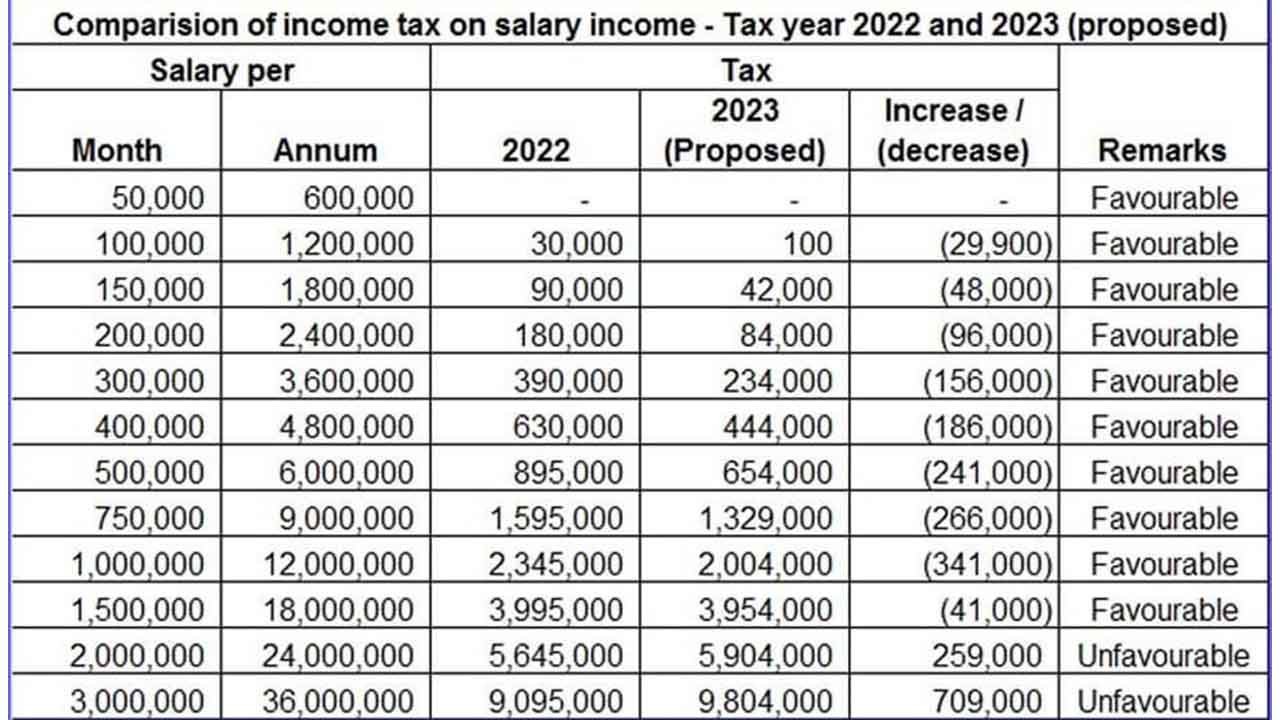
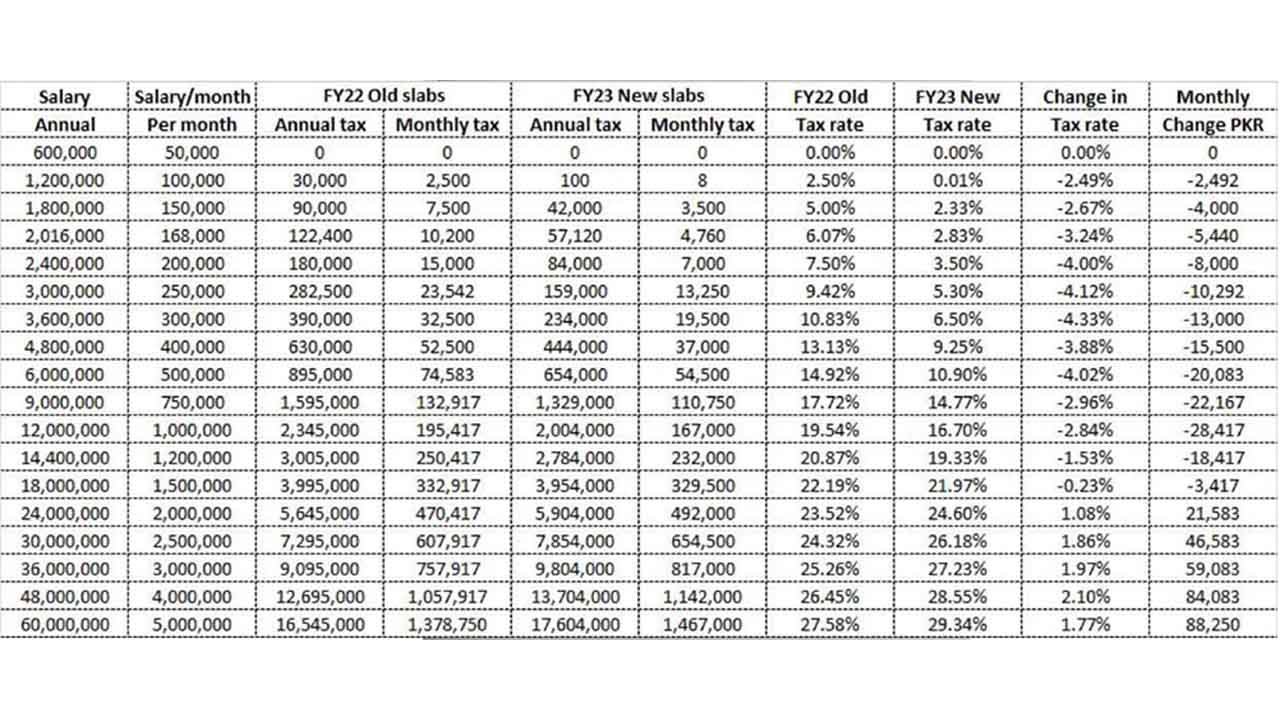
    According to the Finance Bill 2022, those earning up to Rs1.2 million will pay only Rs100 in tax. Previously, those earning up to Rs800,000 per year had to pay Rs10,000, those earning up to Rs1.2 million Rs30,000, and those earning up to Rs2 million Rs120,000. According to the suggested rate, a salary employee earning Rs2 million per year will only have to pay Rs56,000.

    The tax burden for salary earners up to Rs3 million was formerly Rs282,000 per year, but now it is projected to be Rs159,000. Up to Rs4 million in salary, a salary earner had to pay Rs470,000 in income tax, but under the proposed rate, the tax payment is reduced to Rs304,000. The tax due for a salary earner earning up to Rs5 million was Rs670,000, but it was cut to Rs479,000 under the proposed rate.

    The Finance Bill 2022 recommends providing relief up to Rs one million in salary earner who had to pay Rs1.845 million in tax, but now the tax burden has been lowered to Rs1.554 million for salary income up to Rs one million per month under the proposed Finance Bill 2022. The planned tax rates were amended upward in the remaining slabs up to Rs20 million, Rs40 million, Rs60 million, and Rs80 million.

    Increased taxable limit

    The FBR increased the taxable ceiling limit from Rs600,000 to Rs1,200,000 in the Finance Bill 2022, and the number of slabs in the PIT regime was decreased from 12 to 7.

    Where the taxable income does not exceed Rs600,000, there would be no tax, according to new slabs imposed for the salaried class. A tax of Rs100 would be levied on taxable income exceeding Rs600,000 but not exceeding Rs1,200,000.

    There would be a 7 per cent tax on the amount beyond Rs1,200,000 if the taxable income exceeds Rs1,20,000 but not Rs2,400,000.

    If an individual’s taxable income is over Rs2,400,000 but not over Rs3,600,000, you would be charged Rs84,000 plus 12.5 per cent of the amount over Rs2,400,000 per year. The FBR will levy a tax of Rs234,000 plus 17.5 per cent of the amount over Rs3,600,000.

    If the taxable income is more than Rs6,000,000 but not more than Rs12,000,000, the FBR will deduct Rs654,000 plus 22.5 per cent of the amount over Rs6,000,000.

    When taxable income reaches Rs12,000,000, the FBR will assess a tax of Rs2,004,000 plus 32.5 per cent of the amount over Rs12,000,000 every year.

  • Man ran onto field mid-match to salute Shadab Khan, FIR registered

    The police on Friday filed a First Information Report (FIR) against Mohammad Waqas Ashraf, a fan who ran into the ground during the second One Day International (ODI) between Pakistan and the West Indies.

    The FIR is registered under Sections 188 and 452 of the Pakistan Penal Code (PPC). According to the police, Waqas tried to escape the scene after meeting Shadab Khan on the pitch. However, it can be clearly seen in video footage from the match that Waqas was caught by the police on the boundary rope immediately. 

    “A man swiftly entered the ground from under the fence near gate number 3, saluted and hugged a cricketer (Shadab Khan) after reaching the batting crease,” says the FIR against Waqas.

    A police official while talking to Geo Super said that the man has been sent for physical custody.

    The man ran onto the field mid-match to salute Shadab Khan. Shadab hugged the man in return.

     Pakistan whitewashed West Indies 3-0 in a three-match ODI series on Sunday.

  • Army denies taking action against officers after Maryam Nawaz’s speech

    Army denies taking action against officers after Maryam Nawaz’s speech

    The Pakistan Army has revoked all the post-retirement benefits, including pensions and free medical coverage, for five retired army officers for their involvement in anti-army campaign.

    One ex-major general’s name is also included in the list. Action against these officials was conducted last month following legal procedures and allowing the ex-servicemen a chance to defend themselves.

    “The GHQ had proceeded against the five retired officers at least two weeks before Maryam spoke on the issue,” said one of the sources while denying the statements of some YouTubers who are connecting the military action against with a recent statement of Pakistan Muslim League-Nawaz (PML-N) Vice President Maryam Nawaz.

    According to the source, the military expects the government to take action against individuals who defame the military.

    “The social media reports of 150 ex-servicemen facing the action are totally incorrect,” the source added.

  • Here are the latest income tax rates and slabs for salaried class

    Here are the latest income tax rates and slabs for salaried class

    In the budget for fiscal year 2022-23, the government has exempted those earning up to Rs100,000 per month from paying income tax, up from Rs50,000 last year.

    For the salaried income group, the latest budget is a mishmash as the government reduced tax rates and the number of slabs while eliminating available credit through the omission of deductible allowance for profit on debt and tax credit for investment in shares, health insurance, and pension funds.

    Moreover, the government has released a revamped list of income tax brackets for salaried employees. There were previously 12 slabs, which have now been shrunk to seven.

    Here are the new slabs:

    1. For annual incomes less than Rs600,000 (below Rs50,000 per month)
    2. For a yearly income of Rs600,000-Rs1.2 million (Rs50,000 to Rs100,00 per month).
    3. For annual earnings of Rs1.2m-2.4m (Rs100,000 to Rs200,000 per month)
    4. For annual earnings of Rs2.4m-3.6m (Rs200,000 to Rs300,000 per month)
    5. For earnings of Rs3.6m-6m (Rs300,000 to Rs500,000 per month)
    6. For annual earnings of Rs6m-12m (Rs500,000 to Rs10,00,000 per month)

    For annual earnings of more than $12 million (more than $100,000 per month), income tax is not to be levied on people earning between 0 and Rs600,000 per year (where income from salary exceeds 75 per cent of taxable income). A nominal amount of Rs100 will be subtracted per year from those earning between Rs600,000 and Rs1.2 million.

    Employees getting paid more than Rs1.2 million but less than Rs2.4 million per year will be levied 7 per cent of the amount that exceeds Rs1,200,000 in the third slab.

    An employee getting paid Rs1,400,000 per year will be levied 7 per cent of Rs200,000 (Rs1,400,000 minus Rs1,200,000 since that is the amount exceeding Rs1,200,000).

    As per the latest budget resolution, the government recommended an income tax rate of 20 per cent on small business earnings, 42 per cent on banking, and 29 per cent on related companies.