Tag: Pakistan

  • ‘Hindutva pop’: the anti Muslim saffron groove for violent mobs

    ‘Hindutva pop’: the anti Muslim saffron groove for violent mobs

    Orange garments, violent hate speech against Muslims, multiple instruments and consistent chanting constitute the anatomy of a basic Hindutva pop song. Swaddled in gold and saffron, Laxmi Dubey, one of the most popular Hindutva pop artists has uploaded several music videos on YouTube with millions of views, where she engages in anti-Muslim sloganeering, direct attacks on Islamic injunctions, the state of Pakistan, hateful statements regarding the issue of Kashmir and Modi and BJP’s political aggrandization.

    What’s concerning is not just that people like Laxmi Dubey are some of the most popular national icons in India at the moment, but also the fact that through her green screen music videos, YouTube monetization and public shows, she is estimated to be earning 68 Lacs per year. Dubey’s most-listened to song has more than 50 million views. But there is an ensemble of popstars just like her.
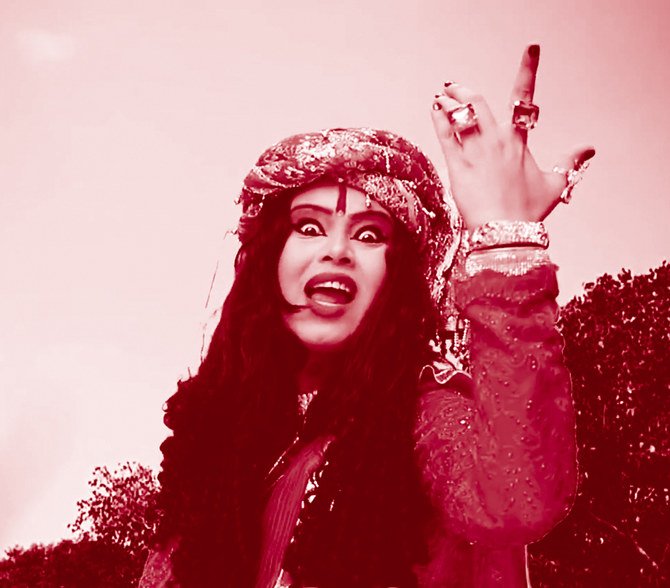
    Laxmu Dubey, 30, Hindutva popstar living in Bhopal, Madhya Pradesh, India.

    Following the 2014 election victory for Bharatiya Janata Party, the country has embarked on a journey of extreme polarization and radical hate against Muslims, Islam and Pakistan. Dubey’s words “Hindustan mein rehna hai tou vande matram kehna seekho” [Translation: If you want to live in India, learn how to say Vande Matram] epitomize perfectly the jingoistic philosophy of nationwide hatred for the Muslim community. In this political atmosphere, films, music, poetry and other forms of art all turned in service of the most influential political campaign of the time.

    Krishnavanshi is another such musician whose songs often embody the strongly felt sentiment of expelling all Muslims from the India and sending them “back” to Pakistan, which is neither their home country nor where they want to live. These songs are akin to a full-fleged battle cry, announcement of an all out war against Muslims and Islamic identity formations, attacking historical symbols of the Mughal-era and contemporary national symbols of Pakistan, rallying violent support against the Muslims of India.

    The famous juvenile Jamia shooter from India rose to prominence when he was apprehended on January 30, 2020 for opening fire at a crowd of unarmed protestors from Jamia. He is also an associated to the famous Hindutva militant leader Deepak Tyagi, who alleged that a 10 year-old Muslim boy, who had accidentally wandered into a temple, was a trained killer. This Jamia shooter and his friends have recorded videos of abduction and assault against Muslims in India which are played against the backdrop of the Hindutva ‘pop’ music. These videos are viral on Indian social media and are standing in to exemplify the far-reaching impact of music on politics and vice versa.
  • Moody’s lowers Pakistan’s rating to Negative after IMF delay

    Moody’s lowers Pakistan’s rating to Negative after IMF delay

    On Thursday, Moody’s Investors Service (Moody’s) lowered Pakistan’s rating from stable to negative. It confirmed the Government of Pakistan’s B3 issuer and senior unsecured debt ratings in local and international currencies.

    “The decision to change the outlook to negative is driven by Pakistan’s heightened external vulnerability risk and uncertainty around the sovereign’s ability to secure additional external financing to meet its needs,” read the statement.

    This grade indicates that the entity is suffering financial instability or has insufficient cash reserves compared to its business needs, debt, or other financial obligations.

    Rising inflation, which puts downward pressure on the current account, currency, and depleting foreign exchange reserves, has exacerbated Pakistan’s external vulnerability risk, according to the ratings agency, especially in the context of heightened political and social risk.

    “Pakistan’s weak institutions and governance strength adds uncertainty around the future direction of macroeconomic policy, including whether the country will complete the current IMF Extended Fund Facility (EFF) programme and maintain a credible policy path that supports further financing,” it stated.

    In a recent report, Brecorder reported, that despite the above-mentioned risks, Moody’s maintained a B3 rating, indicating that Pakistan will complete the seventh review under the IMF Extended Fund Facility (EFF) programme by the second part of this calendar year. “Additional financing from other bilateral and multilateral partners” will result as a result of this.

    “In this case, Moody’s assesses that Pakistan will be able to close its financing gap for the next couple of years,” it said. On the back of rising global commodity prices, Moody’s forecasts Pakistan’s current account to continue under substantial strain through 2022 and 2023.

    For fiscal 2022 (ending June 2022), Moody’s forecasts a current account deficit of 4.5-5 percent of GDP, somewhat higher than the government’s forecast. It anticipates the current account deficit to reduce to 3.5-4 percent of GDP in 2023 as global commodity prices steadily decrease and local demand moderates. Its expectations for fiscal 2022 and 2023 are higher than previous (early February 2022) projections of 4% and 3%, respectively.

    Given Pakistan’s limited foreign exchange reserves, the country’s growing current account deficits highlight the need for further external finance.

    Pakistan is now negotiating the sixth review of the EFF programme with the IMF.

    “Conclusion of the seventh review, and further engagement with the IMF, will also help Pakistan secure financing from other bilateral and multilateral partners. In this scenario, Moody’s expects Pakistan to be able to fully meet its external obligations for the next couple of years.

    “However, Moody’s assesses that the balance of risks is on the downside. An agreement with IMF could take longer than expected, as the government may find it difficult to reduce fuel and power subsidies given rising inflation.”

    According to Moody’s, if Pakistan is unable to get additional funding before the end of the year, its foreign exchange reserves will continue to be depleted, raising the likelihood of a balance of payments crisis.

    Pakistan’s foreign exchange reserves are currently less than $10.1 billion, posing a threat to the country’s balance of payments as rising oil costs and a ballooning import bill put pressure on the currency.

    At the same time, increased political upheaval, including calls by Pakistan Tehreek-e-Insaf Chairman Imran Khan for early elections, and a delay in the IMF program’s reactivation have all contributed to the country’s economic troubles.

    Moody’s Investors Service and B3 rating

    Ratings are the indicators of the creditworthiness of the ratee. For “obligations considered speculative and exposed to significant credit risk,” Moody’s assigns a B3 grade. This grade indicates that the entity is suffering financial instability or has insufficient cash reserves compared to its business needs, debt, or other financial obligations.

    The bond credit rating division of Moody’s Corporation is known as Moody’s Investors Service, or just Moody’s. It is the company’s traditional line of business and historical moniker. Moody’s Investors Service conducts global financial research on corporate and government bonds. The Big Three credit rating agencies are Moody’s, Standard & Poor’s, and Fitch Group. It’s also on the list of Fortune 500 companies to watch in 2021.

    How Entities are Rated?

    The organisation uses a standardised ratings scale to rate borrowers’ creditworthiness, which gauges potential investment loss in the case of default. Moody’s Investors Service assigns ratings to debt securities in a variety of bond markets. Government, municipal, and corporate bonds; managed investments such as money market funds and fixed-income funds; financial entities such as banks and non-bank finance firms; and structured finance asset classes are all examples. Securities are rated from Aaa to C in Moody’s Investors Service’s ratings system, with Aaa being the highest quality and C being the lowest.

  • ‘We have criticised army as well not for our political gains like Khan’: Maryam Nawaz

    ‘We have criticised army as well not for our political gains like Khan’: Maryam Nawaz

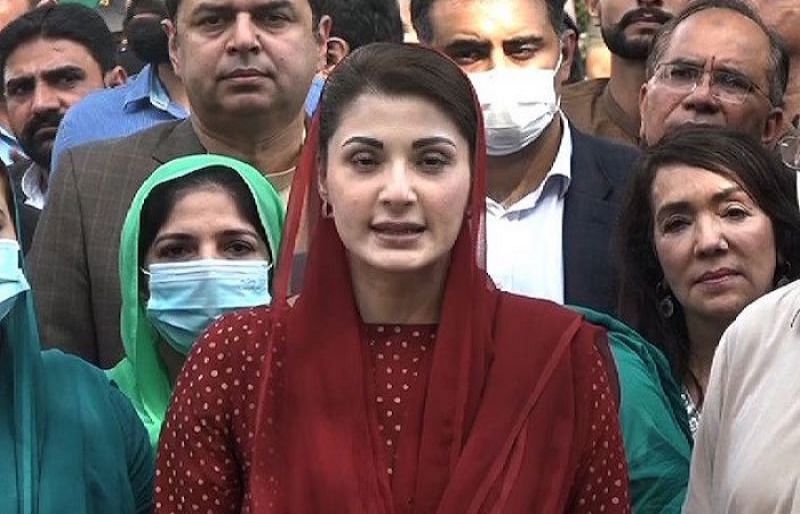
    Pakistan Muslim League-Nawaz (PML-N) Vice President Maryam Nawaz on Thursday has said that they too have criticised the establishment in the past but that was never for any political gains. Her comments are relevant to the Pakistan Tehreek-e-Insaf (PTI) Chairman Imran Khan’s recent remarks on the establishment and the division of Pakistan into three parts.

    “We have criticised the army as well but not for our political gains like Imran Khan but our remarks were to direct the establishment towards the right direction,” said Maryam.

    ‘Who introduced the ‘three-piece’ ideology?’

    “Sometimes you say Kashmir should be divided into three parts and now you are saying Pakistan will be divided into three parts,” said Maryam Nawaz.

    Maryam asked Khan who introduced him to the ideology of the country’s division into “three pieces”.

    “Whose ideology is it? Did Zac Goldsmith give you this ideology or Israel? There will be 300 pieces of the one who said such a thing and his party,” she said.

    Does he have any role in making Pakistan an atomic power?

    Maryam went on to say that the PTI chairman failed within 30 days of assuming the office of prime minister and was exposed within 30 days after being ousted.

    She asked under which right did Imran Khan talk about Pakistan’s atomic programme. “Does he have any role in making Pakistan an atomic power?”

    “[Politicians] have borne exiles and life sentences for Pakistan. [Zulfiqar Ali] Bhutto and Benazir Bhutto were martyred but the voice of Pakistan Khappay [we want Pakistan] was heard,” she said.

    Khan says Pakistan ke teen hissay hongay, Shehbaz warns him not to cross limits

    Prime Minister (PM) Shehbaz Sharif warned Imran Khan on Thursday, saying that his recent remarks on Pakistan make him “unfit for public office”.

    Khan in an interview with Sami Ibrahim for Bol News programme ‘Tajzia’ said that if Pakistan goes bankrupt, then the country will have to face denuclearisation, predicting that the country would then be divided into three parts.

  • ‘Beloved brother’ Shehbaz in Turkey, trade to be expanded from $1bn to $5bn

    ‘Beloved brother’ Shehbaz in Turkey, trade to be expanded from $1bn to $5bn

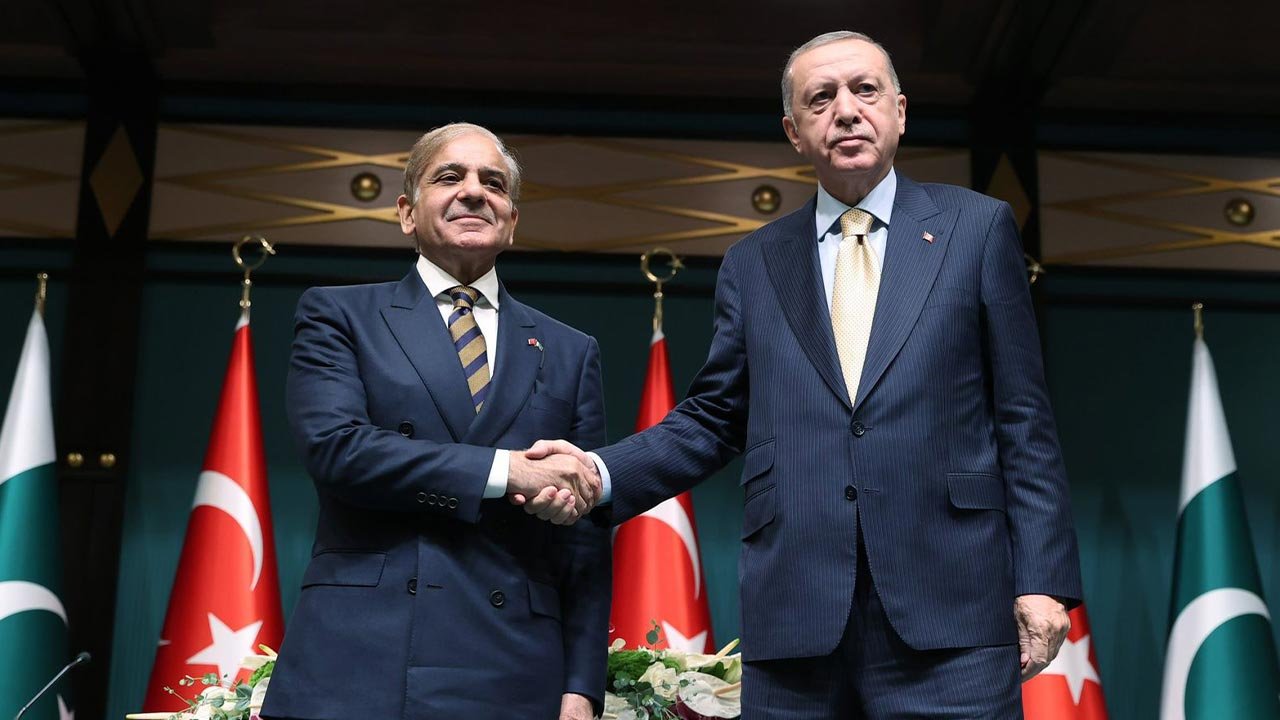
    Prime Minister (PM) Shehbaz Sharif’s formal visit to Turkey, according to Turkish Foreign Minister Mevlut Cavusoglu, will bring bilateral ties a “new dimension”.

    After a meeting in Ankara, he made the remarks, “On the 75th anniversary of our diplomatic ties, we hosted my beloved brother Shehbaz Sharif, Prime Minister of the Islamic Republic of Pakistan. We are prepared to further develop Türkiye-Pakistan relations in light of the two nations’ shared history, friendship, and potential,” Cavusoglu stated on Twitter.

    PM Shehbaz arrived in Istanbul on Tuesday for a three-day official visit, his first since becoming the PM of Pakistan in April.

    According to a Foreign Ministry statement, the premier stressed the significance of growing bilateral trade volume to $5 billion over the next three years.

    “The Prime Minister noted that the bilateral relations were exceptionally warm as the people of the two countries shared special bonds that dated back centuries,” the ministry said in a statement.

    He also emphasised the two countries’ shared interests on a number of regional and international issues, according to the report.

    He said Islamabad aimed to strengthen bilateral trade and cultural ties with Ankara in his address to the Turkey-Pakistan Business Council on Tuesday evening.

  • Khan says Pakistan ke teen hissay hongay, Shehbaz warns him not to cross limits

    Khan says Pakistan ke teen hissay hongay, Shehbaz warns him not to cross limits

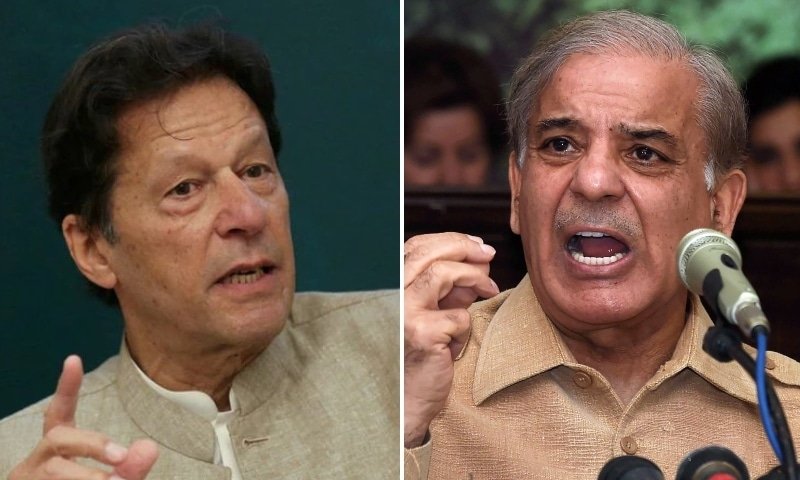
    Prime Minister (PM) Shehbaz Sharif warned Pakistan Tehreek-e-Insaf (PTI) Chairman Imran Khan on Thursday, saying that his recent remarks on Pakistan make him “unfit for public office”.

    Khan in an interview with Sami Ibrahim for Bol News programme ‘Tajzia’ said that if Pakistan goes bankrupt, then the country will have to face denuclearisation, predicting that the country would then be divided into three parts.

    Do your politics but don’t dare to cross limits & talk about division of Pakistan

    PM Shehbaz tweeted: “While I am in Turkey inking agreements, Imran Niazi is making naked threats against the country. If at all any proof was needed that Niazi is unfit for public office, his latest interview suffices.”

    “Do your politics but don’t dare to cross limits and talk about [the] division of Pakistan,” he warned the PTI chairperson.

    Pakistan will have to face de-nuclearisation, the country would then be divided into three parts

    Imran Khan in an interview aired on Wednesday said that the establishment needs to make the right decisions and if they don’t, “the army will be destroyed”.

    Khan questioned what would happen if the country went bankrupt, saying the army will be the worst hit. And if Pakistan goes bankrupt, then according to Khan, Pakistan will have to face de-nuclearisation, predicting that the country would then be divided into three parts.

    Khan said that the current political situation was an equal problem for the establishment and the country.

    He said, “If the establishment doesn’t make the right decisions then I can assure you in writing that the army and they will be destroyed. Pakistan is going towards default. If right decisions aren’t made, then the country will be on a suicidal path.”

    Imran also added that as prime minister, he didn’t have absolute power. “Everyone knows where the real power lies.”

  • FIA Cyber Crime Wing arrests two Pakistanis involved in ‘secretly filming women in Turkey’

    FIA Cyber Crime Wing arrests two Pakistanis involved in ‘secretly filming women in Turkey’

    The Federal Investigation Agency (FIA) has arrested two Pakistanis involved in criminal activities in Turkey.

    The two accused — Muhammad Junaid and Ameer Khan — were arrested during two separate operations. They are allegedly involved in ‘transportation of illegal immigrants’ and secretly filming and sharing videos of Turkish women on social media.

    “Their criminal act created an uproar and anger in the Turkish society and severely damaged goodwill which Turkish people have for their Pakistani brethren,” the FIA statement added.

    Prime Minister Shehbaz Sharif has also taken notice and ordered strict action against the accused. The statement further added that a crackdown has been launched against all agents involved in trafficking.

    “Pakistani Perverts” and “Pakistani Get Out” hashtags trended on Turkish social media in April after videos of Turkish women made by Pakistanis were shared on social media.

    Read more- Fact check: Has Turkey tightened visa policy for Pakistanis?

  • Pakistan records 13.8 per cent inflation in May

    Pakistan records 13.8 per cent inflation in May

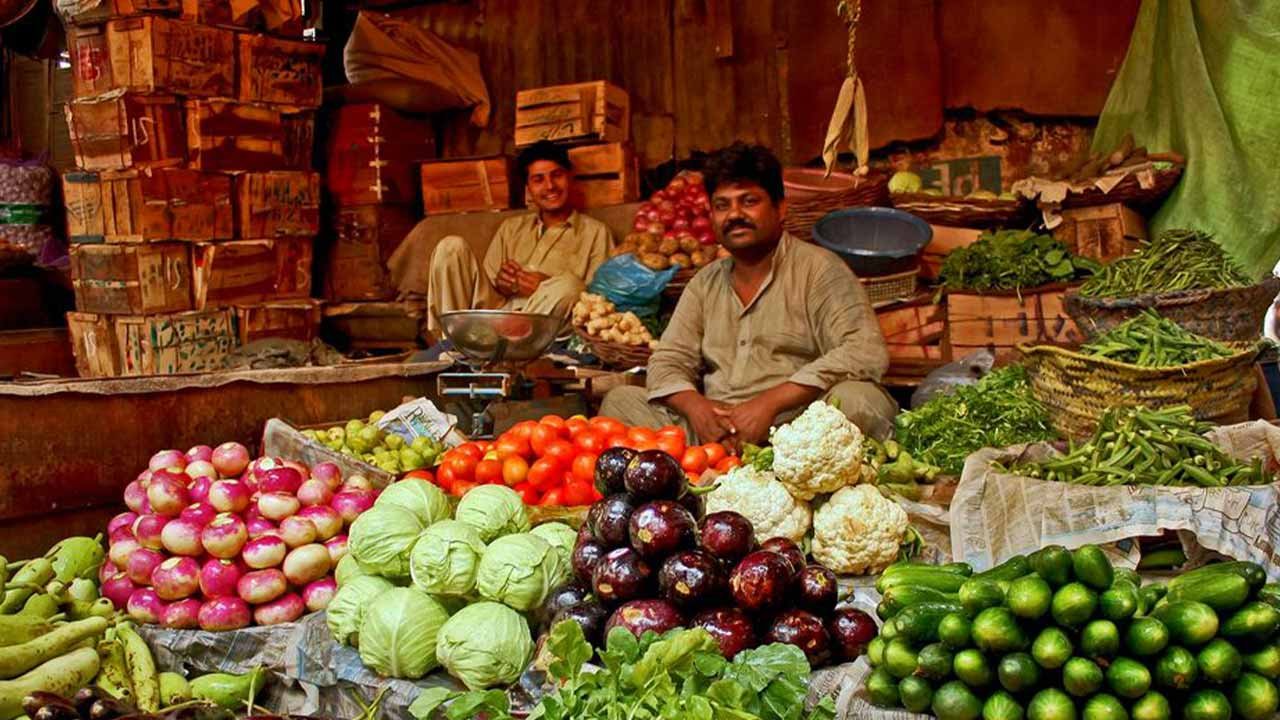
    The latest data provided by the Pakistan Bureau of Statistics (PBS) on June 1, inflation continued to rise in May 2022, with the Consumer Price Index (CPI)-based reading coming in at 13.8 per cent year on year, up from 13.4 per cent the previous month and 10.9 per cent in May 2021.

    In May 2022, inflation climbed by 0.44 per cent month over month, compared to 1.6 per cent the previous month and 0.1 per cent in May 2021. This brings average inflation in 11MFY22 to 11.29 per cent year over year, up from 8.83 per cent in 11MFY21.

    Rising prices have emerged as a major source of concern for the economy of the South Asian country, which is grappling with dwindling foreign exchange reserves and a growing import bill.

    The State Bank of Pakistan (SBP) hiked the main interest rate by 150 basis points to 13.75 per cent last month in an attempt to combat economic headwinds.

    The existing administration, on the other hand, has indicated that it will partially remove subsidies by raising petroleum product tariffs by Rs30 per liter, a move that is projected to raise inflation.

    As per a report from Brecorder, on a month-on-month basis, Inflation in Urban areas increased by 0.3 per cent in May 2022 as compared to an increase of 1.6per cent in the previous month and increase of 0.2per cent in May 2021.

    In the meantime, CPI inflation in urban areas grew 12.4 per cent year over year in May 2022, compared to 12.2 per cent the previous month and 10.8 per cent in May 2021.

    It climbed by 0.3 per cent month over month in May 2022, compared to a 1.6 per cent increase the previous month and a 0.2 per cent increase in May 2021.

    In rural areas, CPI inflation climbed by 15.9per cent year over year in May 2022, compared to 15.1 per cent the previous month and 10.9 per cent in May 2021. It climbed by 0.6 per cent month over month in May 2022, compared to an increase of 1.6 per cent the previous month and a fall of -0.03 per cent in May 2021.

    In May 2022, the SPI inflation grew by 14.1 per cent year over year, compared to 14.2 per cent a month earlier and 19.7 per cent in May 2021. On a month-over-month basis, it climbed by 0.6 per cent in May 2022, compared to 1.5 per cent a month earlier and 0.8 per cent in May 2021.

  • Miftah Ismail says no response by Russia for buying oil at discounted rates

    Miftah Ismail says no response by Russia for buying oil at discounted rates

    Finance Minister Miftah Ismail on Tuesday in an interview with CNN’s Becky Anderson said that he does not know where former premier Imran Khan gets his numbers from, refuting Khan’s claims that Russia has not offered a 30 per cent discount on oil or wheat.

    “Let’s be clear. I don’t know where Khan gets these numbers from,” said Miftah.

    “Khan just makes it up as he goes along. He is the guy who was saying we (PDM) were brought in through an American conspiracy. And now he has come up with this new thing. If Russia was selling him cheap wheat and oil, then why didn’t he buy it? He did not,” said Miftah.

    Difficult for me to imagine buying Russian oil

    Miftah said that Western sanctions have made importing oil from Moscow impossible despite the Pakistani government’s request to buy wheat from Russia and Ukraine.

    “Russia has not offered us any oil either. It is difficult for me to imagine buying Russian oil,” said the finance minister.

     Raising oil prices was ‘a trap for us

    Talking about talks with the International Monetary Fund (IMF), Miftah said, “We have had talks with the IMF in Doha recently. We are talking to the IMF and particularly the IMF is looking at the budget that I am going to present in early June and after that, I am hoping that we will reach an agreement with the Fund.”

    He said the IMF was looking for Pakistan to reverse the subsidies on oil, petrol and diesel in particular “that the previous government had given”.

    Miftah added that the IMF also wanted Islamabad to reverse electric tariff subsidies that the previous government had done.

    “Then it is looking at the budget that I will present. So, I am pretty confident that we should be able to get an agreement with the Fund but there would be some austerity in the budget, some measures to increase taxation in the next budget.”

    The minister said that raising oil prices by the previous government was “a trap for us”.

    “Imran Khan in the last days of his government did a few things to violate all these agreements with the IMF, including giving these unsustainably high subsidies. And he knew we could not sustain this.”

    “And when we came to power, he is now going city to city, trying to rally the people with his theories about conspiracies and all that for putting a lot of political pressure on us.”

    The new government, he said, was finding it difficult to raise the prices right away, but it took a very important step last week.

    Moscow had not even responded to the previous government’s letter

    Ismail said that Moscow had not even responded to the previous government’s letter seeking to buy oil at a discounted price from Russia.

    “The two sides had talked about it, but since Russia is under sanctions, and they have not yet responded to the request sent by the Pakistan Tehreek-e-Insaf (PTI) government, there was no movement on this front.”

    However, he said Islamabad had approached both Ukraine and Russia, “whichever country is willing to sell us wheat we would be happy to buy it”.

    Hammad’s claims

    Former Energy Minister Hammad Azhar said, “Miftah sahib is claiming on national tv that no letter or proof exists of Russian oil talks. And who he should speak to. Russia was enthusiastic on selling discounted oil to us and he should have spoken to Energy Minister of Russia.”

    Miftah’s response:

    Miftah responded to Hammad Azhar’s tweet: “Bhai please listen to my interview again. I did say your govt wrote a letter. But I said no response ever came.”

    He added, “I didn’t say that you waited more than a month after IK’s visit to write the letter & then too when you knew you’d lose the VNC & that it was only done for politics.”

  • ‘Rubbish,’ General Bajwa speaks out against claim made by journalist about him

    ‘Rubbish,’ General Bajwa speaks out against claim made by journalist about him

    “Rubbish, totally rubbish,” said General Bajwa in response to an ARY News anchorperson’s claim about China Pakistan Economic Corridor (CPEC) that was attributed to the army chief, reports Ansar Abbasi for The News and Jang.

    ARY News anchorperson Chaudhry Ghulam Hussain claimed that he was told by the army chief, in the presence of a couple of other people, that out of the initial Chinese investment of $19 billion for CPEC projects during the PML-N government, $10 billion were spent on the ground while $9 billion was stolen by contractors, government officials and political governments at the Centre and in Punjab. Ghulam Hussain said that when he asked why no action was taken, he was told by the army chief that the Chinese said they “don’t want to agitate these things in public” and that they will take action against their own people privately after investigating.

    Abbasi reports that whenThe News shared the video clip of the anchor’s claim with a defence source close to army chief General Bajwa, the source said Bajwa responded to ARY’s claim by saying, “Rubbish, totally rubbish.”

  • Anti-polio infrastructure collapsing in Waziristan, 6th case registered

    Anti-polio infrastructure collapsing in Waziristan, 6th case registered

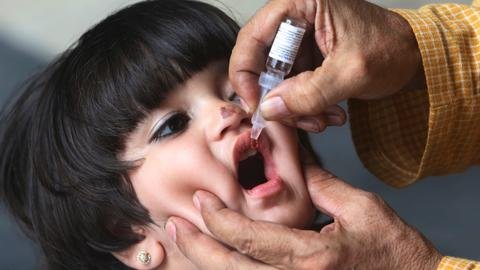
    On May 27, the Government of Pakistan issued a press release on the Pakistan Polio Erradication Programme’s website. In this report, it was confirmed that on May 26, two new cases of polio were confirmed by the Pakistan National Polio Laboratory at the National Institute of Health, Islamabad.

    This marks the 5th and 6th cases of polio, reported in Pakistan this year. The two news cases are associated with two 18 months old children born in Mir Ali Tehsil, a girl and a boy, who both started experiencing the onset of paralysis as early as May 10 and May 11, respectively.

    All six children who have contracted polio are from North Waziristan, where more cases are expected through the year due to a high rate of refusal to give the vaccine and the illegal but process of finger-marking without vaccinations. Considering that the only endemic countries at this point in the whole world are Pakistan and Afghanistan, it must be noted that there is great significance to exploring the causes of this reoccurrence of the disease in the context of polio campaigns and their efficacy in KPK and FATA.

    Polio scam

    The problems with Pakistan’s polio vaccination programme are complex and multifold. On May 28, The News reported that only recently around 8,000 children from 22 union councils, up to the age of five have been identified as never been vaccinated with the oral dose of the polio vaccine. Vaccinators, refusing parents and area incharges colluded to carry out the scam. This was immediately revealed after the two new cases in North Waziristan were registered. Reportedly, so far the National Emergency Operations Center (NEOC) has been relying on fake reports which claimed that 95% children were being vaccinated during each campaign. This leads to a gross underestimation of the number of children still unvaccinated.

    Abduction of Dr Zeeshan

    Journalists working on Waziristan also tweeted on May 26, reported the abduction of Dr Zeeshan, who was serving as a Polio N-STOP officer in Waziristan, who had been working effortlessly on the polio campaign there. He was kidnapped while still on duty. Dawn reported that Dr Zeeshan had come from Swat to specially oversee an anti-polio drive. After involving the law enforcement alongside jirga negotiations, Bannu commissioner Arshad Khan managed to recover Dr Zeeshan.

    The political atmosphere in Waziristan actively creates the strongest hurdle in Pakistan’s journey towards a polio-free nation. 260,000 workers are deployed across the nation to vaccinate children under the age of five. Considering the perceptual concerns of people of Waziristan, it seems unlikely that the situation would improve radically unless some really necessary steps are taken to tackle the perception regarding the vaccine. Access to children in security-compromised areas, attacks on health care workers coupled with governance and operational failures continues to elongate this problem for Pakistan.

    KPK govt failure

    In 2014, Imran Khan government launched the Sehat ka Insaf campaign in KPK where the aim was to target all 9 vaccine-preventable diseases, including polio. This program was restricted to the provincial government and sought to undo completely any international involvement. Although it may seem like this is a good strategy to gain people’s trust to vaccinate, this utter lack of oversight has heavily contributed to the fake markings. This is apparent from the fact that the kids who developed polio were marked in the national record as having been vaccinated six or even seven times.