An interesting incident of theft recently took place in Islamabad. A thief in Bani Gala, Islamabad took off the tyres of a citizen’s car and left a note apologising for his actions.
“I am sorry sir,” read the note. “I am a very poor person and I am doing this because I am helpless. Sir, I have little kids. Please do not curse me for this.”
A viral video has shown a person with uncanny resemblance to a younger Imran Khan, riding a rickshaw in Sialkot.
“Look, there’s Imran Khan on a rickshaw in Sialkot,” the person recording the video from his own vehicle can be heard as jokingly saying.
WATCH VIDEO:
While the unnamed person from the undated video isn’t really Pakistan’s cricketer-turned-politician and now Prime Minister (PM) Imran (unless he travelled to 2021 from the 1990s), this isn’t the first time such a video has left netizens second-guessing what they just saw.
In 2018, the video of an Imran lookalike driving a Mehran had gone viral soon after his election as the country’s premier.
With the video doing the rounds on social media, people, especially Pakistan Tehreek-e-Insaf (PTI) supporters, had started trending tags such as “#NayaPakistan”, “#SayNoToProtocol” and “#ImranKhanOurLeader” on Twitter.
In the said video, those filming the scene could be heard shouting “Naya Pakistan!” and “Wow, Imran Khan!”, to which the person was seen responding with a wave.
Unfortunately, the incident had followed a series of criticism aimed at the PM and his ministers after they did opt for protocol.
Pakistan has improved its position in the World Bank’s Ease of Doing Business Index for the second year in a row.
According to the latest rankings released by the global organization, Pakistan has improved its position by an impressive total of 28 points, surging from 136th place to 108th on the rankings. The World Bank report calls this an “unprecedented improvement”, and it is highly indicative of the country managing to exceed even its own expectations yet again.
Out of the six reform areas highlighted in the 2020 edition of the report, Pakistan made the highest improvement in the “Starting a Business” indicator, which is an area largely being revolutionized by the Securities and Exchange Commission Pakistan (SECP).
Pakistan’s ranking in this indicator has improved from 130 to 72 and is placed at second position in South Asian countries in terms of ease of starting a business.
The improvement, according to the SECP, is primarily due to the integration of e-services with the Federal Board of Revenue (FBR) and the Employees Old Age Benefits Institution (EOBI) at the federal level and with business registration portals of Punjab and Sindh at the provincial level.
After this integration, SECP’s e-services offer a one-window facility for company registration with FBR, EOBI, provincial employees social security institutions, the labour department and excise and taxation departments of Punjab and Sindh.
As a result of this reform, the number of procedures to start a business, as recorded in the Doing Business Report 2020, have been reduced from ten to five and Pakistan has managed to rank “among the top ten reformers globally”.
Pakistan emerging as an increasingly business-friendly nation is massively good news for the local hustle culture and the entrepreneurship environment that has rapidly been garnering interest over the past few years.
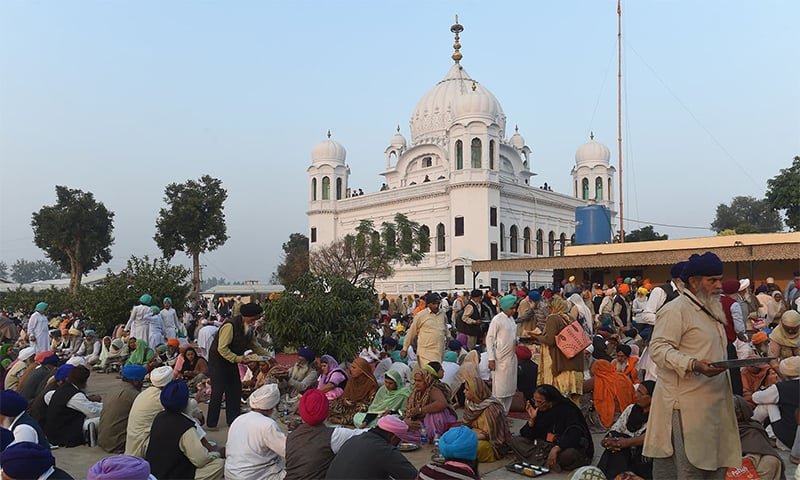
After the inauguration of the Kartarpur Corridor in November 2019, Pakistan has repositioned itself as an attractive destination for the global Sikh community for religious tourism. The numbers so far have not reached the expectations because of many reasons including among others the spread of the coronavirus and the heightened tension between India and Pakistan.
Despite many hurdles, the history of the land of Pakistan retains a rich potential for the Sikh diaspora to relive and reclaim their religious heritage. As an effort to highlight and elaborate the religious memorials, Gurdwara, and history of the important religious figures, we find an impressive effort of Dr Dalvir S. Pannu as, The Sikh Heritage: Beyond Borders of India and Pakistan.
The book is both a culmination of the writer’s ten years journey to explore the present condition of the memorial sites, also beautifully presented pictorially in it and a search for the authentic Sikh history with the help of archival and contemporary sources. The book also engages with the historical interaction between Muslims and Sikhs before 1947.
The book also engages with the historical interaction between Muslims and Sikhs before 1947.
To tell the story of eighty-four memorials in six districts of Punjab, the book sets off from the description of the Gurdwara Janam Asthan (the birthplace of Guru Nanak, the first of the ten Sikh Gurus), in the Nankana district.
Locating 13 more in Nankana, 03 in Sheikhupura and six in Sialkot, the book highlights the importance of Guru Nanak’s life to understand the development of Sikhism. One finds that Gurdwara Sacha Sauda in Sheikhupura commemorates the moment in Guru Nanak’s life when he gave twenty rupees to a group of hungry mendicants instead of using them for personal business purpose. The Gurdwara Babe Di Ber in Sialkot the meeting of Guru Nanak with a Muslim mystic whose anger with the locality was resolved by Guru by pointing out the importance of being forgiving.
Dr Pannu could locate the dilapidated remains of 17 memorials in the Kasur district. The remains of the memorials still exhibit dimly the frescoes on the walls and ceilings, paintings of the saints, dilapidating arches, inscriptions in Gurmukhi, and weakened parapets.
The book surprises its local Muslim reader with the recollection of the story of Baba Bulle Shah (1680-1757) taking refuge in a Gurdwara Sahib of Daftuh, the Union Council of the Kasur district. The famous poet, and later Sufi saint of the Muslims, took refuge in the Gurdwara to save his life from the angry Muslim mob of village Pandoke, his ancestral village.
The shared communal traditions engulf the reader further once the book ferrets out the shrines and memorials in Lahore. The half of the total number of Sikh shrines, the book mines them in Lahore highlighting the importance of the city not only as a center stage for the development of the Sikh religion but also for being a witness to a long history of mutual engagement, strife, and coexistence of Sikhs and Muslims.
One comes to know that Lahore is the birthplace of the sister of Guru Nanak and first GurSikh Bebe Nanki (1464-1518) in a village Chahal memorialized as Dera Chahal, and Guru Ram Das (1534-1581), the fourth of the ten Sikh Gurus, memorialized as Gurdwara Janam Asthan Guru Ram Das.
Lahore also became a place where a Mughal ruler martyred Guru Arjan (1563-1606), the fifth of the ten Sikh Gurus, and the site is memorialized as Gurdwara Dehra Sahib. The city has the site of Gurdwara Shaheed Ganj, memorialized as a site of a painful memory of Sikhs killed in hundreds during the period of Mughal Viceroys of Lahore, including Abdul Samad Khan (1713-1726), Zakariya Khan (1726-1745), and Mir Mannu (1748-1753).
The same city is also important for the shrines of figures including Pir Sheikh Abdul Qadir Jilani Sani (d. 1560), Wazir Khan (Sheikh Il mud Din Ansari, famous for making a grand mosque) and Hazrat Mian Mir (1550-1635), radiating the cheerful memories of friendly and intellectual interaction with Sikh Gurus.
The book ends its journey in the Narowal district at the Gurdwara Darbar Sahib, Kartarpur (God’s dwelling). The story of Gurdwara Darbar Sahib is also the story of the last eighteen years of the life of Guru Nanak who finally settled in this village and favored the life of the household instead of Udasis or life as a Divine Mission.
As the book collected its data before 2019, the story of the Gurdwara Darbar Sahib does not include the development of the site as a Gurdwara Kartarpur Corridor inaugurated in November 2019. However, the details of Guru Nanak’s household life introduce the reader with interesting anecdotes coloring Sikhism with the teachings of Guru in a more practical fashion.
The book is an outcome of the authentic and deep-seated urge to find one’s own identity in the communally divided region.
In the backdrop of the birth of Pakistan that entailed violent communal clashes resulted in the uprooting of almost 2 million Sikhs from the region of Pakistan and constant tension on the borders between India and Pakistan since then, there has been seldom space, especially during the whole twentieth century for conducting such a study.
This book is a witness to the beginning of a new turn in the history of Pakistan, when, instead of bracketing with the victims or perpetrators communally, the painful memories of violence can be commemorated from the humanistic perspective. The search of the Global Sikh community for the Sikhism within this region may become an opportunity for Pakistan to embrace its own heritage truly.
A man from Peshawar, Usman Khan has taken the initiative of spreading smiles after the area where he has lived has witnessed decades of suicide attacks, explosions, and threats from hardline militant groups.
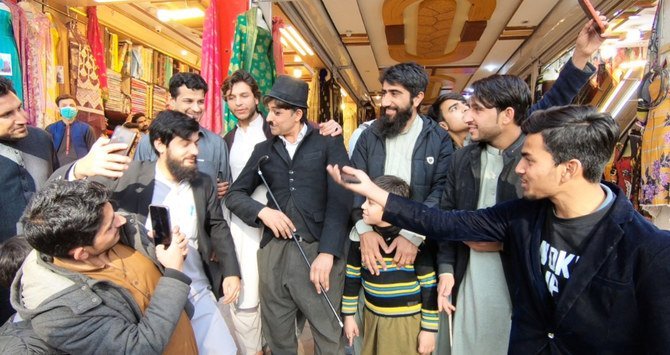
The stand-up comedian wears Charlie Chaplin’s trademark oversized shoes, baggy pants, cane and black bowler hat and performs across the city.
“The sole purpose of this art is to bring a smile to the faces of people,” 30-year-old Khan told Arab News while walking on the streets of Peshawar.
“For the past decades, Peshawar and Khyber Pakhtunkhwa have faced terrible times. I know I can’t perform as well as the great Charlie Chaplin, but with limited resources, I am doing my best to spread happiness,” said Khan.
He added: “I have adopted Chaplin’s character and style in such a deep way that I perform even when I am sleeping. My wife has complained about this.”
Khan shared he started watching Chaplin’s films from childhood and was soon able to copy his iconic walk.
Now, when he travels through Peshawar imitating the famous actor, crowd around him claps for him and ask for selfies.
“This man has been among the few sources of smiles during the toughest times,” local shopkeeper Wali Afridi said. “Khan is now a kind of star in this area; he comes to our shops and takes what he wants and performs a few comic sketches.”
Four friends of Khan help him with his routine. The team is now recreating many of Chaplin’s old routines on video. They are hopeful that social media will help them gain larger audiences and turn their passion for comedy into an earning profession.
“Cheerful faces and crowds around us encourage us to do more funny videos,” Khan said, posing with a local for a selfie.
The Pakistan Cricket Board (PCB) has announced a 20-player squad for the Test series against South Africa (SA). As per details, the squad includes nine uncapped players. Haris Sohail, Mohammad Abbas, and Shan Masood have been dropped by the selection committee, while Hasan Ali has been included in the Test squad after two years.
The 20-player squad includes:
Openers – Abid Ali (Central Punjab), Abdullah Shafique (Central Punjab) and Imran Butt (Balochistan)
Middle-order batsmen – Azhar Ali (Central Punjab), Babar Azam (captain, Central Punjab), Fawad Alam (Sindh), Kamran Ghulam (Khyber Pakhtunkhwa), Salman Ali Agha (Southern Punjab) and Saud Shakeel (Sindh)
All-rounders – Faheem Ashraf (Central Punjab) and Mohammad Nawaz (Northern)
Wicketkeepers – Mohammad Rizwan (vice-captain, Khyber Pakhtunkhwa) and Sarfaraz Ahmed (Sindh)
Spinners – Nauman Ali (Northern), Sajid Khan (Khyber Pakhtunkhwa) and Yasir Shah (Balochistan)
Fast bowlers – Haris Rauf (Northern), Hasan Ali (Central Punjab), Shaheen Shah Afridi (Khyber Pakhtunkhwa) and Tabish Khan (Sindh)
Talking about the selection of uncapped players, Chief selector Muhammad Wasim said, “I want to congratulate all the uncapped players who have made it to the 20-player Pakistan Test squad. These nine players are now just a step away from representing Pakistan in the pinnacle format of the game. As such, they have an outstanding opportunity to step-up show their class and potential and perform strongly so that they can cement their places for future international assignments.
He further added: “Sohail, Abbas, and Masood have been dropped due to inconsistent performances. However, the PCB will not let its investment in these talented players go to waste and will invite them to the High-Performance Centre so that they can work out their technical flaws and get back into contention,”
South Africa will tour Pakistan this month for the first time in 14 years to play two tests and three Twenty20 Internationals. The five-day matches will be staged in Karachi from January 26-30 and in Rawalpindi from February 4-8.
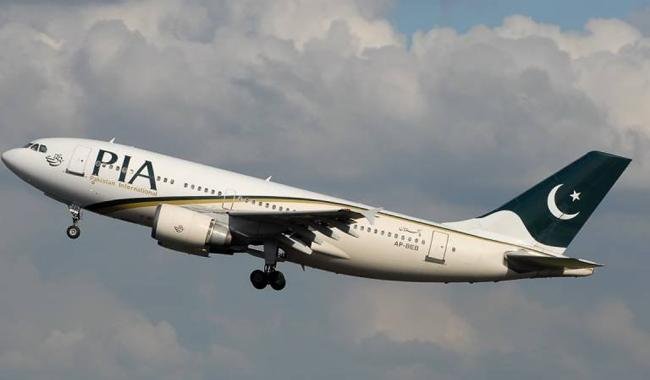
A Pakistan International Airlines (PIA) jet was on Friday impounded by Malaysian authorities, minutes before it took off from the Kuala Lumpur International Airport.
According to media reports, the Boeing-777 was confiscated over the national carrier of Pakistan’s failure to pay leasing dues to a Vietnamese company, and on the orders of a Malaysian court.
ملائیشین حکام نے پی آئی اے کا طیارہ تحویل میں لے لیا، لیز کے واجبات ادا نہ کرنے پر پی آئی اے کا طیارہ تحویل میں لیا گیا، ملائیشیا میں پی آئی اے کا طیارہ ویتنامی کمپنی سے لیز پر لیا گیا تھا#DunyaUpdates#DunyaNews
PIA had leased two aircraft, including the Boeing-777, from the company in 2015.
“Flight was ready for departure with passengers on board and when authorities came on board & informed the crew that they are not allowed to depart,” journalist Mubashir Zaidi claimed.
A #PIA Boeing 777 is impounded by Malaysian authorities in Kuala Lumpur as the leasing company has not been paid the lease amount. Flight was ready for departure with passengers on board and when authorities came on board & informed the crew that they are not allowed to depart.
The aircraft’s 18-member staff also become stranded in Kuala Lumpur due to the seizure, and will now quarantine for 14 days as per protocols, Geo reported.
Meanwhile, PIA confirmed that the aircraft has been held back on the orders of a local court in Malaysia that “took a one-sided decision pertaining to a legal dispute between PIA and another party pending in a United Kingdom (UK) court”.
A PIA aircraft has been held back by a local court in Malaysia taking one sided decision pertaining to a legal dispute between PIA and another party pending in a UK court.
The passengers are being looked after and alternate arrangements for their travel have been finalized.
In a subsequent tweet, the national carrier termed the situation as “unacceptable” and said that the government of Pakistan had been approached to take up the matter using diplomatic channels.
Robbers on Thursday looted burgers from a delivery boy in Gujranwala.
As per reports, a group of six men riding on two motorcycles robbed the delivery boy as he was on his way to deliver the burgers to customers. The unidentified but armed men stopped the boy and snatched six burgers and a mobile from him and escaped from the scene.
The delivery boy has filed an FIR against the suspects. Police officials have assured that they will arrest the suspects soon.
Earlier on December 25, a delivery boy had nabbed two young street criminals after they tried to rob him in Gulshan-e-Iqbal but later allowed them to go thinking that it could ruin their life.
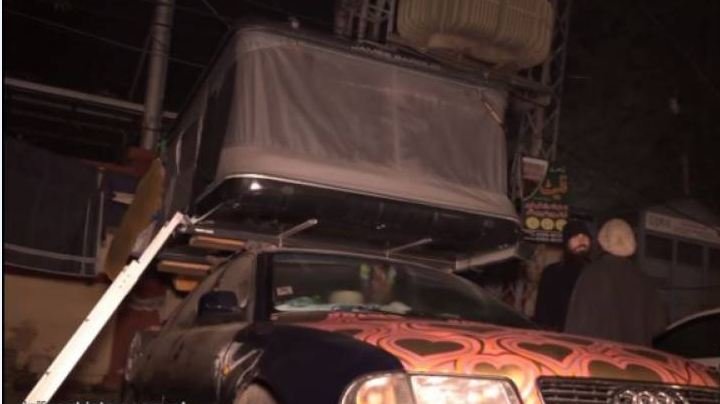
A foreign couple, who is apparently from Australia or Germany, has been residing outside the Customs House in Lahore for the past six months without permission,Daily Pakistanhas reported.
According to locals, they had come to Lahore six months ago and had stayed for a few days at a hotel near Anarkali Bazaar.
However, the couple started living in a car, parked on a road after they ran out of money. They have set up a tent on the car’s roof.
They also have a pet puppy and a small cylinder to cook food.
According to locals, the couple wanted to travel the world on their car and were supposed to cross the Wahga border to reach India, but got stranded in Lahore due to COVID-19.
Since then, they have been living in a car where they also order food deliveries.
Locals said they sometimes distribute soup and rice to the workers in the area.