Tag: Pakistan

  • Creditors reschedule loans worth Rs272bn

    Creditors reschedule loans worth Rs272bn

    Pakistan has secured a $1.7 billion (Rs272 billion) debt relief agreement to help offset the financial headwinds sparked by the coronavirus pandemic, officials have said.

    The deal, following months of negotiations with creditors, will provide a moratorium on debt payments for large swathes of the current fiscal year and help ease the cash-strapped country’s massive financial obligations.

    “The Government of Pakistan has successfully negotiated and concluded rescheduling agreements with 19 bilateral creditors, including members of the Paris club,” the Ministry of Economic Affairs said.

    The ministry described the deal as ‘timely’ that will help save the ‘lives and livelihoods of millions’. Pakistan’s economy was already on life support before officials began shuttering large segments of the economy in the spring as a range of lockdown measures were rolled out to fight the spread of the coronavirus.

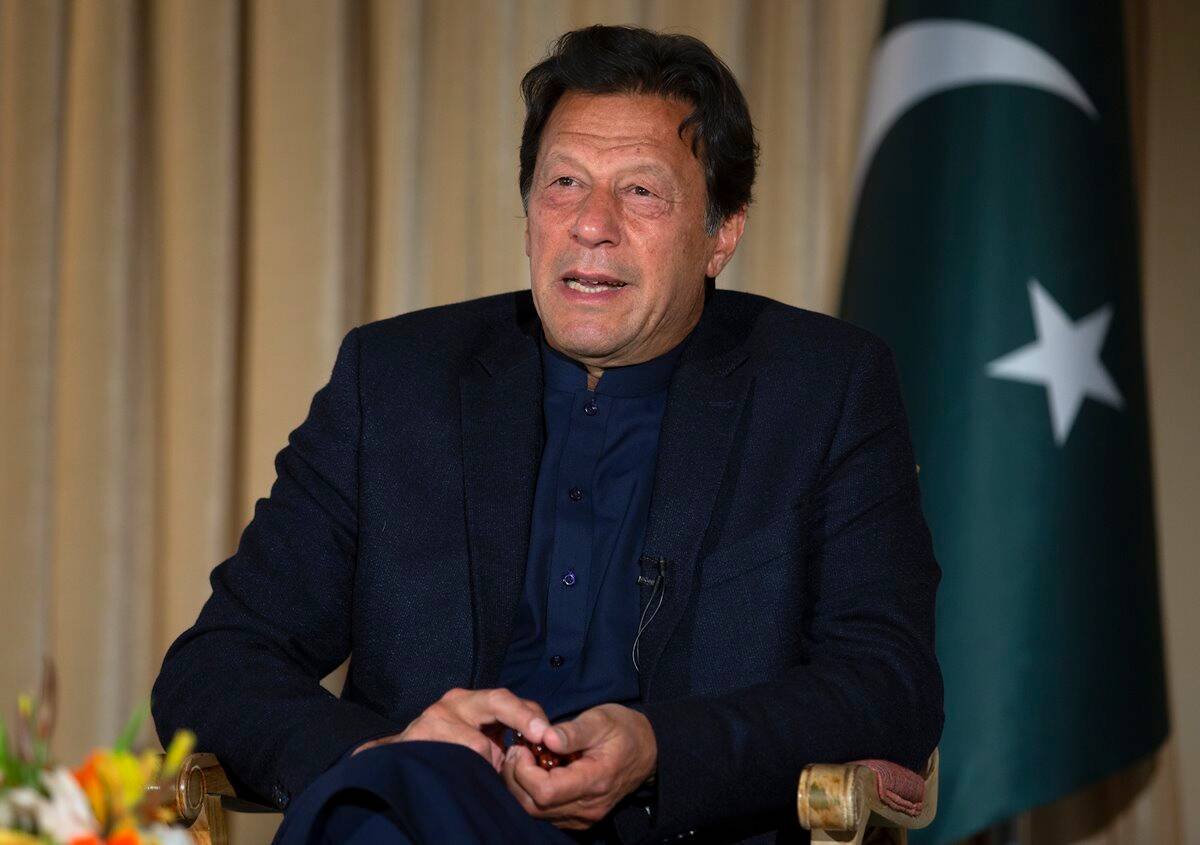
    Prime Minister Imran Khan has repeatedly called for debt forgiveness from international donors as tax revenues cratered, inflation soared, the currency was devalued, and fiscal deficits widened.

    In June, Pakistan was named as one of a handful of countries to secure a moratorium on debt repayments from the Paris Club in an effort to ease the economic impact of the coronavirus crisis. 

  • ‘Sh Rasheed is like a brother to me,’ says Hareem Shah, advises him to get married soon

    TikTok star Hareem Shah on Monday termed recently-appointed Interior Minister Sheikh Rasheed as “her brother” and even advised him to tie the knot soon.

    Harim Shah has 4.9 million followers on the video-streaming platform TikTok.

    Addressing a press conference in Karachi, Hareem said that it is in Sheikh Rasheed’s best interest to get married now.

    “Sheikh Rasheed Sahib should tie the knot, otherwise who knows how many more videos will emerge,” she said in reference to a recent controversy surrounding the minister.

    The TikTok celebrity announced she is not going to marry right now, saying, “My dream boy has not yet landed on planet earth. When I see him, I will marry him.”

    Last year, several videos of Federal Minister for Railways Sheikh Rasheed on live calls with TikTok stars Hareem and Sundal Khatak had gone viral on social media.

  • Pakistan suspends flights from UK amid new coronavirus strain

    Pakistan suspends flights from UK amid new coronavirus strain

    Pakistan has decided to suspend all flights from the UK until December 29 after a new strain of the coronavirus emerged in the United Kingdom.

    The restriction will be on all direct and indirect flights from the UK, effective December 23 at 12:00am, and will be applicable to all persons who are travelling from the UK and are in or have been in the UK for 10 days.

    On the other hand some passengers will be exempted from these restrictions. Transit passengers who do not leave airside in the UK and who were travelling from areas other than the UK will be allowed to travel to Pakistan. Similarly, Pakistani passport holders who travelled to the UK on visitor visas will be allowed to return with the following arrangements:

    1. A negative PCR test within 72 hours before the flight
    2. They will stay in the airport or in a government facility until the PCR test is taken.
    3. Mandatory enforced home quarantine for 7 days
    4. Trace and Test all passengers who arrived from the UK over the past 7 days as per TTQ protocol, including passengers arriving on 22 December.

    The Pass Tack App, introduced by the National Command and Operation Centre (NCOC), is mandatory for all travellers arriving in Pakistan. Those who do not have it will need to fill out the web form of the Pass Track App.

    The passengers who do not have the Pass Track App will need to fill out the web form of the application.

    “NCOC will review the above-mentioned decisions on December 28, 2020, and any change will be communicated to CAA for further necessary instructions,” the notification from the  Aviation Division said.

    It is important to mention that flights from the UK are being suspended to 40 countries across the world including, Spain, India and Hong Kong.

    Other countries to impose a ban on UK arrivals include Belgium, Canada, Germany, Ireland, Italy, Portugal, Romania, Russia, and Switzerland. Some of the bans are already in force while others are to begin on Tuesday.

    The World Health Organisation (WHO) tweeted late on Saturday that it was “in close contact with UK officials on the new #COVID19 virus variant” and promised to update governments and the public as more is learned.

    The new strain was identified in southeastern England in September and has been spreading in the area ever since, a WHO official told the BBC on Sunday.

    A WHO spokeswoman told AFP that “across Europe, where transmission is intense and widespread, countries need to redouble their control and prevention approaches.”

    It is important to note that while increased transmission is proportional to the chances of further mutation, the EU experts do not believe that the mutation should hinder the effectiveness of the vaccines.

  • Boy reportedly dies after losing a PUBG game

    Boy reportedly dies after losing a PUBG game

    A young man from Faisalabad reportedly lost his life on Monday after he “failed to win” a game of PlayerUnknown’s Battlegrounds (PUBG) online.

    According to reports, the man was taken to the hospital yesterday while he was unconscious.

    The family said that the boy had been playing the online game for the last six months. He lost the last stage of the game last night that had a deep effect on his mind. The exact cause of death has not yet been ascertained.

    PlayerUnknown’s Battlegrounds popularly known as PUBG was temporarily banned in Pakistan after reports appeared that it had negative effects on the minds of the youth.

  • Rawalpindi police station gets a daycare centre

    City Police Officer Muhammad Ahsan Younas has set up a day care centre at Rawalpindi Police Station to facilitate women police officers.

    A police spokesman said that the purpose of the centre is to provide a safe and secure environment to the children of police officers so that they have the peace of mind of knowing their children are safe while they work.

    According to details, the centre will be open from 8 am to 4 pm and will have amenities like kitchen, heaters, air conditioners, geysers, washroom, comfortable bedding, toys, LED television, toys and study material for children.

    In a statement, CPO Muhammad Ahsan Younas said that all steps including setting up daycare centre are being taken under the vision of Inspector General of Police (IGP) Punjab Inam Ghani.

     “Welfare of force is our priority, day care centre has been established to provide better working atmosphere and facility for the women police officers and it will make them care-free during their duty hours which ultimately will enhance their working capabilities,” he said.

  • Pakistan reports lowest daily cases since Nov 10

    Pakistan reports lowest daily cases since Nov 10

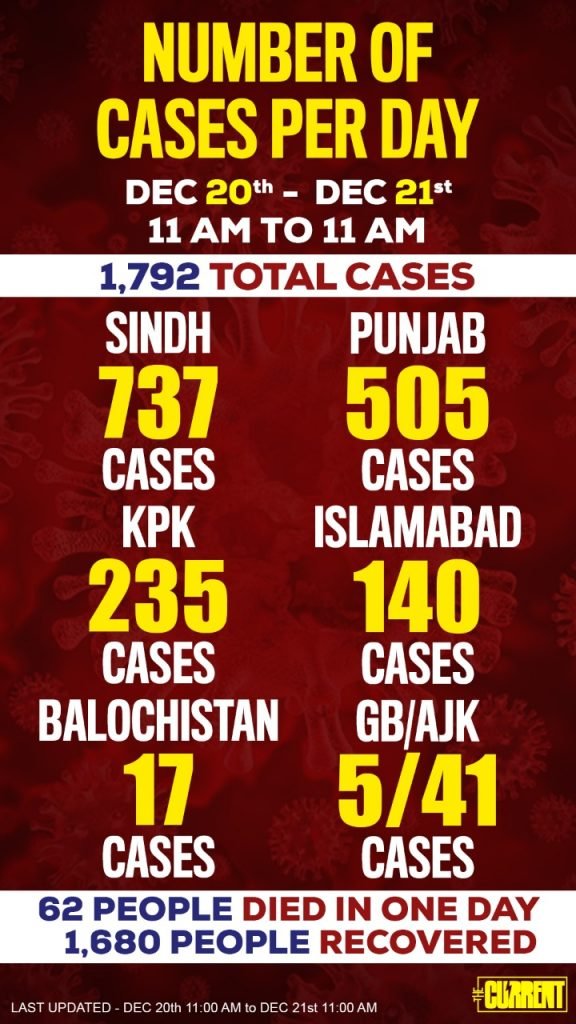
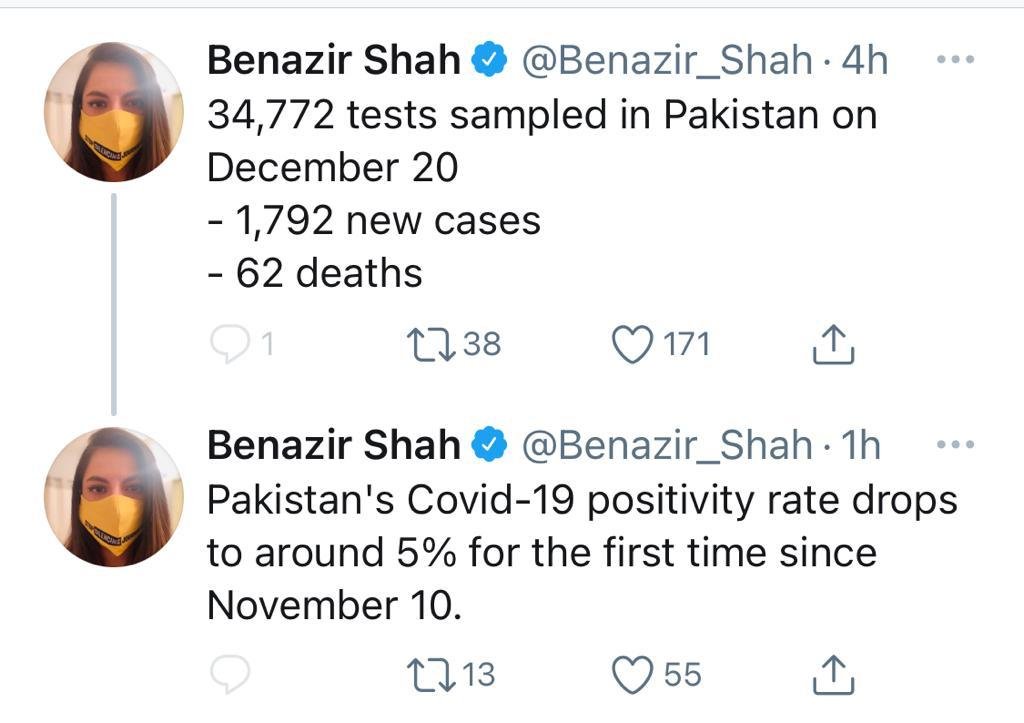
    Pakistan has reported 1,792 COVID-19 cases for December 20. This is the lowest daily tally of cases since Nov 9 when the country reported 1,637 cases.

    As per reports, 62 people lost their lives from the virus in the same time period, down from 80 a day earlier.

    The positivity rate has also gone down to 5% for the first time since November 10.

  • Gallup survey: 92% respondents think Karachi is the best city to live

    Gallup survey: 92% respondents think Karachi is the best city to live

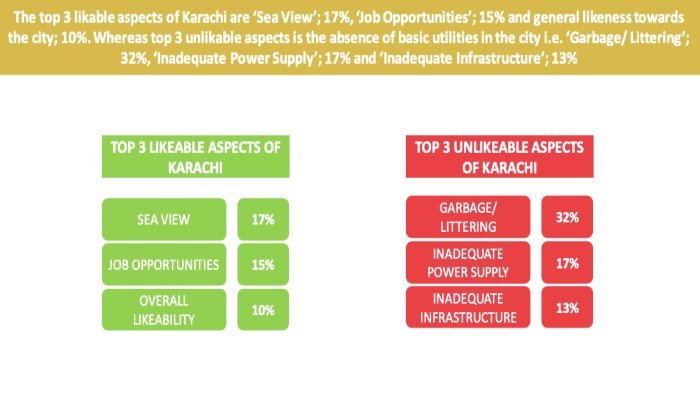
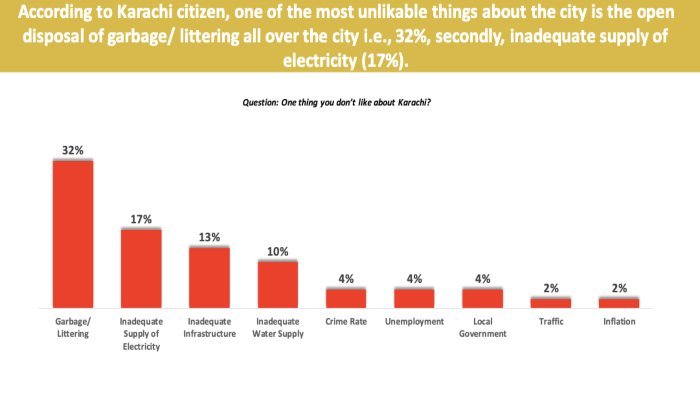
    The survey conducted by Gallup Pakistan has revealed that 92% of the respondents think that Karachi is the best place to live expressing that the Sea View was their most likeable feature of the city, while garbage/littering is the most unlikable aspect of the city.

    Over 500 people from across Karachi took part in the poll conducted by Gallup Pakistan that was held from Oct 27 to November 17, 2020.

    Photo Courtesy: Gallup Pakistan.

    17% Karachiites were not satisfied with the city’s electricity’s supply.

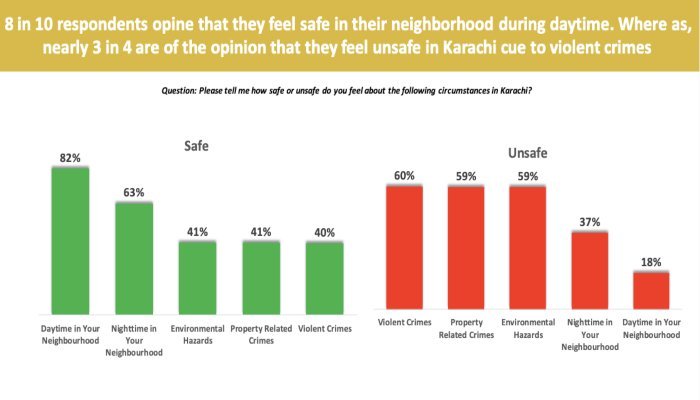
    Photo Courtesy: Gallup Pakistan.

    8 out of 10 citizens representing 82% of the respondents have shared that they felt safe in their neighbourhood during the day. 3 out of 4 expressed that they feel unsafe in the city due to violent crimes.

  • Bittersweet career of Pakistan cricket’s tragic hero

    Bittersweet career of Pakistan cricket’s tragic hero

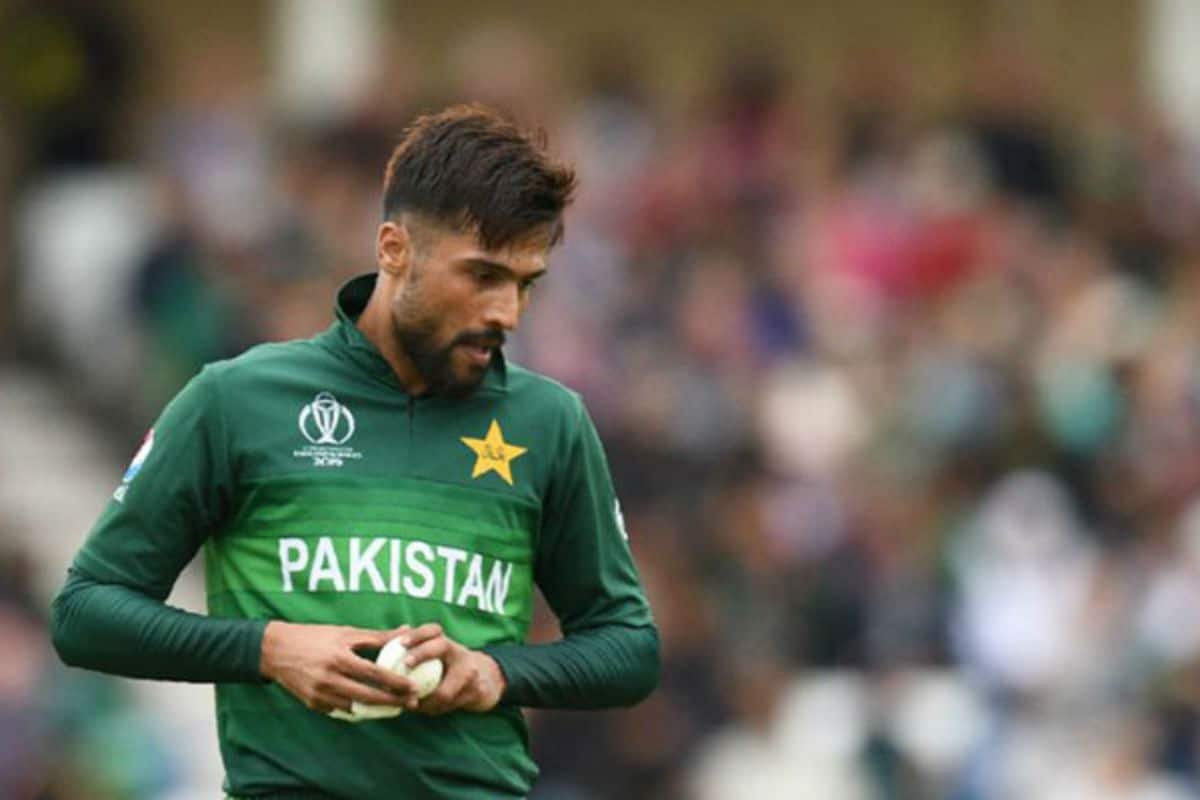
    When Mohammad Amir burst onto the international scene at the tender age of 17, pundits speculated that Pakistan has found its next Wasim Akram. Even Wasim Akram himself, who is inarguably the greatest left-arm pacer ever, has claimed multiple times that Amir reminds himself of his playing days. In my vantage point, such comparisons are often unfair and necessary but it wasn’t a hyperbole by any means to say that anything could stop a bowler possessing such an enormous amount of potential from reaching celestial heights and becoming the next big thing in world cricket.

    However, things didn’t swing Amir’s way and Amir’s career turned out to be an altogether different affair.

    Having quit Test cricket in July last year, Amir announced his retirement from limited-over internationals after representing Pakistan in 147 international matches in a video message whereby he lambasted the Pakistan Cricket Board (PCB) for mentally torturing and overburdening him.

    “Every two months, someone says something against me,” said Amir. “Sometimes the bowling coach [Waqar Younis] says Amir ditched us, sometimes I’m told my workload is unsatisfactory. Enough is enough.”

    The 28-year-old left-arm pacer will now only ply his trade in T20 leagues across the globe.

    The literary term “tragic hero” aptly describes Amir’s career which spans over more than a decade and had its fair share of doom and gloom. He was universally revered in the beginning, then disgraced and booed at after his involvement in a spot-fixing scandal, and then loved again for some heroic performances before finally slipping off the selectors’ radar due to a lean patch.

    After making his debut against England in a T20 match at The Oval in June 2009, Amir could only represent the green shirts until August 2010 when he was banned for five years alongside Pakistan’s then-captain Salman Butt and his bowling partner Mohammad Asif after the now-defunct tabloid News of the World found the duo guilty of bowling deliberate no-balls in exchange of money. This ephemeral period of about 14 months, however, were more than enough to leave his mark with some memorable performances.

    In the final of 2009 T20 World Cup, he accounted for the tournament’s leading run-getter with a well-directed short delivery sending Tillakaratne Dilshan back to the pavilion for a duck. Playing his first test in Australia, where even the top visiting bowlers are treated with disdain, he tore through Australia’s batting order with a five-wicket haul at Melbourne.

    In July 2010, Australia took on Pakistan in England and Australian batsmen were again found all at sea against the teenage pace sensation who pocketed 11 scalps at 21 apiece. Even in that ill-fated tour of England, he fared extraordinarily well becoming the youngest bowler to take 50 Test wickets, breaking into the Top 10 of ICC’s ranking of Test bowlers and getting his name on the Lord’s honours board at an age of 18 years and 136 days.

    The sight of a frail teenager regularly bowling at speeds around 150 kilometres per hour and ripping through the batting order of top teams is always worth savoring. Interestingly, Amir’s best was yet to come. Disappointingly, he fell into the trap set by his skipper as a consequence of which the doors upon his career were closed for five years. And in so doing, he let down countless fans not only here in Pakistan but also across the globe who glimpsed a future star in the prodigious teenager.

    Thereafter, Pakistan relied on their spin triumvirate of Shahid Afridi, Saeed Ajmal and Mohammad Hafeez for a long time to do the damage with the ball. Although plenty of promising pacers like Junaid Khan and Aizaz Cheema came through the ranks to fill the void, Pakistan’s quest to find a pacer for a long term wasn’t smooth sailing as some were scarred by injuries while others were not up to the international standard.

    Fast-forward to 2015, when Amir’s ban expired, he was just 23. The PCB looked on to Amir to bail them out of their fast-bowling woes but they were caught in the crossfire whether they should give someone a second chance who tarnished their reputation. Some asserted that he has already served his punishment and should be given the green light to don the green shirts again whilst others vehemently opposed his comeback with some players showing reluctance to play alongside him. By virtue of strong outings in the Quaide Azam Trophy, he seized the opportunity and clawed his way back into the national team convincing the selectors that he hasn’t lost his touch despite a prolonged absence from playing cricket.

    For their T20 series against New Zealand in January 2016, selectors announced Amir’s name in the squad who got the chance to restart his career in the first match of the series. In the third game of the series, he got a taste of what he should have expected to face frequently throughout his remaining career. The stadium announcer played the sound of a cash register taking a dig at Amir while fans waved cash at him chanting “I’ve got a dollar for you”. The Home of Cricket, which Amir had left in disgrace, turned out to be the venue for his comeback Test and fittingly it was he who cleaned up England’s last batsman to seal off a victory for his side.

    In Pakistan cricket, a good performance against arch-rivals India is a shortcut that can guarantee the player to become a star and be endeared by the fans. Amir knew how to strike the right chord in the hearts of Pakistan cricket viewers and he did it with aplomb. In Asia Cup 2016, he scared the living daylights out of Indian batsmen and displayed a beautiful exhibition of fiery seam bowling against them in the T20 World Cup 2016. In the final of the 2017 Champions Trophy, he was at his devastating best when he dismantled India’s robust top-order putting his team in a commanding position to win the tournament.

    In Amir, Pakistan had a bowler who had the potential to assume the mantle of their pace spearhead for the foreseeable future. Alas, his magical splendor eluded him soon and his ascendency morphed into despondency. His pace dropped drastically in the final stages of his career, and sans World Cup 2019, his performance remained below-par. Even the greatest players go through a lean patch but it is how they emerge from it which sets them apart from ordinary sportsmen. He was full in his right to hang up his boots whenever he wants but his condescending tone in the farewell message gives birth to the barefaced question if he has reciprocated the love and investment PCB put in him. It also imparts a lesson that if PCB finds a prodigy in the future, it needs to ensure that he lives up to his potential and doesn’t meet the same fate as Amir.

  • Pakistan, IMF and our economic future

    Pakistan, IMF and our economic future

    Pakistan is looking to resume the IMF’s $6 billion programme to bring in some much-needed foreign exchange. The programme was earlier suspended due to the government’s unwillingness to increase power tariffs and bring in a mini-budget. The negotiations for programme resumption were further delayed due to COVID-19 but IMF came to the government’s rescue with $1.4 billion emergency financing, which helped the country sail through tough times.

    But now we are back to square one, and it’s time to take some hard decisions.

    Reportedly, IMF is expecting Pakistan to significantly increase electricity prices, bring in additional revenue measures and introduce a few legal amendments. Pakistan was expecting an IMF mission in December to negotiate the conditions, but it seems that IMF is expecting some solid prior actions by the government, before it plans a review mission.

    There is no doubt that an electricity price increase is inevitable to reduce the mounting circular debt, and new tax measures are critical to help the government reach the ambitious Rs4.9 trillion revenue target. But the government is worried on two counts: not only will these measures be unpopular and further strengthen the opposition’s narrative around inflation but will also make a dent in government’s efforts to stimulate the economy. The prime minister has already given a nod to the electricity price increase; however, it is not clear if this increase is enough and how soon the government will be able to pass this on to consumers.

    However, irrespective of whether the government ends up taking these unpopular yet necessary measures or if the IMF ends up showing some flexibility, it remains to be seen if we can keep on relying on these ad hoc measures, pushing electricity tariffs up for the paying consumers and squeezing the existing taxpayers to meet the ever-increasing targets.

    Pakistan has availed 21 IMF programmes over the past 60 years; however, these programmes failed to bring in any sustainable improvement in Pakistan’s worsening conditions. Pakistan’s repeated boom-bust episodes are now a characterising feature of its economy, where sprouts of growth are inevitably followed by prolonged slumps.

    All political governments start in the midst of a balance-of-payment crisis, necessitating going for an IMF programme. IMF brings in foreign exchange to avoid a default but also fiscal and monetary tightening, which slows down growth. As soon as the IMF goes away, the country takes no time in coming back to its expansionary fiscal and monetary policies, owing to political reasons and mostly to win the next election. This in turn increases the demand for imports, increasing the trade deficit, and the country is pushed into yet another balance-of-payments crisis and the cycle starts all over again.

    But every time, Pakistan’s economic indicators sink a bit further than the previous episode. It is clear that we are on an unsustainable economic trajectory, but our political shortsightedness prevents us from seeing what’s written on the wall.

    What can break this vicious cycle? The answer is actually not that difficult. What we need is a serious dose of structural reforms, where we expand the tax net, do away with the exemptions enjoyed by powerful lobbies, control power thefts and line losses, stop the bleeding by state-owned enterprises, rationalise the ever-growing subsidies and strengthen and diversify our exports base. But these reforms require paying high political costs and compromising on short-term gains for the longer-term future.

    IMF is also no stranger to these solutions. Almost all recent IMF programmes have stressed these reform areas, but every time they end up being content on short-term corrective measures rather than the so-called structural benchmarks.

    A research paper by Harvard Kennedy School in 2015 highlighted that IMF ironically adopts a serial lending pattern. More than one-fourth of IMF member countries were part of an IMF programme for fifty percent of the duration since they became a member. Another 37 per cent have been on IMF programmes for 40 per cent of the time or more. This makes it quite evident that Pakistan, like many other developing economies, has ended up being addicted to this repeated dose of IMF money, without ever fixing the underlying problems.

    Recent months, however, have shown some positive signs, with the government mulling over restructuring plans for SOEs like Pakistan Steel Mills and PIA, announcing ambitious and futuristic power sector reforms, re-negotiating contracts with Independent Power Producers (IPPs), stimulating export industries, and even taking stock of the massive subsidy stock.

    The market-based exchange rate regime adopted by the government has already put in place an auto-corrective measure, whereby any significant current account imbalance will lead to currency devaluation, making imports expensive, reducing demand and narrowing the trade deficit.  However, the government needs to follow through on its plans and build further on this groundwork.

    These measures will undoubtedly be hard to put in place, but sooner or later someone has to go this road. If the present government pushes through on these reforms, it can help the country break out of this vicious cycle and can create a name for itself in Pakistan’s economic history. If not, we’ll be knocking on IMF’s doors yet again in another 4-5 years, but in a much worse condition.

  • This guy’s gift to his bride is going viral. Here’s why

    With the wedding season is in full swing, our social media feeds are dominated with pictures and videos of shaadis happening all around us.

    Sometimes, a couple goes viral after they do something out of the box or have some exceptional planned for the better halves. One such couple has gone viral on social media after a groom gifted his wife four amazing portraits of her on their wedding day.

    In the video being circulated on social media, the happy groom can be seen showing paintings to his wife with minor details on them like the dates of their memorable moments, ceremonies and the bride’s ring.

    Check out the video below: