Pakistan Tehreeke Insaf’s (PTI) MNA Uzma Kardar has said that petrol is being sold at Rs75 per litre in the country, which in reality is being sold at Rs114.24 per litre.
Uzma Kardar said this while replying to a question of a reporter about petrol prices in Pakistan.
This is not the first time any PTI leader has made a statement mentioning wrong prices of things in the country. A few days earlier finance advisor Abdul Hafeez and prime miniter’s aide Firdous Ashiq Awan, both in there statements mentioned wrong prices of Tomatoes and Peas (Matar) in Pakistan.
Abdul Hafeez Sheikh had earlier claimed that tomatoes are being sold at Rs17 per kilogramme (kg). However, the fruit is being sold at as much as Rs320 per kg in the market as reported by citizens who bought groceries from multiple locations.
Similarly, Firdous Ashiq Awan had earlier claimed that peas are being sold in the market for only Rs5 per kilogram.
Amid reports of massive changes in the administration in the provincial cabinet, Punjab Chief Minister (CM) Sardar Usman Buzdar has called on Prime Minister (PM) Imran Khan, the second time within 24 hours, The News International reported.
According to the details, a one-line statement was issued by the PM Office that Punjab CM Usman Buzdar met Imran Khan here at the Prime Minister Office on Monday.
Meanwhile, Chairman of PM Inspection Team Ahmad Yar Hiraj has called on the premier and the two had deliberations on the performance of various government departments.
The premier has said that in the light of the PMIT report, the government departments should make every possible effort to strictly follow the report.
It is important to note here that the party’s core committee and members of the provincial assembly of Punjab had expressed serious concerns regarding the bureaucracy.
In the last 15 days, CM Buzdar has held a series of meetings with the Punjab Assembly members who repeatedly have complained that the bureaucracy is not cooperating to resolve the public’s issues in the province.
President Arif Alvi has offered Qatar of providing security for the next FIFA World Cup being held in the Gulf country in 2022, stressing that Pakistan had vast experience in that domain, The Express Tribune reported.
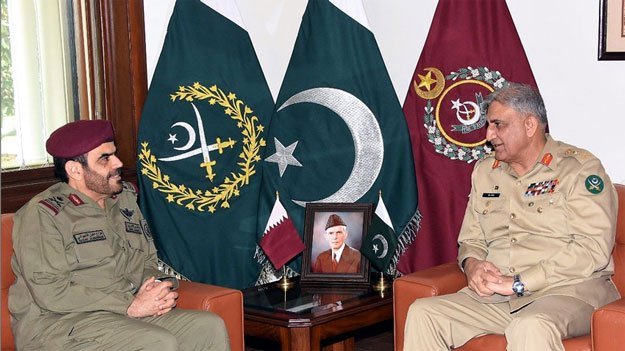
According to the details, talking to Commander of the Qatar Emiri Guard, Maj-Gen Hazzaa Bin Khalil Bin Mansour Al-Shahwani, President Alvi said that a lot of scope existed between the two countries to include defence export and joint production ventures.
Dr Alvi underscored that having vast experience in the domain of security and the professionalism of its armed forces, “Pakistan can provide Qatar security for Football World Cup 2022″.
He also emphasised on the need for enhancing the training collaboration and professional interaction between defence forces of the two countries, appreciating the agreement for sale of eight Super Mushak aircraft to Qatar worth $57.74 million in 2016.
The president urged Qatar to support Pakistan in its endeavours to highlight Indian human rights violations in Indian occupied Kashmir (IoK) before the world, and stressed the need for the international community to persuade India to resolve the long withstanding dispute in accordance with United Nations (UN) Security Council resolutions.
“The fascist Indian regime is flagrantly violating the human rights of Kashmiris by revoking the special status of occupied Kashmir and by suspending their civil liberties. The Indian government has adopted a hostile attitude towards all its minorities,” the report quoted Alvi as saying.
Maj-Gen Al-Shahwani said, “Qatar considered it a religious duty to support Pakistan at all levels”.
Separately, the Qatari commander also called on army chief General Qamar Bajwa at the GHQ in Rawalpindi, and discussed matters of mutual and professional interest and regional security situation.
Former finance minister Asad Umar, earlier this year, had announced that the government was pushing for PayPal, the online payment system that supports online money transfer in over 200 countries, to come to Pakistan.
A delegation from Pakistan’s Information Technology Ministry visited the United States in October to convince them to come to Pakistan but failed.
Urdu News reported that PayPal officials told the delegation that Pakistan was not included in its three-year road map because it didn’t have adequate business opportunities.
A Pakistani official of the National Institute of Technology said that PayPal changes its road map every year and Pakistan is still hopeful that they might come into the Pakistani market in the future.
Pakistan has clinched a favourable ruling in an international court regarding its one billion rupees of liquidated damage claim against a Chinese energy conglomerate for delaying renewable power projects, The News reported.
According to reports, officials have said that London Court of International Arbitration (LCIA) issued its final awards related to a dispute between Central Power Purchasing Agency (CPPA-G) and Zonergy Company Limited last week.
In the determination of the disputes between the parties, the sole arbitrator decided the required commercial operations date, “as agreed between the parties under the respective energy purchase agreements, represented a valid and binding obligation”.
“Consequently, CPPA-G’s imposition of liquidated damages for the power projects’ delay in achieving COD (commercial operations date) by RCOD (required commercial operations date) was justified,” the official said, citing the awards.
The CPPA-G and three subsidiaries of Zonergy approached the London Court of International Arbitration earlier this year to agitate their disputes under three identical energy purchase agreements signed between CPPA-G and the subsidiaries of Zonergy in June 2015 to set up 300 megawatts of solar power project. Each solar independent power producer has the capacity to generate 100 megawatts.
The final hearing for the LCIA arbitration numbers (183,881, 183,884 and 183,885) initiated by the independent power producers took place from April 29, 2019 to May 3, 2019 in Islamabad. The sole arbitrator appointed by the LCIA issued his final awards in the LCIA arbitration on November 19, 2019.
The federal cabinet has approved a draft of a renewable energy policy, envisaging 20 percent clean energy by 2025 and 30 percent by 2030, up from around 4 percent currently. The government would soon convene a meeting of the Council of Common Interests to finalise the renewable energy policy.
Consequent to expiry of RE Policy 2006 in March 2018, AEDB initiated the formulation of a new policy in view of government’s decision to come up with a policy aimed at creating conducive environment supported by a robust framework for the sustainable growth of renewable energy sector.
London Court of International Arbitration further determined that the identical liquidated damages provision in the energy purchase agreements was legal and enforceable.
Prime Minister (PM) Imran Khan’s office has again confirmed the three-year extension given to Chief of Army Staff (COAS) General Qamar Javed Bajwa recently, saying a notification pertaining to the extension in the general’s tenure has already been issued on August 19, Pakistan Today reported.
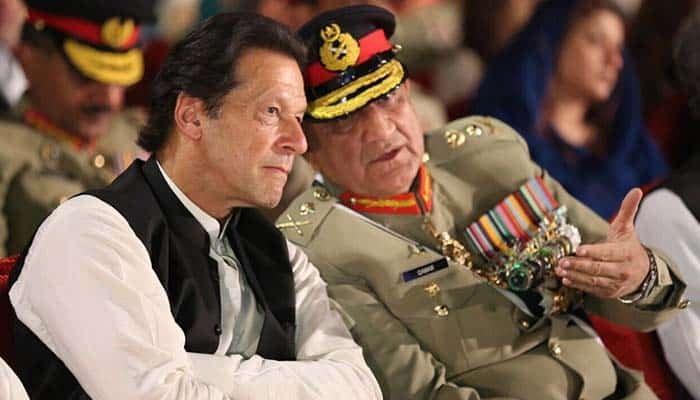
According to the details, the statement came after a meeting between PM Imran and Gen Bajwa amid reports of an alleged rift between the civilian government and the military establishment. This was the second meeting of the two bigwigs in a week.
During this meeting, the top leaders discussed matters pertaining to national security, said the statement issued by the PM House.
In the earlier meeting, Gen Bajwa met Imran in an apparent attempt to allay the latter’s concerns over the recent political developments in the country. The statement further said that the two sides discussed the prevailing situation in Indian-occupied Kashmir (IoK) and at the western border, and internal security issues were discussed.
The PM’s meeting with the army chief was followed by a meeting with Inter-Services Intelligence (ISI) chief Lt Gen Faiz Hameed on Tuesday.
However, media reports dub these meeting as an attempt to assuage Imran’s concerns by the military. “The government and army are not on the same page due to disagreement on certain points, especially the exit of former PM Nawaz Sharif from the country on health grounds,” reports had earlier stated.
After these statements, military spokesperson Major General Asif Ghafoor refuted claims of an alleged divide between the country’s civilian and military leadership, reiterating that both sides are on the same page.
“This is baseless gossip. There is absolutely nothing of the sort,” said ISPR director general as he dismissed speculations of a rift.
“The army is supporting a democratically elected government as per the constitution. There will be no let-up in this [support] as it is a must for the progress and prosperity of Pakistan”, he added.
On November 2 and 3, 2019, in a meeting hosted by the Progressive Students’ Collective, more than twenty students’ organisations from all across the country, including Gilgit-Baltistan (GB) and Azad Jammu & Kashmir (AJK) formed the Students’ Action Committee to demand revival of student unions and other issues in higher education.
The committee vowed to
launch a nationwide struggle for revival of student unions, against the cut in
educational budget, increasing harassment cases in universities, security
forces interferences in educational institutions, student torture cases, lack
of educational infrastructure and ban on freedom of expression. It also decided
that the first public activity under the banner of Students’ Action Committee
would be the Students’ Solidarity March on November 29, 2019.
The current crisis of
higher education in Pakistan confronts students in the form of rising cost of
education and a drastic decrease in immediate returns from a college degree.
Not only is it harder to afford college education, but education expenses also
leave students and their families in more debt and with limited job
opportunities. A shrinking job market with employment opportunities swayed
through social capital in the form of “contacts” has no space for a majority of
graduates.
We are marching on November 29 to organise and to seek institutional power in universities and create a way of holding onto that power. It’s our education — we should control it.
It seems like a
four-year degree only qualifies one to become a daily-wage labourer. Given this
continual crisis, students are organising on campuses across the country for
the forthcoming Students’ Solidarity March, after so many decades their
struggles for the restoration of students’ unions are not fragmented but
coordinated.
Since the collapse of
the students’ movement of the 70s and the subsequent ban on student unions in
1984 under the dictatorship of General Ziaul Haq, most campus activism has
taken the form of single-issue groups. There is a ban on any kind of political
activity by students on campus and those who have tried to raise their voice
for rights, have been rusticated, abducted and sometimes killed by fascist
groups. By using anti-terror laws, their voices have been suppressed.
Due to different kinds of repression on campuses, students haven’t been able to form an alliance that can give voice to all those being robbed of their rights and facing severe repression.
From the past one year,
students are agitating in different campuses on different issues, which include
protests and sit-ins against fee hikes, sexual harassment, against the
abduction of a number of students and for better housing, internet and transport
facilities on campuses.
While the resistance
that popped up at Quaid-e-Azam University (QAU) against budget cuts and tuition
hikes remained partially successful in pressurising the administration to succumb
to some of their demands, the fiscal situation and budget cuts at QAU are not
unique.
We are marching because if we want to create radical change on our campuses — change that addresses economic and cultural aspects of our life — we need to move towards students’ unionism.
Provincial governments
across the country are cutting funding to schools and universities; the
university officials are using budget cuts to jack up tuition fees (hikes that
will continue for a long time) and to cut essential services and programmes.
While the students at QAU, Punjab University (PU), Sindh University (SU) and
the University of Balochistan (UoB) are putting up an amazing response to fee
hikes, sexual harassment and securitisation of campuses, a coordinated effort
under the banner of Students’ Action Committee to revive student unions would
be more beneficial for the student body to assert its power as a class that
represents the youth of this country.
Therefore, we are marching on November 29 to organise and to seek institutional power in universities and create a way of holding onto that power.
Progressive policy
changes are a great thing on our campuses and they should be fought for, but
they should be fought for in the context of building student power at campus
level as well as at national level. Building student power means gaining more
and more control over our campuses and the decisions that affect us as students.
In the end, student power means a student-run higher education system.
It’s our education — we should control it.
We are marching
together to ensure that local victories do not become isolated pockets of
progress and resistance. We are marching to ensure that this work spreads and
students find ways to coordinate efforts with those underway at other campuses
in their areas.
Movements grow not only by example, but when they actively engage people and share resources and hard-earned lessons. Because the federal government still makes most of the higher education policy decisions, students also need to coordinate on the national level in ways that foster cross-campus solidarity and encourage local initiatives.
We are also aware of
the fact that coordinating efforts should never mean that local campus organising
becomes merely an extension of some larger campaign because this sort of
strategy cannot support long haul organising. We need coordination that is
mutually beneficial to everyone involved.
We are marching on November 29 because if we want to create radical change on our campuses — change that addresses economic and cultural aspects of our life — we need to move towards students’ unionism. Unions that are run by the rank and file students; that fight alongside faculty and workers; that seek to empower the historically oppressed and revolutionise our educational system.
The Civil Aviation Authority (CAA) has denied reports that any United States (US) military aircraft entered Pakistani airspace.
“Relevant departments have informed me that no aircraft entered Pakistan’s limits. In our record, no airplane has crossed our airspace,” said CAA spokesperson Ismail Khoso, Daily Times reported.
On Wednesday, ARY had reported that an aircraft from Muscat was heading towards Karachi. The pilot was asked about the permission and the code to which he didn’t answer. The air traffic controller warned the aircraft after which it moved out of its territory.
Aviation Division Senior Joint Secretary and spokesperson Abdul Sattar Khokhar said Muscat authorities informed Pakistan on November 18 at 9:15 am that an aircraft was flying towards Pakistani airspace.
“However, the plane did not enter our airspace and remained in international airspace. The authorities contacted the airplane for identification, but it did not respond either,” he added.
Khosa said there are air spaces of other countries besides Pakistan about which the CAA could not say anything. “We must have noticed any aircraft if it had entered Pakistan’s limits.”
“The aircraft was of US origin. However, I cannot confirm if it was a military plane, a fighter or a bomber or a transport plane,” Khokhar added.
British-Pakistani boxer Amir Khan has said that he would like to become the sports minister in Pakistan to promote sports, Geo News reported.
According to the details, Amir in an interview has alleged that Prime Minister (PM) Imran Khan has done ‘nothing for sports in Pakistan’ after coming to power, adding that he is the only person that does anything for sports.
Amir Khan, who is a friend of PM Imran, said that “all the people in Pakistan are crying”, and credited himself for taking Pakistani boxers around the world to put them in fights.
The boxer further alleged that a government minister visited his boxing academy, made some pictures and left, and nothing was done after that.
“There should be at least 10-15 boxing academies in Pakistan because there are so many boxers in Pakistan but nothing’s happening so that’s why I said that Imran khan, being a sports man, he is not really backing sports”, Amir said.
He also feared that sports are “probably going down even more than before because Nawaz Sharif is the one who got the Sports Council of Pakistan to give me the boxing academy, then I spent my own money around $100,000 on it to build it up but all I say is that Imran Khan is less supporting boxing”.
Amir Khan also expressed desire to enter in Pakistani politics, saying that he will do something for people if he became sports minister.
Amir Khan often attended fundraising events with PM Imran in Manchester in the past. The prime minister had at one event promised to take people like Amir Khan to Pakistan.
Lahore on Thursday once again topped the global list of cities with poor air quality as monitors showed an average “hazardous” Air Quality Index (AQI) of 335.
According to Newsweek Pakistan, residents of the capital of the country’s most populous province woke up again to the sight of a haze covering the city, with residents complaining of sore throats, itchy eyes and other ailments linked to inhaling toxic material through the smog that has increasingly become a regular fixture.
While the average AQI for the entire city stood at 335 around noon, parts of the city with individual air quality monitors showed the figure rising as high as 763, which posits a PM2.5 of nearly 900 ug/m3 — the equivalent of smoking nearly 40 cigarettes.
While smog is not a new phenomenon in Pakistan, it has taken on greater urgency this year amid ever worsening air quality that is particularly unhealthy for children, the elderly and the infirm. In 2007, the Lahore High Court (LHC) ordered authorities to prepare a smog response action plan to overcome the health crisis. The Punjab Environment Protection Council, however, adopted a plan that utilised a modified AQI classification system, which claims a PM2.5 rating of 60 is “satisfactory” even though US AQI adopted by much of the world declares it “unhealthy”.
PM2.5 refers to atmospheric particulate matter that has a diameter of less than 2.5 micrometers, so small that they can only be detected with an electron microscope. These fine particles, which can come from various sources including power plants, motor vehicle emissions, and agricultural burning, last longer in the air than heavier particles. This increases chances of them being inhaled by humans and animals, where they can bypass the nose and throat and penetrate deep into the lungs. The air pollution worsens during winter, emerging as smog, due to temperature inversion, which produces a layer of warm air that traps air pollutants.
Meanwhile, schools on Friday will once again remain closed across the city due to smog.Both public and private schools in Gujranwala and Faisalabad will also remain shut.
The Punjab School Education Department has issued a notification in this regard as well.