Tag: Pakistani Celebrities

  • Ahmed Ali Akbar’s upcoming film ‘Gunjal’ follows investigation of labor activist Iqbal Masih’s murder

    Actor Ahmed Ali Akbar’s upcoming film ‘Gunjal’ will certainly change the way Pakistani audiences see him. Akbar will essay the role of a journalist investigating the brutal murder of bonded child labor activist Iqbal Masih, who was assassinated on 16 April, 1995 when he was just 12 years of age.

    The film also stars veteran actor Resham and Aamna Ilyas.

    The film is directed by Shoaib Sultan and the screenplay has been written by Nirmal Bano and Ali Kazmi.

    Iqbal Masih had campaigned against abusive child labor in Pakistan from a very young age. He had received the Reeebok Human Rights Award in 1994 for spreading awareness about child labor and bonded slavery. He was posthumously awarded the Sitara-e-Shujaat in 2022.

  • ‘Janwaron say bad dua lenay say behtar hai’: Hamza Ali Abbasi joins rallying cry to shut down zoos across Pakistan

    ‘Janwaron say bad dua lenay say behtar hai’: Hamza Ali Abbasi joins rallying cry to shut down zoos across Pakistan

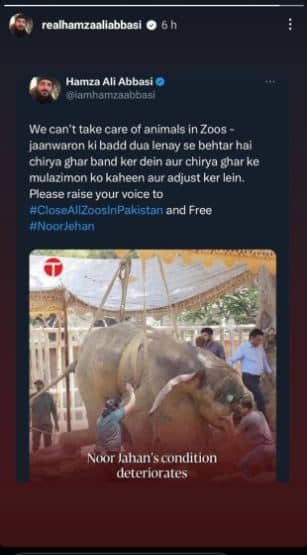
    Actor Hamza Ali Abbas has joined the chorus of voices calling for zoos across Pakistan to be shut down. As the country watches veterinarians try to save the life of one of Karachi Zoo’s elephants, Noor Jehan, celebrities have lent support to the demand that the animals be shifted to sanctuaries.

    Taking to Instagram, the ‘Maula Jatt’ actor shared a clip of a post by Express Tribune, slamming authorities for not caring about the welfare of the animals:

    “We can’t take care of animals in zoo’s- it is better than to receive curses from animals that we should ban zoos and send the animals to a safer place.”

    Abbasi’s criticism comes after countless celebrities, including Grammy award winner Arooj Aftab, raised their voices to support animals and shut down zoos. Aftab re-shared a clip from her interview with The Current where she had talked about the abysmal conditions of animals in Lahore’s zoo, calling for better facilities to be set up for animals.

    Just as Noor Jehan improved, she fell into a concrete pond built inside her shelter, leading to worsening of her condition. Authorities had remained in contact with the animal welfare organization Four Paws to coordinate for her treatment.

    Yesterday, The Nation reported that Minister of Climate Change and member of Pakistan People’s Party (PPP) Sherry Rehman, had advised Sindh government to shut down Karachi Zoo, and for the animals to be moved to enclosures where they are provided with proper facilities.

  • ‘Just get out!’: Sheheryar Munawar fights with director Sohail Javed in viral video

    A video showing actor Sheheryar Munawar fighting with director Sohail Javed has gone viral. The person responsible for sharing the video is unknown.

    While many people are claiming that the feud looks staged, neither Sheheryar Munawar nor his PR manager have commented on the clip while Sohail Javed has also chosen to remain quiet.

    The Current has reached to both for a statement. We will update the article as soon as we receive a response.

    If it is proven that this feud was staged, we would condemn it because such publicity stunts aren’t acceptable and should not be commended.

    Actor Imran Ashraf has so far been the only public figure to comment on this video. Underneath the video of the feud shared by Diva Magazine, the ‘Heer Da Hero’ actor had written:

    “I am well aquainted with both of them and I know that Sheheryar wouldn’t shout like this and nor would Sohail bhai. I hope that this is dramatized.”

  • 13 years later, Hassan and Bano’s tragic love story in ‘Dastaan’ is still a fan favourite

    Television in Pakistan went through a seismic shift when 13 years ago, the drama ‘Dastaan’ debuted on our screens. Featuring a star-studded cast like Fawad Khan, Sanam Baloch, Saba Qamar and Ahsan Khan, the series was an adaptation of the novel ‘Bano’ by Razia Butt, an exploration of the aftermath of the subcontinent’s partition.

    The main leads, Hassan (played by Khan) and Bano (played by Baloch), are two lovers who meet when their relatives Suraiya and Salim get married. At first Hassan tries to befriend Bano, but Salim refuses to let them marry because he wants to marry her off to another man. However, just as their families approve and both are engaged, Hassan has to leave for University, and then the partition of 1947 takes place after which their lives are completely changed.

    Pakistani dramas today can’t seem to move on from saas-bahu kay jhagray and toxic love stories where women are nothing but a prop for men, so many remember the magic of ‘Dastaan’ especially the tragedy of the love story between Hassan and Bano.

    A viral tweet on Twitter had asked about a couple from a drama series that had devastated them, and the most popular reply in the Pakistani context had to be Hassan and Bano’s tragedy from ‘Dastaan’.

    https://twitter.com/MaryamAmir59627/status/1647221392369147906?s=20

  • After ‘Kuch Ankahi’, ‘Fairy Tale’, Is 2023 the year we’re finally not glorifying toxic masculinity?

    We have been wasting our breath for years, criticising the entertainment industry and asking it to stop scraping the bottom of the barrel to give us another done-to-dust drama about saas-bahu jhagray. It seems like somebody has been listening to our laments. Recent serials, starring the likes of actors such as Mira Sethi, Ali Safina and Wahaj Ali, have us wondering whether the industry has finally begun to understand that toxic masculinity is not something to glorify or even a trait that women think is swoon worthy?

    In the disastrous year that was 2022, we got drama after drama with the same topic: bad boy meets good girl, he’s broken and needs fixing which apparently no therapist can do, his severe mommy issues need to be resolved by some naïve girl who has lived under a bunker all her life and is now the saviour she never signed up to be.

    However, this year with dramas like ‘Kuch Ankahi’, the popular Ramzan show ‘Fairy Tale’ and even Wahaj Ali’s hit ‘Mujhe Pyaar Hua Tha’, main leads are stepping away from toxic characteristics that symbolized what patriarchy thinks an ideal man must be like. Instead, men in these dramas are gentler, caring about the women they love and showcasing that being a man is not about being loud and brash, but infact it is about how attentive you are to the people around you.

    ‘Kuch Ankahi’ was like a breath of fresh air for audiences who were nostalgic for the days of Haseena Moin dramas, where the women were fearless and outspoken, not props to the men around them. The women in ‘Kuch Ankahi’ come in different shades of femininity: Samia is a shy homebody who wants to fulfil her parents wishes and get married to the man they pick, while Aliya is the complete opposite because she’s a headstrong, career-obsessed woman who wants to succeed in her retail-estate business. Their differences don’t prevent the siblings from bonding with each other or from standing up for their families. Many have praised the series for depicting a healthy relationship between siblings and called it the desi version of ‘Little Women’.

    https://twitter.com/decalsajal/status/1614558374787432456?s=20

    But what is also heartening to witness in ‘Kuch Ankahi’ is how all the men in the dramas are gentle and actively work around the family, rather than the typical men who lounge around, while the women cook. Agha Ji, the patriarch, champions his daughters, refrains from asking them to do his chores and continuously encourages the girls to pursue their dreams.

    Bilal Abbas’ character, Salman, Aliya’s professional rival in the drama, is also a fan favourite. He’s ambitious but he never resorts to sexist or demeaning jokes to push her out of the game. He is also respective and caring to his mother and even pulls his weight by helping around the house.

    Among the current on-going Ramzan dramas, ‘Fairy Tale’ has been winning hearts across Pakistan because of how it has re-written the grumpy x sunshine trope in a humorous, addictive story where the women lead the show and where the male lead treats women with respect.

    If audiences were left horrified when the male lead from last year’s ‘Kaisi Teri Khudgarzi’ forced the female lead to keep repeating his name in exchange for her dad’s release, this time they have better content to cheer on. Many Twitter users have found Farjaad’s dedication to Umeed quite moving as he keeps coming back to her despite convincing himself that they’re too different.

    We can not say that we’re okay with the current pacing of ‘Mujhe Pyaar Hua Tha’ and how the storyline features the trope of the selfish female lead and the money-obsessed mother-in-law, but credit to Wahaj Ali’s character Saad, the anti-thesis of the typical misogynist Pakistani male lead, if ever there was one. He refuses to engage in abuse or violence to pressurize the woman he likes to be with him, instead supporting Maheer in all of her decisions.

    Might we be witnessing the rebirth of the golden age of Pakistani dramas? Fingers crossed .
  • Maya Ali’s favourite scene from ‘Yunhi’ is a replay of sexist ‘beti ka ghar na raha’

    It’s Friday, Mercury has stopped going in retrograde and everything is going back to normal, except for Pakistani dramas, which will keep scraping the bottom of the barrel to search for sexist content.

    It’s hilarious and yet quite terrifying how dedicated Pakistani dramas are to not provide what their audiences actually want: progressive storylines that recognise women as equals, rather than as props. But what currently popular trending dramas like ‘Yunhi’ prove, the best way to get ratings and to keep eyes glued to screens is to keep peddling the same sexist tropes over and over again and proclaim it as the standard content everyone should watch.

    ‘Yunhi’ began trending on social media this week when the actor playing the female lead on the show, Maya Ali, shared a clip from the latest episode. In it, her character is having an emotional, heart-to-heart with her father (played by fashion designer Deepak Perwani). Judged on performance alone, the scene is definitely tearjerking. However, we made the mistake of unmuting the video and heard the female character discuss how tragic it is for her to leave her father and how happy she is that her mother isn’t alive to see her wedding day.

    We should clarify here that Maya’s character is not heading off to war or to a distant land, but is actually getting married and leaving for her new home.

    Exactly what magical powers does a yellow mayun joraa hold, we want to ask Deepak Perwani, because of which a woman suddenly becomes a shadow of her past self and leaves behind her old family and friends? Does signing a marriage pact suddenly mean that over night, no woman can come back to her old home, and is now just the wife of the man that she has married?

    And most importantly, how is this supposedly tear jerking scene suppose to sit well in a country where women are taught that once they are married, they can never freely visit their families nor can they wear what they want or go where they want? They are not even allowed to escape domestic abuse.

    The message that Maya Ali likes, is once more, a terrifying reminder that for Pakistani families, marriages are basically equivalent to exiling women from their parents’ homes. And that for parents, including the dead mother who Maya is glad isn’t alive to watch her get married, the sole emotional and fundamentally important moment is their daughter getting married, nothing else.

    If these drama creators need any advice to show a rukhsati that actually makes the audience sob, take notes from ‘Kuch Ankahi’. That drama serial included a wedding scene where the phupoo (aunt) passionately defended women’s right to include protective clauses in the nikkahnama, and prove that women do not become strangers to their own families once they get married. They are still individuals with a personality, and definitely more than just the wives of the men they are getting married to.

    https://twitter.com/sunflowermochii/status/1637183811300601858?s=20
  • ‘She’s Pakistani, due respect,’ Adnan Siddiqui schools Priyanka for ignoring Sharmeen Obaid’s nationality

    Pakistani filmmaker Sharmeen Obaid-Chinoy has gone from strength to strength, initially by becoming the first Pakistani and woman of color to first win two Oscars, then to helming Marvel projects and now to taking on the mantle of the first female director to take on the iconic franchise ‘Star Wars’.

    Chinoy’s remarkable achievements have made Pakistanis incredibly proud, putting the country on the global map of the entertainment industry.

    The ‘Star Wars’ announcement has prompted a lot of people to congratulate Chinoy, including local and international stars. However, Hollywood actress Priyanka Chopra’s sentimental note about the director irked a lot of people, including actor Adnan Siddiqui.

    Chopra has shared a note for Chinoy on Instagram, calling her the first ‘South Asian’ woman to achieve such monumental heights.

    Adnan Siddiqui then schooled her in a tweet, reminding her that Chinoy was a Pakistani first, then a South Asian

    “With due respect, @priyankachopra . Sharmeen Obaid Chinoy is a Pakistani first just to brush up your knowledge. Much like the way you flaunt your Indian nationality whenever you get the opportunity before claiming to be a South Asian.”

    Siddiqui’s savage response earned him praises from Twitter.

  • Wahaj Ali, Hareem Farooq’s upcoming drama ’22 Qadam’ is an ode to women in sports

    If fans haven’t had enough of Wahaj Ali in ‘Tere Bin’ and ‘Mujhe Pyaar Hua Tha’ then they’re in for a treat. His next drama is unique because it explores the issue of women in sports.

    Ali shared a first look of the venture where he will be playing a cricketer, writing on Instagram about the drama’s premise which is about supporting women cricket players.

    “As a society we need to promote women coming into all professional fields – from sports to sciences. The roots of 22 Qadam are embedded in inspiring and taking pride in the dreams and achievements of our women.”

    The female lead of this drama is going to be played by ‘Sar-e-Rah’ actor Hareem Farooq, who will essay the role of a small town girl named Fari, who dreams of becoming a cricketer.

    The Current reached out to Farooq on why she had chosen to become a part of this project, and she responded:

    “When we came up with this concept, the thought behind it was that we need to empower women in the best way possible and there is no way better than projecting women in sports. Cricket, especially being the most loved sport in South-Asia.”

    Farooq also reflected on how women like Sana Mir, who is a commentator and former cricket captain, served as inspiration for the drama by breaking stereotypes:

    “The first person that comes to our mind when you talk about women and cricket is Sana Mir, she’s been an inspiration for so many women out there. It is just about breaking stereotypes and the taboos out there that women can also excel in sports, and if nothing else it makes you more independent and gives you that confidence that allows you to face the world in the best way possible.”

    Hareem Farooq said that she feels that society needs the kind of entertainment where people are not just enjoying themselves but are also educated that stereotypes and taboos can be broken. “Even women, infact everybody, can achieve their dreams if they’re passionate about it.”

    Speaking about her character, the actress said that her character Fari dreams of playing for the national cricket team and making her country proud:

    “I play the character of Fari, who is this bubbly and happy girl who wants to spread joy and happiness where ever she goes. But she has a dream and a passion she wants to follow and she is determined to do that. In this way breaking stereotypes and taboos by playing for the national team and make her country proud, and make her parents proud. It is a journey of achieving that dream and the up’s and down’s she goes through, and how or will she ever be able to achieve that dream.”

    In many ways, Farooq says that ’22 Qadam’ is a groundbreaking show because it is “the voice of the unheard.”

    The drama is written by Zeeshan Ilyas and directed by Anjum Shahzad.

  • ‘I loved my character in Kuch Ankahi because she’s fearless’: Qudsia Ali

    Qudsia Ali has won accolades from audiences for her performance as Tania in ‘Kuch Ankahi’, where she plays the younger sister of the family. Speaking to BBC Urdu, Ali opened up about what drove her to the script and how she fell in love with her character:

    “When I read about Tania’s character, the first thing I loved about her was that she’s fearless. She isn’t afraid of anything. A lot of the times women in our families are scared of a lot of things like disapproval from their parents or even their families, especially my character who is scolded for eating. But she loves herself, she doesn’t mind if her mother calls her a ‘gama pelwan’ to which she responds ‘kya gama phelwan meri tarhaan cute tha?’”

    Ali also shared what set Taniya apart from other characters in Pakistani dramas is how she has male friends. It is still quite rare that a man and a woman are shown as just friends and not be romantically innvolved:

    “In the drama, Tania’s closest friend is a boy, which is a new thing for our industry to witness a boy and a girl being friends because in our society, we don’t believe in such things.”

    The ‘Betiyaan’ actress also raved about working next to actors like Sajal Aly and Bilal Abbass.

    “My first question had been ‘Who else has signed up for this drama?’ Then I was told that Sajal Aly and Bilal Abbas had, I was so overwhelmed and excited to become a part of this show.”

    On the fan-favorite moments of the drama involving her interaction with Shakeel, played by Samad Khan, Ali revealed that most of their moments weren’t scripted. Instead, they were improvised.

    “Our bond was based on how both of them are confident, despite their flaws. Shakeel fumbles while speaking but he owns it, while she is told she eats a lot but she doesn’t care. Which is why they have such a strong bond with each other.

    Watch the complete interview below:

  • Saas-bahu tamasha say akhir chuti mili, Hum TV’s ‘Fairy Tale’ is winning hearts

    Pakistani dramas have a quintessential love story format: shy and naive girl meets mysterious and broody boy, a quick marriage, fights, misunderstandings, infidelity, the necessary tarka that is the scheming saas, her weird obsession with her son and then jump to the happily ever after.

    But this Ramzan, ‘Fairy Tale’ has put a twist in the tale and given audiences a wholesome, enemies-to-lovers story that has captivated audiences. That there’s a headstrong female lead, is just icing on the cake.

    The plot has engaged audiences right from the start with a completely different set up: game shows. It revolves around the 20-years-old Umeed, a chai-obsessed vivacious girl who dreams of becoming a millionaire to be able to afford all the things her strict father refuses to purchase for her. When the opportunity to sign up for a game show turns up, Umeed is quick to fly to Islamabad, but her outspoken nature puts her at direct odds with Farjaat, a grumpy CEO who is her complete opposite in every way.

    Audiences have praised the story for its humor and creativity. Twitter users have pointed out how Umeed and the rest of the women in the show depict female friendships in healthy ways.

    Other users have praised the growing chemistry between Umeed and Farjaat, and how despite how the two coming off as complete opposites, they are able to cultivate respect, coming to love the unique perspectives they bring into each other’s lives.

    Although not much is said between the two because of how much Umeed and Farjaad are trying to avoid each other, but Twitter users love how the male lead’s powerful expressions show how much he is falling for Umeed despite his efforts not to.

    And yes we’ll happily take an extra ten episodes only to watch them bicker in an adorable manner.