What would be the most controversial, yet important take you have about desi society?
A user on X posed this challenge to their followers, asking for opinions about every single aspect of desi society. Whether it is excessive body shaming, poor funeral etiquettes, division of household chores within family members, or wedding obsessions, desi social media users held back nothing, leaving us with some very blunt, but direly needed takes.
Your wives are not unpaid house helpers. We wish more families would understand this.
It’s not the bahu’s responsibility to serve the whole family. If she is not willing to cook and clean for anyone except her husband no one can force her and that’s shari’ah https://t.co/CdjW2giXOO
Please understand that funerals are a time when family members need to grieve. Instead of giving them space, desi family members end up doing the opposite which is tragic to witness.
That women and girls don’t get to mourn the loss of a loved one. They are constantly expected to service food and tea to guests and look after them. The men get a head start on processing their grief and start to get some kind of a closure. Women do not. https://t.co/XlUzcRvRxy
Teach your sons to be the kind of men your daughters would feel safe around.
Turning a blind eye to the things your sons get up to but then teaching your daughters to protect themselves from such men is WILD. https://t.co/x0cWbarTAe
We hope more people start unlearning that talking about periods is a taboo.
Menstruation being a hush hush topic is the reason why a lot of women suffer in silence. It’s why conditions like endometriosis, genital TB, hypomenorrhea, dysmenorrhoea, and metrorrhagia go undiagnosed. https://t.co/D5C1S5v6MU
This prevalent practice of hiring underaged help for housekeeping or as nannies under the guise of “helping out their poor families” is such a fallacy. These kids are easily manipulated and continually fall victim to anger issues or latent predatory behaviour at the hands of- https://t.co/FWgShJuvpX
the average housewife works harder than all men who take six figure salaries. physical labour 18 hours every day (assuming they get 6 hours of sleep) on all days of the week with extra work on holidays like eid when they have to prepare grand feasts, and you say they do nothing https://t.co/xQacMzZOic
When Cyclone Biparjoy was hurtling towards the Sindhi coastline, many heard the name ‘Keti Bandar’ repeatedly on television, as well as talk of the existential threat the port-town faced due to the tropical storm. Many only recognised Keti Bandar as the part of coastal Sindh that Biparjoy was initially predicted to make landfall on.
Yet Keti Bandar is the remnant of a practically ancient community that has long suffered the systematic destruction of the Indus delta. What many don’t realise is that, before Biparjoy even began stirring in the Indian Ocean, Keti Bandar had sank under the Arabian sea and reemerged three times.
This is the story of a community that is fighting against a disappearing delta. A community that still stands after being swallowed by the sea. A community that may not survive another submergence.
The lords of the sea
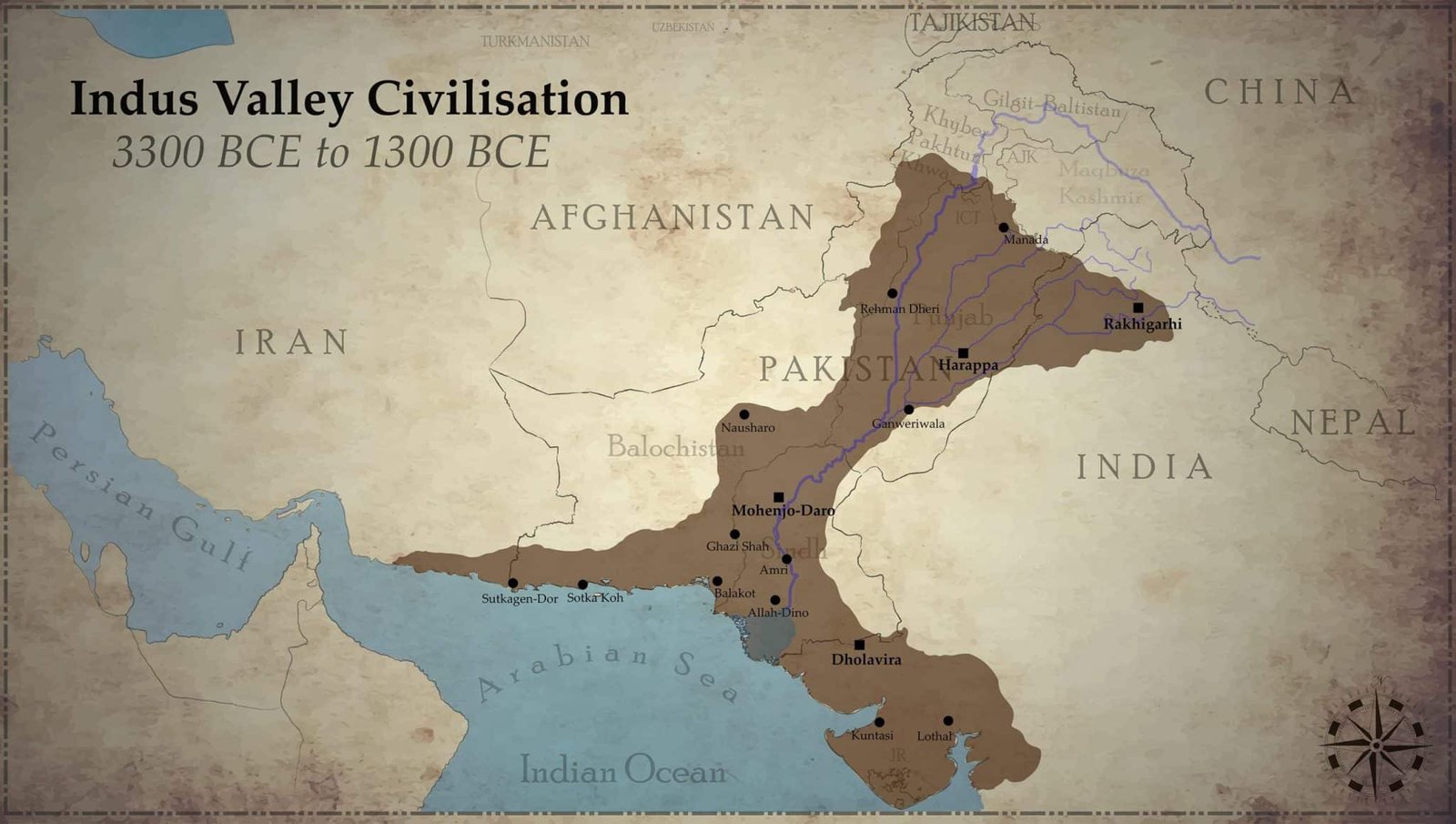
The residents of Keti Bandar are part of the Mohana tribe, descendants of the first inhabitants of the Indus valley. The remains of the original Mohana settlement can still be seen at the archeological site of Mohenjo-daro, which once stood on the banks of the Indus before the mighty river changed its course.
The Mohana refer to themselves as ‘Mir Bhar’, an Arabian word which means ‘kings of the sea’. They are historically a boat and river folk, engaged in the business of fishing and transport along the sea and river. The Mir Bhar are one of the oldest castes that have existed in Sindh. It is one of the few cultures dating back to the ancient Indus Valley Civilization that has remained continuous in the region.
Much of lower Sindh lay beneath the Arabian Sea 3000 years ago. Part of a rivers’ natural process is the deposit of silt. A river is as much mud as it is water, a fact that is often forgotten. Over time, the Indus deposited so much silt that the sea water receded, creating the mud flats that comprise much of lower Sindh. The mudflats that house communities such as Keti Bandar.
Keti Bandar exists solely because of its connection to the river. There are so many subtribes of the Mohana fishermen community that live across lower Sindh, which shows the crucial part the Indus played in its creation and livelihood.
It was a thriving port once – in fact, the inhabitants of Keti Bandar were once far more affluent than those of Karachi. Rich fishermen and farmers that cultivated red rice would lend money to aspiring businessmen in the bustling city. The fresh river water of the delta allowed the Mir Bhar to live well and prosper.
Keti Bandar sank three times due to hurricanes and sea advances: once in 1857, then in 1877, and the last known submergence was in 1910. When Cyclone Biparjoy came around, the sea swallowed many homes along Keti Bandar again, but the water receded fairly quickly as the storm moved along its course.
Yet the persisting Mohanas were damned long before Cyclone Biparjoy, long before the current throes of climate change. The deposit of silt, that was so instrumental to the creation and preservation of Keti Bandar, was halted when the Kotri Barrage was finished in 1955.
The Gradual Death of the Delta
The construction of the Kotri Barrage began during the British Raj in 1932. Environmental activist Zulfikar Ali Bhutto Jr. reflected on his visit to Keti Bandar in 2015. He shared how Kotri Barrage (also known as the Ghulam Muhammad Barrage), as well as other barrage systems built by The World Bank and IMF post partition, were the ‘final nail in the coffin’ on what we knew once as the mighty Indus delta.
“It’s as though Keti Bandar has suffered 15 – 16 years of dehydration,” Zulfikar said. Indeed, there can be no development with no fresh water. The excessive damming and redirecting of the Indus has drastically decreased the water flow from the river to the mudflats of lower Sindh. As a result of resource degradation, the Indus delta has seen a mass exodus.
According to a study by Altaf Memom published in 2005, an estimated 90, 000 had been displaced and about 120 villages depopulated. One can only imagine the state of things now: the lack of fresh water and the encroaching Arabian Sea has rendered Keti Bandar practically unlivable. And yet, the community persists. While we are hearing the term ‘climate refugees’ now more than ever – especially considering the devastation of the 2022 floods – Pakistan has technically had climate refugees since the 50s.
Due to the various irrigation systems along the Indus, 43% of land in Northern Sindh has been left saline. Because of this, the entire delta system has seen catastrophic changes. The locals of Keti Bandar primarily complain of ‘kaala paani’: no fresh water. Without fresh water, there can be no development. And with the now obstructed deposition of silt, Keti Bandar and other coastal regions that lie atop mud flats are facing the existential threat of being swallowed by the sea.
When asked about the recent floods and their potential benefit to the arid region, Zulfikar said, “Even if there is a good summer monsoon, so much of it is still drained out. Whatever’s left behind after crossing through Sukkur Barrage is just seepage and not enough silt.”
The Decline of Keti Bandar
The Mohanas, once one of the oldest and wealthiest tribes of Sindh, has now become one of the poorest. The entire province of Sindh is part of the Indus delta, and because of it shrinking, the locals of Keti Bandar have gone from living in the abundance of the rich river to living in sheer poverty.
As lords of the sea, Keti Bandar’s community is mostly comprised of fishermen. They rely solely on fishing for sustenance. However, this stream of income is not only threatened by extreme weather events such as Cyclone Biparjoy. The fishermen of Keti Bandar have been ruined by loans with astronomical interest rates, endowed on them by Middlemen that orchestrate business between the fishermen of Keti Bandar and the fish markets of Karachi.
They buy the catch at low prices, and sell them to traders in Karachi and other cities for a 200-500 percent profit. Since the poor fishermen owe them money, they have no choice but to sell their catch to these people, otherwise risking the seizure of their boats and fishing nets.
The locals are very cognizant of the decline of wealth and prosperity in Keti Bandar. Some of the oldest members of the community were still alive when Keti Bandar’s municipality was loaning to the growing metropolis of Karachi. Since its steady decline, the government has made empty promises to provide for the community, but to no avail.
On a visit to Keti Bandar in 2011, Moin Khwaja shared the frustration of a local fisherman: “The government is literally pushing us into the sea. Loan sharks visit us every single day while the politicians come to us once in five years to beg for our votes”.
While the climate crisis worsens, communities such as the Mohanas along Keti Bandar have already been facing the brunt of drastic environmental changes and lack of governmental support. One can only imagine the magnitude of the threat they face now, as extreme weather events such as Biparjoy will only increase in frequency.
Special thanks to Zulfikar Ali Bhutto Jr. for giving The Current his insights regarding the environmental degradation of the Indus Delta and Keti Bandar.
Altaf A. Memon (May 14–19, 2005). “Devastation of the Indus River Delta”. World Water & Environmental Resources Congress 2005. Anchorage, Alaska: American Society of Civil Engineers. World Wildlife Fund.
Everyone can agree that desi culture may have the finest food or the grandest weddings, but will also have the biggest closet full of family secrets and important discussions we need to talk about.
It’s incredibly important that adults and children in the family learn to keep their communication open with each other and discuss things that we often prevent opening up about.
So when a Twitter user asked their followers tat if given an opportunity, what are the things they wished desi culture would change?
If you’re grumbling about disrespectful children, maybe some adults should reflect if it is them who are being disrespectful.
elders must not get special respect just by virtue of time spent on this planet. Many of them have regressive views which shouldn’t be passed on to newer generations. https://t.co/HSV7SyBh87
We should encourage more people to be respectful at funerals and stop treating it like a meet-and-greet moment
absolutely FUCK desi jinaza culture this is not a little hangout, aunties!! its not eid!! do NOT sit for hours torturing the family of the deceased do NOT repeatedly ask them what happened!! Go HOME https://t.co/xBN8mbSmFc
Your children are not your second chance at life, stop implementing your takes on “life” and “profession” on them. Not everything needs to be controlled https://t.co/RBn9sHWlQM