Tag: Pakistani dramas

  • Death clarification: Saeeda Imtiaz posts statement to rubbish death rumours

    Death clarification: Saeeda Imtiaz posts statement to rubbish death rumours

    Actress and model Saeeda Imtiaz rubbished rumours about her death by posting a video, where she revealed that her Instagram and Facebook account had been hacked, leading to the posting of the fake death news.

    Imtiaz also revealed the mental anguish her family and loved ones went through:

    “My family members were incredibly upset, I don’t live with them.. they are here right now to see whether I was okay.”

    Imtiaz also made it clear that she is currently tracing down the people who were responsible for the hacking and will take strong action against them. You can listen to her full statement below:

    Imtiaz’s lawyer, Mian Shahbaz Ahmed, posted the clarification on his Instagram account by slamming the death rumors, and wrote that the ‘Kaptaan’ actor was alive and well.

    Inna lillahi wa inna ilayhi raji’un.

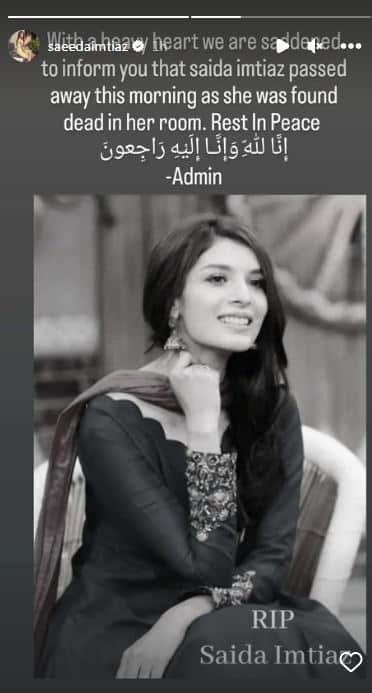
    Model and film actress Saeeda Imtiaz has passed away at her home on Tuesday morning, her team has confirmed in a statement posted on her Instagram account.

    The statement said that Imtiaz was found dead in her room. No cause of death has been given as yet.

    Imtiaz was born in the United Arab Emirates and raised in New York, USA.

    She started her career working as a model, before moving on to the bigger screen in 2012, starring as Jemima Khan in the biographical film about Imran Khan, “Kaptaan: The Making of a Legend”. She also starred in ‘Wajood’ in 2018.

    We send our condolences to her friends and family.

  • 13 years later, Hassan and Bano’s tragic love story in ‘Dastaan’ is still a fan favourite

    Television in Pakistan went through a seismic shift when 13 years ago, the drama ‘Dastaan’ debuted on our screens. Featuring a star-studded cast like Fawad Khan, Sanam Baloch, Saba Qamar and Ahsan Khan, the series was an adaptation of the novel ‘Bano’ by Razia Butt, an exploration of the aftermath of the subcontinent’s partition.

    The main leads, Hassan (played by Khan) and Bano (played by Baloch), are two lovers who meet when their relatives Suraiya and Salim get married. At first Hassan tries to befriend Bano, but Salim refuses to let them marry because he wants to marry her off to another man. However, just as their families approve and both are engaged, Hassan has to leave for University, and then the partition of 1947 takes place after which their lives are completely changed.

    Pakistani dramas today can’t seem to move on from saas-bahu kay jhagray and toxic love stories where women are nothing but a prop for men, so many remember the magic of ‘Dastaan’ especially the tragedy of the love story between Hassan and Bano.

    A viral tweet on Twitter had asked about a couple from a drama series that had devastated them, and the most popular reply in the Pakistani context had to be Hassan and Bano’s tragedy from ‘Dastaan’.

    https://twitter.com/MaryamAmir59627/status/1647221392369147906?s=20

  • After ‘Kuch Ankahi’, ‘Fairy Tale’, Is 2023 the year we’re finally not glorifying toxic masculinity?

    We have been wasting our breath for years, criticising the entertainment industry and asking it to stop scraping the bottom of the barrel to give us another done-to-dust drama about saas-bahu jhagray. It seems like somebody has been listening to our laments. Recent serials, starring the likes of actors such as Mira Sethi, Ali Safina and Wahaj Ali, have us wondering whether the industry has finally begun to understand that toxic masculinity is not something to glorify or even a trait that women think is swoon worthy?

    In the disastrous year that was 2022, we got drama after drama with the same topic: bad boy meets good girl, he’s broken and needs fixing which apparently no therapist can do, his severe mommy issues need to be resolved by some naïve girl who has lived under a bunker all her life and is now the saviour she never signed up to be.

    However, this year with dramas like ‘Kuch Ankahi’, the popular Ramzan show ‘Fairy Tale’ and even Wahaj Ali’s hit ‘Mujhe Pyaar Hua Tha’, main leads are stepping away from toxic characteristics that symbolized what patriarchy thinks an ideal man must be like. Instead, men in these dramas are gentler, caring about the women they love and showcasing that being a man is not about being loud and brash, but infact it is about how attentive you are to the people around you.

    ‘Kuch Ankahi’ was like a breath of fresh air for audiences who were nostalgic for the days of Haseena Moin dramas, where the women were fearless and outspoken, not props to the men around them. The women in ‘Kuch Ankahi’ come in different shades of femininity: Samia is a shy homebody who wants to fulfil her parents wishes and get married to the man they pick, while Aliya is the complete opposite because she’s a headstrong, career-obsessed woman who wants to succeed in her retail-estate business. Their differences don’t prevent the siblings from bonding with each other or from standing up for their families. Many have praised the series for depicting a healthy relationship between siblings and called it the desi version of ‘Little Women’.

    https://twitter.com/decalsajal/status/1614558374787432456?s=20

    But what is also heartening to witness in ‘Kuch Ankahi’ is how all the men in the dramas are gentle and actively work around the family, rather than the typical men who lounge around, while the women cook. Agha Ji, the patriarch, champions his daughters, refrains from asking them to do his chores and continuously encourages the girls to pursue their dreams.

    Bilal Abbas’ character, Salman, Aliya’s professional rival in the drama, is also a fan favourite. He’s ambitious but he never resorts to sexist or demeaning jokes to push her out of the game. He is also respective and caring to his mother and even pulls his weight by helping around the house.

    Among the current on-going Ramzan dramas, ‘Fairy Tale’ has been winning hearts across Pakistan because of how it has re-written the grumpy x sunshine trope in a humorous, addictive story where the women lead the show and where the male lead treats women with respect.

    If audiences were left horrified when the male lead from last year’s ‘Kaisi Teri Khudgarzi’ forced the female lead to keep repeating his name in exchange for her dad’s release, this time they have better content to cheer on. Many Twitter users have found Farjaad’s dedication to Umeed quite moving as he keeps coming back to her despite convincing himself that they’re too different.

    We can not say that we’re okay with the current pacing of ‘Mujhe Pyaar Hua Tha’ and how the storyline features the trope of the selfish female lead and the money-obsessed mother-in-law, but credit to Wahaj Ali’s character Saad, the anti-thesis of the typical misogynist Pakistani male lead, if ever there was one. He refuses to engage in abuse or violence to pressurize the woman he likes to be with him, instead supporting Maheer in all of her decisions.

    Might we be witnessing the rebirth of the golden age of Pakistani dramas? Fingers crossed .
  • Maya Ali’s favourite scene from ‘Yunhi’ is a replay of sexist ‘beti ka ghar na raha’

    It’s Friday, Mercury has stopped going in retrograde and everything is going back to normal, except for Pakistani dramas, which will keep scraping the bottom of the barrel to search for sexist content.

    It’s hilarious and yet quite terrifying how dedicated Pakistani dramas are to not provide what their audiences actually want: progressive storylines that recognise women as equals, rather than as props. But what currently popular trending dramas like ‘Yunhi’ prove, the best way to get ratings and to keep eyes glued to screens is to keep peddling the same sexist tropes over and over again and proclaim it as the standard content everyone should watch.

    ‘Yunhi’ began trending on social media this week when the actor playing the female lead on the show, Maya Ali, shared a clip from the latest episode. In it, her character is having an emotional, heart-to-heart with her father (played by fashion designer Deepak Perwani). Judged on performance alone, the scene is definitely tearjerking. However, we made the mistake of unmuting the video and heard the female character discuss how tragic it is for her to leave her father and how happy she is that her mother isn’t alive to see her wedding day.

    We should clarify here that Maya’s character is not heading off to war or to a distant land, but is actually getting married and leaving for her new home.

    Exactly what magical powers does a yellow mayun joraa hold, we want to ask Deepak Perwani, because of which a woman suddenly becomes a shadow of her past self and leaves behind her old family and friends? Does signing a marriage pact suddenly mean that over night, no woman can come back to her old home, and is now just the wife of the man that she has married?

    And most importantly, how is this supposedly tear jerking scene suppose to sit well in a country where women are taught that once they are married, they can never freely visit their families nor can they wear what they want or go where they want? They are not even allowed to escape domestic abuse.

    The message that Maya Ali likes, is once more, a terrifying reminder that for Pakistani families, marriages are basically equivalent to exiling women from their parents’ homes. And that for parents, including the dead mother who Maya is glad isn’t alive to watch her get married, the sole emotional and fundamentally important moment is their daughter getting married, nothing else.

    If these drama creators need any advice to show a rukhsati that actually makes the audience sob, take notes from ‘Kuch Ankahi’. That drama serial included a wedding scene where the phupoo (aunt) passionately defended women’s right to include protective clauses in the nikkahnama, and prove that women do not become strangers to their own families once they get married. They are still individuals with a personality, and definitely more than just the wives of the men they are getting married to.

    https://twitter.com/sunflowermochii/status/1637183811300601858?s=20
  • ‘I loved my character in Kuch Ankahi because she’s fearless’: Qudsia Ali

    Qudsia Ali has won accolades from audiences for her performance as Tania in ‘Kuch Ankahi’, where she plays the younger sister of the family. Speaking to BBC Urdu, Ali opened up about what drove her to the script and how she fell in love with her character:

    “When I read about Tania’s character, the first thing I loved about her was that she’s fearless. She isn’t afraid of anything. A lot of the times women in our families are scared of a lot of things like disapproval from their parents or even their families, especially my character who is scolded for eating. But she loves herself, she doesn’t mind if her mother calls her a ‘gama pelwan’ to which she responds ‘kya gama phelwan meri tarhaan cute tha?’”

    Ali also shared what set Taniya apart from other characters in Pakistani dramas is how she has male friends. It is still quite rare that a man and a woman are shown as just friends and not be romantically innvolved:

    “In the drama, Tania’s closest friend is a boy, which is a new thing for our industry to witness a boy and a girl being friends because in our society, we don’t believe in such things.”

    The ‘Betiyaan’ actress also raved about working next to actors like Sajal Aly and Bilal Abbass.

    “My first question had been ‘Who else has signed up for this drama?’ Then I was told that Sajal Aly and Bilal Abbas had, I was so overwhelmed and excited to become a part of this show.”

    On the fan-favorite moments of the drama involving her interaction with Shakeel, played by Samad Khan, Ali revealed that most of their moments weren’t scripted. Instead, they were improvised.

    “Our bond was based on how both of them are confident, despite their flaws. Shakeel fumbles while speaking but he owns it, while she is told she eats a lot but she doesn’t care. Which is why they have such a strong bond with each other.

    Watch the complete interview below:

  • Saas-bahu tamasha say akhir chuti mili, Hum TV’s ‘Fairy Tale’ is winning hearts

    Pakistani dramas have a quintessential love story format: shy and naive girl meets mysterious and broody boy, a quick marriage, fights, misunderstandings, infidelity, the necessary tarka that is the scheming saas, her weird obsession with her son and then jump to the happily ever after.

    But this Ramzan, ‘Fairy Tale’ has put a twist in the tale and given audiences a wholesome, enemies-to-lovers story that has captivated audiences. That there’s a headstrong female lead, is just icing on the cake.

    The plot has engaged audiences right from the start with a completely different set up: game shows. It revolves around the 20-years-old Umeed, a chai-obsessed vivacious girl who dreams of becoming a millionaire to be able to afford all the things her strict father refuses to purchase for her. When the opportunity to sign up for a game show turns up, Umeed is quick to fly to Islamabad, but her outspoken nature puts her at direct odds with Farjaat, a grumpy CEO who is her complete opposite in every way.

    Audiences have praised the story for its humor and creativity. Twitter users have pointed out how Umeed and the rest of the women in the show depict female friendships in healthy ways.

    Other users have praised the growing chemistry between Umeed and Farjaat, and how despite how the two coming off as complete opposites, they are able to cultivate respect, coming to love the unique perspectives they bring into each other’s lives.

    Although not much is said between the two because of how much Umeed and Farjaad are trying to avoid each other, but Twitter users love how the male lead’s powerful expressions show how much he is falling for Umeed despite his efforts not to.

    And yes we’ll happily take an extra ten episodes only to watch them bicker in an adorable manner.

  • Loving ‘Kuch Ankahi’? Then you should check out PTV drama ‘Tum Se Kehna Tha’

    Loving ‘Kuch Ankahi’? Then you should check out PTV drama ‘Tum Se Kehna Tha’

    ‘Kuch Ankahi’ has made an indelible mark on the Pakistani entertainment industry, for tackling sensitive issues like marriage pressure, body shaming, as well as infidelity. However, many audience members won’t know that the writer as well as the actor who plays the dad in the drama, Syed Mohammad Ahmed, has written countless scripts for film and television, including the iconic PTV drama ‘Tum Se Kehna Tha’ which was his debut effort.

    Directed by the brilliant Sahira Kazmi, the drama is an adaptation of the Hollywood rom-com ‘While You Were Sleeping’ which is about a young woman, who is accidently mistaken to be the fiancée of a man in a coma. The drama is incredibly funny, with powerful performances by actors Marina Khan and Ali Haider, and if our audiences are hung up on the fact that there are no good dramas out there that outshine the way ‘Kuch Ankahi’ did, here are some reasons why they should definitely check out this cult classic.

    1 The powerful chemistry between Hira (played by Khan) and Bilal (played by Haider)

    Hira and Bilal are feuding opposites in the beginning of the drama, because the family completely takes her in once they find out she was Saad’s (played by Farhan Ali Agha) fiancee, but Bilal opposes this because he suspects that she is telling a lie. As the episodes progress, their rivalry turns into friendship and then in to love, giving us a healthy and meaningful relationship.

    2 Powerful women lead the drama

    Powerful, witty Hira immediately captures the hearts of the audience, especially due to the exceptional acting shown by Marina Khan. Hira works in a travel agency under her boss who was her late father’s best friend, and is like father figure to her. She has everything that any woman would want: friends, an apartment and lots of wealth, but deep down, Hira longs for a family so she won’t remain alone. If fans of ‘Kuch Ankahi’ love the sisters and their fierce devotion and dedication to each other, then they will love the way Hira loves and defends her family members, helps her sister in law tackle with the grief from divorce, and especially how drama refuses to pit women against each other.

    3 Debunks the stereotype that divorced women can never find happiness

    ‘Kuch Ankahi’ has definately engaged Pakistani audiences with its refreshing script that provided us with complex female characters who refuse to be dictated around by patriarchal expectations, then they would also find ‘Tum Se Kehna Tha’ addictive because in the same manner, it engages with the societal disgrace that divorcees often face. Through the journey of Meher (played by Seemi Pasha), a divorced woman who is still recovering from the betrayal of her first marriage, she learns to empower herself through becoming friends with Hira, and forming a friendship with Sajjad, another divorcee who encourages her to keep living her best life.

    4 Humorous and engaging side characters

    A lot of times one of the biggest criticisms of Pakistani dramas has been that the side characters are incredibly dense, and limited to only showing up to push the main lead’s story forward. However the brilliance of Syed Mohammad Ahmed is that in his scripts, each character is interesting and keeps us engaged with the show. In ‘Kuch Ankahi’, fans are in love with the Tiktok star Neeha who is the househelp’s daughter, or Shakeel, the clumsy nephew. In a similar way, in ‘Tumse Ye Kehna Tha’ side characters like the neighbour Gringo or Buwa who add to the humor of the drama.

  • From dream boy to bad boy: Twitter shares why certain Pakistani dramas have aged badly

    If you’re a citizen of Pakistani Twitter, then you would be familiar with cult dramas like ‘Zindagi Gulzar Hai’, ‘Humsafar’ and ‘Tere Bin’, that have dominated social media with swoon worthy romances as well as dreamboats like Fawad Khan and Wahaj Ali. We’ll admit it, we have been obsessed too.

    But it might turn out that all that is old is not gold? And sadly, our fav heroes might not actually be the shehzada of our dreams but actually toxic men who needs to be re examined again.

    A Twitter user shared a tweet of the main leads from the most popular Pakistani dramas: ‘Tere Bin’, ‘Zindagi Gulzaar Hai’, ‘Humsafar’ and ‘Mere Humsafar’, and in the caption she shared that arranged marriage might not be such a bad idea if it were with men like them.

    But in today’s climate when more women are asking for better representation on television screens, a man like Ashar or Zarrun won’t sit well with audiences, regardless of how good looking Fawad Khan is. With that, more twitter users began sharing the ways audiences had overlooked how regressive and sexist these male leads actually were, and should not have been projected as the standard kind of man women should look for.

    Users shared that in ‘Humsafar’, Khan’s character Ashar, kicks his wife Khirad (played by Mahira Khan) out of the house while she was pregnant because he suspects her to be cheating on him with her friend, Khizar.

    Twitter users shared how toxic Murtasim was in ‘Tere Bin’ because he slapped Meerab in episode 5, and in the most recent episode he asks her to jump to prove she wasn’t having an affair behind his back.

    We hope that the entertainment industry takes a note of this and works on improving their scripts to stop romanticizing toxic men, who can only offer the bare minimum to the women in their lives.

  • Hadiqa Kiani writes moving tribute to fellow cast as ‘Pinjra’ airs last episode

    Actress and singer Hadiqa Kiani wrote a moving tribute to her fellow cast members and fans of the drama ‘Pinjra’ as the last episode aired on Friday.

    “Our beautiful family ”, wrote the ‘Dupatta’ singer. “Grateful to be a part of such an important experience. The cast, the crew, these talented children, the story, the great late writer Asma Nabeel, the wonderful @shaziawajahat, our amazing director @najafbilgrami…just feeling so grateful. Thank you to all of those who connected with the drama  @arydigital.tv.”

    Pinjra revolved around a family where the father Javed (played by Omair Rana) and the mother Khadija (Kiani) are both strict parents, demanding their son Abaan to stay away from his interest in art and music, and to focus more on his studies. The pressure to succeed has an impact on Abaan -along with being bullied by his siblings due to his poor grades- he begins doing drugs and even harming another child.

    Twitter users praised the series for carefully discussing issues like societal pressures, bullying, and helping parents understand how to be kinder to their children.

    Kiani was previously praised for her powerful performance in ‘Dobara’ as a newly widowed middle-aged woman, who takes stand for herself after being restricted by her husband through out her marriage, and in the process she falls in love with a man who is ten years younger than her.

  • ‘Completely unnecessary’: Tere Bin’s latest episode is drawing criticism for including an attempted suicide scene

    Drama serial ‘Tere Bin’ had been hitting the right notes for a while with electrifying chemistry between Yumna Zaidi and Wahaj Ali who star as conflicted enemies turned lovers. Fans have lauded the series for Ali’s powerful acting as well as Zaidi’s feisty and headstrong character Meerab who isn’t afraid to stand up for what she believes in. However, a recent episode has left fans conflicted with some arguing that the series has diverted away from the true nature of the male lead, Murtasim.

    In the previous episode, Meerab is kidnapped by her male friend, Rohail, who takes her to his house and confesses his feelings to her. After being unable to contact his wife and panicking, Murtasim rescues her from Rohail’s clutches and threatens to shoot him if he ever comes near her again. But this incident leaves our hero traumatised, thinking that Meerab is still in love with Rohail and had gone to Karachi solely to meet him.

    Now in the latest episode, Murtasim refuses to engage with his wife, despite her attempts to make him happy while cooking his favorite dishes. As the attempts fall flat, Murtasim accuses her of cheating by visiting Rohail in Karachi. When Meerab’s explanation doesn’t satisfy him, he takes his wife to the rooftop and asks her to jump from there to prove herself.

    Fans have slammed this scene as a complete betrayal to Murtasim’s character. Something Haute editor Aamna Isani wrote that the scene was completely unnecessary and had shattered the efforts the show had made in the previous episodes to put Murtasim in a positive light.

    “Like the slap, the jump scene was also totally unnecessary and stripped Murtasim of the human light he was portrayed in when he cried. Very confused, poor writing I’d say. #TereBin,” she wrote.

    Journalist Marvi Sirmed criticised ‘Tere Bin’ for turning Murtasim in to an ‘alpha male’ who tries to domesticate the free-spirited and ambitious Meerab, and slammed the writer Noor Makhdoom for this controversial scene.

    “But this final nail in the coffin of sanity was put when a stupid toxic Murtasim asks Meerab to jump from roof in order to prove her innocence. A grim reminder of Seeta’s Agni Priksha. What nonsense. Really Ms Makhdoom, what bloody nonsense?” she wrote.

    Many users had to point out that in previous episodes, Murtasim had spent two nights in his village with the antagonist Haya, an act that had angered Meerab. But did it lead to Murtasim being forced to prove his innocence? Then why was this imposed over Meerab?

    This is not the first time Tere Bin has attracted criticism for including controversial scenes that were contrary to the characters’ build up. For instance, the slap scene in episode five attracted intense backlash as social media users criticised the show for peddling sexist stereotypes once more.