Tag: Pakistani food

  • English vlogger  rates this Pakistani dish as best in the world

    English vlogger rates this Pakistani dish as best in the world

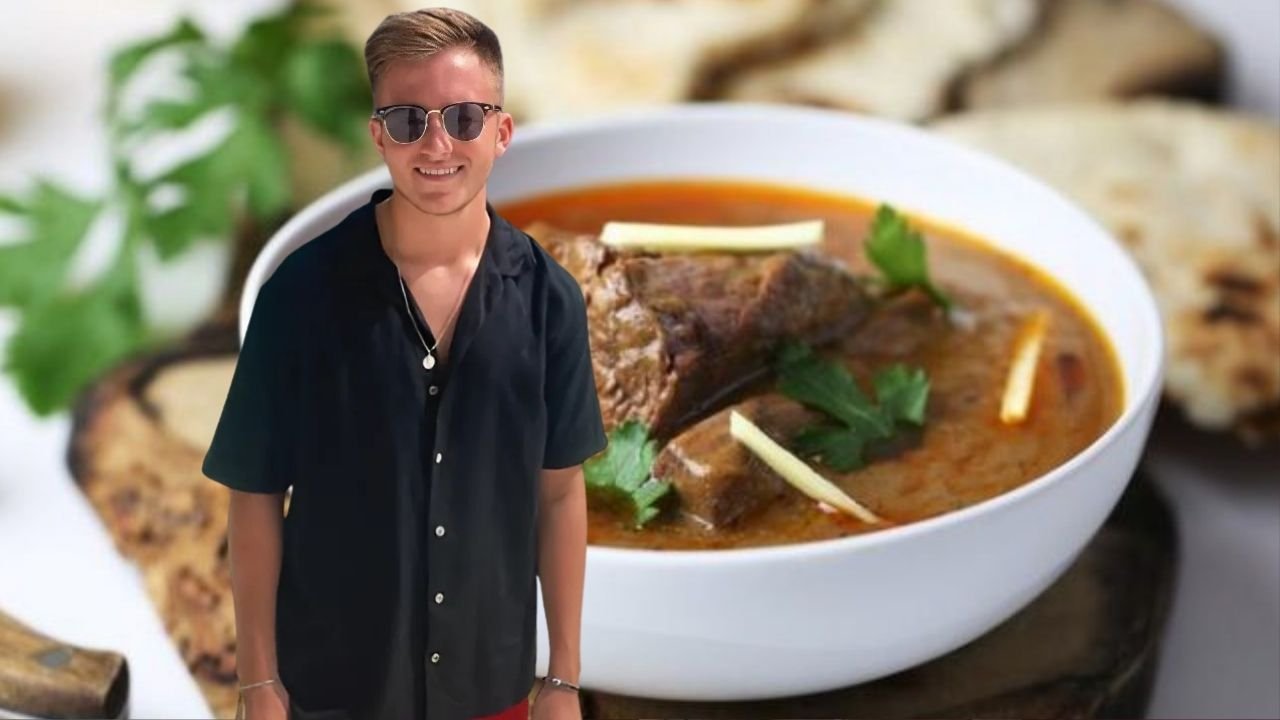
    English travel vlogger and digital content creator Harry Jaggard has been travelling across the world to try different national dishes.

    His fun videos not only show mouth-watering food but also help people learn about different cultures through them. In his latest video, he explored Pakistan and tried a very popular dish called nihari.

    “Pakistani nihari is traditionally served with naan or paratha, nihari was originally a dish served to the royalty in the Mughal court and was eaten, early in the morning, after the Fajr prayer,” he said.

    After tasting the nihari, Jaggard was amazed by the flavours and gave it an impressive rating of 9.0 out of 10. He added, “I am going rate this nihari 9.6 out of 10.

    What is Nihari? Nihari is a stew that comes from Lucknow, a city in India; it was popular during the Mughal Empire in the 18th century.Nihari is made by slow cooking of meat. People usually use beef, lamb, or mutton.In Pakistan and Bangladesh, people often eat nihari with naan, a type of flatbread.

    In addition to nihari, Harry tried other national dishes from around the world he rated: Khichi from India at 9.3, Turkish Kebeb from Turkey at 9.2, The Afghan Grill from Afghanistan at 9.5 and Masgouf from Iraq at 9.3.

    These ratings show the delicious variety of food available globally, but nihari stood out in his tasting adventure. If you are in Pakistan and you want to try nihari, check out these famous places:

    Muhammad Nihari House (Lahore)Javed Nihari (Karachi) Al Qamar Nehari (Multan) Majeed Nihari (Rawalpindi)

    As Harry continues to find the best national dishes, his praise for Pakistani nihari will encourage more people to try this finger-licking dish.

  • Hold my halwa: tweet dissing Pakistani desserts ki band bajadi Pakistani Twitter nay

    Did y’all think you have seen everything? Well, the bird app will keep proving you all wrong. After the Manchurian war, the Ali Sethi peshwa conflict, now it is time to take a swipe at Pakistani desserts.

    A tweet has gone viral for all the wrong reasons, deciding to comment on something that made us clutch our third plate of sawaiyaan, because how dare you say that Pakistani deserts aren’t good.

    Did you really not grow up in Pakistan? How can one say Pakistani deserts are not good while growing up eating gulaab jamun, jalebi or kulfi?

    If ever there was a time for Pakistani Twitter do it’s thing, it was now. And it delivered beautifully.

    Saying Pakistani desserts aren’t good and apparently cookies can outshine jalebi is a crime against humanity

    https://twitter.com/superhbics/status/1650759755634462720?s=20
    https://twitter.com/fagittarius_jd/status/1650655889131708416?s=20

    Pakistani desserts aren’t bad, your taste is.

  • No sweet, all sour: India sarr gaya as Pakistan owns Chicken Manchurian

    How will World War III break out? If Twitter had its way, then not because if water shortage or land dispute; but because of a plate of chicken manchurian.

    You’re probably wondering kya zalzala agaya tha TL pay. So let us breakdown the latest beef between Pakistan and India for you, since Pak Studies ka entire chapter is par anay walay talib-e-ilm ko rata marna parey ga.

    So basically the instigator was a Western source, like it always has been: The New York Times. The newspaper published a piece on the famous Chinese dish, Chicken Manchurian, and called it ‘a stalwart of Pakistani cooking’ that is widely served in Chinese restaurants across South Asia. The article never said that the dish was owned and created by Pakistanis.

    But dear students, this is where the Twitter feud exploded because Indians flooded the comments underneath the tweet pointing out that the dish was actually Indian, since it was invented by a third generation Chinese chef Nelson Wang, who lived in Calcutta. And Pakistanis retaliated as they do best- with hilarious memes. The dispute over the sweet n sour dish turned into the most hilarious Twitter exchange we have ever witnessed in our lives.

    Even Ali Gul Pir couldn’t hesitate to spread some fahashi

  • Pakistani-born businessman receives MBE from Prince William

    Pakistani-born British entrepreneur and restaurateur Suleman Raza was awarded the MBE by Prince William for his services to the business and philanthropy sector in Britain. Raza revealed on Twitter that he was happy to witness immigrants coming to Britain and becoming successful.

    According to his Medium article, Raza hails from Rawalpindi, but had moved to London where he started working as a chef in an eatery. He went on to open a restaurant in Tooting where he served Pakistani food.

    Raza also launched the project ‘No One Eats Alone’ in 2019 to provide meals to elderly and homeless communities during Christmas. He received public praise for his campaign “One Million Meals” to support National Health Service (NHS) workers in hospitals during the pandemic by providing them with hot meals.

  • Sharmeen Obaid to launch museum to celebrate diverse food culture

    Sharmeen Obaid to launch museum to celebrate diverse food culture

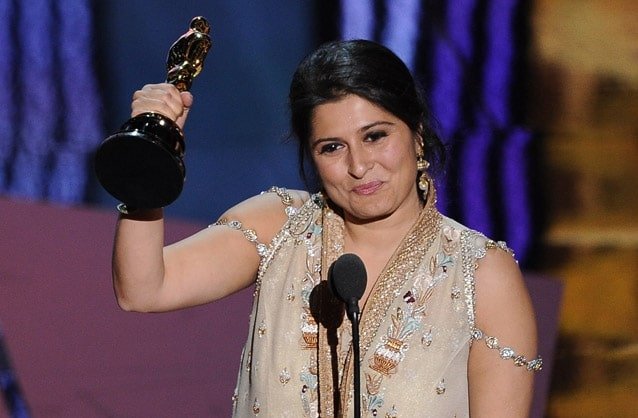
    Pakistani-American filmmaker Sharmeen Obaid has announced that she is launching a project “Museum of Food” which will celebrate and preserve the food culture in Pakistan. 

    Announcing her new intitiative in an Instagram post, the two-time Oscar winner revealed that the idea was inspired by her grandmother who had taught both young women and men how to cook:

    “I grew up around my Nani’s dinning table…For as long as I can remember she was teaching young women and sometimes men how to cook…She diligently preserved all her recipes and every Friday an advert in the classified section would appear with the weeks menu under the banner: Mrs Azra Syed’s Cooking classes. Thousands of her students now live around the world carrying her recipes with them…My museum of food is an ode to her and her generation whose recipes are fast disappearing..”

    Obaid elaborated that this project was set up for people across Pakistan to send their food recipes that were celebrated in their families so that Pakistan does not lose its cultural heritage

    Read her complete statement below 

  • World unites over Twitter debate that Swedes don’t let you eat if you are at their house

    World unites over Twitter debate that Swedes don’t let you eat if you are at their house

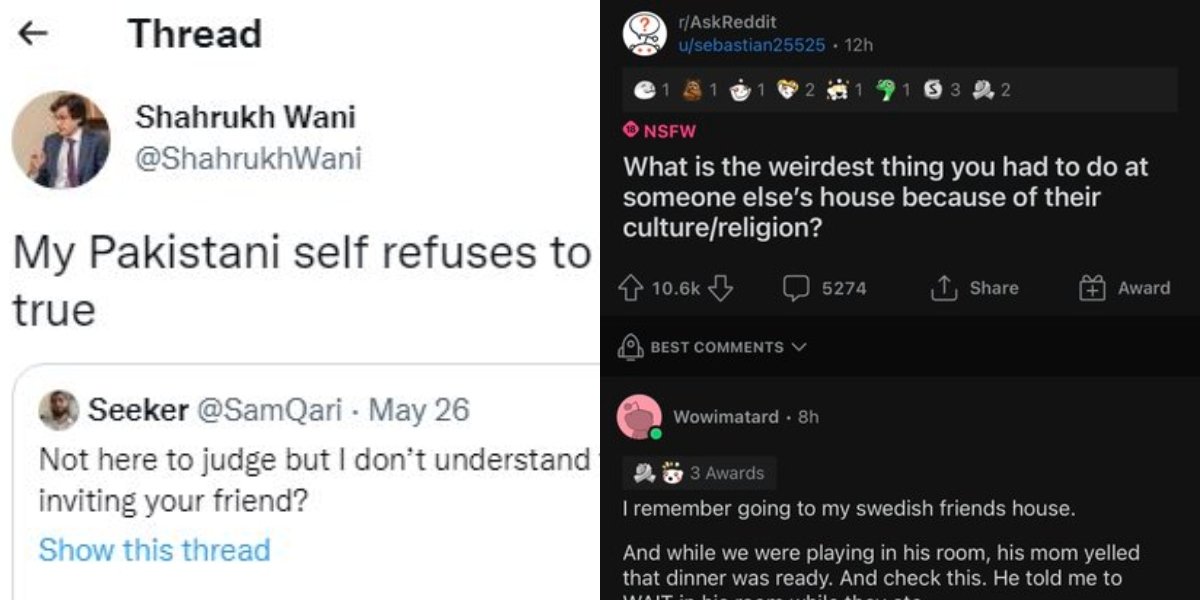
    A Twitter thread went viral recently in which people shared their experiences of visiting Swedish homes and not being served food.

    A question was posted on Reddit: “What is the weirdest thing you had to do at someone else’s house because of their culture/religion?”

    One of the users replied, “I remember going to my Swedish friend’s house. And while we we were playing in his room, his mom yelled that dinner was ready. And check this. He told me to wait in his room while they ate.”

    “I slept over a friends house. When we woke up, he said he was going downstairs for a few minutes. After about 15 minutes I go on the stairs to see wtf is happening and they are eating breakfast. They see me and tell me he has almost done and will be up there soon. I still think about it 25 years later,” another user replied.

    People on social media are finding this tradition a little “weird”. Have a look at some of the reactions:

  • Don’t want to eat beef? Here’s a list of places from where can order chicken

    If you are someone who does not like to eat Mutoon or Beef then this meaty Eid can make you miss the chicken.

    Here’s a list of places from where can order food that is all chicken :

    Roast Works

    This newly opened restaurant can be a good option for you this Eid.

    You can place an order by calling on this number: 0337-ROASTIN (7627846)

    Jessie’s Burgers

    If you are in the mood for some finger-licking chicken burgers then Jessie’s is the right place for you.

    They have their restaurants in Lahore, Islamabad and Nathia Gali.

    Cray wings

    To place your orders can WhatsApp or at 0311-11-WINGS ( 0311-11-94647)

    Broast Hub

    Broast Hub, based in Islamabad is famous for its Crispy chicken.

    You can order by calling at this number:  03356806856

    Xander’s cafe Karachi

    What about some Tacos on Eid?

    You can place your order on this website: xanders.pk

  • ‘Forbes 30 under 30 Europe’: Chef Zahra Khan makes Pakistan proud

    Chef Zahra Khan, who hails from Pakistan, has made it to Forbes 30 Under 30 Europe in the Retail and E-commerce category, making Pakistan proud.

    Read more – This girl just made Pakistan proud but here’s why you might’ve missed it

    Sharing the news on social media, Zahra said: “Truly blessed to have been recognised amongst the top emerging and game-changing entrepreneurs.”

    “Deeply humbled and so thankful to my family, my girls- who are my biggest inspiration, my friends and lastly my teams at Feya and Dyce without whom none of this would have been possible,” she added.

    Writing about Zahra, Forbes said: “Immigrant Zahra Khan defied Pakistani cultural stereotypes and launched a career in the UK focused on empowering women.”

    “The chef and mother of two runs Feya cafes and shops. She employs 30 full-time staff, hires female illustrators to design packaging, and donates 10% of retail profits toward professional coaching for women.”

    Zahra opened her debut eatery Feya Café on Bond Street just months after the birth of her first daughter in 2018. Following the unprecedented success, the award-winning DIY dessert parlour and interior masterpiece DYCE was opened in quick succession, followed by flagship Feya Knightsbridge in December 2019. Zahra now employs a 75% female workforce across her three restaurants.

    Meanwhile, the Forbes ’30 Under 30 Europe’ class of 2021 includes 300 honourees across each of the 10 categories, all under 30.

    “Against the backdrop of turbulent social and economic conditions across the region, the sixth annual Under 30 Europe list celebrates the young visionary leaders and entrepreneurs who have made their mark on business and society in the past year,” says a statement by the publication.

  • Bun Kebab: ‘Pakistan’s most beloved street food’

    Every morning before sunrise in Karachi, Pakistan, while the city is largely asleep, Abdul Ameen ducks through a tunnel and crosses dilapidated railway tracks to the more affluent side of town. Here, parked strategically between a mosque and a marketplace, his pushcart awaits him.

    An incandescent bulb illuminates him as he stacks shami kebab (ground beef-and-lentil patties) brought from home in columns behind glass panes. Next, he forms cascading towers of onion rings, lettuce and thickly sliced tomatoes. Working with almost flamboyant grace, it’s evident his routine has been perfected over the past 30 years.

    By the time the first call to prayer, Fajr, is made (traditionally, when there’s enough daylight to distinguish between white and black thread), he’s already dipping into his 16kg canola oil dabba (a rectangular tin bucket) and warming up his giant cast-iron griddle. Over the next few hours, a donkey cart owner, sleepy office workers, domestic helpers and an armed entourage of personal guards all stop by Ameen Burgers to purchase their greasy bounty wrapped in brown paper.

    But despite the name of his stall, Ameen is not selling burgers.

    Bun-kebabs, widely considered the most beloved Pakistani street food, are thin shami kebab or potato patties in fluffy, milky buns with tangy chutney and crisp vegetables. Optional fried eggs add an extra protein hit. The combination of explosive South Asian flavours, chutney-drenched buns and vegetarian options create a starkly different culinary experience from that of a burger. Ubiquitously available at kiosks and small shops or peddled on pushcarts throughout the country, they are generally sold for between 50 and 120 Pakistani rupees (£0.23-£0.55), depending on the neighbourhood. Some consider them Pakistan’s affordable (and zestier) answer to burgers

    Potato bun-kebabs have long been staples at school canteens, and travellers in Pakistan will see women perched on wooden benches feasting on them in crowded shopping plazas. They’re accessible enough to grab for a quick bite, but not so heavy – on the pocket or the stomach – to require serious investment.

    For many Pakistanis, bun-kebabs are intertwined with nostalgic family memories, often representing a first experience of eating out or getting a takeaway. Osamah Nasir, who founded the Karachi Food Guide in 2013, remembers first eating bun-kebabs during load-shedding (power outages) at his maternal grandmother’s house when he was a child, where nearly a dozen of his cousins spent lazy Sunday afternoons. “In less than 100 Pakistani rupees (£0.46), we’d all be fed,” he said.

    Pinpointing a definitive moment in history when bun-kebabs originated is difficult. Some consider them Pakistan’s affordable (and zestier) answer to burgers, especially because of the unique phenomenon of bun-kebab stalls positioned right outside fast-food franchises. Others, like Haji-Adnan, the third-generation owner of an unnamed bun-kebab stall in Burns Road (a food street in Karachi) think they came about in the 1950s. Haji-Adnan believes his grandfather, Haji Abdul Razzak, introduced them as a mess-free, to-go option for bustling workers in the city centre in 1953 before fast food joints started proliferating across Pakistan’s cities.

    Fahad Bhatti, the founder of A-Lister Mister, Pakistan’s first men’s interest e-magazine, traces their origin to the then-newly partitioned subcontinent’s shared heritage. “They started out as vada pav [spiced potato patties in bread buns accompanied by chutney]… They’ve since been evolving… with non-vegetarian options added for our meat-eating nation,” Bhatti said.

    Today, vendors experiment with their own spins on the iconic bun-kebab – including sliced beetroot and more expensive fillings like hunter beef (a Pakistani version of dried, salted meat similar to corned beef). Some even offer deconstructed versions. But while spiced potato patties or shami kebabs remain favourites of the roadside staple, the patty is not the sole star of the dish.

    Mr Burger, Pakistan’s first burger joint, was created in 1980 when McDonald’s and Burger King deemed the nation not ready for burgers. Adamant to maintain a difference from the local bun-kebab, the creators of the newly introduced burgers viewed condiments and vegetables as frills, instead focusing on perfecting the beef patty and using a “secret sauce” instead of chutney. For bun-kebab vendors such as Ameen, though, these “frills” are necessities – forming the essence of the taste at a fraction of the cost. Instead of juicy cuts of meat, the delectable flavour often comes from simple spice-infused combinations such as coriander, cumin and green chilli, mixed into the patty or ground in the tamarind chutney.

    It is, proudly, a poor man’s burger.

    Bun-kebabs act as universal levellers, even in the polarised opposite sides of town. “Clifton Bridge in Karachi has long served as an infamous symbol of socio-cultural divide,” explained Nasir, referencing a common Urdu saying: “Pull ke us paar, pull ke is paar” (That side of the bridge; this side of the bridge). “The ‘affluent’ side has most high-end eateries. But bun-kebabs? They’re everywhere,” he said.

    They’re one of the last vestiges of local street food without upscale, gentrified versions (unlike “artisanal” chaiNutella-slathered parathasand overpriced chickpea chaat – all dressier, more expensive counterparts to Pakistani street food).

    But in 2019, McDonald’s replicated the beloved “anday-waala burger” (a bun-kebab with egg). Describing it as an “eggcelent fusion of Desi taste”, McDonald’s did attempt to pay tribute to the indigenous roots of the dish, wrapping it in newspaper packaging designed to look like that of bun-kebabs. It was almost as if the trend had come full circle, with the very chain that deemed a nation not ready for burgers changing its menu to cater to local tastes.

    But the “Bun Kabab Meal”, retailing at 250 Pakistani rupees (£1.15) (which is at least three times the price of a roadside anday-waala burger), left some Pakistanis outraged. Others offered two-star ratings, mainly put off by the missing dhaaba (roadside cafe or food stall) experience.

    Curious to find out why locals see the anday-waala burger as being unreplicable, I spoke to Qalander Ali, the second-generation owner of Super Nursery Burgers, an established bun-kebab shop in Karachi. Operational since 1977, it sells a whopping 300 to 400 bun-kebabs daily, with locals and travellers flocking here for the perfectly spiced and tangy chutney.

    According to Ali, the food resists mass-production because labour-intensive steps (such as shaping the sticky patty by hand, dipping it in whipped egg whites immediately before frying, intentionally “smooshing” the egg yolk for fried eggs, greasing the bun on all sides and even slicing the buns as they don’t always come pre-halved) make preparing bun-kebabs ahead of time tricky.

    And even if McDonald’s did manage to distil the taste, the roadside experience is unique and resists standardisation. “When I saw the McDonald’s version of my local favourite, I wasn’t just upset. I was triggered,” said Nasir. “Part of the enduring charm of the bun-kebab is being able to experience it – to smell it – to see the artisan add his little flairs and endlessly customise it,” he explained.

    To many, it felt almost dehumanising to see this idiosyncratic form of self-expression reduced to a mass-produced assembly line. It also felt like an infringement on cultural territory. “I get my McFlurries and Happy Meals from you. Don’t do bun-kebabs,” Nasir said.

    The commodification of the beloved staple may have evoked such strong responses because in Pakistan, the terms “burger” and “bun-kebab” aren’t used just for food. They’re identities.

    “Burger” is a colloquial term for the urban elite that was conceived and popularised by Pakistan’s “King of Comedy”, Umer Sharif. As consumers of imported food, “burgers” are believed to have values aligned more with the West than their own country, and are viewed as part of a demographic that speaks English well, has foreign exposure and is privileged with access to resources. At times, “burger” is used pejoratively, akin to “spoiled”, or “Mama’s boy”.

    But with burgers’ illustrious rise to fame, a homegrown bun-kebab’s identity emerged almost in antithesis. The bun-kebab is what the burger is not: rooted in, not removed from, reality; and owned rather than mocked. As one Pakistani wrote in an article in The Express Tribune, “Dear burgers, I am a bun kebab, and proud of it.”

    However, with time, it seems that the distinction, especially at a linguistic level, is becoming increasingly blurred. As another Pakistani put it, placing a nation’s identity between two slices of bread is a baffling predicament, especially when the terms start being used interchangeably for the food itself. Colloquial slang surrounding the street food fuels the debate. For example, the practice of referring to bun-kebabs – the food – with the tacked on “waala” (Urdu for the one/the one with) implies both familiarity and mystery. “There’s this underlying assumption that you don’t exactly know what goes into the bun-kebab. And that’s the beauty of it,” said Rashid.

    A chicken or beef burger is simply “chicken” or “beef”, whereas “anday-waala”, “daal-waala” or “aloo-waala” bun-kebab (the one with eggs, lentils or potatoes respectively) are the customary orders people place, often with a knowing smile. When Pakistanis ask for “the bun-kebab with…”, they’re asking for more than a snack. They’re asking for an experience – Pakistani-waala.

    In their oily paper packaging, bun-kebabs might get squished. They defy mass-production and don’t offer slick fodder for pretty food-porn.

    But bun-kebabs are unpretentious. They’re home.

    This story is written by Aysha Imtiaz and was originally published in BBC- Travel.
  • ‘Pakistan bohat khoobsurat hai’: UK envoy reveals what he likes the most about Pakistan

    ‘Pakistan bohat khoobsurat hai’: UK envoy reveals what he likes the most about Pakistan

    British High Commissioner to Pakistan, Dr Christian Turner has shared that he is a huge fan of Karachi Biryani and Lahori food. He expressed his love for Pakistan’s foods and cities in Urdu that is quite impressive and interesting. 

    In an interview with Hamid Mir, Dr Turner said, “Well, I should say, first of all, Pakistan bohat khoobsurat hai, Meri Urdu kharab hai. Thodi jaanta hun.” 

    Turner agreed with the old saying “Lahore Lahore Hai (Lahore is Lahore)” and said that all he had done for three days in Lahore was eat. The representative revealed he was fond of Karachi’s biryaniHe said it was “Bohat mazedaar (very delicious)”. 

    Watch the video here:

    Dr Turner has also documented, in detail, his experiences in Pakistan on his social media.