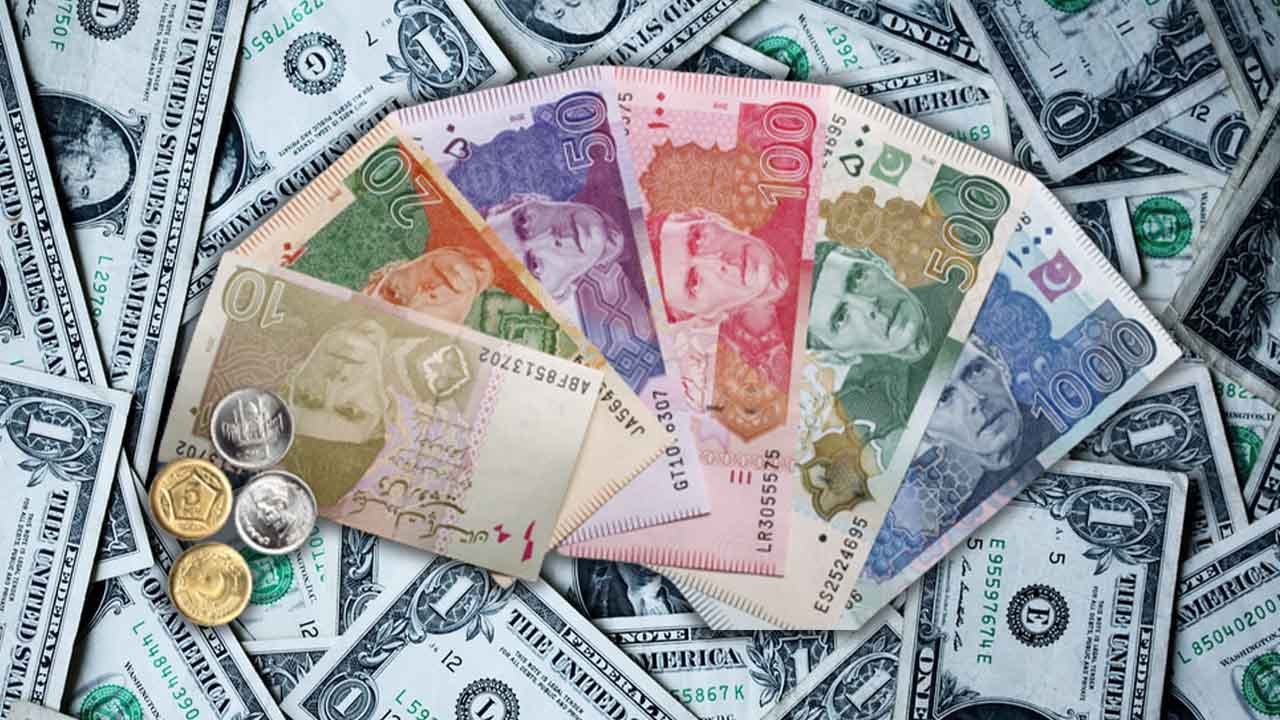
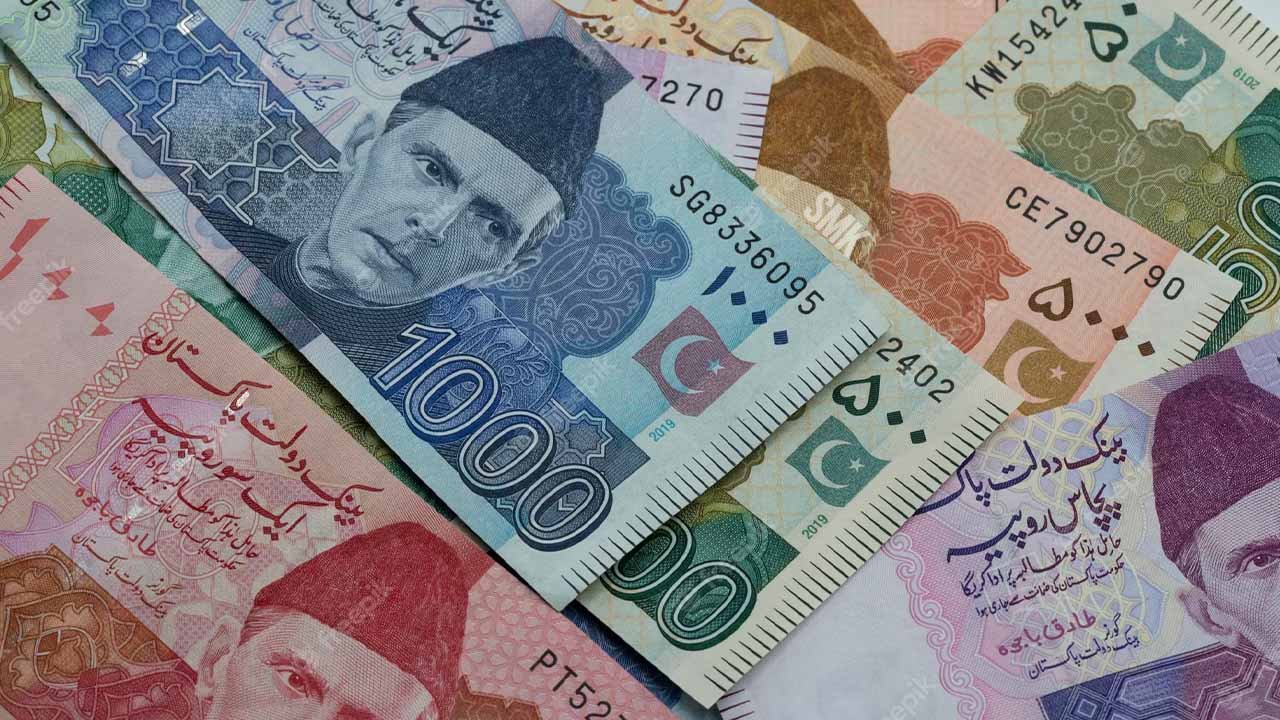
The Pakistani rupee faced its eleventh consecutive session of losses against the US dollar, depreciating by 0.34 per cent in the inter-bank market on Monday.
According to the State Bank of Pakistan (SBP), the rupee settled at 285.29, marking a decline of Re0.98.
In the preceding week, the rupee had also suffered losses against the US dollar, closing 1.33 per cent lower at 284.31 in the inter-bank market, equivalent to a decrease of Rs3.74. This marked the third consecutive week of declines for the local currency.
Prior to this recent trend, the Pakistani rupee had maintained a positive trajectory for 28 consecutive sessions, one of the longest appreciation runs, gaining a cumulative 10.93 per cent since reaching a record low of 307.1 in the inter-bank market on September 5.
This surge was largely attributed to efforts to combat smuggling and increased controls on exchange companies.
However, the situation has since shifted in favour of the US dollar, with global currencies remaining stable on Monday but appearing poised to continue their recent uptrend. This comes as the US dollar retreated following a moderation in the Federal Reserve’s hawkish stance.
Internationally, major global currencies showed stability early on Monday, with the US dollar index flat at 105.11 and the euro at $1.0726.
The dollar index experienced its most significant decline since mid-July, falling over 1 per cent last week and reaching a six-week low.
Weakness in US job data, softer global manufacturing figures, and declining longer-term Treasury yields also contributed to the dollar’s weakened position.
Recent trade data for Pakistan reveals a monthly trade deficit increase of $0.6 billion, primarily driven by an $0.8 billion surge in imports.
However, on an annual basis, the trade deficit is gradually shrinking at a modest rate of 4 per cent.
This is not necessarily negative news, as import restrictions have been lifted as part of the İnternational Monetary Fund (IMF) programme while the economy is experiencing an uptick in demand.
The encouraging aspect lies in the positive signs displayed by the export sector. The Pakistani rupee (PKR) has depreciated by approximately 35 per cent year-on-year, falling from PKR 220/USD to PKR 280/USD.
Last year, exporters faced challenges in importing raw materials, machinery, and intermediate goods.
Consequently, the 14 per cent year-on-year growth in exports, rising from $2.4 billion to $2.7 billion, is a heartening development, provided this trajectory continues.
Recent measures by the State Bank of Pakistan (SBP) aimed at promoting exports, including competitive gas rates for exporters, reflect a positive intent.
While industries reliant on gas may require more regionally competitive energy rates, the direction is favorable.
Moreover, the alignment of open market and interbank exchange rates may encourage a shift from official channels.
To address Pakistan’s economic challenges, two key corrections are imperative, among many others: increasing tax revenues and enhancing value-added exports.
Depreciation of the currency alone cannot serve as the sole remedy for stimulating growth.
To achieve a comprehensive economic framework, it is essential to boost the exports-to-GDP ratio beyond the current 8 per cent.
This should encourage capitalists to prioritise exports and foreign direct investment (FDI) over property, fixed income, currency, and trading, ensuring sustained double-digit growth over the next five years.
The Pakistani Rupee (PKR) is expected to rebound against the US dollar this week, with this revival contingent on the approval of the next tranche by the International Monetary Fund (IMF).
Last week, the PKR weakened by 1.78 rupees (0.6 per cent), closing at Rs280.57 against the US dollar, marking a second consecutive week of decline. On the last trading day, it reached a high of Rs280.5 and a low of Rs280.15 against the greenback.
In the open market, the rupee depreciated by 50 paisa, closing at Rs279.5 for buying and Rs292.8 for selling, compared to Rs279 and Rs282 a week ago.
The rupee’s decline is attributed to expectations of the IMF’s approval for the next $700 million tranche of its $3 billion loan. Geopolitical tensions in the Middle East and decreased export receipts have also played a role.
Despite hopes for recovery post-IMF approval, concerns linger about its long-term stability, with Goldman Sachs predicting a short-lived strong performance.
The rupee’s fate remains tied to the 280 level until the IMF’s decision. The upcoming weeks and months hold uncertainty amid global economic challenges and geopolitical issues.
Economists and financial experts are closely watching events, especially the IMF’s decision, which will significantly impact Pakistan’s economic stability as it strives to restore economic health and growth.
In the financial markets this week, the Pakistani rupee (PKR) experienced a depreciation of 1.78 rupees against the US dollar (USD), closing the week’s trade at PKR 280.57.
This marks a significant shift from the previous week’s closing rate of PKR 278.8 per USD.
During today’s trading session, the local currency saw a decline of 48.1 paisa. The intraday high (bid) was recorded at Rs280.5, while the low (ask) reached Rs280.15 against the US dollar.
In the open market, exchange companies quoted the US dollar at Rs279.5 for buying and Rs292.8 for selling, indicating a loss of 50 paisa compared to the previous closing rates of Rs279 for buying and Rs282 for selling.
This decline against the US dollar signifies the second consecutive weekly decrease for the Pakistani rupee. In comparison to other major currencies, the PKR experienced fluctuations as well.
Against the Euro, the PKR depreciated by 64.78 paisa, closing at Rs296.17 compared to the previous value of Rs295.53.
The British Pound became more expensive by 1.21 rupees, closing at Rs339.94 in contrast to Rs338.73 from the previous day.
PKR lost 0.69 paisa against the Japanese yen, closing at Rs1.869 versus Rs1.862 the previous day.
The UAE dirham also increased in value by 12.89 paisa from Rs76.257 to Rs76.386.
It’s noteworthy that during the current financial year, the PKR has appreciated against the dollar by Rs5.42, or 1.93 per cent.
However, in the current calendar year, PKR has depreciated by 54.14 rupees, or 19.3 per cent.
This dynamic market movement reflects the ongoing economic fluctuations in the country.
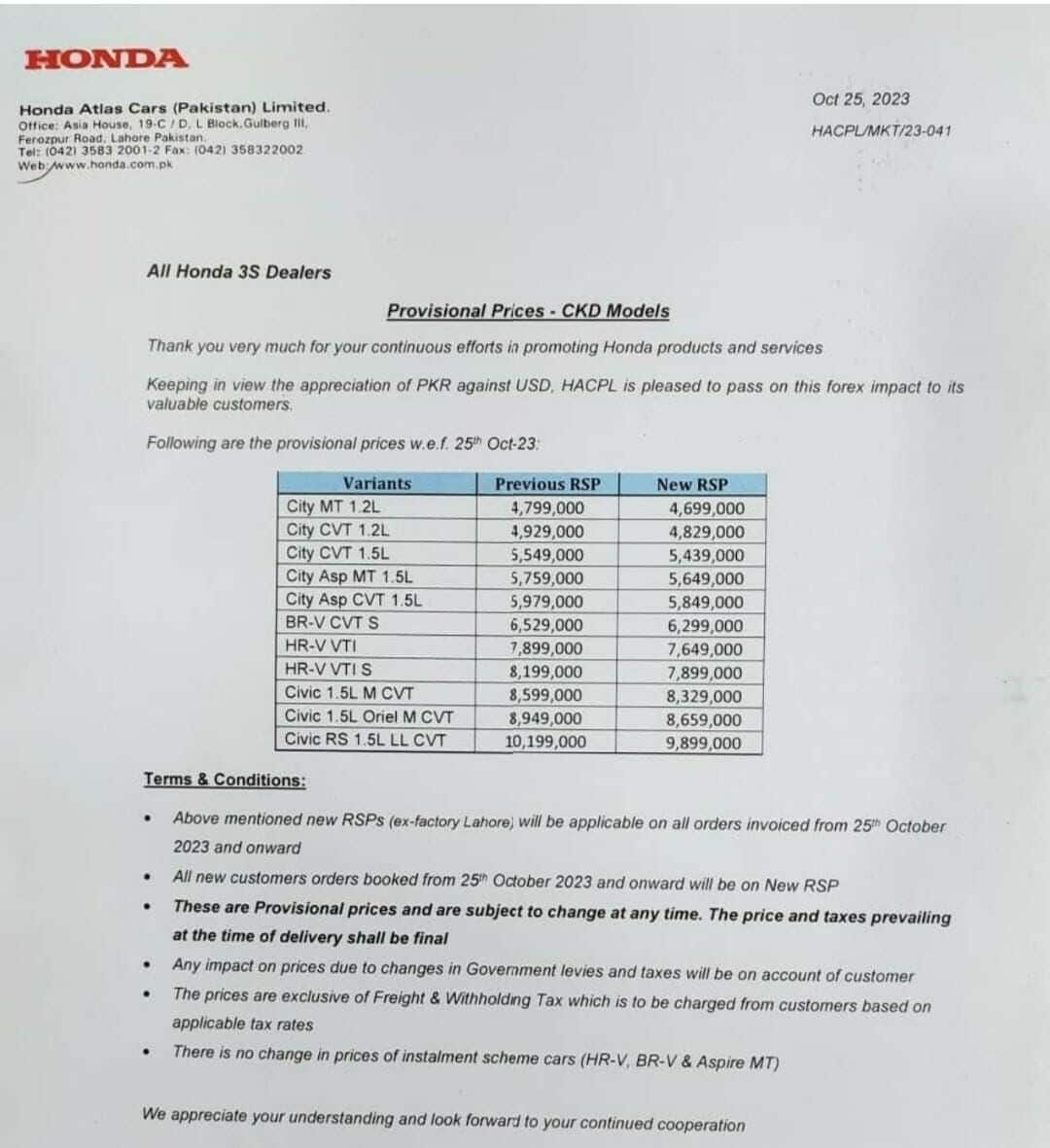
In a move similar to what Toyota did earlier, Honda Atlas Cars (Pakistan) Limited announced on Wednesday that it is reducing the prices of its vehicles, especially the popular Honda City lineup.
This decision was made due to the significant strengthening of the Pakistani rupee (PKR) against the US dollar.
Through an official circular, Honda Pakistan disclosed the updated ex-factory prices for all its car models, reflecting reductions of up to PKR 300,000.
This substantial price drop is expected to make Honda vehicles more affordable for a broader consumer base.
After these adjustments, the price of the most budget-friendly Honda car in Pakistan, the City MT 1.2L, now stands at Rs4.699 million following a reduction of Rs100,000.
Moreover, the top variant, the Aspire CVT 1.5L, is now available for Rs5.849 million after a cut of Rs130,000.
The most significant price changes have been applied to the popular Honda City lineup, generating excitement among potential buyers.
The Pakistani rupee experienced a 0.16 per cent depreciation against the US dollar in the inter-bank market on Wednesday, settling at 279.88, marking a decrease of Re0.45, as reported by the State Bank of Pakistan (SBP).
The previous day, the rupee had depreciated by 0.11 per cent, closing at 279.43 against the US dollar. In a related development, the SBP anticipates an increase in remittances to Pakistan due to a notable rise in labour migration.
In fiscal years 2022 and 2023, Pakistan observed a significant surge in labour migration compared to the preceding two years, with around 0.8 million Pakistani workers registered through the Bureau of Emigration and Overseas Employment (BEOE) and Overseas Employment Corporation (OEC) during FY23.
Internationally, the US dollar gained strength on Wednesday, supported by robust US economic data. Meanwhile, the euro faced challenges due to a dimming growth outlook in the Eurozone. US business output showed improvement in October, signalling a recovery from a five-month contraction, as reported on Tuesday.
In contrast, data from the same day indicated an unexpected downturn in business activity in the Eurozone. The euro, against the dollar, was up 0.05 per cent at $1.0595 but had declined by 0.75 per cent the previous day. This shift boosted the dollar index, which steadied at 106.23, moving away from a one-month low of 105.35 recorded in the previous session.
Furthermore, oil prices remained above $88 on Wednesday, driven by concerns about escalating conflicts in the Middle East, which offset worries about reduced demand due to the gloomy economic prospects in Europe.
Indus Motor Company, the leading assembler of Toyota-brand vehicles in Pakistan, has made a significant move to benefit its customers.
In a recent announcement sent to its dealers on Tuesday, the company revealed a substantial reduction in car prices, effective October 24. This decision was prompted by the recent strengthening of the Pakistani rupee against the US dollar.
Following this development, the basic Yaris model 1.3MT LO is now more affordable, with a price decrease of Rs100,000, or 2.2 per cent, bringing its new price to Rs4.399 million.
Similarly, the top variant, 1.5 CVT Aero, will now be available at Rs5.849 million after a reduction of Rs120,000.
The Toyota Corolla’s variant prices have been reduced between Rs200,000 and Rs250,000. Furthermore, Toyota’s pickup Revotrucks are now more budget-friendly, with price reductions ranging from Rs450,000 to Rs790,000.
One of the most notable changes is seen in the Fortuner G4x2 Petrol STD, which will now be priced at Rs14.499 million after a substantial reduction of Rs1.31 million, or 8.3 per cent.
This price adjustment follows the footsteps of other major players in the industry, including MG Motors and Lucky Motor Corporation (LMC), both of which have also announced price reductions for their vehicles.
The automobile sector in Pakistan has faced challenges recently, mainly due to fluctuating exchange rates and restrictions on imports.
The rupee experienced a significant depreciation against the dollar, reaching a record low of Rs307.1 on September 5.
However, it has since recovered, stabilising around the Rs279–280 level. This positive trend aligns with the efforts of the caretaker government, which took measures against smugglers and hoarders, contributing to the currency’s recovery.
Apart from currency fluctuations, the auto sector was affected by previous government policies, including import restrictions aimed at preserving foreign exchange reserves.
Additionally, higher finance costs and a considerable rise in car prices led to a decrease in consumer demand. In the first quarter of FY24, car sales in Pakistan plummeted to 20,983 units, marking a 40 per cent decline compared to the same period the previous year.
Here are the latest prices of all Toyota cars in Pakistan:
On Friday, the KSE-100 benchmark index of the Pakistan Stock Exchange surpassed the 50,500-point mark, a level last witnessed in May 2017 when it reached 50,592 points.
The Karachi Stock Exchange (KSE-100) index has advanced by 207 points and is presently at 50,572 points.
Yesterday marked a significant milestone for the Pakistan Stock Exchange as its benchmark KSE-100 index crossed the 50,000-point threshold, an achievement that experts have noted took six years to accomplish.
During intraday trading, the benchmark Karachi Stock Exchange (KSE) 100 Index surged by 600 points, settling at 50,025 points, a level not seen since June 7, 2017.
Concurrently, the Pakistani rupee exhibited a recovery against the US dollar in the interbank market on Thursday. After experiencing a Rs1 gain against the PKR in interbank trading on Wednesday, the US dollar depreciated by Rs1.96 in early Thursday afternoon trading.
As of the latest data, the Pakistani rupee has gained Rs1.96 against the US dollar, now trading at Rs278.30 in the interbank market, according to forex dealers.
In the open market, banks are selling the greenback to importers at Rs278.80, while the US currency has also experienced a Rs1 loss against the local currency.
The Pakistani rupee’s remarkable 28-day winning streak against the US dollar came to an end today, as it recorded losses following an initial trade opening at Rs278.5 in the interbank market.
In the morning, the rupee had steadied, maintaining a level of Rs276 against the greenback. Subsequently, between 1:00 PM and 2:35 PM, the interbank rate dipped to Rs278 before settling at Rs277 for the rest of the day.
Open market rates, observed across various currency exchange counters, ranged from Rs277 to Rs279 throughout the day.
At the close of the trading day, the PKR experienced a depreciation of 0.07 per cent, concluding at Rs277.03 after losing 20 paisas against the US dollar.
Despite today’s setback, it is noteworthy that the disparity between interbank and open market rates has significantly decreased by Rs60 since September 4th. The rates have fluctuated between as low as Rs277 and sporadic spikes up to Rs280 today.
The recent surge in the performance of the benchmark KSE-100 Index at the Pakistan Stock Exchange (PSX) can be attributed to the combination of a positive earnings season and notable economic improvements.
On Tuesday, the index breached the significant 50,000-point threshold, marking the first time in over six years since June 7, 2017.
Around 11 am, the benchmark index was trading at 50,017 points, reflecting a gain of 286 points, equivalent to a 0.58 per cent increase. However, it later retracted from this milestone.
This momentous achievement was supported by multiple factors, including an enduring upward trend observed in various sectors, such as automobile assemblers, commercial banks, cement, chemical, oil marketing companies, and oil and gas exploration firms.
The bullish momentum on the Pakistan Stock Exchange has been a consistent theme, extending through 11 consecutive trading sessions. Intra-day trading on Monday nearly brought the KSE-100 Index to the 50,000 level, closing at 49,731.35 points.
One significant driver behind this surge has been the strengthening of the Pakistani rupee against the US dollar, with the exchange rate holding steady at around Rs275 in the inter-bank market.
Additionally, the ongoing earnings season has instilled confidence in the market, with high expectations, especially in the banking sector, for positive financial results. These factors collectively contribute to the robust performance witnessed in the Pakistani stock market.