Tag: pandemic

  • Pakistan’s decision to lift lockdown early helped boost exports: report

    Pakistan’s decision to lift lockdown early helped boost exports: report

    Pakistan’s decision to loosen pandemic restrictions early has helped the country’s exports emerge stronger than its South Asian peers, Bloomberg reported on Saturday.

    Bloomberg reported that outbound shipments have grown at a faster pace than Bangladesh and India as textiles, which account for half of the total export, led the recovery.

    The country saw total shipments grow 7 per cent in September, compared with New Delhi’s 6pc and Dhaka’s 3.5pc.

    It stated that Prime Minister (PM) Imran Khan’s administration was the first in the region to ease pandemic restrictions, allowing export units to reopen in April, a month after locking them down to stem the spread of Covid-19. This helped draw companies from the South Asian nation.

    “Pakistan has seen orders shifting from multiple nations including China, India and Bangladesh,” the report quoted All Pakistan Textile Mills Association (APTMA) Secretary General Shahid Sattar as having said. “Garment manufacturers are operating near-maximum capacity and many can’t take any orders for the next six months.”

    Even as lockdown curbs disrupted trade in India and Bangladesh for at least two months beginning late March, Pakistan was already making face masks and personal protective gear for export.

    The South Asian nation also gained some orders from companies looking to diversify their supply chains amid the trade war between the U.S. and China, the world’s top textile exporter, despite factories there reopening as early as April.

    “This war between two giants has given us new opportunities in polyester-cotton products,” the report quoted the nation’s largest textile maker, Nishat Mill’s Garment and Home Textile Operations Head Khalid Mehmood having said. “So there is a six-month slot for Pakistan now to capture the maximum number of customers who were China-based.”

    Executives from Nishat Mills and Interloop Ltd, one of the world’s largest manufacturers of socks that counts Nike Inc. and Adidas AG among its clients, said they have seen some orders diverted to them from China.

    Meanwhile, Gadoon Textile Mills Ltd. received orders redirected from Bangladesh, the world’s second-largest apparel exporter, and India, the third-largest textile exporter.

    “The orders we were exporting to Europe and the US have not recovered,” Gadoon Chief Financial Officer (CFO) Muhammad Imran Moten said during an analyst briefing. “But the diversion of orders from China and Bangladesh is the compensating factor.”

  • ‘Corona se darna nahi, larrna hai’ declared un-Islamic as top religious body says virus is Allah’s will

    ‘Corona se darna nahi, larrna hai’ declared un-Islamic as top religious body says virus is Allah’s will

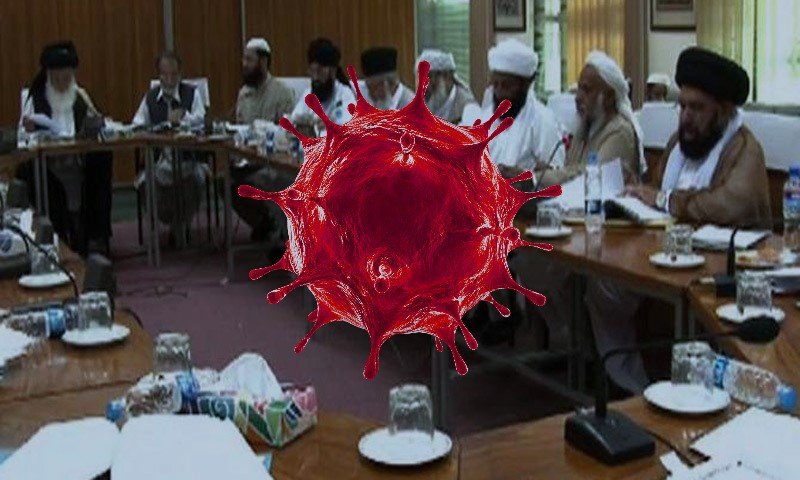
    The popular anti-coronavirus slogan “Corona se darna nahi, larna hai [we have to fight, not fear corona]” has been declared un-Islamic by the Council of Islamic Ideology (CII) that says the virus outbreak is Allah’s will.

    According to Dawn, the Lahore High Court (LHC), while hearing a petition filed by a lawyer against the use of these words in national print and electronic media and official sources of communication, was on Wednesday informed that the top religious body has advised the government against using the slogan.

    The petitioner-lawyer, Salman Idrees, had argued that no one could fight against God’s will but the national media and government communication sources had been using “un-Islamic” and “immoral” words challenging the supremacy of God. He asked the court to ban the use of the words “corona se darna nahi, larrna hai”.

    In the last hearing, LHC Chief Justice Muhammad Qasim Khan had directed the CII to give its opinion on the choice of words in the anti-COVID-19 slogan.

    On Wednesday, a government lawyer informed the court that the CII after considering the slogan had stopped the government from using it.

    The council had advised the government to refer the matter to the federal cabinet to come up with a new anti-virus slogan, Deputy Attorney General Asad Ali Bajwa said.

    An official at the CII told the English daily that the reason the council had opposed the slogan was that in its view, humans could not fight God’s will and the term “fighting corona” should be replaced with “protecting against corona”.

    The hearing has been adjourned until next week.

  • Majority of young adults in the US now live with their parents

    Majority of young adults in the US now live with their parents

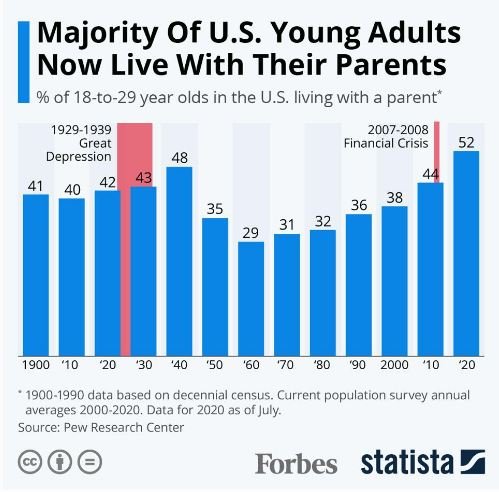
    A record number of young adults in the United States (US) have had to move back in with their parents because of the COVID-19 pandemic, a recent analysis by the Pew Research Center has shown.

    About 52% of 18-to-29-year-olds are now living with one or both parents. This is recorded for the first time that more than half of that age group has lived with their parents, the research center said. 

    The highest historical value was previously recorded in the 1940 census towards the end of the Great Depression when 48 percent of young adults lived with a parent.

    The Great Depression was a severe worldwide economic downfall that took place mostly during the 1930s. Though the timing of the Great Depression differed across the world, it began from the United States in 1929 and continued until the late 1930s in most countries. It was the longest, deepest, and most widespread depression of the 20th century. 

    The graph shows that the share reached its lowest point in 1960 at 29 percent. It has increased gradually ever since, hitting 49 percent by February 2020. The Pew Research Center states that the number of 18-29-year-olds living with a parent increased by 2.6 million since February and the total number stood at 26.6 million in July.

    According to Pew polling conducted in June, among all of the grown-ups who moved as a result of the pandemic, 28% said that they wanted to avoid the spread of the virus, 23% moved because their college campus shut down and 20% wanted to spend time with their family.

    Money seems to have played a big part in young people’s decisions, as young Americans have faced some of the worst financial impacts of the COVID-19 pandemic. In April and May, 40% of workers ages 18 to 29 reported that they’d lost their job or taken a pay cut.

    According to the June poll, about 18% of all adults who moved because of COVID-19 said that the biggest reason was related to money or losing their job.

  • ‘Coronavirus over in Pakistan’: Myth [busted?]

    The nationwide coronavirus lockdown in Pakistan ended on August 10 as the government announced returning to pre-coronavirus life with a few standard operating procedures (SOPs) and social distancing guidelines amid a significant drop in infections and fatalities.

    Previously shut down sectors, including tourism and recreation, food among all other businesses except marriage halls and educational institutions were allowed to re-open and now, despite the passage of nearly two weeks, no prominent increase in COVID-19 cases has been recorded against officials and experts’ predictions in light of Eidul Azha and Independence Day celebrations during which people flouted all guidelines.

    While large gatherings, including religious congregations and family feasts over the Eid weekend, added to the risk of a second wave of the virus in the days to come, a large number of people taking to roads on August 14 to express their love for Pakistan, mistaking the drop in COVID-19 cases for its eradication, did the same. Independence Day was marked by firework displays at midnight in major cities, including Lahore and Karachi, where tens of thousands flooded the roads without face masks or any regard to the SOPs.

    Here is how the pandemic situation turned out from August 1 to August 20 amid the said recklessness of the masses:

    While the country is still at risk owing to the behaviour of the people over Eid and the Independence Day as officials fear it can lead to a sudden spike in COVID-19 cases, some experts believe that herd immunity has been achieved in metropolises like Lahore and Karachi as they were the most affected by the virus when it peaked in June.

    A study conducted in 25 cities shows that almost 11% of Pakistanis have developed protective immunity (antibodies) across the country against COVID-19. The research further says that seropositivity in urban areas is more when compared to rural areas, and a majority of those who came into contact with corona-positive patients are more likely to have developed antibodies.

    While infectious disease experts such as Prof Dr Faisal Mahmood of Aga Khan Hospital say the drop in number of cases is real but the reason that led to it has not yet been ascertained, according to a report by The Telegraph, Pakistan’s young population — two-thirds of its total population is under the age of 30 — can also be a major factor if herd immunity has actually been developed.

    Even though it is too early to be sure about Pakistan’s victory in the battle against COVID-19, the significant drop is a huge achievement. It, however, might not last if people continue flouting social distancing guidelines in the days to come, leading to the second and or even third wave of the pandemic in September.

  • 10 million Pakistanis to fall below poverty line

    10 million Pakistanis to fall below poverty line

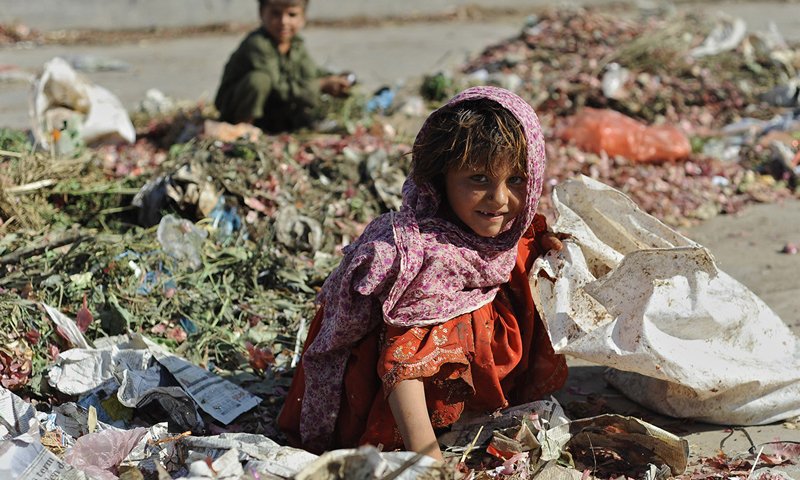
    At least 10 million more Pakistanis will drop below the poverty line because of the toll of the COVID-19 pandemic, the government’s new economic survey estimates.

    Around one in four Pakistanis are currently too poor to meet basic needs, but the figure is predicted to rise closer to 30 per cent of the world’s sixth most populous nation.

    “The COVID-19 outbreak is expected to have a negative impact on Pakistan’s economy, and the number of people living below the poverty line may rise from the existing figure of 50 to 60 million,” the survey says.

    The government’s annual Economic Survey also warned that the economy would contract for the first time in 68 years.

    “The country’s provisional gross domestic product (GDP) growth rate will likely contract 0.4 per cent instead of growing 3.3 per cent as previously forecast,” Adviser to Prime Minister (PM) on Finance Abdul Hafeez Shaikh told a news conference.

    The adviser said the International Monetary Fund (IMF) and World Bank (WB) were making bleaker assumptions keeping in view the severity and duration of the coronavirus pandemic. “In my view, we will have a better estimation when this year ends on June 30.”

    He highlighted the government’s swift and decisive policy actions since the start of the current fiscal year, including resource mobilisation, completion of the IMF programme, austerity measures and monetary policies helping stabilise the economy.

    The adviser stated that these measures helped the economy to reverse large external and internal imbalances. He said that significant improvement in external accounts was made as the current account and trade deficit witnessed a substantial contraction.

    “Foreign reserves steadily improved. There was an increase in foreign direct investment (FDI). The credit rating profile also improved. Fiscal performance remained strong during the first three quarters of the outgoing fiscal year, on the back of consolidation efforts and targeted reforms.”

    “To mitigate the socio-economic impact of the pandemic, the government announced a stimulus package of Rs1.24 trillion and offered further relief measures through the State Bank of Pakistan (SBP). The policy rate was also cut by 5.25pc to 8.0pc,” he said, adding that monetary and fiscal policy interventions had been made to restore economic activity in this difficult time and to reduce negative effects on poverty and unemployment.

  • ‘Ye Watan Tumhara Hai’: celebrities honour nation’s heroes

    ‘Ye Watan Tumhara Hai’: celebrities honour nation’s heroes

    To honour those fighting on the frontlines against the COVID-19 pandemic, producer (Naqsh Shany) Haider has released a rendition of Mehdi Hassan’s Ye Watan Tumhara Hai.

    The song features a plethora of celebrities including Adnan Siddiqui, Imran Abbas, Zara Noor Abbas, Faysal Qureshi, Ahsan Khan, Asma Abbas, Zhalay Sarhadi, Asad Siddiqui, Anoushey Abbasi and Gohar Rasheed among others.

    According to the song’s producer, “Tum Se Hai Yeh Watan is a symphonic tribute to the sovereignty of Pakistan featuring silver screen artists as singers. This song is dedicated to our nation’s unsung heroes during COVID-19 pandemic and a salute to the armed forces, doctors, engineer’s, scientists, artists and our overseas Pakistanis and the entire nation.”

    The song has been recorded and produced over social media apps in a completely virtual environment.

    “It is a special effort to uplift nationalism within our hearts”, says the producer.

    Watch video:

  • Broken seals at Wuhan lab holding 1,500 different strains of virus, including bat coronavirus

    Broken seals at Wuhan lab holding 1,500 different strains of virus, including bat coronavirus

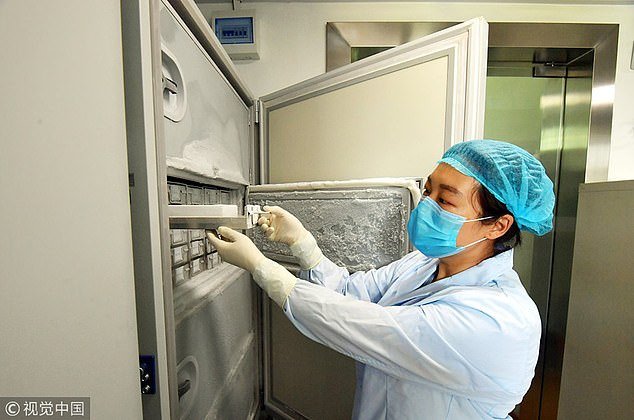
    In a rare glimpse inside a Chinese laboratory in Wuhan amid global suspicions about the COVID-19 pandemic, scenes from the “secretive” Institute of Virology have sent shockwaves over the internet.

    According to Mail Online, pictures from inside the laboratory show a broken seal on the door of one of the refrigerators used to hold 1,500 different strains of virus, including the bat coronavirus that has jumped to humans with over 2.4 million infections and over 165,000 deaths since the first case in November last year.

    The pictures, first released by a state-owned Chinese newspaper in 2018, were also published on Twitter last month, before being deleted.

    Meanwhile, according to New York Post, the director of the lab denies that the bug accidentally spread from his facility.

    “There’s no way this virus came from us,” Yuan Zhiming, director of the Wuhan Institute of Virology, told state media.

    Yuan admitted that the lab is studying “different areas related to the coronavirus,” but told the English-language state broadcaster CGTN that none of his staff has been infected.

    “As people who carry out viral studies we clearly know what kind of research is going on at the institute and how the institute manages viruses and samples,” he said.

    He said that since the lab is in Wuhan “people can’t help but make associations”, but claimed that some media outlets are “deliberately trying to mislead people”.

    But officials in the past have raised concerns over the safety conditions of the Wuhan Institute of Virology.

    In March 2018, US science diplomats dispatched to the lab issued two “sensitive” diplomatic cables about inadequate safety measures at the lab, the Washington Post reported, citing intelligence sources.

    The first cable warned the experiments conducted in the lab on coronavirus in bats “represented a risk of a new SARS-like pandemic,” according to the report.

    The cable, written by two US-China embassy officials, said there is a “serious shortage of appropriately trained technicians and investigators needed to safely operate this high-containment laboratory,” according to the report.