Tag: Paris

  • Farmers protest: From India to Europe

    Farmers protest: From India to Europe

    Farmers are protesting from India to Europe, separately, for their rights and to register their rebellion with sitting governments against soaring fuel, and fertilizer costs, lower prices of their produce, and restrictive regulations. The protests are shedding light on the very pertinent issues faced by the primary food-producing sector of countries owning big agricultural markets.

    Demands of Greek farmers

    Farmers in Greece are protesting across the country against rising costs. They are conducting a tractor rally all across the country. Manolis Liakis, a farmer from the southern island of Crete, talked to __ and singled out fuel costs as his biggest problem. He said farmers pay more than three times as much for petrol as shipping companies due to tax disparities. Farmers can’t sell their products “for ridiculously low prices while the consumer buys them at extremely high prices”, he said.

    Demands of Polish farmers

    In Poland, farmers are blocking roads to stop cheap grain imports crossing the border from Ukraine. They are demanding a “complete embargo” on Ukranian produce. During the protests on Tuesday against competition from imports of cheaper Ukrainian products, farmers in Gorzyczki, southern Poland, unfurled a banner saying “Putin, get Ukraine, Brussels, and our government in order”. Consequently, the farmers were warned by the government against raising the slogans.

    Demands of Spanish farmers

    Spanish farmers are gathering with hundreds of tractors in tow to protest against the unfair competition from outside the European Union. They want to include production costs in the end product so they don’t end up selling their goods at a loss. Additionally, they want imported products to be subjected to the same conditions that they have to face.

    Demands of French farmers

    French farmers blocked a milk transport in protest against wholesale prices they say are too low. The farmers’ unions have made it clear they want ironclad assurances that their grievances over produce prices and red tape have been addressed. French Prime Minister Gabriel Attal is trying to negotiate and pacify the raging farmers with the negotiations.
    Demands of Czech farmers

    In Prague, farmers are on the roads because they feel neglected in the policy-making process. After all, they are not given due attention by the government. “Around 3,000 tractors took to the streets,” The Czech Chamber of Agriculture said in a statement on the nationwide protests. Their demands included an end to restrictions on agricultural production, cutting red tape for farming, and introducing changes to the EU-Ukraine arrangements on farming imports.

    Demands of Italian farmers

    In Rome, cowbells are clanking with the message that Farmers feed the world, but can’t afford to farm.
    Demands of Indian farmers

    In India, massive protests have broken out over minimum crop price guarantees which were promised nearly a year ago but not implemented by the government. Thousands of Indian farmers riding tractors attempted to resume their push towards New Delhi. They were attacked by the police claiming the life of young farmer Shubhkaran Singh and injuring 25 others. Farm unions are demanding a law to set a minimum price on all crops, expanding a government scheme that already exists for staples, including rice and wheat. They have also demanded other concessions, including the waiving of loans and universal pensions for farmers aged 60 and above.

    Concerns of Canadian Farmers

    In Canada, there are fewer environmental regulations but farmers feel a disconnect with the central government whose main mandate is based on the environment. They have been pushing forward all kinds of policies about fertilizer reduction and disallowing certain pesticides. The green policies and higher costs have instead of favouring them making farmers feel ignored. Experts say the consumers feel that lower output prices and higher input prices are just a way for the government to tell them that do whatever they want but in a cleaner and environmentally friendly way.

    Conclusion

    Protesting farmers are trying to divert attention to the most neglected yet important sector of a country which is the food-producing sector which is the backbone of both the society and the economy of the country yet remains ignored by the political class for their vested interests.
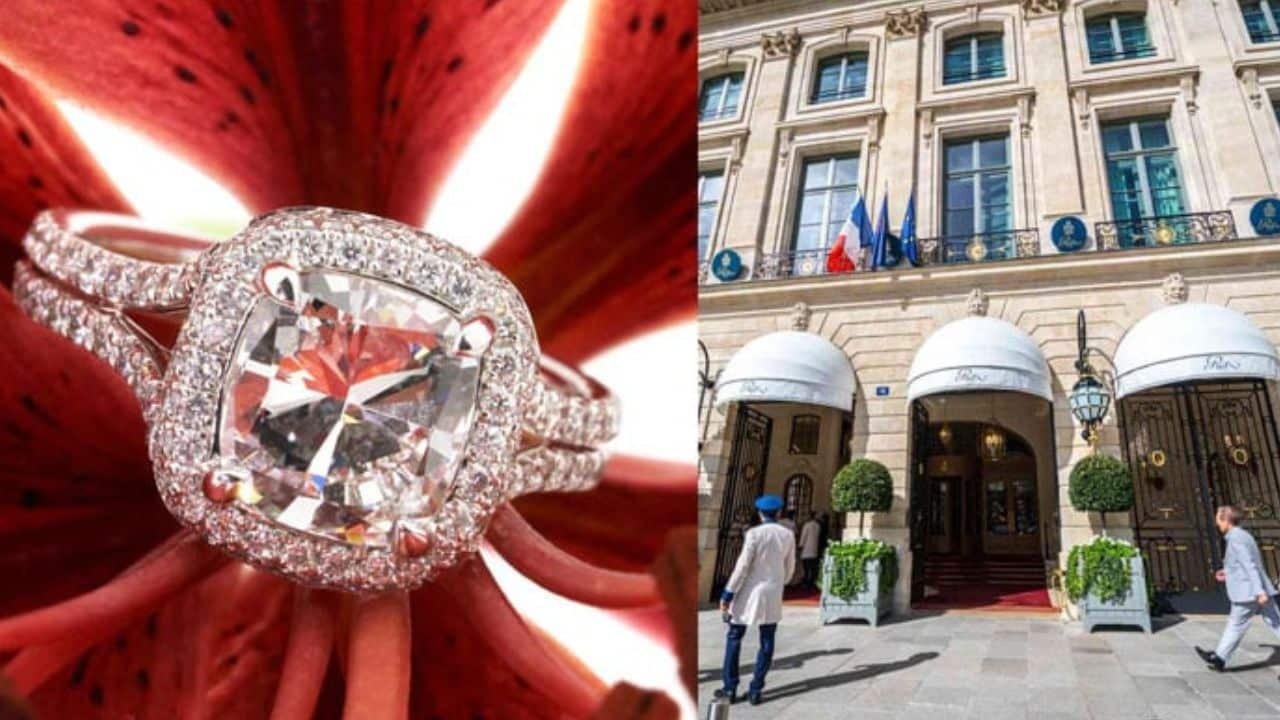

  • Woman finds ring worth more than 22 crore in an unusual place

    Woman finds ring worth more than 22 crore in an unusual place

    A woman lost a diamond ring worth more than $800,000 or Rs 22 crore, 45 lac, 34 thousand and 480 rupees at the Ritz Hotel in Paris, kicking off a large search campaign by hotel and security staff.

    The ring was eventually found in a vacuum cleaner bag.

    The woman was staying at the famed Ritz Hotel when she left her ring on the nightstand in her room.
    When she returned from a morning outing, the ring was gone. Authorities were alerted, but after a search by hotel and security staff, the ring was found in a vacuum cleaner bag.

    The woman is originally from Malaysia and is currently in London where she will receive her ring soon.

  • Sister Zeph from Gujranwala wins The Global Teacher Prize 2023

    Sister Zeph from Gujranwala wins The Global Teacher Prize 2023

    Sister Zeph, the founder of Zephaniah Education and Empowerment Foundation, received the Global Teacher Prize 2023 worth a million dollars, on November 8.

    Sister Zeph began teaching when she was 13 years old in the courtyard of her home in Gujranwala. Her students were neighbourhood children who couldn’t afford school fees. She has empowered many students from underprivileged backgrounds in a journey spanning 27 years. Her organization is operating two schools and a skills centre primarily in Gujranwala, with students from 11 nearby villages, all of them from humble families.

    She got selected from over 7,000 nominations for the Global Teacher Prize from 130 countries around the world. The ceremony was held at UNESCO’S General Conference in Paris where she accepted her award. “We are delighted to announce that Sister Zeph, an English, Urdu, culture, inter-faith harmony, climate change teacher at Gujranwala, Punjab in Pakistan, has been named the winner of the Varkey Foundation Global Teacher Prize 2023,” the orgnisation announced in a statement.

    UNESCO Director-General Audrey Azoulay congratulated the Pakistani teacher on receiving the prestigious award. “We all remember a teacher who has had an impact on our life and changed our future. It may sound like a truism but it’s true: teachers are life-changers. Congrats to Sister Zeph from Pakistan, 2023 Global Teachers Prize Winner. Thanks to her for her commitment as a life-changer,” she wrote on her Twitter handle.

    With this award, she plans to open another bigger school on a scale of 10 acres where children from poor families can be educated without any discrimination. She has aims of making an orphan house as well where kids will be taught about a range of subjects.

    In an interview, she said that she felt the need to become a teacher because she believed “there should be more people in this profession” and because she thought that there should be more children in school.

  • EU parliament urges Indian PM Modi to protect minorities

    EU parliament urges Indian PM Modi to protect minorities

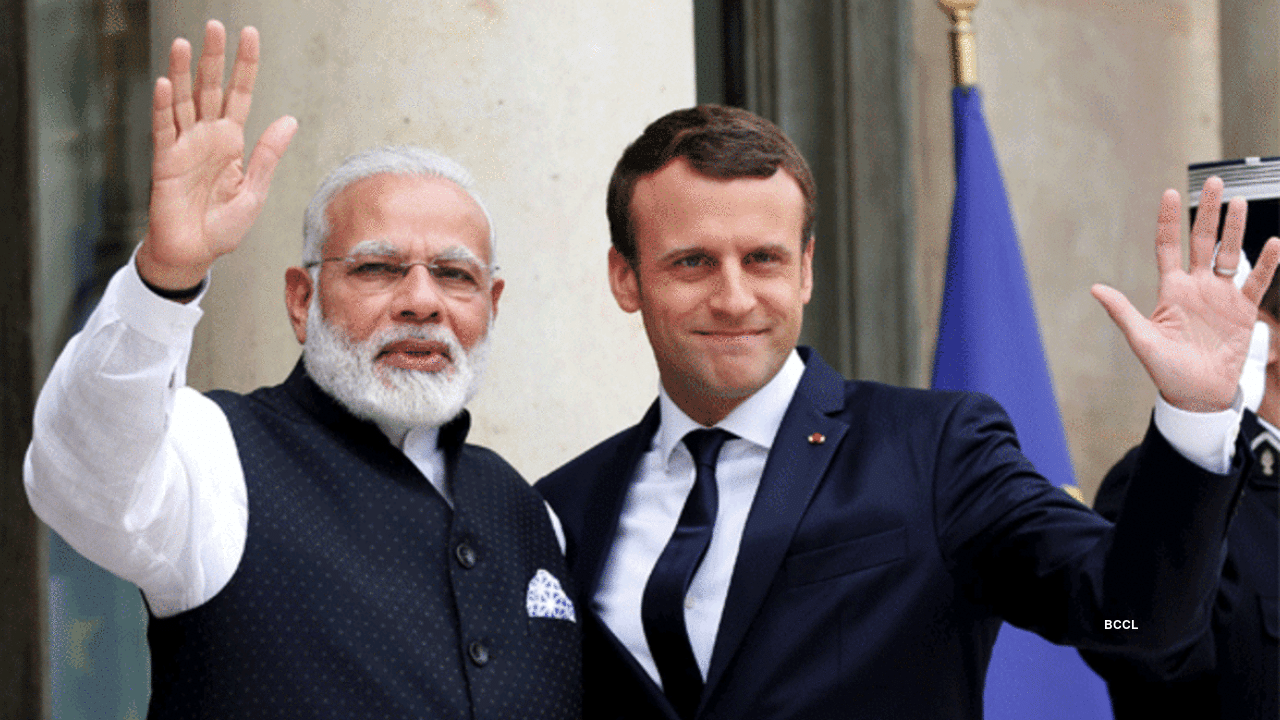
    On Thursday, the European Parliament urged Indian Prime Minister Narendra Modi to end ethnic violence in Manipur, and to do more to protect ethnic and religious minorities in India. Modi is currently on an official visit to France, having been invited to attend the country’s annual Bastille Day national festival as a guest of honour. 

    However, between the ceremony and the diplomatic courting, EU parliamentarians in Strasbourg approved a motion that urged India to end violence in the country’s northeastern Manipur state, and to protect the minorities there. 

    The motion also criticised the ‘national rhetoric’ of the local state government, run by Modi’s right-wing Bharatiya Janata Party (BJP). EU parliamentarian Pierre Larrouturou released a statement on his Twitter, with an accompanying video.

    In his tweet, Larrouturou stated that Modi and Macron can “pretend that everything is going well in India”,however, the EU parliament is recalling facts, and strongly condemns the human rights violations that take place in India.

    “Every day in India, thousands of Muslims, Christians, and members of ethnic minorities see their rights repressed,” the statement read. “To remain silent on the situation would have been a humiliation for all those who fight for their fights and suffer every day from the Hindu nationalism imposed by the Modi government.”

    In May, CNN reported how residents of Manipur say there has been a breakdown of law and order. This was after a spell of violence that left at least 58 dead and tens of thousands more homeless.

    In a speech to the public, Larrouturou went on to point out, “In Manipur, for the past two months, we have seen monstrous violence. Over 120 people have died and 1700 homes have been devastated, 250 churches have been destroyed, 40,000 people have fled for their lives.”

    Despite differences over the war in Ukraine, namely India’s continued support to Russia, as well as tensions over human rights violations in the country, Western democracies are courting Modi and what is currently the world’s most populous country, as a counterweight to China’s influence in Asia.

    India is also one of the largest global buyers of French arms. On Thursday, India approved in principle the purchase of 26 French marine Rafale jets and three Scorpene-class submarines, news agency ANI reported. 

    During Modi’s last visit to Paris in 2015, he announced a landmark deal for 36 Rafale fighter jets worth around €4 billion ($4.48 billion).

  • Is France considering an internet shutdown after riots, mayor’s house set on fire with family inside?

    Is France considering an internet shutdown after riots, mayor’s house set on fire with family inside?

    Multiple media outlets have reported that after six straight nights of riots in France, the country’s interior minister has posted a statement announcing a partial ban on the internet after hundreds were arrested for protesting the brutal murder of 17-year-old Nahel, a French national of African descent.

    However, the reports remain unconfirmed, being carried only by Asian news outlets like Samaa and Indian publication Scroll.

    The protests in France continue to grow stronger, with Sunday witnessing Paris mayor Vincent Jeanbrun’s house being set on fire, injuring his wife and children, who were inside sleeping.

    Writing on Twitter, Jeanbrun revealed that rockets were thrown at his house as they fled, calling the attack an “assassination attempt” and “unspeakable cowardice”.

    “A line has been crossed,” he wrote. “If my priority today is to take care of my family, my determination to protect and serve the Republic is greater than before.”

    According to Jeanbrun, a car was used to ram through the gates of his family’s home, and then the vehicle was set on fire which then spread towards the house.

    The mayor also revealed that a murder investigation has been launched against the perpetrators behind the violent attack.

    The protests in France began last Sunday after the brutal death of Nahel, reigniting long standing accusations of racism and police brutality within the French police.

    According to Al-Jazeera, the French Interior Minister reportedly deployed 45,000 police officials along with helicopters and armed vehicles. Around 700 people have been arrested since the protests began.

  • Pakistan likely to exit FATF grey list after 4 years

    Pakistan likely to exit FATF grey list after 4 years

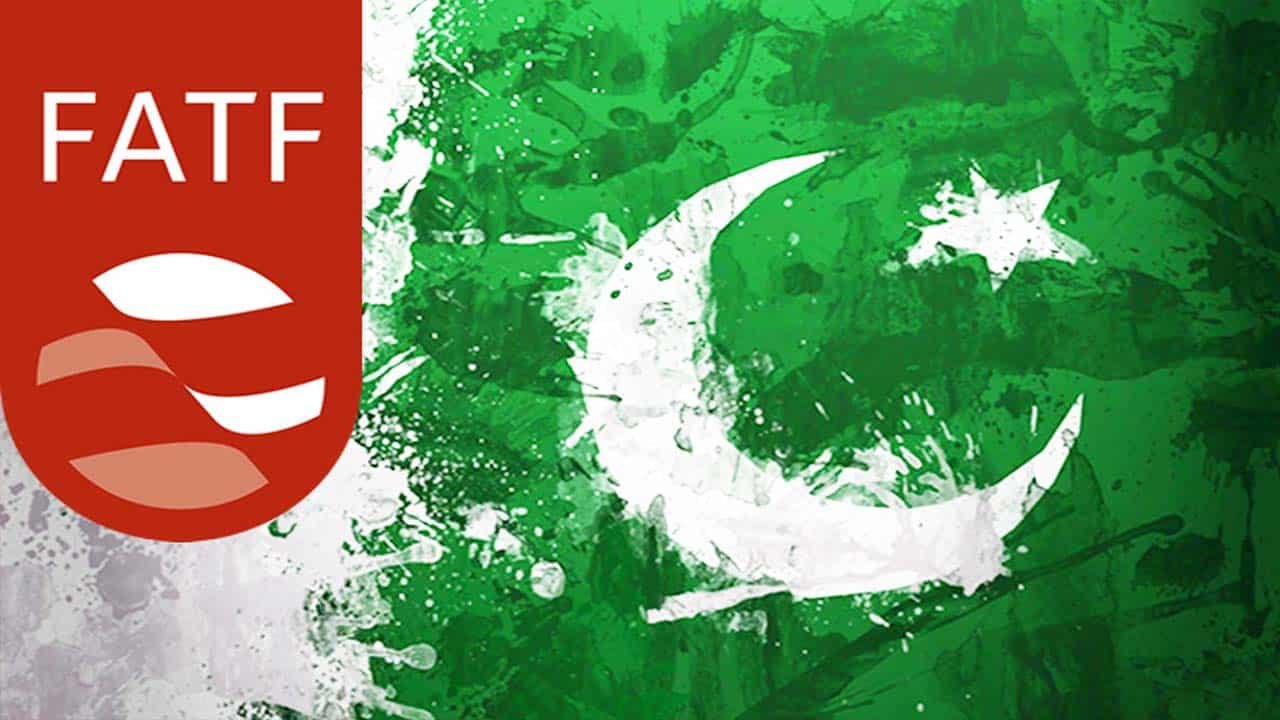
    Pakistan is expected to leave the Financial Action Task Force (FATF) grey list on October 21 after topping the dreaded chart for over four years.

    According to Dawn, a 15-member team of the money-laundering watchdog concluded its onsite visit to Pakistan on September 2, with the final decision on the country’s grey list status now expected at its next meeting set to take place in Paris this week.

    According to an official statement, panellists from 206 Global Network members and observer organisations, including the International Monetary Fund, the United Nations, the World Bank, Interpol, and the Egmont Group of Financial Intelligence Units, will attend the Working Group and Plenary meetings in Paris.

    The outcome of the two-day deliberations on Pakistan’s status would be announced. The FATF Onsite team’s report on Pakistan is scheduled to be reviewed at the plenary meetings.

    Pakistani authorities believe that after four years of hard effort, the country has achieved not just a high level of technical compliance with FATF standards, but also a high degree of efficacy through the implementation of two comprehensive FATF action plans.

    It is worth noting that the FATF found Pakistan generally compliant on all 34 issues in June of this year and opted to send an onsite team to verify it on the ground before formally declaring the country’s removal from the grey list in August and September.

    Pakistan was rated “compliant or generally compliant” with FATF criteria in 38 of 40 recommendations, putting the country among the top FATF-compliant countries in the world.

    Pakistan was officially placed on the FATF grey list for the third time on June 28, 2018, and has been working to remove itself off the list ever since.

    The country was originally placed on the FATF grey list in 2008 after failing to meet international anti-money laundering (AML) and counter-terrorism financing (CFT) requirements. Pakistan was removed from the list in 2010 after upgrading its AML/CFT regime. However, Pakistan was placed on the grey list again in 2012 and remained there until 2015.

  • Loadshedding in Paris? Symbol of love Eiffel tower will go dark early every night

    Loadshedding in Paris? Symbol of love Eiffel tower will go dark early every night

    One of the best-known and most imitated monuments in the world— the Eiffel Tower— will shut down its lights earlier than usual due to the ongoing energy crisis in Europe.

    The decision was announced by Paris Mayor Anne Hidalgo. The government’s plan includes aiming to save 10 per cent of Paris’ energy consumption during winters. Not just the famed tower but all of the city’s municipal buildings will turn off their lights starting at 10pm. However, public lighting will remain switched on in the city for the safety of its citizens.

    The earlier shutting off of the Eiffel Tower lights will begin on September 21. All lights will be switched off at 11:45pm when visiting time has ended.

    It is pertinent to mention that the tower makes up about 4 per cent of the monument’s annual energy expenses.

    Earlier, it was usually illuminated in golden hues within less than 10 minutes of nightfall and has an hourly 5-minute show of dazzling sparkles until 1am.

    Other actions in the mayor’s plan include lowering temperatures in public buildings, reducing water temperature in swimming pools, and axing hot water in administrative buildings and some public buildings.

    Europe’s energy crisis is one of the many setbacks of Russia’s ongoing invasion of Ukraine. When the war broke out in Ukraine, European nations overwhelmingly supported the young country in its defense against Russian forces. But, historical reliance on Russian energy exports has left the continent reeling under rising energy costs.

  • VIDEO: Climate change protester disrupts Louis Vuitton show in Paris

    VIDEO: Climate change protester disrupts Louis Vuitton show in Paris

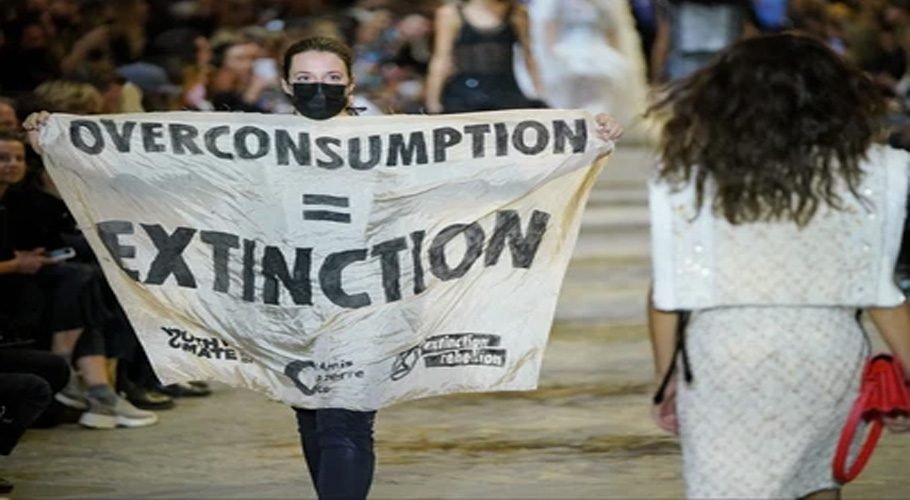
    A protester interrupted a Louis Vuitton fashion show in Paris on Tuesday by walking down the ramp with a banner protesting the impact of excessive consumption on the environment, Reuters reported.

    The woman with the banner, which read “Overconsumption = Extinction”, was representing Amis de la Terre France, Youth for Climate and Extinction Rebellion. She walked down the same path as the models, causing a stir in the audience, a Reuters witness said.

    The protester was wrestled to the ground by security officials before being led away.

    The disruption did not interrupt the show as models marched down the runway.

    The show itself had a punk flavour, with sleeves ripped off suit jackets, leaving arms bare, and accessories including studded boots and chainmail headpieces.

    Amis de la Terre France said it targeted the LVMH-owned (LVMH.PA) label to throw a spotlight on the issue of overconsumption.

    “LVMH is the world leader of luxury and has a responsibility when it comes to trends that push the textile industry to constantly renew collection faster and produce more,” Alma Dufour, a group spokesperson, told Reuters.

  • VIDEO: Egg on French president’s face over Islam remarks?

    French President Emmanuel Macron has come under criticism over his remarks on Islam after a teacher was beheaded on the streets of Paris allegedly for showing blasphemous cartoons to students.

    Amid this, a video of Macron having an egg thrown at his face as he is in conversation with some people is circulating on social media.

    WATCH VIDEO:

    The claim along with the video says Macron was attacked for his remarks on Prophet Mohammad (PBUH) and Islam, which have led to calls for a boycott of French products across the Muslim world.

    The Current has found the claim along with the video to be misleading. The video was shot in March 2017 in Paris days before the presidential elections in France, when Macron was a candidate for the top post.

    Using related keywords, we found some media reports carrying a similar video of the event, shot from a different angle.

    A report by Express says Macron was attacked by a protester with an egg when he was attending an agriculture show in Paris in March 2017.

    This was not the first time when Macron was egged. In 2016 too, an angry mob pelted eggs on Macron in Paris.

    So, it has been established that the video is more than three years old and has nothing to with Macron’s recent remarks on Islam.

    ‘WON’T GIVE INTO ISLAMIC RADICALS’:

    On Sunday, Macron tweeted, “We will not give in, ever to Islamic radicals.”

    “We do not accept hate speech and defend reasonable debate,” the French leader added.

    Calls to boycott French goods are already growing in the Arab world and beyond after Macron criticised Islamists and vowed not to “give up cartoons” depicting the Holy Prophet (PBUH).

    Macron’s initial comments, on Wednesday, had come in response to the beheading of a teacher, Samuel Paty, outside his school in a suburb outside Paris earlier this month, after he had shown the blasphemous cartoons during a class he was leading on free speech.

    With the French president pledging to fight “Islamist separatism”, which he said was threatening to take control in some Muslim communities around France, hashtags such as the #BoycottFrenchProducts in English and the Arabic #ExceptGodsMessenger trended across countries, including Pakistan, Kuwait, Qatar, Palestine, Egypt, Algeria, Jordan, Saudi Arabia and Turkey.

  • Rihanna launches her new fashion brand in Paris with LVMH

    Rihanna launches her new fashion brand in Paris with LVMH

    Rihanna is followed almost as much for her style as her music in the West. Rihanna has partnered with the luxury multinational brand LVMH (Louis Vuitton and Moët Hennessy) to launch Fenty Maison, a ready-to-wear, shoes, and accessories. The brand is called Fenty after the singer’s full name – Robyn Rihanna Fenty

     The pop star will become the first black woman in charge of a major luxury fashion house in Paris. “My fashion will be different and non-traditional because I do not come from this industry,” says the singer and hopes to bring a “new vision of fashion”.

    Rihanna’s
    Fenty line has a luxury price point, with pieces going for Rs 31,000 to  166,485. The lower priced pieces are in there
    too minimum for Rs 9400.

    The brand will first be available in 14 countries, in Europe and the United States, and will open in Asia by the end of the year.