Human Rights Watch (HRW) said Wednesday that the Pakistani government has a responsibility to uphold the constitution and allow for voting without threats or violence on the no-confidence motion.
HRW Associate Asia Director Patricia Gossman, in a statement, said both the government and Opposition should send a “strong message” to their supporters not to subvert the democratic process or sway the vote through intimidation or other criminal acts.
The mystery shrouding the elusive proposed draft of the Pakistan Media Development Authority (PMDA) is quite intriguing. Some consultations have been held with journalists, civil society members, and parliamentarians but without a copy of the proposed draft. Members of the National Assembly (NA) Standing Committee on Information and Broadcasting on Thursday demanded that the draft be shared instead of verbal briefings by the Information Ministry. Chairman of the NA standing committee Mian Javed Latif then formed a sub-committee, which will be headed by Marriyum Aurangzeb with Nafisa Shah and Kanwal Shozab as its members. Let’s see if the proposed draft will now be shared with the sub-committee.
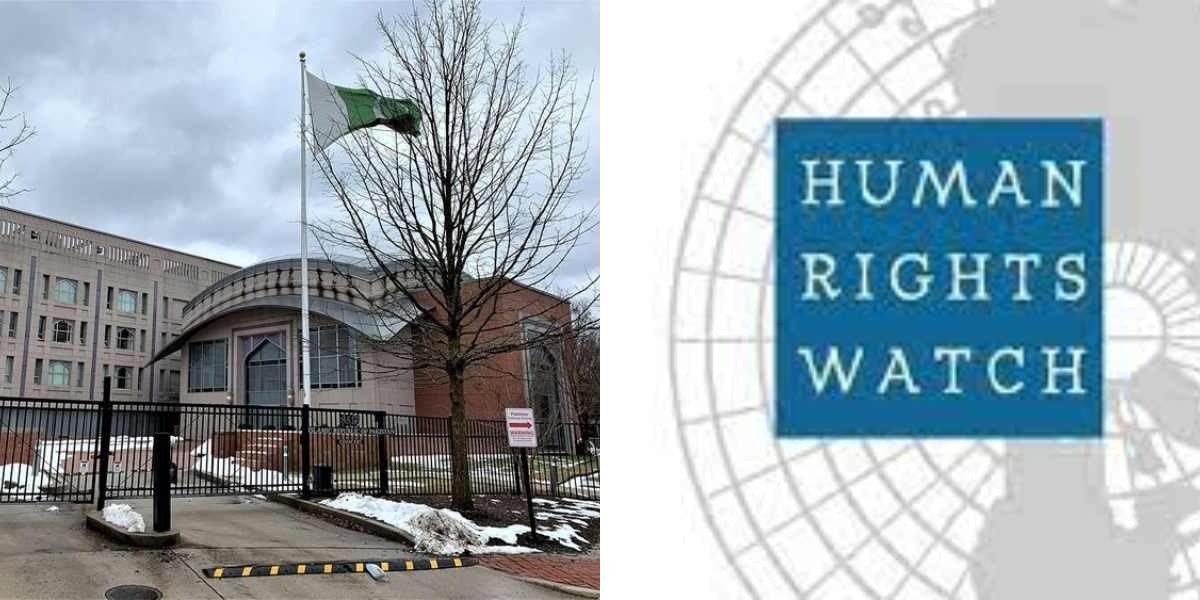
Last month, representatives of media organisations issued a joint statement that rejected the proposed media authority. They said that it was unconstitutional and deemed it as a draconian law. It seems that this is yet another tactic by the government to curb media freedom. Human Rights Watch (HRW) recently also issued a statement on the PMDA saying that the Pakistani government is “seeking broad new powers to control the media as part of its crackdown on freedom of expression. Journalists, human rights activists, and political leaders across that country have raised the alarm about proposed legislation that would bolster powers of the government to censor and restrict the media.” The government reacted to HRW’s statement by issuing a rejoinder through the Pakistan Embassy in the US challenging the human rights organisation’s assertions on PMDA. Patricia Gossman, HRW’s associate director for the Asia division, asked for a draft, which has so far not been shared with anyone.
It is quite worrying that in a country where media freedom is already quite curtailed, where interviews have been stopped from going on air or stopped mid-way, where anchors have been taken off-air, where there are now so many red lines that media organisations have to tread very carefully, where attacks on journalists have become frequent and culprits are still at large, where online trolling of journalists has become a norm, where the government issues reports of social media trends and hashtags it deems anti-state, where government officials keep on targeting journalists and media organisations without any shred of evidence, a new media authority with immense powers is being proposed without sharing the details of the proposed law and/or taking the main stakeholders on board.
We hope that the government will share the proposed draft with all stakeholders so that the mystery shrouding this media authority ends once and for all. There is already a lot of mistrust between the government and the media. We hope the government will listen to the legitimate concerns of media organisations and not dismiss them. A free and independent media is essential for any democracy. Pakistan is a democracy and we hope the government will not undermine it in any way.
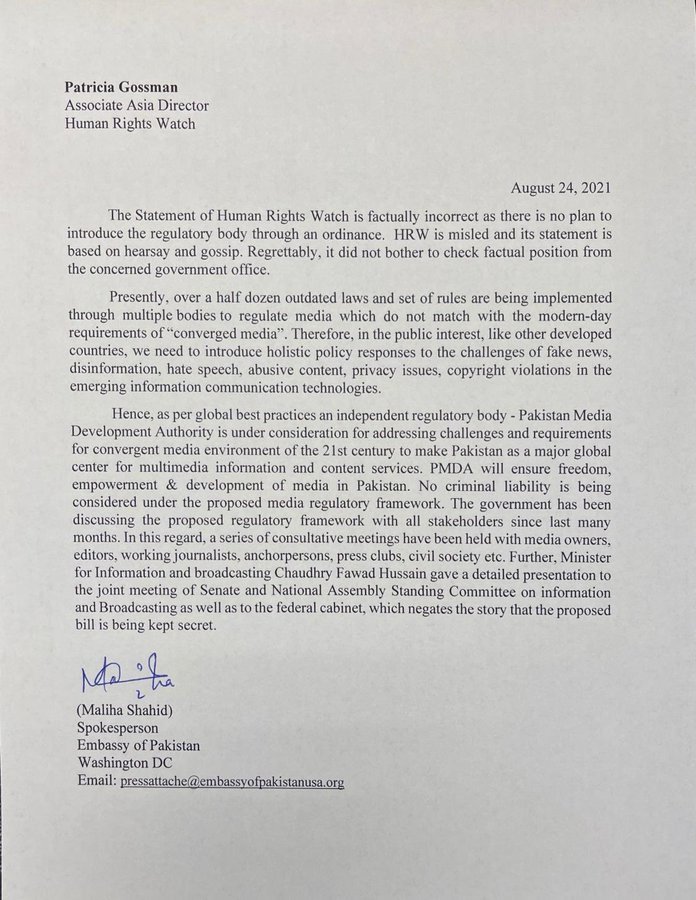
Pakistan responded to a dispatch by the Human Rights Watch (HRW) Associate Asia Director, Patricia Gossman, on the proposed media bill. Pakistan condemned the claims of the organisation and termed the statement “factually incorrect”.
“The statement of Human Rights Watch is factually incorrect as there is no plan to introduce the regulatory body through an ordinance,” read the letter from Pakistan’s Embassy in Washington DC.
The letter further added, “HRW is misled and its statement is based on hearsay and gossip.”
“In the public interest, like other developed countries, we need to introduce holistic policy responses to the challenges of fake news, disinformation, hate speech, abusive content, privacy issues, copyright violations on the emerging information communication technologies.”
The letter further states, “Hence, as per global best practices and independent regulatory body – Pakistan Media Development Authority is under consideration for addressing challenges and requirements for convergent media of the 21st century to make Pakistan a major global center for multimedia information and content services.”
Patricia Gossman took to Twitter and wrote, “Wow. You have identified no inaccuracies in our article and you have failed to provide a draft of the law. What are you hiding?”
Meanwhile, in its statement, HRW said, “The government claims an ordinance setting up the Pakistan Media Development Authority (PMDA) would replace the ‘fractured’ regulatory environment and fragmented media regulations currently in place. The proposed PMDA would bring all media in Pakistan – print, television, radio, films, and digital media – under one regulator.”
The proposed law would also increase government control by allowing government officials to be appointed to key positions.
With journalists under relentless attack for doing their jobs, the Pakistan government needs to stop trying to control reporters and instead start protecting media freedom, added HRW.