Tag: PBS

  • Weekly inflation witnesses slight increase of 0.62%

    Weekly inflation witnesses slight increase of 0.62%

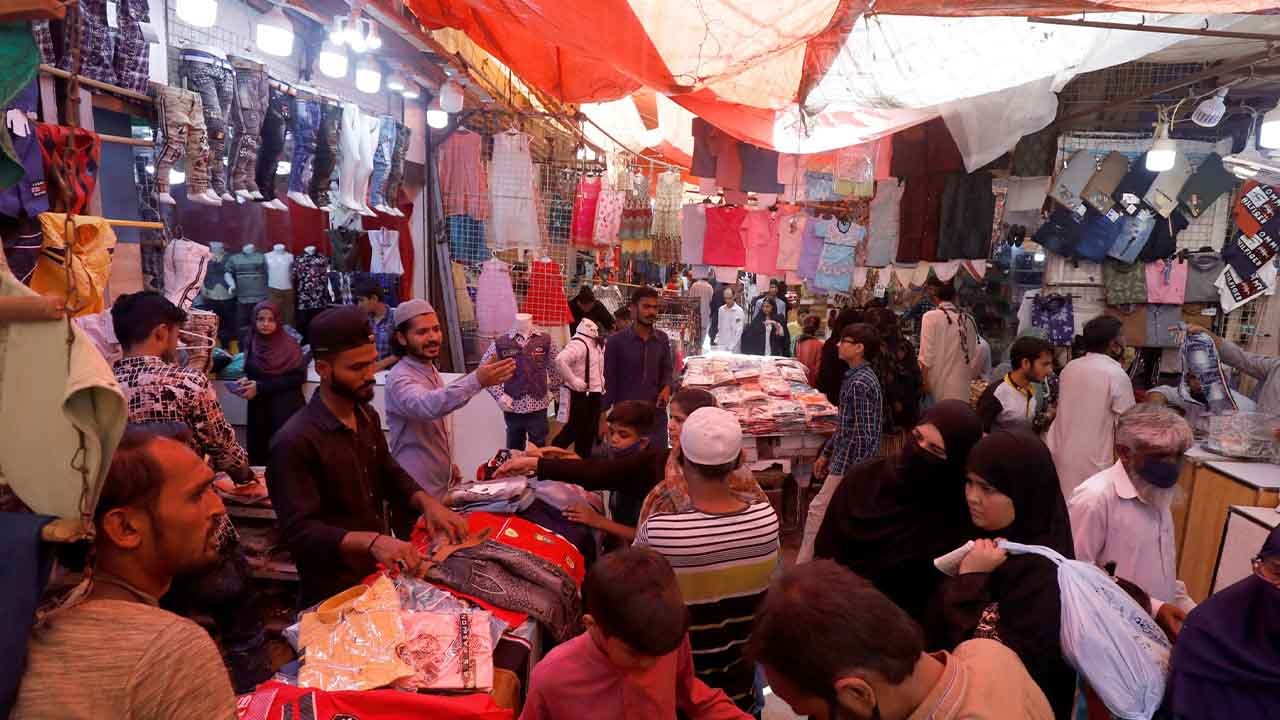
    Sensitive Price Indicator (SPI) data shows that short-term inflation in the week ending November 17 decreased to 0.62 per cent week-over-week (WoW), primarily as a result of lower prices for some food products such tomatoes, lentils, and cooking oil. The SPI was 0.74 per cent last week.

    The Pakistan Bureau of Statistics (PBS) revealed data on Friday showing that the weekly inflation rate increased by 28.67 per cent year over year (YoY).

    Since reaching a peak of 45.5 per cent in the week ending September 1, the annual increase in SPI has been declining. YoY inflation was measured at 29.24 per cent last week.

    Based on a study of 50 markets in 17 cities across the country, the SPI tracks the costs of 51 necessities. 23 items had price increases over the week, 13 saw price decreases, and 15 saw no change.

    Highest WoW increase

    Salt: 7.61 per cent

    Lipton tea: 5.9 per cent

    Chicken: 4.89 per cent

    Onions: 4.61 per cent

    Eggs: 3.66 per cent

    Highest WoW decline

    Tomatoes: 6.06 per cent

    Pulse Masoor: 1.56 per cent

    Pulse Gram: 1.46 per cent

    Ghee (1 kg): 1.03 per cent

    Pulse Mash: 0.68 per cent

    Highest YoY increase

    Onions: 319.35 per cent

    Lipton tea: 59.27 per cent

    Pulse Gram: 57.39 per cent

    Petrol: 53.85 per cent

    Pulse Moong: 51.24 per cent

    Highest YoY fall

    Chilli powder: 41.42 per cent

    Sugar: 4.27 per cent

    After slowing to 23.2 per cent in September from a 49-year high of 27.3 per cent in August as the nation continued to be gripped by high food and transportation expenses, annual CPI inflation soared to 26.6 per cent YoY in October.

    In recent weeks, inflation has been driven up by rising vegetable prices, particularly those of onions and tomatoes, as a result of standing crops damaged by floods, as well as a significant increase in electricity prices.

    The Food and Agriculture Organization of the United Nations issued a warning last month that severe food insecurity is likely to get worse in some areas of Pakistan as a result of the negative effects of floods and the astronomically high prices of energy and gasoline.
  • Pakistani rupee drops by 0.35% to close at Rs221.43 versus dollar

    Pakistani rupee drops by 0.35% to close at Rs221.43 versus dollar

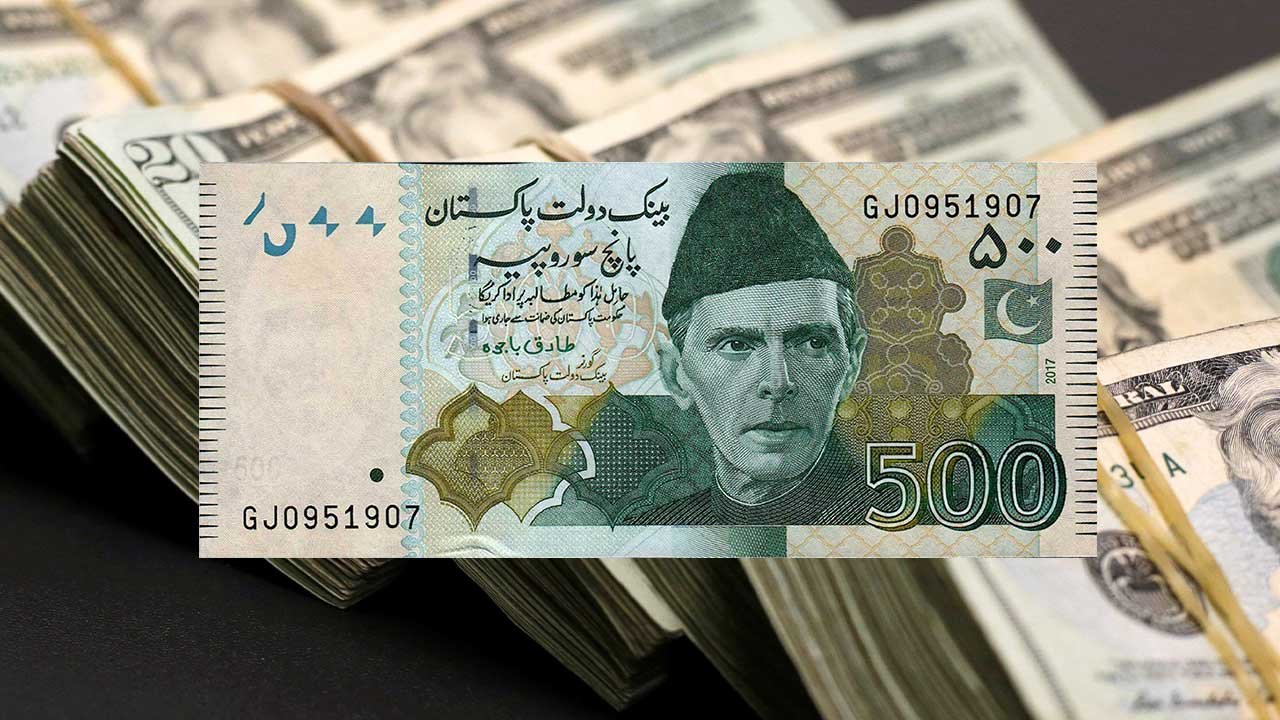
    As investors await the US Federal Reserve’s decision on the policy rate, the Pakistani rupee (PKR) depreciated by 0.35 per cent against the greenback on Wednesday.

    According to the State Bank of Pakistan (SBP), the local unit appreciated by Rs0.78 and ended the day at Rs221.43.

    The Pakistani rupee enjoyed gains against the US dollar on Tuesday, and it ended the day at Rs220.65 after rising by Rs0.24 (or 0.11 per cent) in the interbank market.

    Gains were recorded when market confidence improved as a result of discussions held by Finance Minister Ishaq Dar with senior bank and exchange company executives.

    However, in a significant development, according to the most recent data released by the Pakistan Bureau of Statistics (PBS) on Tuesday, consumer price index (CPI)-based inflation increased to 26.6 per cent on an annual basis in October 2022 as opposed to an increase of 23.2 per cent in the previous month and 9.2 per cent in October 2021.

    Globally, the US dollar slipped on Wednesday as investors awaited the US Federal Reserve’s policy decision amid speculation it might indicate a slowdown in future rate hikes. The central bank will soon release its policy statement with investors widely expecting a 75 basis points (bps) rate hike, the fourth such increase in a row.

    The dollar index – which gauges the greenback against a basket of six counterparts that includes the yen, euro and sterling – eased 0.2 per cent to 111.28, but was not far below Tuesday’s high of 111.78, the strongest level since October 25. The index has fluctuated widely around the 112 level since its retreat from a two-decade high of 114.78 at the end of September.

    Oil prices, a crucial gauge of currency parity, increased on Wednesday after data from the sector revealed a surprising decline in US oil supplies, indicating that demand is still strong despite sharp interest rate increases that are slowing down global development.

  • ‘Pakistan’s international debt should be immediately cancelled’: British MP

    ‘Pakistan’s international debt should be immediately cancelled’: British MP

    United Kingdom (UK) Member of Parliament (MP) Claudia Webbe has called on the international community to cancel Pakistan’s debt as the country’s inflation hits the highest level since 1973.

    In a statement on Twitter, Webbe said, “Inflation in Pakistan is at an all-time high at 27 per cent! Pakistan’s international debt should be immediately cancelled – they should instead be given reparations for the climate crisis caused.”

    According to the Pakistan Bureau of Statistics (PBS), Pakistan’s Consumer Price Index-based inflation (CPI) climbed by 27.3 per cent on a year-over-year basis in August 2022.

    Prior to this statement, she repeatedly urged foreign countries to stand shoulder to shoulder in full solidarity with Pakistan and termed the silence from western countries a “moral crime”.

    “We need a global climate tax so that the global rich can be made to pay for the climate damage they cause in the world,” she said.

    She also blamed rich countries for the climate crisis and said that they should bear the cost, not Pakistan, as the country is responsible for 1 per cent of global emissions.

    On her official Twitter account, she also shared videos of the devasting floods in Pakistan.

    Water levels continued to rise on Friday as the overall death toll from the devastating floods has crossed 1,200.

    On Thursday, the UK announced an additional £15 million of lifesaving support for flood victims in Pakistan.

    More than 33 million people are affected — one in every seven Pakistanis — and reconstruction work will cost more than $10 billion.

    United Nations (UN) chief Antonio Guterres called the floods a “climate catastrophe” and launched an appeal for $160 million in emergency funding. Meanwhile, western countries have also donated millions of dollars to Pakistan.

  • Exports of leather garments witness 10.15 per cent increase

    Exports of leather garments witness 10.15 per cent increase

    Owing to a partial recovery of international orders and government support programmes, Pakistan’s non-textile exports increased by 25.85 per cent year over year to $12.46 billion in the preceding 2021–22.

    The value-added sectors are primarily driving overall growth in the non-textile sector. According to data produced by the Pakistan Bureau of Statistics (PBS) on Thursday, the non-textile sector has not yet received full orders to pre-Covid levels.

    Despite lockdowns in several nations, three industries—leather clothing, medical equipment, and engineering goods—maintained growth in export revenues in FY21.

    Exports of leather clothing increased by 10.15 per cent and those of leather gloves by 10.60 per cent in the value-added leather industry. In contrast, raw leather exports rose by more than 28.50% over the previous fiscal year.

    One of the major producers of surgical instruments worldwide is Pakistan. However, well-known brands resell these instruments in western nations. Because of this, the export value of these goods is still extremely low.

    In FY22, surgical tool exports experienced a 1.29 per cent decline. Pharmaceutical exports, however, decreased by 0.49 per cent.

  • The recent ban on imports might barely make a dent

    The recent ban on imports might barely make a dent

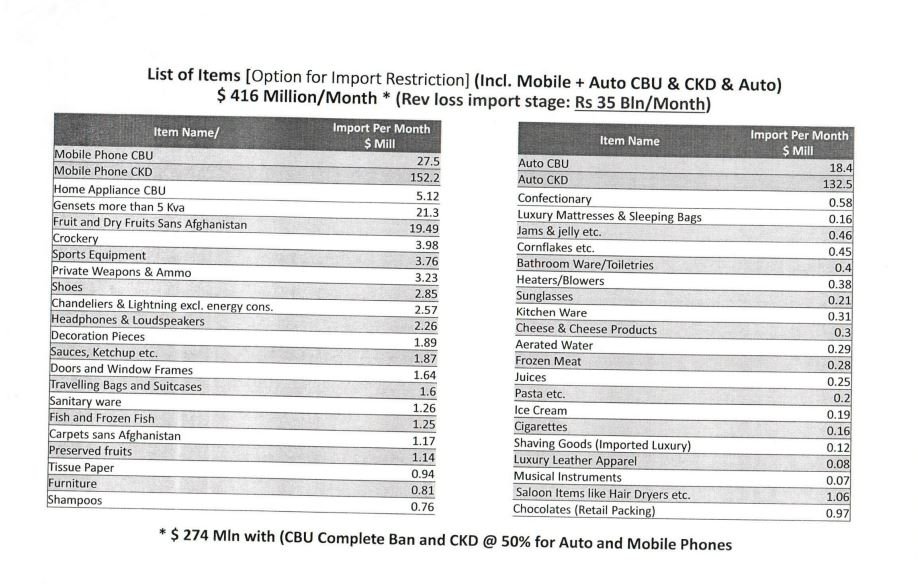
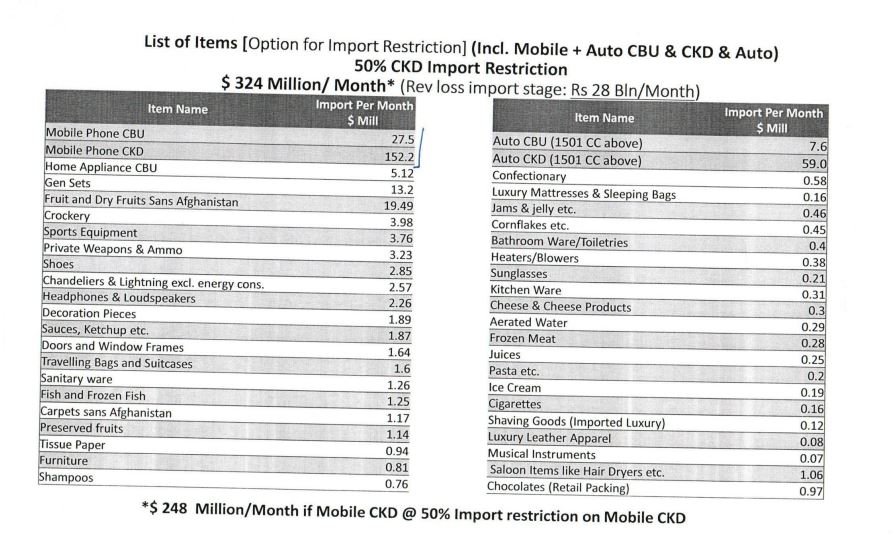
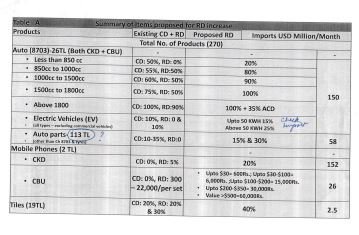
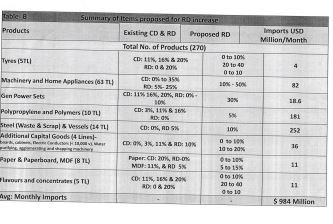
    On Thursday, May 19th, 2022, the federal cabinet issued a list of 41 items which will be banned from being imported for two months. This is in an attempt to address the current account deficit. The list of products is banned from being imported into the country, which means that essentially any shops or restaurants which rely on using these products will be forced to find local alternatives.

    These products will be banned regardless of what branding or packaging they use and only on the basis of whether the specific product is imported or not. Even products which are imported from abroad but packaged locally, will now be banned.

    Economists, university professors and business journalists took to Twitter to analyze and assess the merits and demerits of this decision. The discussion around luxury products and the fact that a lot of products which are labelled as “luxury items” are actually essential. Sanitary imports, valued at $16.4m are wrongly categorized as non-essential and although local alternatives also exist but it is definitions like these which disallow such decisions to be founded in research and expertise.

    The valuation of these imports which was published by the Pakistan Bureau of Statistics, was being quoted to ridicule the decision by many. What’s interesting to note is that most brands which appear to be entirely local, import a major chunk of their supply and will now be forced to smuggle goods instead.

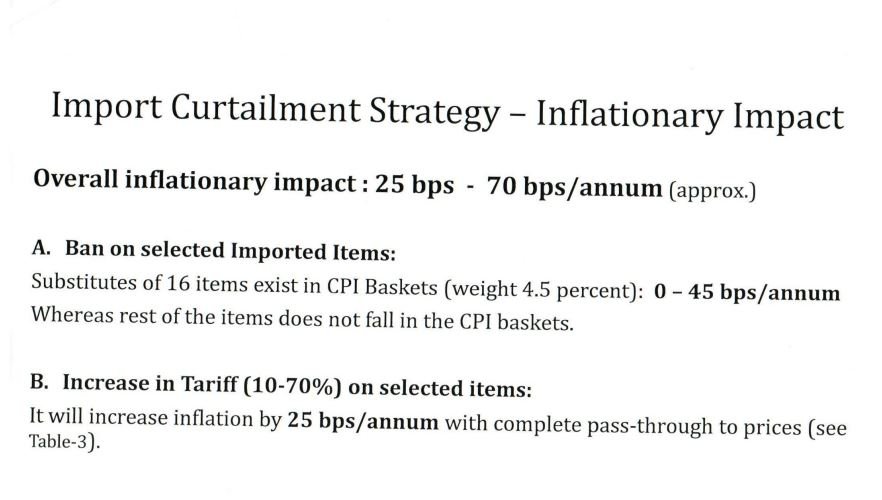
    Only from the data shared by PBS it becomes clear that for the fiscal year 2022, June to March, the total value of petroleum imports was $11 billion, while the total value of banning all these non-essential “luxury” items is a total $984 million, which forms only about 8.9% of the total value of petroleum imports.

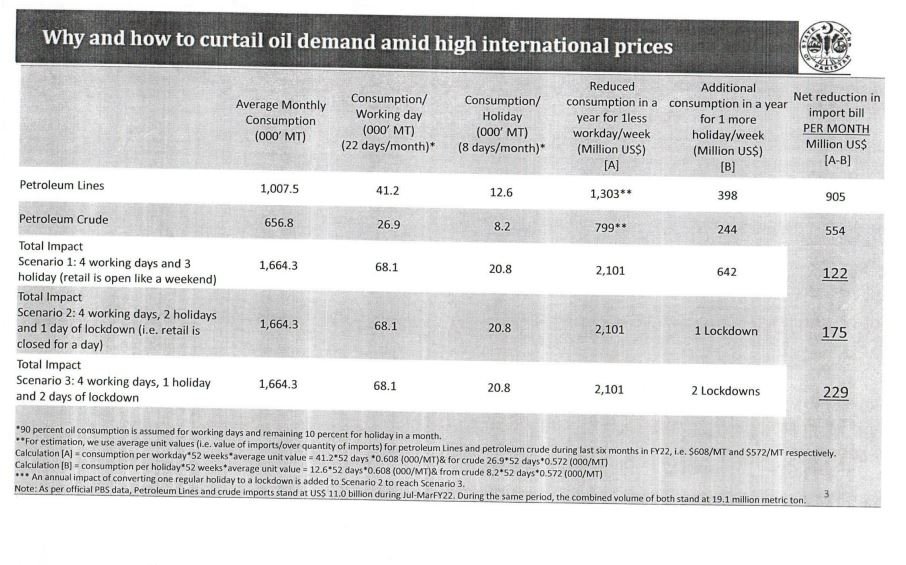
    In conversation with Profit Magazine’s Ariba Shahid, she clarified that this would still prove to be a largely fruitless move since the most significant chunk of the import bill is still being used up to run the energy sector without any thought being given to the humongous fuel subsidies . “For a very long time the State Bank of Pakistan has been talking about how if we remove the oil component from it, the current account deficit is improving, which is true and basically means that people are not spending money to buy other items and most of the import bill is petrol and soy bean oil.”

    Economists Ammar Khan and Atif R Mian also took to Twitter to analyze this decision of “patchwork economics”. Commenting on this unsustainable gap in Pakistan’s balance of payment, on April 15th, 2022 during a discussion on Pakistan’s economy at Princeton University, he explains that for Pakistan to grow it is a necessary condition for Pakistan to deal with this problem and digs deeper into the structure of the economy. He particularly takes apart urban land reforms, the necessity to levy a capital gains tax on speculative real estate transactions and analyzes how Pakistan is not even economically stable enough to grow at the rate of India and Bangladesh and it is primarily due to the elite capture of the economy that disallows the economy to attempt to fix its loopholes.

    Echoing similar sentiments, Ariba Shahid explained that due to a weaker economy, the import bill is not as significantly high due to a reduced demand pull because of a lowered purchasign power and hence banning these products will be insignificant and might barely make a dent in the current account deficit. “The need of the hour is to reverse the fuel subsidy,” says Shahid, “This decision will swell up the grey market economy and smuggling will increase.”

  • Inflation hike up to 11.5pc, highest in 20 months

    An increase in consumer prices continued as inflation rises up to 11.5 per cent from 9.2 per cent in November, the highest increase in the past 20 months due to a record hike in fuel prices last month, reports Dawn. This has been revealed by Pakistan Bureau of Statistics (PBS) data.

    Inflation measured by the Consumer Price Index (CPI) increased to its highest level in 20 months.

    Prices of fresh vegetables, fruits, and meat have also shown a significant increase in major urban and rural centres.

    The average inflation during the July-November period rose to 9.32 per cent on a yearly basis.

    Currently, the government aims to increase agriculture productivity for food security and self-sufficiency to counter food inflation by offering Agri-loans.

    The finance division in its recent report claimed that taking into account new price impulses in November and the low base effect, inflation would remain between 8.5 and 9.5 per cent, but the November inflation has already surpassed the projected figure.

  • Mobile phone imports nearly double in last 12 months

    Mobile phone imports nearly double in last 12 months

    Mobile phone imports have increased by 81.32 per cent as compared to the last fiscal year (July-June) 2019-20.

    The imports reached $1.369 billion compared to $755.548 million during the same period last year, according to the latest report released by the Pakistan Bureau of Statistics (PBS).

    Telecom experts are linking the phenomenal increase in import to the implementation of Device Identification Registration and Blocking System (DIRBS).

    Mobile phone imports increased 300 per cent in June 2020 as compared to $57.736 million imports of June 2019.

    Overall telecom imports saw an increase of 34 per cent during July-June (2019-20) if compared to the same period of last year.

    Total imports were recorded at $1.86 billion when compared to $1.37 billion in July-June (2018-19), while registering 71.62 per cent growth in June 2020.

    The figures stood at $272.576 million in June 2020 as compared to $158.93 million during May 2020.

    Other telecom apparatus imports witnessed a decline of over 21.36 per cent in July-June (2019-20) as they stood at $490.754 million against $624.017 million during the same period last year.

    When compared to May 2020, other telecom apparatus imports registered a 13.41 per cent decline in June as they were $41.453 million as compared to $47.871 million in May 2020.