Tag: Pegasus Spyware

  • ‘PM Khan’s phone does not have messages of Gujarat massacre like Modi’: Fawad

    ‘PM Khan’s phone does not have messages of Gujarat massacre like Modi’: Fawad

    Federal Minister for Information and Broadcasting Fawad Chaudhry, while speaking on Geo News’ programme ‘Jirga’, said, “Two days prior to the story of Pegasus spyware being published, I received a letter from The Guardian revealing that there was a list of phone numbers that had been hacked. Three numbers previously used by Prime Minister Imran Khan were also in the list.”

    Fawad said that the letter further added that he needed to confirm whether the numbers included in the list belonged to PM Khan or not.

    Fawad said that a team was being put together by the government, who would do the forensics to verify whether the premier’s phone was hacked or not. Only then will the government be able to tell if the attempt to hack the phone was successful or not.

    “It is confirmed that an attempt to hack the phone was made,” said Fawad.

    On being asked by Saleem Safi that if the phone was indeed hacked and the Indians did get the data from the premier’s phone, what implications would it have for the country, Fawad replied, ” PM Khan’s phone did not have messages of Gujarat massacre like Indian Prime Minister Narendra Modi. His phone does not have any orders of murder in it.”

    Fawad condemned how Modi and his government had hacked the phones of Indian journalists, judges, his own government officials, and other world leaders and said that the United Nations must intervene in this regard.

    Fawad Chaudhry added that the Foreign Office has taken notice of India’s use of Israeli spyware, Pegasus, to hack Prime Minister Imran Khan’s phone and had already said: “We call on the relevant UN bodies to thoroughly investigate the matter, bring the facts to light, and hold the Indian perpetrators to account.”

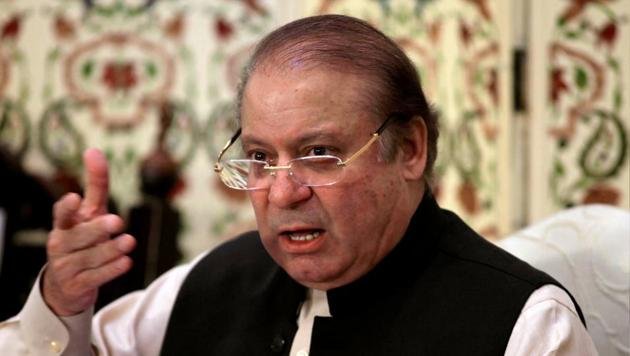
    When questioned about the meeting between Imran Khan and Narendra Modi before he came into power and whether it was discussed with the then government, Fawad responded that PM Khan’s meeting was public and the media was present. Fawad criticised Nawaz Sharif’s meeting with Afghan National Security Adviser (NSA) Hamdullah Mohib in London and said this was news shared with the Afghan media.

    “I won’t call Nawaz Sharif a traitor but it was a very irresponsible act by him,” added Fawad.

    Earlier this week, Pakistan Muslim League-Nawaz (PML-N) leader Nawaz Sharif was met by Afghan National Security Adviser Hamdullah Mohib and State Minister for Peace Sayed Sadat Naderi.

    The National Security Council of Afghanistan (NSCA) gave an update about the meeting on Twitter Saturday, saying that the Afghan state minister for peace and NSA discussed “matters of mutual interest” with the former Pakistan prime minister.

    Nawaz Sharif’s meeting faced extreme criticism from the government.

  • ‘Smartphones are worse than a spy in your pockets’: Edward Snowden

    ‘Smartphones are worse than a spy in your pockets’: Edward Snowden

    Ex-computer intelligence consultant at the United States (US) National Security Agency (NSA) Edward Snowden has said that smartphones are “worse than a spy in your pockets”, reports Geo News.

    Snowden urged governments to impose a global delay on the international spyware trade or face a world in which no mobile phone is safe from state-sponsored hackers, reported The Guardian.

    In the wake of the revelations about Israeli NSO Group, whose software Pegasus was used to hack mobile phones for surveillance, Snowden said the consortium’s findings illustrated “how commercial malware had made it possible for repressive regimes to place vastly more people under the most invasive types of surveillance”.

    “If you don’t do anything to stop the sale of this technology, it’s not just going to be 50,000 targets. It’s going to be 50 million targets, and it’s going to happen much more quickly than any of us expect,” he warned.

    Snowden said commercial malware such as Pegasus was so powerful that ordinary people could in effect do nothing to stop it.

    Asked how people could protect themselves, he said: “What can people do to protect themselves from nuclear weapons?”

    “There are certain industries, certain sectors, from which there is no protection, and that’s why we try to limit the proliferation of these technologies. We don’t allow a commercial market in nuclear weapons.”

  • Government blames Nawaz Sharif for PM Khan’s phone hacking

    Government blames Nawaz Sharif for PM Khan’s phone hacking

    Minister of State for Information and Broadcasting, Farrukh Habib, said that when Prime Minister Imran Khan’s phone was being hacked through Pegasus spyware, it was Nawaz Sharif’s government.

    Farrukh made this statement after The Guardian reported that the Indian government targeted Prime Minister Imran Khan’s phone for surveillance.

    Farrukh further added that while Indian Prime Minister Narendra Modi was busy hacking the phones of his Opposition, who knows, Nawaz Sharif might have sought Modi’s help for some other purposes as well.

    “We will not allow them [Nawaz Sharif and Narendra Modi] to remain silent on these issues,” added Farrukh.

    Special Assistant to Prime Minister Dr Shahbaz Gill tweeted, “Maryam Safdar kept speaking against Imran Khan. Today, the international media has once again exposed the nexus between her [Maryam Nawaz’s] father and Israel.”

    “He [Nawaz Sharif] was working with Israel to hack the phones of Imran Khan and other government officials,” added Gill.


  • Indian government spying on PM Khan through his phone: Report

    Indian government spying on PM Khan through his phone: Report

    The Indian government targeted Prime Minister Imran Khan’s phone for surveillance, reports The Guardian. Analysis of the more than 1,000 mostly Indian phone numbers selected for potential targeting by using Pegasus spyware strongly indicates intelligence agencies within the Indian government were behind the selection.

    Among other numbers identified by the Pegasus Project, the client identified two numbers registered to or once known to have been used by PM Imran Khan. The records also included numbers of known priorities of India’s security agencies, including Kashmiri separatist leaders, Pakistani diplomats, Chinese journalists, Sikh activists, and business people who have known to be the subject of police investigations.

    Narendra Modi’s political rival and Congress leader Rahul Gandhi was twice selected as a potential surveillance target in the leaked phone number data, making him one of the dozens of Indian politicians, journalists, activists, and government critics whose numbers were identified as possible targets for the Israeli company’s government clients.

    The phone numbers of over 40 Indian journalists appeared on a leaked list of potential targets for surveillance, and forensic tests have confirmed that some of them were successfully snooped upon by an unidentified agency using Israel’s Pegasus spyware, reported The Wire.

    Forensic tests conducted as part of this project on a small cross-section of phones associated with these numbers revealed clear signs of targeting by Pegasus spyware in 37 phones, of which 10 are Indian.

    Indian ministers, government officials, and Opposition leaders also figure in the list of people whose phones may have been compromised by the spyware, claimed The Wire.

  • 40 Indian journalists were secretly spied on by their govt, Pak shows concern

    40 Indian journalists were secretly spied on by their govt, Pak shows concern

    The phone numbers of over 40 Indian journalists appeared on a leaked list of potential targets for surveillance, and forensic tests have confirmed that some of them were successfully snooped upon by an unidentified agency using Pegasus spyware, a private Israeli firm, reports The Wire.

    Forensic tests conducted as part of this project on a small cross-section of phones associated with these numbers revealed clear signs of targeting by Pegasus spyware in 37 phones, of which 10 are Indian.

    Indian ministers, government officials, and Opposition leaders also figure in the list of people whose phones may have been compromised by the spyware, claimed The Wire.

    The leaked data includes the numbers of top journalists at big media houses like the Hindustan Times, including executive editor Shishir Gupta, India Today, Network18, The Hindu, and Indian Express.
    The leaked database was accessed by Paris-based media nonprofit Forbidden Stories and Amnesty International and shared with The Wire, Le Monde, The Guardian, Washington Post Die Zeit, Suddeutsche Zeitung, and 10 other Mexican, Arab and European news organisations as part of a collaborative investigation called the ‘Pegasus Project’.

    Information Minister Fawad Chaudhry tweeted: “Extremely concerned on news reports emerging from @guardiannews that Indian Govt used Israeli software to spy on Journalists, political opponents, and politicians, unethical policies of #ModiGovt have dangerously polarised India and the region… more details are emerging.”

    The Pegasus Project, a consortium of news organisations that analysed this list, has reason to believe that the data is indicative of potential targets identified in advance of surveillance attempts. The presence of a phone number in the data does alone not reveal whether a device was infected with Pegasus or subject to an attempted hack – technical examination of the phone’s data is needed for that.

    The important factor is how the results of the forensic analysis threw up shows the sequential connection between the time and date a phone number is entered in the list and the beginning of surveillance. The gap usually ranges between a few minutes and a couple of hours. In some cases, including forensic tests conducted for two India numbers, the time between a number appearing on the list and the successful detection of a trace of Pegasus infection is just seconds.

    Pegasus is sold by the Israeli company, NSO Group, which says it only offers its spyware to “vetted governments”. The company refuses to make its list of customers public but the presence of Pegasus infections in India, and the range of persons that may have been selected for targeting, strongly indicate that the agency operating the spyware on Indian numbers is an official Indian one.

    NSO disputes the claim that the leaked list is linked in any way to the functioning of its spyware. In a letter to The Wire and Pegasus Project partners, the company initially said it had “good reason to believe” that the leaked data was “not a list of numbers targeted by governments using Pegasus”, but instead, maybe part of “a larger list of numbers that might have been used by NSO Group customers for other purposes”.

    However, the forensic testing of targeted phones has confirmed the use of Pegasus spyware against some of the Indian numbers on this list and has also established that this highly obstructive form of surveillance – technically illegal under Indian law as it involves hacking – is still being used to spy on journalists and others.

    A majority of the numbers identified in the list were geographically concentrated in 10 country clusters: India, Azerbaijan, Bahrain, Hungary, Kazakhstan, Mexico, Morocco, Rwanda, Saudi Arabia, and the United Arab Emirates.