Tag: petrol

  • Pakistan starts oil and gas production from Dhok Sultan DS X-1

    Pakistan starts oil and gas production from Dhok Sultan DS X-1

    Pakistan’s state-owned natural gas and petroleum products supplier Pakistan Petroleum Limited (PPL) has started production from the recently installed Oil Handling Facilities (OHF) in the Dhok Sultan Block in Punjab province.

    The business claimed in a filing on May 6 that it is the operator of the Dhok Sultan Block and owns 75 per cent of the working interest, while Government Holdings (Private) Limited (GHPL) owns 25 per cent.

    As per the filing, The present production figures from DS X-1 are 5 MMscfd gas, 3000 bbls/day oil, and 25 M.Ton/day LPG. The Dhok Sultan OHF is in charge of oil production, while the Meyal Gas Processing Facilities (MGPF) of Pakistan Oilfields Limited (POL) in District Attock is in charge of gas processing.

    The gas production from this facility will go to Sui Northern Gas Pipelines Limited, while the oil will go to Attock Refinery Limited, according to the business.

    This finding is currently in the Extended Well Testing (EWT) production phase, and the data obtained during this phase will aid in its continued development. Through indigenous hydrocarbon production, the start of production from DS X-1 will contribute to increasing energy security and saving significant foreign cash for the country, according to the company.

    Considering the high demand, Pakistan’s economy is significantly reliant on fossil fuels, with petroleum products and other fuels accounting for a large portion of the country’s import bill.

    Read more: Pakistan’s foreign currency reserves down by $328 million

    Due to its surge in the global market, Pakistan’s oil imports have increased dramatically in recent months. The overall petroleum group’s imports were $14.812 billion in the first nine months of the current fiscal year (2021-22), up from $7.553 billion in the same time in 2021.
  • Lahore continues to face gas and power outage in Ramzan

    Lahore continues to face gas and power outage in Ramzan

    People in several localities of Lahore have complained of substantial pressure reduction as well as unannounced power cuts, bringing the natural gas and power shortages back in the holy month of Ramzan.

    On Friday, customers reported that natural gas load shedding had resumed in the city, making cooking at home difficult. Natural gas pressure only improved to a limited extent during Sehri and Iftari hours due to micromanagement by Sui Northern Gas Pipelines Ltd (SNGPL).

    As per the gas load management plan, gas supply to Compressed Natural Gas (CNG) filling stations has been a concern in the country, which has yet to be updated to accommodate this sector.

    Shortages, according to experts, are due to a gap in the import of Liquefied Natural Gas (LNG) shipments. After long-term sellers were unable to deliver, the government attempted to negotiate cargoes of spot LNG as a backup plan. Such attempts, however, have yet to show positive outcomes. The same goes for power load shedding.

    Read more: Another hike of Rs4.9 per unit approved in power tariff

    Gas disruptions and load shedding have become the norm, according to residents. Affected locations include Canal Bank Housing Scheme, Bedian Road, Taj Bagh, Mughalpura, Saddar, Johar Town, and many more Lahore neighbourhoods.

  • PM Shehbaz rejects OGRA’s proposal, petrol price to remain unchanged till April 30

    PM Shehbaz rejects OGRA’s proposal, petrol price to remain unchanged till April 30

    Pakistan’s new Prime Minister (PM) Shehbaz Sharif on Friday dismissed the proposal from the Oil and Gas Regulatory Authority (OGRA) to raise the price of petroleum products for the fortnight. The recent decision is aimed at providing relief to the public affected by inflation.

    It is worth noting that the present government’s choice to maintain the same prices will oblige it to provide another substantial subsidy till the end of April 2022.

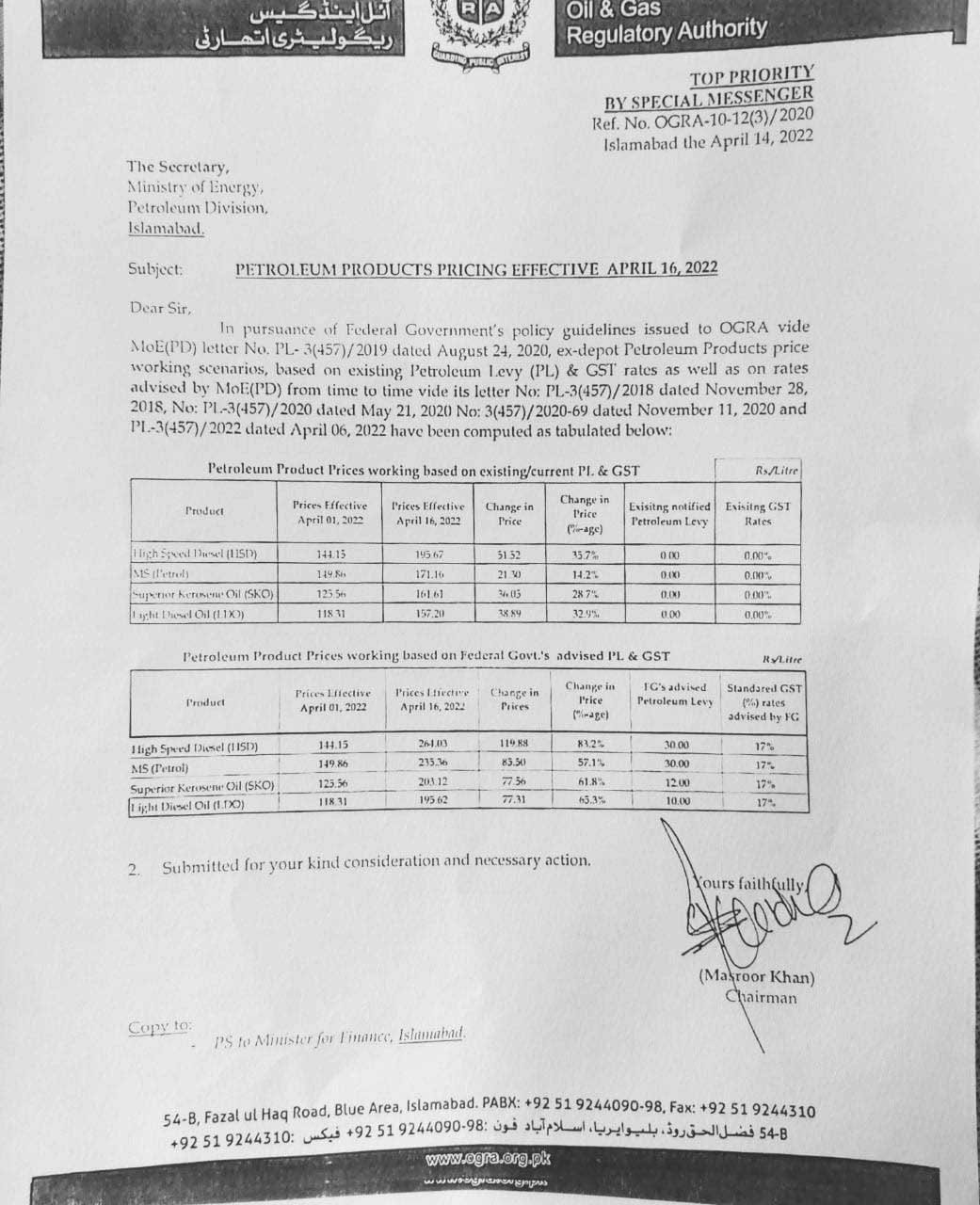
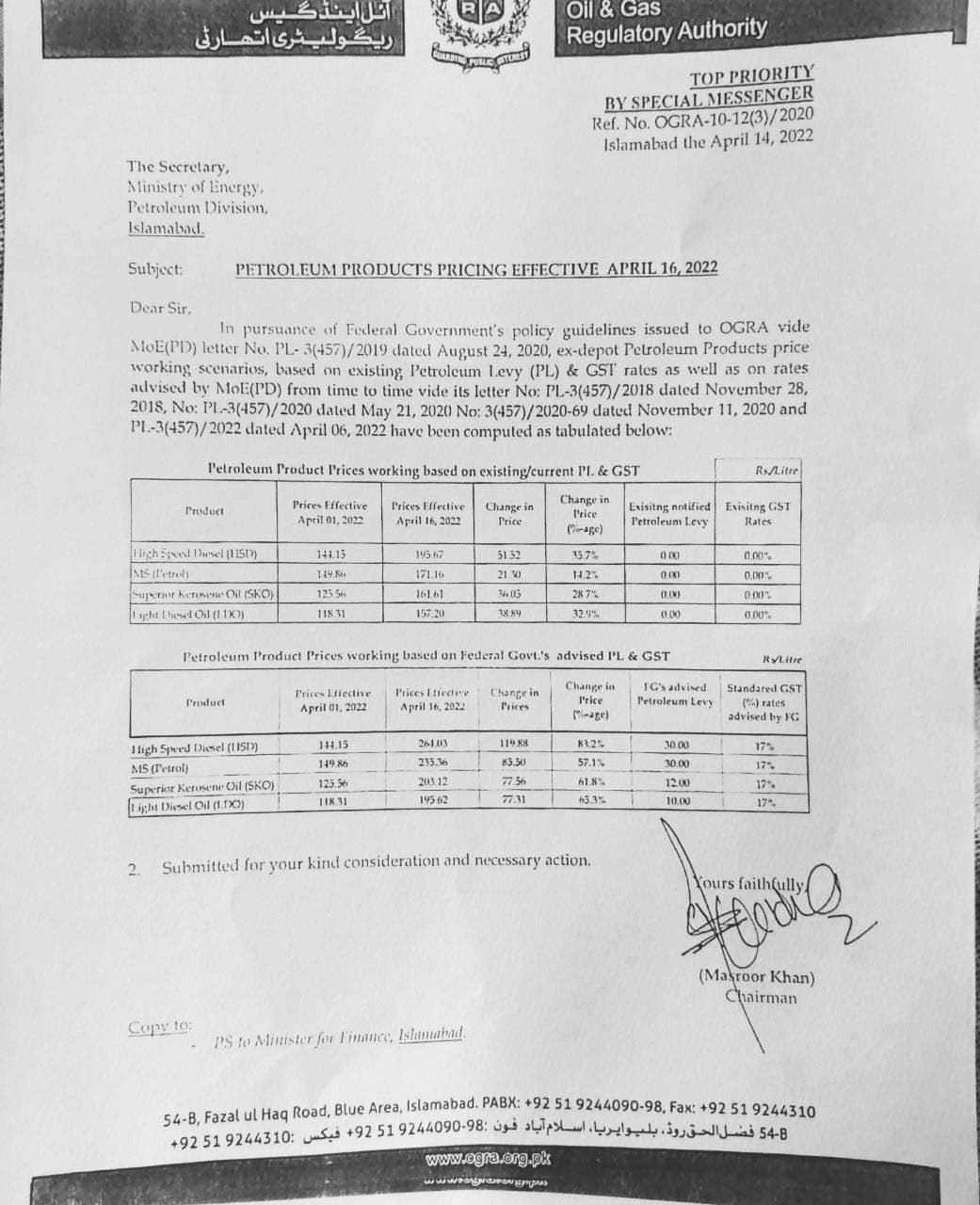
    Earlier, OGRA suggested to the Finance Division that the price of petrol be increased by Rs21.50 and that of diesel be hiked by Rs51.30 in view of the current petroleum levy and general sales tax (GST).

    Read more: Massive hike of Rs83.5 for petrol, Rs119 for diesel proposed by OGRA

    The authority also proposed a hike of Rs83.50 per liter of petrol and Rs119.88 per liter of diesel considering the federal government’s recommended petroleum levy of Rs30 and 17 per cent GST, as per the official statement.

  • Massive hike of Rs83.5 for petrol, Rs119 for diesel proposed by OGRA

    Massive hike of Rs83.5 for petrol, Rs119 for diesel proposed by OGRA

    The Oil and Gas Regulatory Authority (OGRA) suggested the federal government elevate fuel prices by up to Rs83.5 per liter for petrol and Rs119 for diesel.

    A summary to the petroleum division was presented by OGRA for the huge increase in petroleum rates to come into effect on April 16 in Pakistan.

    The proposed raise was calculated using a 70 per cent GST rate plus a Rs30 per liter levy. It is worth noting that the current duty on fuel and diesel is Rs30 per liter, plus 17 per cent GST.

    On the basis of complete levy and taxes, the body has recommended raising petrol prices by Rs83.5 per liter, while diesel prices should be raised by Rs119 per liter.

    According to reports, the OGRA proposed raising the petrol price to Rs21.53 per liter in line with the current tax rate, Rs51.3 for diesel, and Rs77.56 for kerosine oil on the grounds of full tax and levy.

    Read more: Gold prices go up by Rs350 per tola to Rs130,300

    Concerning other oil products, a full tax rate and levy hike of Rs77.31 was suggested for light diesel, Rs36.5 for kerosine oil, and Rs38.89 for light diesel. According to sources, the finance ministry would make the final decision on the OGRA summary after briefing Prime Minister Shehbaz Sharif.

  • Oil prices jump following Russia’s biggest production decline

    Oil prices jump following Russia’s biggest production decline

    Oil prices rose on April 13, after concerns that declining output in sanctions-hit Russia may affect supply, following the Russian announcement that peace negotiations to stop its invasion of Ukraine had reached a stalemate.

    Consequently, Brent crude futures were up 59 cents, or 0.6 per cent, to $105.23 a barrel, while West Texas Intermediate (WTI) crude futures were up 60 cents, or 0.6 per cent, to $101.20 a barrel. The previous session saw both contracts rise by more than 6%.

    On Tuesday, Russian President Vladimir Putin criticised Ukraine for the termination of peace talks and stated that Russia will not abandon its “special operation” to disarm its western neighbor.

    He stated that peace talks with Ukraine are at a stalemate, but that the seven-week operation is going as planned. In a note, ANZ oil experts stated that this raises the threat of the prolonged potential of supply disruptions in the oil sector.

    According to those familiar with the figures, Russian oil and gas extract output declined below 10 million BPD on April 11, the biggest drop since July 2020, as a result of sanctions imposed by numerous nations after Russia invaded Ukraine and logistical difficulties, which hindered business.

    This is quite serious as Russia is the world’s second-largest oil exporter.

    According to reports, Russia’s Energy Minister Nikolai Shulginov said late Tuesday that the government was willing to sell oil and oil products to “friendly countries in whatever price range,” adding that Moscow was focused on guaranteeing the oil sector’s proper functioning.

    Read more: International oil prices declined by 4%, crashing below $100 per barrel

    Meanwhile, indications of a partial relaxation of some of China’s strict COVID-19 restrictions have fueled optimistic sentiment between some market players this week.

  • International oil prices declined by 4%, crashing below $100 per barrel

    International oil prices declined by 4%, crashing below $100 per barrel

    Brent crude slid below $100 for the first time since March 16 amid plans to release huge amounts of petroleum and oil products from strategic storage, and also China’s prolonged coronavirus closure.

    Crude oil was down $4.1, or 3.99 per cent, at $98.68 per barrel. The price of US West Texas Intermediate (WTI) crude fell $4.28 a barrel, or 4.28 per cent, to $94.07 per barrel.

    The International Energy Agency (IEA) recently announced that member countries will release 60 million barrels over the next six months, with the United States matching that amount as part of its 180-million-barrel release announced in March.

    The actions are meant to make up for a shortfall of Russian crude after Moscow was extensively sanctioned for what it claims was a “special military operation” in Ukraine.

    As per JP Morgan analysts, the release of Strategic Petroleum Reserve (SPR) volumes will amount to 1.3 million barrels per day (BPD) over the next six months, enough to cover a 1 million BPD shortfall in Russian oil supplies.

    The release of strategic government oil reserves is projected to relieve some market tightness in the coming months, reducing the likelihood of oil prices rising and re-enforcing near-term supply constraints.

    While this is the largest release since the IEA stockpile was established in 1980, market participants believe it will fail to affect the principles of the oil market and will just delay further increases in production from crucial suppliers.

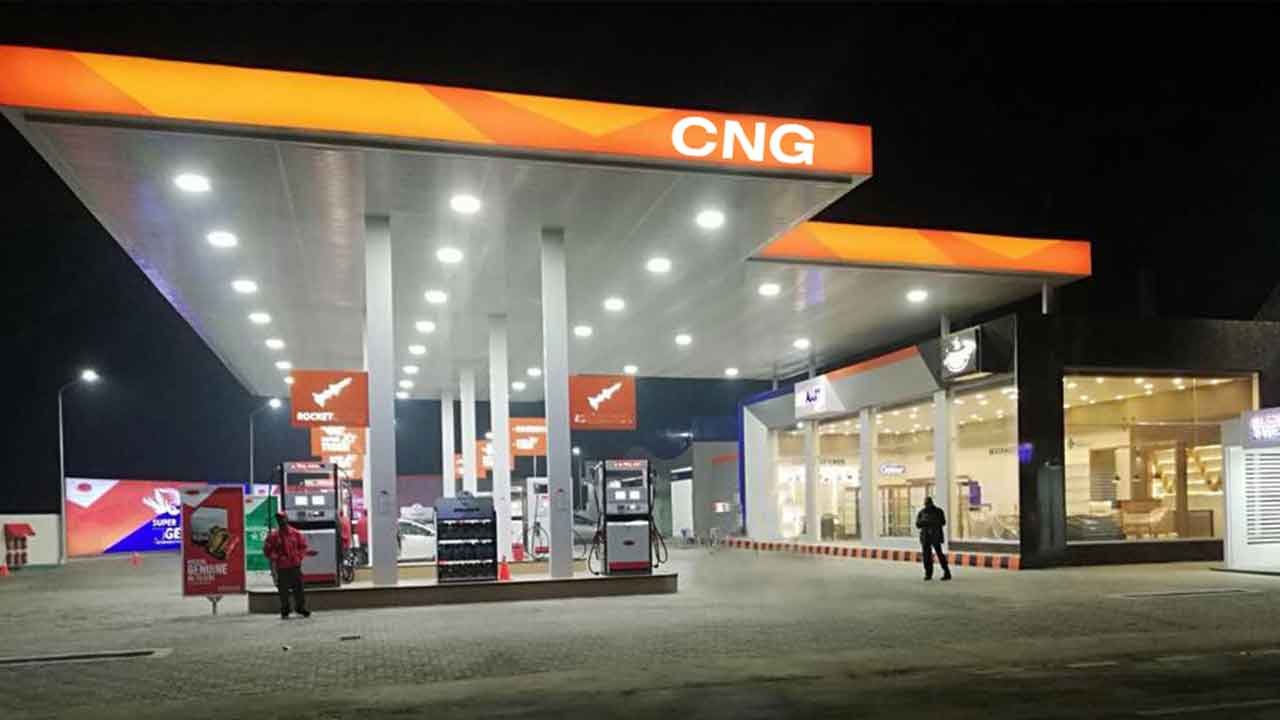
  • CNG stations in Sindh to open on April 11

    CNG stations in Sindh to open on April 11

    On April 6, the Sui Southern Gas Company Limited (SSGC) ordered the three-day closure of all compressed natural gas (CNG) stations in Sindh.

    According to a statement from the gas company, all CNG stations will remain closed for 72 hours, starting at 8 AM on Friday and ending at 8 AM on Monday.

    The CNG stations were closed in the province to address the gas shortage in the country and as a part of the gas load management plan.

    “Due to the short supply of gas in the SSGCL system, the availability of gas has diminished, resulting in line pack depletion and low pressure in the system,” according to the statement.

    “All CNG stations in Sindh (including those using RLNG) would stay closed in accordance with the current sectoral priority order for gas load management”.

    It is worth noting that CNG dealers had reopened their business on February 14 after a two-and-a-half-month hiatus. Following the gas load management plan, gas supplies to the CNG sector were suspended from December 1, 2021, to February 15, 2022.

    The unavailability of CNG multiplied the problems of the common man as the masses were forced to top their automobiles up with Petrol, which nearly touched Rs160 during that period.

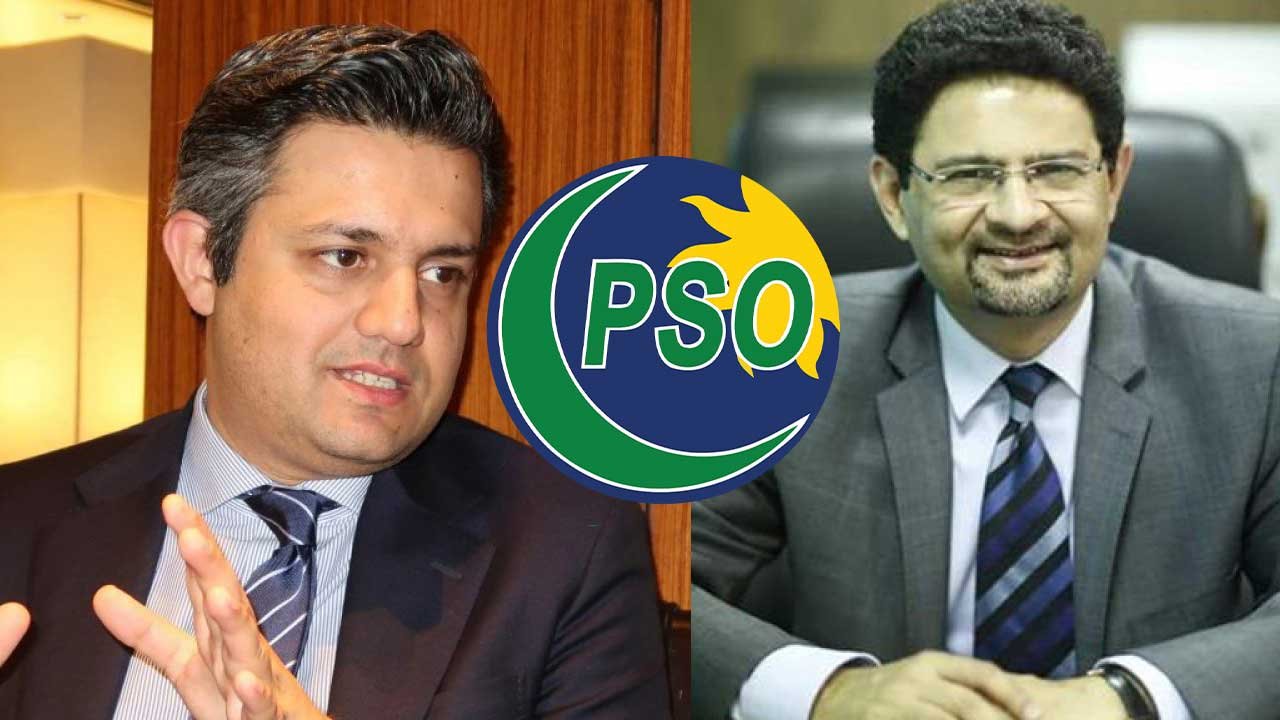
  • PML-N’s Miftah Ismail fact-checked by PTI’s Hammad Azhar on load-shedding, Miftah acknowledges

    PML-N’s Miftah Ismail fact-checked by PTI’s Hammad Azhar on load-shedding, Miftah acknowledges

    Miftah Ismail, General Secretary of the Pakistan Muslim League-Nawaz (PML-N) in Sindh, recently took to Twitter, saying that Pakistan State Oil (PSO) has restricted fuel supplies to Independent Power Projects (IPPs), potentially resulting in significant load shedding in the coming week.

    He directly accused Prime Minister (PM) Imran Khan of the impending power outage, writing that it is the result of his incompetence, corruption, falsehoods, and “lust for power: that has gotten the country into such a mess.

    After an hour, Former Energy Minister, Hammad Azhar responded to Ismail’s tweet, calling it “Fake news” and claiming that he had checked with PSO and there had been no such supply cuts notified for IPPs.

    “My statement regarding IK’s corruption (Farah), incompetence (Buzdar), lying (Sh Rasheed) & hunger for power (Suri) is valid,” Ismail responded with a strange tweet to cover up his incorrect finding about PSO.

    It is worth noting that PSO serves a diverse range of customers, including Pakistan’s industrial sector, several power projects, aviation, and maritime sectors. On a daily basis, the company meets the POL needs of millions of clients.

    Apart from selling oil to Pakistan’s power utilities, such as K-Electric and Wapda, PSO is the primary supplier of furnace oil to all IPPs in the country, with a local market share of more than 80 per cent.

  • Pakistan to import 32.7 million barrels of oil to cover petroleum needs

    Under a deferred payment agreement with the Saudi Fund for Development (SFD), Pakistan would acquire roughly 32.7 million barrels (MBL) of crude oil in 2022 to cover its petroleum product needs.

    The Pak-Arab Refinery Company Limited (PARCO) and National Refinery Limited (NRL) plan to import 16.89 and 15.81 million barrels of oil in the ongoing year, respectively.

    Crude oil worth $100 million per month may be imported under the terms of the arrangement, with payment deferred for a year. The price will be set in accordance with the existing long-term agreement between Saudi Aramco, PARCO, and NRL.

    The facility will be available for a 12-month period, which may be increased for one year. The withdrawn funds, plus the margin of 3.8 per cent, will be repaid in one annual installment in US dollars.

    Previously, In June 2021, the Saudi government agreed to pay $4.2 billion in providing economic aid to Pakistan, which was legally formalised in November. While the SFD programme has been in effect since March 7, 2022, and oil purchase has now already begun.

  • Petroleum sales increase by 23% in March, despite hefty oil prices

    Petroleum product sales rebounded in the last month after a dismal February with Oil marketing companies (OMC) witnessing an increase of 23 per cent in sales of petroleum products on a year-over-year (YoY) basis in March 2022.

    Overall petroleum sales in March 2022, increased to 1.82 million tonnes compared to 1.54 million tonnes in March 2021, as per the data released by Arif Habib Limited.

    The stability comeback shows a 19 per cent increase in overall OMC sales on a month-over-month (MoM) basis.

    OMC volume growth was driven by furnace oil, which climbed by 34 per cent on a YoY basis, followed by HSD volume growth of 29 per cent and MS volume growth of 13 per cent. MoM growth in OMC volumes followed a similar pattern, with FO taking the lead.

    Although the increase in furnace oil volumes was driven by increased furnace oil usage in the power sector due to low gas and Re-Gasified Liquefied Natural Gas (RLNG) availability.

    The increase in HSD volumes was driven by increased demand from the transportation and agriculture sectors and increased usage in generators and the power sector.

    Moreover, the government’s price caps and the additional number of days in March compared to February were the main contributors to MoM growth in diesel and gasoline sales.

    Consequently, petroleum sales increased by 19 per cent on a YOY basis in 9MFY22, with double-digit increases for petroleum products.

    Diesel sales grew by 17 per cent, followed by 16 per cent increase for furnace oil and a 10 per cent growth for motor oil.

    While some are expecting a drop in petroleum sales due to the political turmoil and rising commodity prices, others say that higher oil consumption cannot be overturned as the summer is already here and people are likely to consume more electricity, also that the power sector may switch to furnace oil due to RLNG commitment defaults.