Tag: petrol

  • Petrol price may go down by Rs9.63 per litre for the next fortnight

    The price of petrol is expected to decrease by Rs9.63 per litre for the next two weeks, while diesel prices are anticipated to increase.

    According to reports, the Oil and Gas Regulatory Authority (OGRA) has advised lowering gasoline prices for the final fifteen days of the current month, September.

    However, a final decision about increased petroleum pricing would only be made after receiving Prime Minister Shehbaz Sharif’s approval.

    For the specified period, the cost of diesel is probably going to go up by Rs3.04 per litre, bringing the price from Rs247.26 per litre to Rs250.30.

    The federal government announced an increase in the price of gasoline and diesel for the first two weeks of September on August 31.

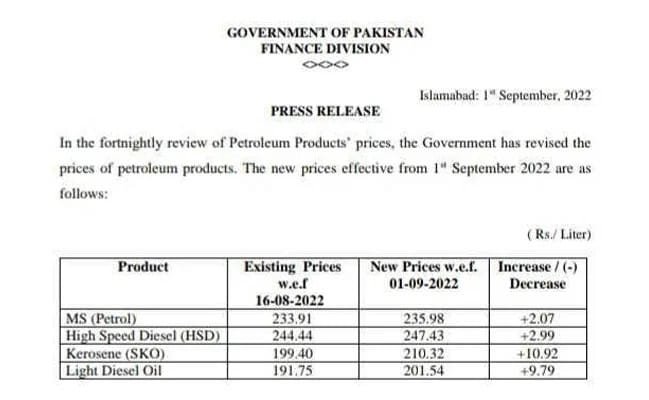
    The price of gasoline increased by Rs2.07 to reach Rs235.98 per litre, while the price of high-speed diesel increased by Rs2.99 to reach Rs247.43.

    According to Express Tribune, various strategies have reportedly been used by the government and OGRA to maintain low petroleum prices in order to avert political reaction.

  • Govt raises petrol price by Rs2.07 to Rs235.98 per litre

    Govt raises petrol price by Rs2.07 to Rs235.98 per litre

    The price of petrol was raised by the government on Wednesday by Rs2.07 per litre, making it Rs235.98 for the upcoming two weeks.

    Additionally, it announced a hike in the costs of kerosene oil by Rs9.79 per litre to Rs201.54, high-speed diesel by Rs2.99 per litre to Rs247.43, and light diesel oil by Rs10.92 per litre to Rs210.32.

    Contrary to what the market anticipated, the decision to raise gasoline prices, even more, was finally made. In the first half of September 2022, the market anticipated a price drop of up to Rs 20 per litre for the two main petroleum products—petrol and high-speed diesel.

    Expectations were sparked by a decline in the average exchange rate for the purchase of Pakistan State Oil (PSO), which fell from Rs227 in the first half of August to Rs217 in the next15 days.

    Similar to this, the premium paid on gasoline and HSD in the first half of August had decreased from $17 and $8.5 per barrel, respectively.

  • Fuel Cost Adjustment: Consumers protest against inflated electricity bills

    Fuel Cost Adjustment: Consumers protest against inflated electricity bills

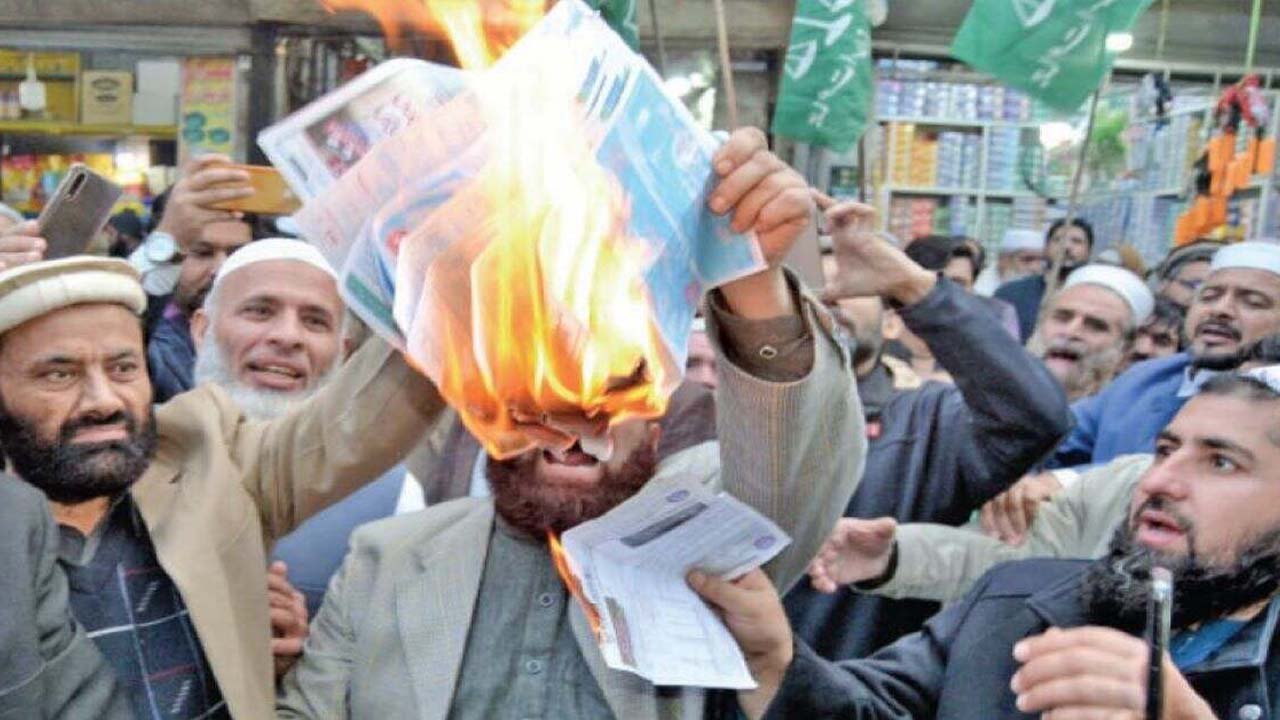
    Power consumers protested in major cities against the government and power supply companies due to excessive residential and commercial bills that were issued under the pretext of Fuel Cost Adjustment (FCA).

    A number of Lahore residents were seen protesting outside LESCO offices, complaining about the skyrocketing electricity bills, chanting anti-LESCO slogans at Dharam Pura, Begum Kot and Ghazi Road.

    A number of farmers in Jhang also participated in a protest by burning their power bills while obstructing traffic on the Jhang Road. On the other hand, the shopkeepers and locals of Faisalabad organised a sizable protest against FESCO for billing residential and commercial customers for nearly twice the actual cost of electricity.

    PM Shehbaz demands urgent report on inflated electricity bills

    In response to complaints from the public about excessive electricity bills, Prime Minister Shehbaz Sharif ordered the relevant authorities to provide an immediate report to address the issue.

    The premier ordered the concerned officials to present a thorough report with recommendations for resolving consumer complaints against energy bills on an urgent basis.

    What is FCA?

    In addition to criticising the power supply companies, consumers are questioning the FCA charges that take up a significant portion of their monthly bills.

    Understanding the actual fuel cost (the cost of fuel in a month) and the reference fuel cost is crucial for comprehending the fuel price adjustment.

    Simply put, FCA is charged/adjusted in customers’ monthly bills to reflect the actual increase or decrease in fuel prices.

    Based on the price of fuel (such as coal, LNG, or furnace oil) used in the nation’s various energy sources, the total cost of fuel used in the production of electricity in a month (basket fuel cost) is calculated.

    The entire fuel cost for that month is therefore compared to the reference fuel cost at the end of each month, and as a result, the FCA is applied to the power bills after two months.

    The electricity bill will reflect a change in the FCA amount if the total fuel cost for that month exceeds the reference cost, while it will reflect a change in the FCA amount if the total fuel cost is less than the reference cost. We refer to this as a fuel price adjustment.

    How power suppliers calculate FCA?

    Whenever a power plant uses coal, it is possible to estimate how much coal was burnt and at what cost, as well as the total cost of the energy needed to generate the power.

    For instance, if hydel electricity generation has increased, the overall fuel price will reduce; likewise, if gas is consumed more frequently in a month due to its higher price, the fuel price would climb.

    It is also impacted by the rupee’s appreciation or depreciation. This is due to the fact that coal, LNG, and furnace oil are imported, therefore a weakening or strengthening rupee directly affects the cost as a whole.
  • Govt raises petrol price by Rs6.72 to Rs233.91 per litre

    Govt raises petrol price by Rs6.72 to Rs233.91 per litre

    Despite several reports of an expected decrease in prices of petroleum products, the government increased the price of petrol by Rs6.72 per litre and decreased the price of high-speed diesel (HSD) by Rs0.51 and kerosene oil by Rs1.67 per litre.

    The price of light diesel oil (LDO) was raised by Rs0.43 per litre by the government.

    Prior to this, the coalition administration had decreased the cost of petrol and LDO starting on August 1 by Rs3.05 and Rs0.12, respectively.

    However, starting on August 1, 2022, the government had increased the price of HSD by Rs8.95 per litre and kerosene oil by Rs4.62 per litre.

    With the most recent announcement, the price of petrol has gone up from Rs227.19 per litre to Rs233.91 per litre, and that of LDO has gone up to Rs191.75 from Rs191.32 per litre; and that of HSD has gone up to Rs244.95 from Rs244.44.

    Kerosene oil is now available for Rs199.40 per litre as opposed to its earlier price of Rs201.07 per litre.

    The rapid depreciation of the rupee against the dollar had previously also been a significant determinant of oil prices.

    The standing of the rupee against the dollar had improved recently. In spite of this, the cost of gasoline had increased.

    Additionally, there had not been a significant decrease in the cost of diesel, which is widely used in the nation’s transportation and agricultural sectors.

  • Govt slashes petrol price by Rs3.05,  raises diesel by Rs8.95 per litre

    Govt slashes petrol price by Rs3.05, raises diesel by Rs8.95 per litre

    Due to changes in oil prices on the global market, the government announced a revision in petroleum prices on Sunday.

    According to a statement released by the Finance Division, the cost of petrol has been reduced by Rs3.05 a litre for the first half of August 2022.

    Petrol will now be sold for Rs227.19 per litre as a result of the pricing revisions. Previously, the price of petrolin the country per litre was Rs230.34.

    The price of high-speed diesel has been upped by Rs8.95, the new price per litre is now Rs244.95.

    The depreciation of the rupee against US dollar has raised the cost of purchasing petroleum products, the Ministry of Energy notified the Economic Coordination Committee (ECC) of the cabinet today.

  • Govt may cut petrol price by Rs11 per litre today

    Govt may cut petrol price by Rs11 per litre today

    The price of petrol may be reduced by Rs11 per litre by the government, according to sources privy to the matter.

    According to Dawn, the cost of petrol is anticipated to drop by Rs11 per litre, while the cost of high-speed diesel is anticipated to rise by Rs8 per litre. Petrol is currently available for Rs230 per litre.

    The tax on petrol is expected to surge by Rs5 per litre and the tax on diesel, kerosene, and light diesel by Rs10 per litre, as per reports.

    However, the Ministry of Finance will reveal a price revision today, and the new rates will take effect on August 1.

  • Petroleum prices may increase by Rs28.44 on Monday

    Petroleum prices may increase by Rs28.44 on Monday

    The Oil and Gas Regulatory Authority (OGRA) has calculated a price increase for petroleum products of up to Rs28.44 per litre that could go into effect on August 1.

    According to regulatory agency sources, the estimated ex-depot price of gasoline may increase by Rs6.53, high-speed diesel (HSD) by Rs28.44, kerosene oil (SKO) by Rs11.02, and light diesel oil (LDO) by Rs5.64 per litre based on the current rate of petroleum levy (PL).

    On Saturday (today), the Finance Division will move a summary calling for an increase in gasoline prices of up to approximately 11 per cent beginning August 1. The prime minister will, as usual, make the final choice in this matter.

    The cost of gasoline and HSD will also increase if the government decides to include the Rs7 per litre petroleum dealer’s per centage in the pricing structure. The Economic Coordination Committee (ECC) had earlier that day approved the petroleum dealers’ increased margin.

    The Petroleum Division had given the dealers assurances that the government would implement the margin as of August 1, 2022.

    According to these projected prices, the price of gasoline would increase from Rs230.24 to Rs236.77 per litre, the price of HSD from Rs236.00 to Rs264.44 per litre, the price of SKO from Rs196.45 to Rs207.47 per litre, and the price of LDO from Rs191.68 to Rs197.32 per litre.

    Presently, the PL on gasoline is Rs10 per litre, the PL on HSD, SKO, and LDO are each Rs5, and there is no sales tax.

    In order to reach the budgetary goal of Rs750 billion set in the Finance Bill 2022–23, the National Assembly has approved a rise in the maximum limit of PL from Rs30 per litre to Rs50 per litre.

    Read more: Petrol, diesel prices may increase by Rs10-17 per litre

    However, sources in the Petroleum Division believed that, at the current rate, the government was unlikely to collect Rs750 billion from PL in the current fiscal year, as that would only amount to a maximum of Rs14 billion per month.

    In addition, if the 17.5 per cent general sales tax (GST) is not imposed on these goods, a revenue shortfall of Rs45 billion per month is likely.

  • ADB projects Pakistan’s economy to ‘recover slightly’ in FY23

    ADB projects Pakistan’s economy to ‘recover slightly’ in FY23

    In FY2023, Pakistan’s Gross Domestic Product (GDP) growth is expected to modestly improve due to structural changes, according to the Asian Development Bank (ADB).

    According to the bank’s most recent Asian Development Outlook Supplement, Pakistan’s GDP growth is predicted to decrease in FY22 (which ends on June 30, 2022), as a result of fiscal tightening measures taken to control rising demand pressures and contain external and fiscal imbalances.

    As the country’s inflation surged from 12.3 per cent in December 2021 to 21.3 per cent in June 2022, the bank slightly lowered Pakistan’s inflation for FY22 and dramatically for FY23.

    “In addition to the effects of elevated global energy and food prices, the government’s efforts to revive the stalled International Monetary Fund (IMF) programme has meant raising power tariffs and withdrawing subsidies in the oil and power sectors,” said ADB.

    In comparison to Sri Lanka, which boosted its policy rate by 950 basis points over the previous six months, the State Bank of Pakistan (SBP) has upped interest rates by 525 basis points since January 1. This also makes it one of the most active central banks in the region.

    The ADB also reduced its 2022 growth prediction for Asia and issued a warning that things could become worse as a result of the conflict in Ukraine and supply chain disruptions that are expected to drive up costs.

    Read more: Pakistani rupee plunges to Rs227 against US dollar at midday trading

    Although Covid-19’s effects had subsided, the region was now dealing with the consequences of Russia’s invasion of Ukraine, lockdowns in China, and aggressively raised interest rates, according to the Manila-based lender.

    The bank reduced its 2022 growth prediction to 4.6 per cent to reflect the decline in developing Asia, which runs from Kazakhstan in Central Asia to the Cook Islands in the Pacific.

    South Asia’s economy is anticipated to grow less than the projected rate of growth in the Asian Development Outlook 2022.

  • Petrol price reduced by Rs18.50 per liter, Diesel by Rs40.54 per liter

    Petrol price reduced by Rs18.50 per liter, Diesel by Rs40.54 per liter

    In an attempt to provide relief to the masses and share the advantages of falling crude prices on the global market, the price of petrol has been slashed by Rs18.50 per liter.

    The price reductions for petroleum products were announced by the Prime Minister, Shehbaz Sharif, in an address to the nation.

    Diesel will now cost Rs236 per liter, while gasoline will now be sold at Rs230.24 per liter. The new prices for petroleum products, according to the Prime Minister, will take effect from midnight.

    He went on to explain why, after taking office, his government had to raise the price of gasoline. He continued, “We had raised fuel prices to meet the demands made by the International Monetary Fund (IMF), which were approved by the previous administration.

    “The government has decided to pass on the relief to the people and has therefore reduced the price of petrol and diesel by Rs18.50 and Rs40.54 per liter, respectively,” he continued.

  • Govt may reduce petrol prices before midnight: Miftah Ismail

    Govt may reduce petrol prices before midnight: Miftah Ismail

    The government will lower petroleum prices before midnight, according to Finance Minister Miftah Ismail, who also announced that Prime Minister (PM) Shehbaz Sharif has received a report from the Oil and Gas Regulatory Authority (Ogra) recommending the drop.

    Speaking to the media, he emphasised that the International Monetary Fund (IMF) had no issues with the government’s decision.

    The announcement came the same day the IMF announced that it had reached a staff-level agreement with Pakistan for the conclusion of the combined seventh and eighth reviews of the Extended Fund Facility; the agreement is now awaiting the Executive Board’s approval.

    Additionally, he declared that the government will lower oil prices now rather than wait until July 15th (14 July). “PM Shehbaz wants to announce immediate relief to the people of Pakistan,” he said. “The public stood with the government during difficult times and bore the burden of inflation and now we want to provide relief.”

    In its conclusion, Ogra suggested lowering the cost of gasoline by Rs18 per liter and diesel by more than Rs20 per liter.

    The decision to lower petroleum product prices was made in response to recent sharp declines in the price of crude oil on the world market.

    The government approved a price increase for petroleum products on June 30. The increase brought the new ex-depot price of gasoline to Rs248.74 per liter (up Rs14.85), and diesel to Rs276.54 (after a hike of Rs13.23).

    On July 1, the new rates became effective. In the pricing structure, a petroleum levy of Rs10 had been added to the cost of gasoline, and Rs5 had been added to the cost of kerosene, high-speed diesel, and light diesel oil per liter.