Tag: Pfizer

  • Karachi Eat 2022 will be held this weekend despite 20 percent positivity rate in city

    Karachi Eat 2022 will be held this weekend despite 20 percent positivity rate in city

    The annual food festival, Karachi Eat 2022 will be held at the Beach View Park in Clifton from Friday till Sunday this month. The organisers are hopeful that the festival will be held according to schedule. They are not intending to cancel the event despite the covid positivity rate increasing to 20 percent in Karachi.

    East River, which is responsible for public relations and digital media of the festival, has taken strict precautionary measures to ensure SOPs compliance for the crowd. They have also uploaded the mandatory instructions on their official Instagram for people who want to attend the food festival.

    According to the Head of Special Projects Amna Saleem, people will receive booster shots of Pfizer at the festival in partnership with HANDS, a Non-Governmental organisation (NGO). It is also mandatory to wear masks and carry your vaccination certificate.

    The company has arranged an online ticketing system and partnered with TicketWala this time to avoid overcrowding at the ticket booth.

    Meanwhile, the Covid positivity rate has increased to 20 percent in Karachi which is an alarming situation. Until now, 1,223 cases of coronavirus of omicron variant are confirmed in the city.

    According to the Sindh health ministry, “The ratio of Omicron variant being reported in Karachi has reached 95 percent.”

  • How and where to get your free booster shot in Pakistan

    How and where to get your free booster shot in Pakistan

    The fifth wave of Covid-19 has recently emerged all over Pakistan. Authorities have urged citizens to get vaccination completely and follow strict SOPs. Those who completed two doses of the vaccine can get booster shots from designated centres.

    Eligibility of booster shot

    According to the National Command and Operation Centre (NCOC), health personnel, citizens who are above aged 30, and those children who are above age 12 and have weak immune systems can receive booster shots.

    It is important to note for those people who want to get a booster shot, the gap between the second dose of vaccine and booster shot should be more than six months.

    Which vaccine you can choose?

    People can choose booster shots of their choice from four available vaccines which are Sinopharm, Sinovac, Moderna, and Pfizer.  

     Director-General of Ministry of National Health Service, Dr Rana Safdar said, “mix and match has been allowed or booster of the same company, which was administered earlier, can be given as per the choice of the people.”

    Here, the term “mix and match” means those people who had been vaccinated with another vaccine, can get booster shots from the different manufacturing companies.

    Where people can receive booster shots?

    Sindh:

    The media coordinator of the Provincial Health Department, Mehar Khursheed told that people can get booster shots from any vaccination centre in the province. People need to take their vaccination cards and the National Identity cards to get shot in the vaccination centre.

    Punjab:

    According to the spokesperson for the Primary and Secondary Healthcare Department, doses for booster shots are available in all approved district headquarters hospitals (DHQs) and tehsil headquarters hospitals (THQs).

    Balochistan

    The administration of booster shots had started already from December 30 according to the Provincial Coronavirus cell in charge Dr Naqeebullah. The facility of booster shots is available at 96 vaccination centres in the province. He notified that the people who got the dose for booster were all above aged 30 with six month time period gap from the second dose of vaccination.

    Khyber Pakhtunkhwa

    Director-General Health Department Niaz Mohammad said that all approved vaccines are available to vaccination across the province for booster shots. People need to take their vaccination cards to get a dose of the booster.

    Islamabad

    According to the spokesperson of the Ministry of Health, Sajid Shah, all Chinese manufacturing vaccines, Sinopharm and Sinovac are available in all vaccination centres for booster shots however for other vaccines Moderna and Pfizer are available in mass vaccination centres.

    Azad Jammu and Kashmir

    Divisional Monitoring Officer for Covid-19 Vaccination, Shafaq Malik said that people can get booster shots from any of the approved vaccines available at currently 142 centres in the region.

  • NCOC lowers age limit for Covid-19 booster shot to 30

    NCOC lowers age limit for Covid-19 booster shot to 30

    The National Command and Control Centre (NCOC) announced its decision to lower the age limit for the administration of Covid-19 booster shot for people who got both their shots six months back. Pakistanis aged 30 or above can now get a booster shot of their own choice across Pakistan from January 1, 2022.

    Only Sinopharm, Sinovac, and Pfizer will be given as booster shots. The booster shot will be administered free of cost.

    Health workers, immunocompromised people and anyone above or of the age of 30 years is eligible for a booster shot.

    Earlier this month, NCOC had approved a booster shot of Covid-19 vaccines for healthcare workers, those aged over 50 years, and immunocompromised people.

  • NCOC approves Chinese vaccine for children aged 12 and older

    The National Command and Operation Centre (NCOC) announced on Thursday that its committee of health experts has approved two Chinese vaccines to be administered to children aged 12 years and older from November 15.

    The Chinese vaccines approved by the committee are Sinopharm and Sinovac.

    “Chinese vaccines Sinopharm and Sinovac have been approved by NCOC Health Expert Committee for administration to children above 12 years of age from 15 November onwards,” NCOC tweeted.

    “Now, these vaccines will also be available in addition to already approved Pfizer for children above 12 yrs,” tweeted NCOC.

    Earlier, Planning and Development Minister Asad Umar, who also heads NCOC, said more than 50 per cent of students between the ages of 12 and 18 have received at least one dose of coronavirus vaccine across the country.

  • Pfizer says Covid-19 vaccine more than 90 percent effective in kids

    Pfizer says Covid-19 vaccine more than 90 percent effective in kids

    Kid-size doses of Pfizer’s coronavirus vaccine appear safe and almost 91 per cent effective at preventing symptomatic infections in 5 to 11-year-olds according to study details released Friday, as the US considers opening vaccinations to that age group.

    The shots could begin in early November — with the first children in line fully protected by Christmas — if regulators give the go-ahead.

    Details of Pfizer’s study were posted online. The Food and Drug Administration (FDA) was expected to post its independent review of the company’s safety and effectiveness data later in the day.

    Advisers to the FDA will publicly debate the evidence next week. If the agency ultimately authorises the shots, the Centers for Disease Control and Prevention will make the final decision on who should receive them.

    Full-strength Pfizer shots are already authorised for anyone 12 or older, but pediatricians and many parents are waiting for something that can protect younger children from the extra-contagious delta variant and help keep kids in school.

    More than 25,000 pediatricians and primary care providers already have signed up to get the shots for the kids.

    A Pfizer study tracked 2,268 kids in that age group who got two shots three weeks apart of either a placebo or the low-dose vaccine. Each dose was one-third the amount given to teens and adults.

    Researchers calculated the low-dose vaccine was nearly 91 per cent effective, based on 16 virus cases in youngsters given dummy shots versus three cases among vaccinated children. There were no severe illnesses reported among any of the youngsters, but the vaccinated ones had much milder symptoms than their unvaccinated counterparts.

    Pfizer’s study of younger kids found the low-dose shots proved safe, with similar or fewer temporary side effects such as sore arms, fever or achiness that teens experience.

    The study isn’t large enough to detect any extremely rare side effects, such as the heart inflammation that occasionally occurs after the second dose, mostly in young men.

    While children run a lower risk of severe illness or death than older people, Covid-19 has killed more than 630 Americans 18 and under, according to the CDC. Nearly 6.2 million children have been infected with the coronavirus, more than 1.1 million in the last six weeks as the delta mutant surged, the American Academy of Pediatrics says.

    Moderna also is studying its vaccine shots in elementary school-age youngsters. Pfizer and Moderna are studying even younger children as well, down to 6-month-olds. Results are expected later in the year.

  • Pakistan lowers Covid vaccination eligibility age to 15

    Pakistan lowers Covid vaccination eligibility age to 15

    The government has officially decided to further lower the Covid vaccination eligibility age to 15 years, reported Geo News.

    Children between the ages of 15 and 18 will be vaccinated with the Pfizer vaccine, the National Command and Operations Centre (NCOC) said.

    According to the NCOC, Pfizer vaccine will be available at all central vaccination centres across the country. Moreover a registration certificate will be required for children up to the age of 18 to be vaccinated.

    In combating the pandemic, the NCOC has also taken another step by sending mobile vaccination teams to visit schools and colleges for vaccination.

    Meanwhile, NCOC has said that all those people whose second dose against Covid-19 has become due are not required to wait for the sms message and can visit any vaccination centre throughout the week.

    A day earlier, NCOC head Asad Umar had announced on Twitter that more than 20 million people in Pakistan are now fully vaccinated against coronavirus.

    Pakistan has administered at least 66,456,245 doses of Covid vaccines so far. Assuming every person needs two doses, that’s enough to have vaccinated about 15.3 per cent of the country’s population.

  • WHO warns against mixing, matching Covid-19 vaccines, calls it ‘dangerous trend’

    WHO warns against mixing, matching Covid-19 vaccines, calls it ‘dangerous trend’

     The World Health Organization’s chief scientist on Monday advised people not to mix and match Covid-19 vaccines from different manufacturers, calling it a “dangerous trend” since there was little data available about the health impact.

    “It’s a little bit of a dangerous trend here. We are in a data-free, evidence-free zone as far as mix and match,” Soumya Swaminathan told an online briefing.

    “It will be a chaotic situation in countries if citizens start deciding when and who will be taking a second, a third and a fourth dose.”

    Read More: Study shows AstraZeneca, Pfizer vaccines effective against Delta Covid-19 variants

    The advice came after a study conducted in the United Kingdom earlier found that adopting a mix-and-match approach to Covid-19 vaccines gives a more robust immune response. 

  • Study shows AstraZeneca, Pfizer vaccines effective against Delta Covid-19 variants

    Study shows AstraZeneca, Pfizer vaccines effective against Delta Covid-19 variants

    COVID-19 vaccines made by AstraZeneca and the Pfizer-BioNTech alliance remain broadly effective against Delta and Kappa variants of the COVID-19 which were first identified in India, according to a scientific study.

    According to the details, the study by Oxford University researchers, published in the journal Cell, examined the ability of antibodies in the blood from people, who were vaccinated with the two-shot regimens, to neutralize the highly contagious Delta and Kappa variants, a statement said.

    “There is no evidence of widespread escape suggesting that the current generation of vaccines will provide protection against the B.1.617 lineage,” the paper said, referring to the Delta and Kappa variants by a commonly used code.

    However, the concentration of neutralising antibodies in the blood was somewhat reduced, which may lead to some breakthrough infections, they warned.

    Last week, an analysis by the Public Health England (PHE) showed that vaccines made by Pfizer Inc (PFE.N) and AstraZeneca offer high protection of more than 90% against hospitalization from the Delta variant. 

    “We are encouraged to see the non-clinical results published from Oxford and these data, alongside the recent early real-world analysis from Public Health England, provide us with a positive indication that our vaccine can have significant impact against the Delta variant,” AstraZeneca executive Mene Pangalos said in a separate statement.

    The Delta variant is becoming the globally dominant version of the disease, the World Health Organization’s chief scientist said on Friday.

    The Oxford researchers also analysed reinfection patterns in people who had previously had COVID-19. The risk of reinfection with the Delta variant appeared particularly high in individuals previously infected by the Beta and Gamma lineages that emerged in South Africa and Brazil, respectively.

    By contrast, previous infection with the Alpha, or B117, variant first detected in Britain, conferred “reasonable” cross-protection against all variants of concern, lending itself as a template that next-generation vaccines could be molded on.

    “B117 might be a candidate for new variant vaccines to provide the broadest protection,” the researchers said.

  • Expats protest, demand Pfizer vaccines ‘only’

    Expats protest, demand Pfizer vaccines ‘only’

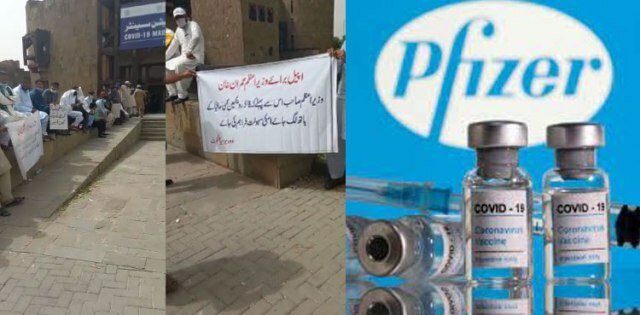
    Several overseas Pakistanis protested outside the Mass Vaccination Centre at F-9 Park in Islamabad, on Monday. The expats demanded that they should only be administered the vaccine manufactured by Pfizer, reports The Express Tribune.

    The staff present at the vaccination centre stated that they could only administer the vaccine provided by the government which was not what the expats were demanding.

    As a result of this, expats protested by holding placards and demanded that the prime minister should ensure the availability of Pfizer vaccine for them.

    They maintained that Overseas Pakistanis are a source of billions of dollars coming into the country yet they are being humiliated over a vaccine. They demanded a date be announced for them so that they could get vaccinated.

    Earlier, it had issued guidelines that only a limited amount of Pfizer vaccine was available in Pakistan, therefore, only Haj pilgrims and student and work visa holders for foreign countries would be immunised with it.

  • Who will get the Pfizer vaccine in Pakistan?

    Who will get the Pfizer vaccine in Pakistan?

    Federal Minister for Planning and Development Asad Umar said on Thursday that the government has decided to prioritise giving the Pfizer vaccine to those who have a work visa. The government aims is to inoculate Hajj pilgrims and students proceeding for education abroad first.

    The federal minister said that the government is working hard to accelerate the vaccination process across the country so that restrictions are lifted and businesses are resumed.

    Umar, replying to a question, said that Pakistan had received a limited quantity of Pfizer this month and therefore, preference for its administration had to be given to some segments.

    However, he added, Pakistan would receive more doses of Pfizer in the future.

    The minister further warned that countries not accepting vaccination certificates of Chinese vaccines would turn out to be a problem for the entire world if a decision was not taken on the issue at the global level.