Tag: polio

  • Four dead in attack on polio team in North Waziristan

    Four dead in attack on polio team in North Waziristan

    One polio worker and three others have been killed as a result of an attack on the polio team in North Waziristan.

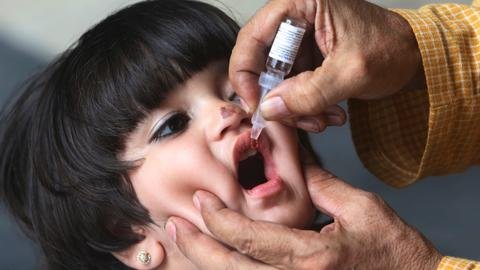
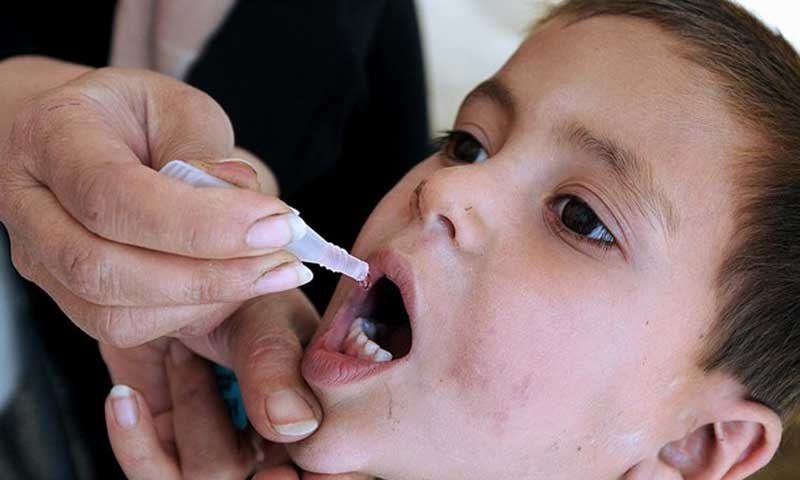
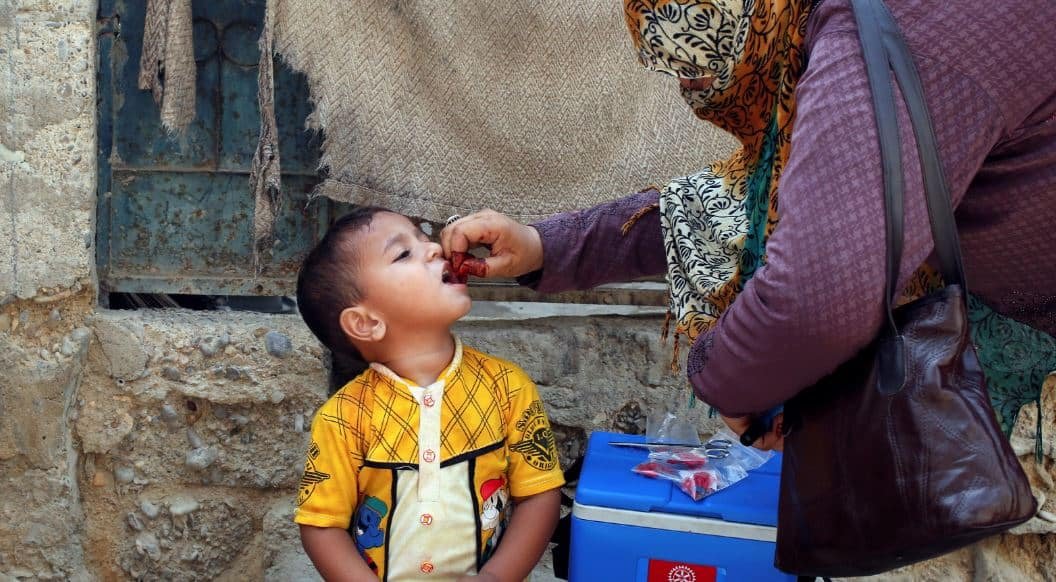
    According to North Waziristan DSP Traffic Sher Wali Khan, during a polio vaccination drive in the Dand Kali neighbourhood of Tehsil Datta Khel, unknown assailants opened fire on the polio team, killing two police officers, one polio worker, and a passerby. The incident happened as the polio worker was giving a young patient the oral polio vaccine (OPV).

    Pakistan has reported at least six cases of polio this year, As per the World Health Organisation (WHO), Pakistan and Afghanistan are the only two polio-endemic nations in the world.

    Prime Minister (PM) Shehbaz Sharif has expressed his grief over the incident and has ordered an inquiry.

  • Anti-polio infrastructure collapsing in Waziristan, 6th case registered

    Anti-polio infrastructure collapsing in Waziristan, 6th case registered

    On May 27, the Government of Pakistan issued a press release on the Pakistan Polio Erradication Programme’s website. In this report, it was confirmed that on May 26, two new cases of polio were confirmed by the Pakistan National Polio Laboratory at the National Institute of Health, Islamabad.

    This marks the 5th and 6th cases of polio, reported in Pakistan this year. The two news cases are associated with two 18 months old children born in Mir Ali Tehsil, a girl and a boy, who both started experiencing the onset of paralysis as early as May 10 and May 11, respectively.

    All six children who have contracted polio are from North Waziristan, where more cases are expected through the year due to a high rate of refusal to give the vaccine and the illegal but process of finger-marking without vaccinations. Considering that the only endemic countries at this point in the whole world are Pakistan and Afghanistan, it must be noted that there is great significance to exploring the causes of this reoccurrence of the disease in the context of polio campaigns and their efficacy in KPK and FATA.

    Polio scam

    The problems with Pakistan’s polio vaccination programme are complex and multifold. On May 28, The News reported that only recently around 8,000 children from 22 union councils, up to the age of five have been identified as never been vaccinated with the oral dose of the polio vaccine. Vaccinators, refusing parents and area incharges colluded to carry out the scam. This was immediately revealed after the two new cases in North Waziristan were registered. Reportedly, so far the National Emergency Operations Center (NEOC) has been relying on fake reports which claimed that 95% children were being vaccinated during each campaign. This leads to a gross underestimation of the number of children still unvaccinated.

    Abduction of Dr Zeeshan

    Journalists working on Waziristan also tweeted on May 26, reported the abduction of Dr Zeeshan, who was serving as a Polio N-STOP officer in Waziristan, who had been working effortlessly on the polio campaign there. He was kidnapped while still on duty. Dawn reported that Dr Zeeshan had come from Swat to specially oversee an anti-polio drive. After involving the law enforcement alongside jirga negotiations, Bannu commissioner Arshad Khan managed to recover Dr Zeeshan.

    The political atmosphere in Waziristan actively creates the strongest hurdle in Pakistan’s journey towards a polio-free nation. 260,000 workers are deployed across the nation to vaccinate children under the age of five. Considering the perceptual concerns of people of Waziristan, it seems unlikely that the situation would improve radically unless some really necessary steps are taken to tackle the perception regarding the vaccine. Access to children in security-compromised areas, attacks on health care workers coupled with governance and operational failures continues to elongate this problem for Pakistan.

    KPK govt failure

    In 2014, Imran Khan government launched the Sehat ka Insaf campaign in KPK where the aim was to target all 9 vaccine-preventable diseases, including polio. This program was restricted to the provincial government and sought to undo completely any international involvement. Although it may seem like this is a good strategy to gain people’s trust to vaccinate, this utter lack of oversight has heavily contributed to the fake markings. This is apparent from the fact that the kids who developed polio were marked in the national record as having been vaccinated six or even seven times.

  • More than 63 million children to be vaccinated in massive five day polio drive

    More than 63 million children to be vaccinated in massive five day polio drive

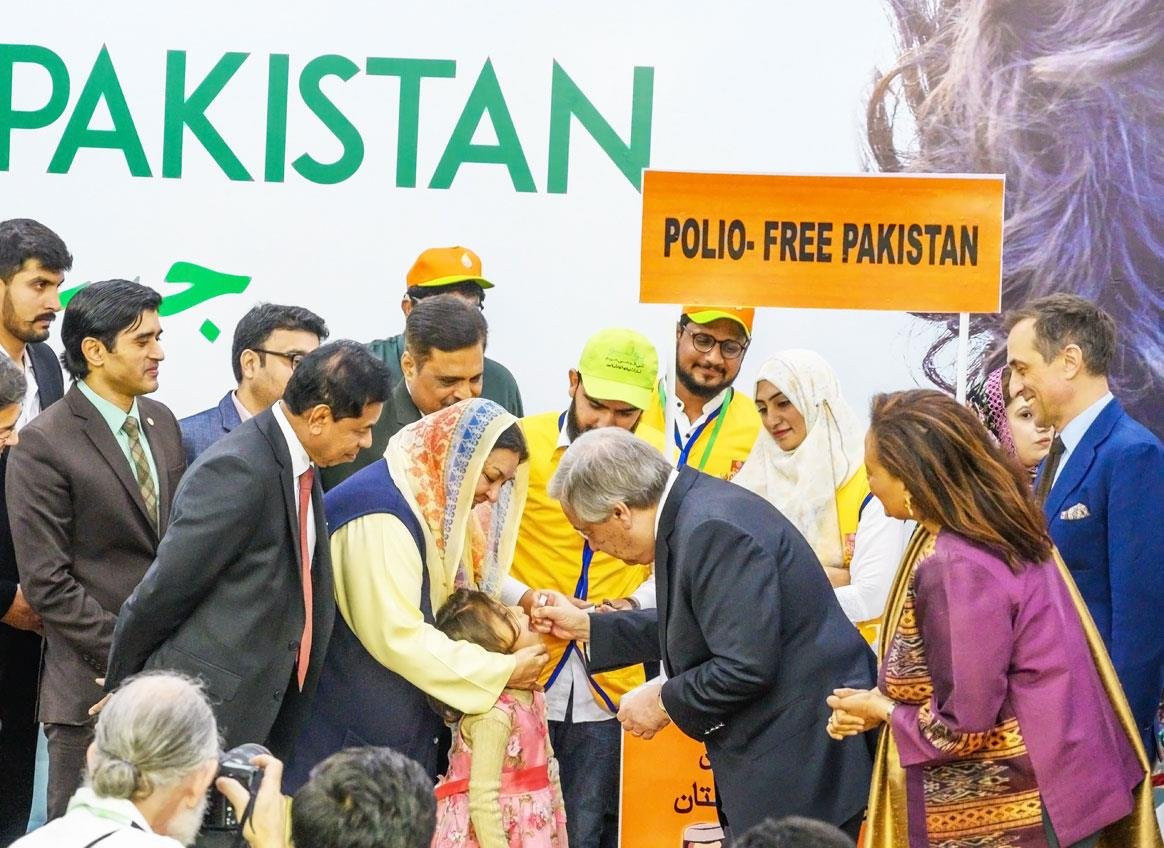
    A five-day anti-polio drive began in different parts of the country on Monday. More than, 63 million children will be will be vaccinated during the polio drive. The government has set a target of twenty-two million children in Punjab and more than one hundred and fifty thousand polio workers have been deployed for the purpose.

    In Sindh, anti-polio drops will be given to approximately ten million children under the age of five in thirty districts. The initiative will involve seventy thousand health professionals and ten thousand supervisors.

    During the drive, anti-polio drops would be given to nearly 2.5 million children under the age of five in Balochistan. Approximately 10,000 teams have been formed for this purpose.

    In the province of Khyber Pakhtunkhwa, anti-polio vaccination will be provided to around 6.2 million children under the age of five in twenty-nine districts.

    During the door-to-door campaign, over 30,000 teams will administer anti-polio drops to children. To esnure the administering anti-polio drops to maximum children polio teams will also be available at railway stations.

  • Pakistan to mark one year polio-free

    Pakistan to mark one year polio-free

    Pakistan will mark one year of being polio-free tomorrow. The last infection of the poliovirus in Pakistan was recorded on January 27, 2021, according to officials, and Friday marks the first time in Pakistan’s history that a year has passed with no new cases, reports AFP.

    Lahore became the first polio-free city in the country back in April 2021.

    A five-day anti-polio campaign kicked off on Monday all over Pakistan. About 150,000 health workers are taking part in the five-day anti-polio drive to inoculate 22.4 million children under five years of age, according to a statement issued by Shahzad Beg, the coordinator for polio programme. 

    Hamid Khan, a police constable who was escorting polio vaccinators, was martyred in a terrorist attack in Kohat on Tuesday.

    Pakistan and Afghanistan are the only two countries where polio has not yet been eradicated. To formally eradicate the disease, a nation must be polio-free for three consecutive years. Nigeria was declared free from wild polio in August 2020.

  • ‘A physically challenged girl doesn’t need anyone,’ three Pakistanis on solo trip to Egypt

    ‘A physically challenged girl doesn’t need anyone,’ three Pakistanis on solo trip to Egypt

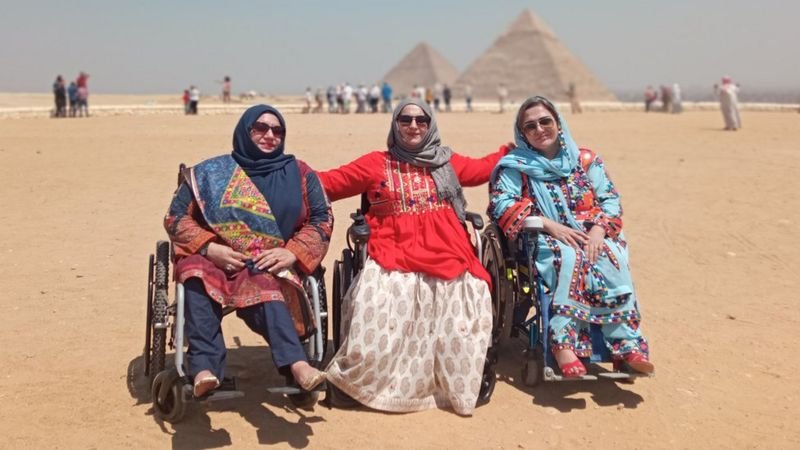
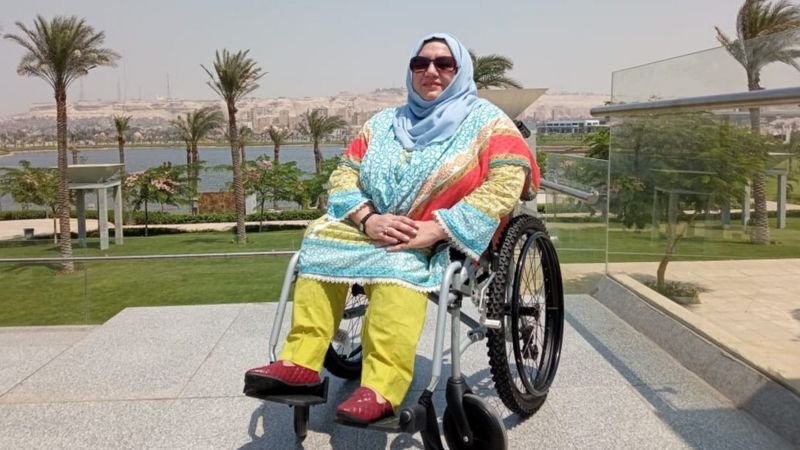
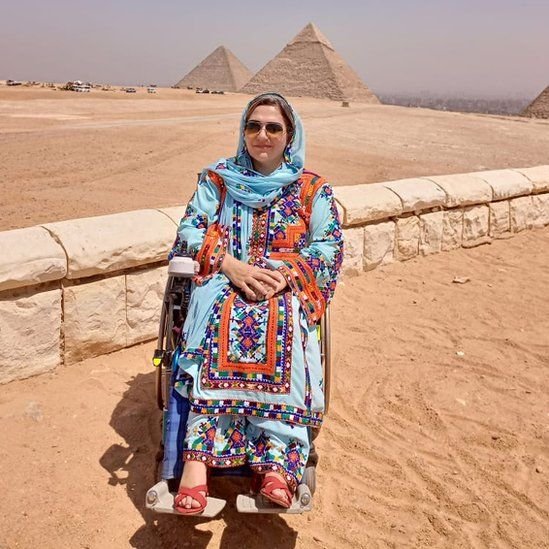
    Pictures of three physically challenged Pakistani friends on a tour to Egypt are doing the rounds on social media. The three women are Tanzeela, Afshan and Zarghona. Tanzeela is from Lahore, Afshan hails from Peshawar and Zarghona lives in Quetta.

    Talking to BBC Urdu, Tanzeela said that she is physically challenged since her childhood. She says, “I have no legs below the knees and I have been in a wheelchair all my life,” but so far she has travelled 20 countries in a wheelchair.

    “I wanted to prove that a disabled girl doesn’t need anyone, she can be independent, she can make her own decisions,” she said talking about travelling alone.

     Tanzeela said, “Allah has created us all independent, but in our country, a differently-abled person is made dependant on others and he cannot go anywhere without the help of anyone, from restaurants to public washrooms.” She added that there are no facilities for physically challenged persons to go anywhere alone. They have to ask for someone’s help to go to the restaurants or public washrooms. There is no privacy and if there is no privacy, then your self-confidence is completely destroyed.

    “I thought I would take a step forward and set an example for other people.”

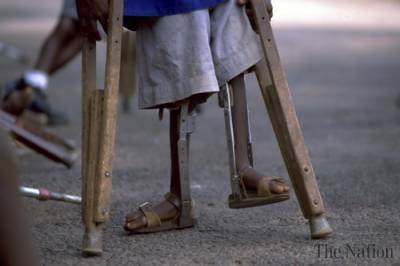
    The other friend, Afshan told BBC Urdu that 75 per cent of her body was paralysed because she was not vaccinated against polio when she was a child. Physiotherapy has made her healthy enough that she can now sit in a wheelchair.

    Sharing her feelings about travelling alone, she said that women with disabilities are often looked upon with pity. “It is a common notion about them that they cannot go anywhere so I decided to show the world that when you have the courage, then nothing is impossible.”

    Afshan said that we used to see girls travelling outside Pakistan but never saw anybody mentioning facilities provided to the physically challenged people who want to travel to other countries. “Nobody mentioned whether the conditions are the same in foreign countries as in Pakistan or better for people like us.”

    Zarghona was seven months old when she contracted polio and was unable to walk.

    “I have never travelled from Quetta to Islamabad or Karachi alone before this and I used to have some attendant with me. Even if I go somewhere in Quetta, I have to take someone with me,” she said.

    This is her first trip alone. She has previously travelled with different groups to three countries. “I was very excited to see Tanzeela and Afshan and I dared to travel alone,” she added. “If they can travel alone, why can’t I?”

  • Only two countries have Polio cases: Pakistan is one of them

    Only two countries have Polio cases: Pakistan is one of them

    World Polio Day is celebrated on October 24th every year, and this year’s theme is “A win against polio is a win for global health” acknowledging the fact the humanity is very close to achieving the goal of having a polio-free world, after 30 years of global hard work. Only two countries – Pakistan and Afghanistan – remain affected by the polio epidemic, according to the World Health Organization (WHO).

    World Polio Day was established by Rotary international to commemorate the birth of Jonas Salk, who led the first team to make a vaccine against poliomyelitis. Polio is a potentially deadly infectious disease. The best approach to eradicate polio is based on preventing infection by immunizing every child until the transmission of this disease stops and the world is polio-free.

    Africa declared free from Polio

    As per details, WHO has declared Africa free of the deadly polio virus after decades of documentation and immunization efforts to eradicate this viral disease worldwide.

     “Today is a historic day for Africa” said Professor Rose Gana Fomban Leke, ARCC Chairperson “The African Regional Certification Commission for Polio eradication (ARCC) is pleased to announce that the Region has successfully met the certification criteria for wild polio eradication, with no cases of the wild poliovirus reported in the Region for four years,”

    WHO Director-General Tedros Adhanom Ghebreyesus also appreciated the efforts of Africa on eradication of Polio. He tweeted “Big day for my African brothers & sisters – our continent will be declared #polio-free. This is one of the greatest public health achievements, demonstrating that with science & solidarity we can beat viruses & save lives.”

    How was Polio eradicated in Africa?

    In 1996, South African Prime Minister Nelson Mandela partnered with Rotary, an international non-profit organization to launch “Kick Polio out of Africa” Campaign. The first synchronized campaigns began in 17 countries, with 76 million children being vaccinated by tens of thousands of volunteers, and the work fanned out across the continent from there. Between 2008 to 2010, 85 million children were vaccinated in 24 countries in western and central Africa.

    Will Pakistan ever be Polio-free?

    Pakistan and Afghanistan remain the last two countries across the globe, where polio remains endemic and as long as it exists anywhere, it will remain a threat everywhere.

    Today, as the world commemorates World Polio Day, Pakistan reaffirms its commitment to eradicating polio and making the country polio-free. Taking to the twitter, Chief Minister of Punjab Sardar Usman Buzdar ensures that the government is fully committed towards eliminating polio from the country.

    Pakistan lowered its wild poliovirus type 1 (WPV1) cases from 146 in 2019 to 69 cases this year, as stated in a report by Global Polio Eradication Initiative. Pakistan Polio Eradication Programme further confirmed that approximately 39 million children had been vaccinated against poliomyelitis during a nationwide immunization campaign in September.

    Commenting on the country’s effort towards polio elimination, Dr Rana Muhammed Safdar Faisal Sultan, the Coordinator of the National Emergency Operations Centre of the Pakistan Polio Eradication Programme, appreciates the workforce engaged in achieving the goal of polio-free Pakistan.

    There is no cure for polio, but it can be prevented through immunization. The sub-national campaign by Pakistan Polio Eradication Programme will resume in the country by the end of this month.

  • 13 new polio cases reported in a single day in Khyber Pakhtunkhwa

    13 new polio cases reported in a single day in Khyber Pakhtunkhwa

    In a shocking development, Khyber Pakhtunkhwa has reported 13 new cases of type 2 polio cases. This is the highest number of cases to be reported in the province in one day.

    According to the provincial health department, seven of the cases were reported from Khyber tribal district, while one case each was reported from Lakki Marwat, Bannu, Mardan, Nowshera, Bajaur and Lower Dir.

    WATCH: The Current tours Pakistan’s Polio Lab

    A senior public health specialist told a leading newspaper on condition of anonymity, that several Pakistani health specialists had raised the issues over the polio programme, but “they are either sidelined or kicked out of the programme,” also adding that the reason why the virus spreading so fast is that not every child is being reached in infected areas and the government is missing a lot of children that need to be vaccinated.

    “Pakistan has this year reported 25 cVDP2 (type 2) cases, in which Khyber Pakhtunkhwa alone had a share of 24,” the report said. Type 2 polio does not cause paralysis but is debilitating. The type 2 virus was eliminated in the country in 2016 and reemerged last year.

    In 2019, Pakistan had reported 22 cases of type two polio cases, including 16 from KP. These were apart from type one polio cases in 2020, which are 29 in the country and 15 in KP.

    “It is a money-driven programme and huge salaries and incentives are being taken by the consultants at the top level. Unfortunately, some people in the programme are very influential and answerable to none and they set their agenda ignoring local needs and requirements,” he maintained, according to The News.

    Another senior official said that after working with the polio programme for many years, he realises that the elimination of polio is not a priority.

  • INFOGRAPH: Will Pakistan ever be polio free?

    INFOGRAPH: Will Pakistan ever be polio free?

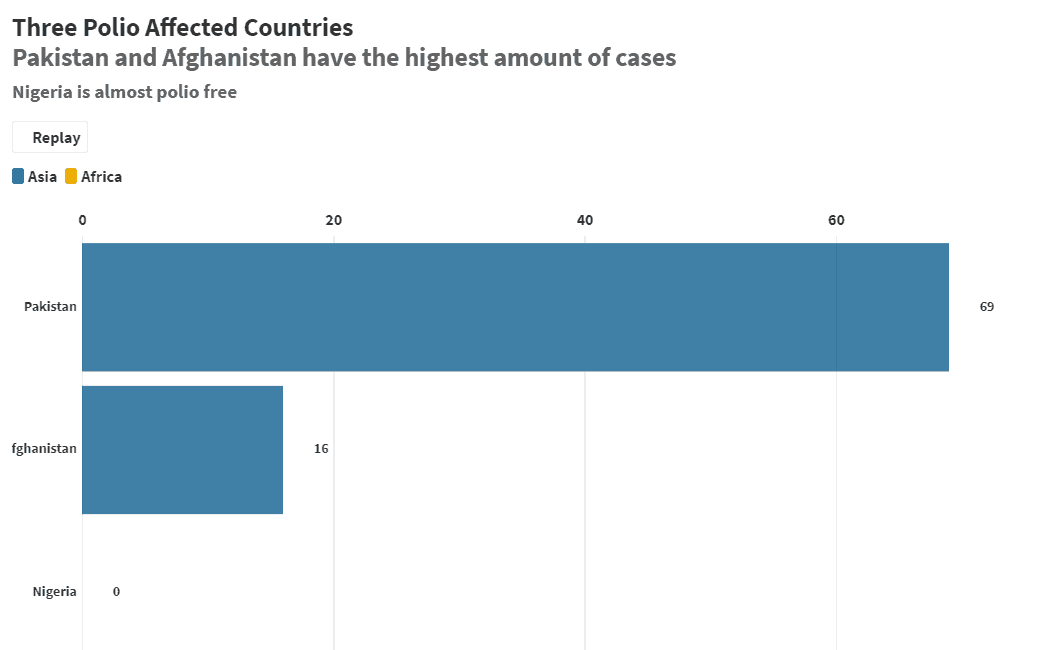
    There are three countries in the world that still have an epidemic of the polio virus and the third, Nigeria, is almost polio free. Pakistan, on the other hand, is experiencing a rise in polio cases.

    Pakistan has the highest number of polio cases in 2019

    Pakistan had lowered its polio cases to 12 last year and has increased almost 5 times to 69 cases. Afghanistan is at 12 cases reported this year which is a decrease from 21 cases last year.

    Nigeria has been polio free for the past three years but since they were 4 cases reported in 2016, they have not been declared polio free yet but will most likely get that coveted title by next year.

    Data courtesy: http://polioeradication.org/

  • Crippling state: Striving for a polio-free Pakistan

    The commitment to eradicating polio from Pakistan is now a national cause led by the prime minister himself.

    The question that I ask myself every day since assuming office is that Pakistan’s polio programme is 25 years old, but why haven’t we been able to eradicate polio till this day?

    The answer is complicated, to say the least.

    My days and nights are consumed in brainstorming strategies and constructing innovative methodologies on how to reach all the children of Pakistan consistently, so one day in the near future I can hand over the keys of the Emergency Operation Centre (EOC); the headquarters of the polio eradication in Pakistan, to the prime minister and we raise the flag of a polio-free Pakistan.

    To begin explaining the scope of the problem, it’s important
    to understand the enemy you are dealing with. The poliovirus is ferocious and
    with evil-intelligence leaves crumbs behind for us to follow. One of our
    biggest mistakes has been taking its bait, fighting it in territories that it
    poses to be its home. While it has kept us engaged fighting its proxies, it has
    multiplied and expanded its arsenal to the extent that we now have to revise
    our strategy to counter it, more aggressively in it is home. We have had 158
    cases of polio in the last five years, and 64 this year alone.

    To me, the number of cases is not mere statistics or a reputation hazard, but these figures represent actual children that have been paralysed for life. We must acknowledge it for what it really is — a daunting and horrific reality of what this virus is capable of, and a stark reminder of just how urgently we need to bring polio to an end.

    But the cases are a mere symptom of the number of children we are missing in every polio campaign — this is where the real problem begins.

    The current outbreak the country is facing was not unpredictable. The Independent Monitoring Board (IMB), one of the highest bodies that evaluate the success of the strategies countering the poliovirus, had predicted the outbreak a year earlier than it actually happened.

    The fact is that the data being collected during polio
    eradication campaigns had been misleading operational priorities. The number of
    children recorded as ‘missed’ aided by fake finger markings has had disastrous
    connotations on campaign quality and in return has not accurately reflected ground
    realities leaving hundreds and thousands of children unvaccinated and
    vulnerable to the virus. The root cause of which boils down to the communities
    resistance to being vaccinated.

    This past year saw an upsurge of anti-vaccine propaganda
    spreading like wildfire on social media platforms. As time went on, community
    distrust in the programme fueled by propaganda ended up sparking catastrophic
    incidents like the one in Peshawar on April 22, 2019. Consequently, motivation
    levels of polio eradication teams dwindled as refusals to the vaccine continued
    to spike across the nation.

    I am no newcomer to the programme. I have been associated with polio eradication efforts for over eight years. In all that time I’ve seen people committing the same mistakes over and over again, with my voice unheard. It was immediately clear to me that our traditional approaches had failed. We had to think out of the box and the transformation had to happen soon.

    To this end, I am proud to say that the Pakistan Polio Eradication Programme has worked long and hard over these past few months to adapt to the growing myriad of challenges and to transform and re-vitalise its efforts to bring polio to a halt.

    The commitment to eradicating polio from Pakistan is now a national cause led by none other than the prime minister of Pakistan, Imran Khan, himself. Such is the commitment that the premier asks for text updates on an almost daily basis and this goes all the way down, right to the frontline workers.

    To make the requisite changes for the desired impact, I have
    been personally involved in the review of the entire programme structure. This
    review has already identified many of the operational deficiencies embedded
    within the programme, including issues with programme structures and has
    reconfirmed the fault-lines that were evident to everyone but were never fixed.

    But, I believe that there needs to be an accountability
    framework that not only measures our success but also guarantees that everyone
    is accounted for their assigned role and nobody is allowed to play with the
    future of our children.

    A 24/7 WhatsApp helpline has also been established to provide direct responses to all parent and caregiver queries, concerns and complaints. Any and all queries, concerns or complaints are logged by the programme, responded to instantaneously, or then forwarded to district officials for remedial follow-up. The Polio Helpline is being initiated in the following months as a 24/7 call centre as well.

    I also believe that one of the biggest hindrances to the
    success of the polio programme is the way it is perceived in the eyes of the
    masses. For this, my team is working with the most creative minds in this
    country to design and launch a Perception Management Initiative which does not
    only aim to counter propaganda and helps builds trust within the community but
    aims at creating demand for the polio vaccine, which has been only a topic of
    several discourses but not been achieved to date.

    I am confident that this transformation of the programme will deliver the results we desperately need. I reassure all Pakistani citizens that I along with my team will not sit idle until Pakistan is certified polio-free.

    The writer is prime minister’s focal person on polio. He tweets at @babarbinatta.
  • Govt launches WhatsApp polio helpline

    Govt launches WhatsApp polio helpline

    The Prime Minister’s Focal Person Babar Bin Atta announced the launch of a first-ever WhatsApp helpline where people can ask questions about the polio program, report on children missed out on anti-polio campaigns in any part of the country and can also lodge complaints.

    Taking to the twitter, he wrote:

    Soon after the tweet, he again tweeted, “Dear brothers & sisters this is a WhatsApp text helpline, since my tweet, there is a flurry of calls on the number. Please do not call, just send your query via WhatsApp Text”