Tag: population

  • There are very few single people in Pakistan

    There are very few single people in Pakistan

    The detailed results of Pakistan’s seventh and first digital census have been released, providing insights into the marital status and demographics of the population.

    According to the Institute of Statistics report, 29.75 percent of people in Pakistan are single, while 65.97 percent are married. The report also notes that 3.78 percent of the population are widows.

    In addition, the statistics agency reports that 0.35 percent of the population is divorced and 0.15 percent are separated.

    Furthermore, the census reveals that 79 percent of Pakistan’s population is under 40 years of age. Specifically, 40.56 percent are under 15 years old, and the age group of 15 to 29 years constitutes 26 percent of the population.

    These findings underscore the youthful demographic profile of Pakistan, with a significant proportion of the population being unmarried and under the age of 40.

  • Pakistan becomes fifth most populous country

    Pakistan becomes fifth most populous country

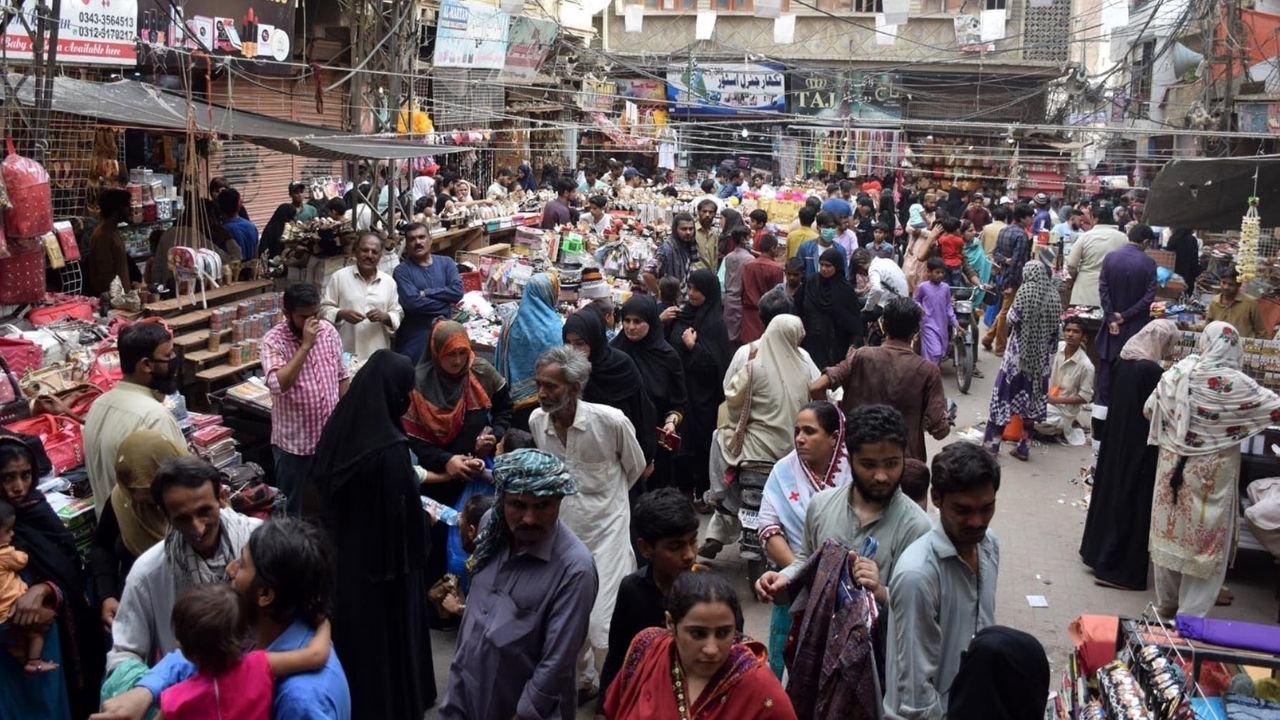
    Pakistan has become the fifth most populous country in the world with a population of 241,490,000, according to the detailed results of the seventh and first digital census of Pakistan.

    A report released by the Institute of Statistics reveals that Pakistan has the fastest population growth rate in the region, at 2.55 per cent annually. The country has also emerged as one of the top 30 countries globally with rapid population growth, surpassed in growth rate by only 27 other nations.

    The report projects that if current trends persist, Pakistan’s population will double by 2050. It also highlights that 79 per cent of the population is under 40 years old, making Pakistan the country with the largest youth population in the world.

    Pakistan currently stands at fifth place in global population rankings. Balochistan has the highest population growth rate at 3.2 percent, followed by Sindh at 2.57 percent and Punjab at 2.53 percent. Khyber Pakhtunkhwa has the lowest growth rate among provinces, with an annual increase of 2.38 percent.

    According to the report, 51.48 percent of population is male and 48.51 percent is female. Rural areas house 61.12 percent of the population, with only 39 percent residing in urban centres.

    In terms of urbanisation within provinces, Khyber Pakhtunkhwa has the lowest urban population at 15 percent, while Sindh and Punjab have higher urbanisation rates of 54 percent and 52 percent respectively. About 31 percent of Balochistan’s population is currently living in cities.

    The report also indicates that 96.35 percent of Pakistan’s population is Muslim, with minorities making up 8.7 percent. Hindus constitute 44 percent of the minority population, while Christians account for 37.63 percent.

  • Targets set to control growing population in Pakistan

    Targets set to control growing population in Pakistan

    The federal government has set targets to curb population growth as part of its five-year plan.

    Sources report that the Prime Minister approved the Ministry of Planning’s proposal during the NEC meeting. According to the plan, the target is to reduce the annual population growth rate to 1.1 percent by 2030. The latest census in 2023 recorded a growth rate of 2.55 percent, one of the highest in the region.

    The Ministry of Planning is aiming to decrease the total fertility rate to 2.2 percent by 2030. In FY 2024, the rate stood at 3.32 percent.

    Sources indicate that efforts are underway to increase intentional contraception usage to 60 percent by 2030. As of FY 2024, the rate was 39.36 percent.

    It has been reported that a limited adoption of modern contraception methods has caused Pakistan to witness 2.5 million intentional abortions annually.

    As of now, Pakistan’s population is at 241.49 million according to the 2023 census.

  • Tokyo govt to launch dating app to boost birth rate

    Tokyo govt to launch dating app to boost birth rate

    Japan’s capital will launch its own dating app as early as this summer as part of government efforts to boost the plunging national birth rate, a Tokyo official said Tuesday.

    Users will be required to submit documentation proving they are legally single and sign a letter stating they are willing to get married.

    Stating one’s income is common on Japanese dating apps, but Tokyo will require a tax certificate slip to prove the annual salary.

    “We learned that 70 percent of people who want to get married aren’t actively joining events or apps to look for a partner,” a Tokyo government official in charge of the new app told AFP.

    “We want to give them a gentle push to find one,” he said.

    It’s not unusual for municipalities to organise matchmaking events in Japan, where births dropped to a new low in 2023, but it is rare for a local government to develop an app.

    An interview will be required to confirm a user’s identity as part of the registration process for the Tokyo app, which has been on a test run for free since late last year.

    Many social media users expressed scepticism over the plans, with one saying, “is this something the government should be doing with our tax?”

    Others wrote they were interested as they would feel safer.

    Last year Japan recorded more than twice as many deaths as new babies.

    Births fell for the eighth consecutive year to 758,631, a drop of 5.1 percent, preliminary government data showed. The number of deaths stood at 1,590,503.

    The nation is facing growing labour shortages, and Prime Minister Fumio Kishida has promised policies including financial aid for families, easier childcare access and more parental leave.

  • Global fertility rate to keep plummeting, major study warns

    Global fertility rate to keep plummeting, major study warns

    Paris (AFP) – The population of almost every country will be shrinking by the end of the century, a major study said Wednesday, warning that baby booms in developing nations and busts in rich ones will drive massive social change.

    The fertility rate in half of all nations is already too low to maintain their population size, an international team of hundreds of researchers reported in The Lancet.

    Using a huge amount of global data on births, deaths and what drives fertility, the researchers tried to forecast the future for the world’s population.

    By 2050, the population of three quarters of all countries will be shrinking, according to the study by the US-based Institute For Health Metrics and Evaluation (IHME).

    At the end of the century, that will be true for 97 percent — or 198 out of 204 countries and territories, the researchers projected.

    Only Samoa, Somalia, Tonga, Niger, Chad and Tajikistan are expected to have fertility rates exceeding the replacement level of 2.1 births per female in 2100, the study estimated.

    During this century, fertility rates will continue to increase in developing countries, particularly those in sub-Saharan Africa, even as they tumble in wealthier, ageing nations.

    “The world will be simultaneously tackling a ‘baby boom’ in some countries and a ‘baby bust’ in others,” senior study author Stein Emil Vollset of the IHME said in a statement.

    ‘Implications are immense’

    “We are facing staggering social change through the 21st century,” he said in a statement.

    IHME researcher Natalia Bhattacharjee said the “implications are immense”.

    “These future trends in fertility rates and live births will completely reconfigure the global economy and the international balance of power and will necessitate reorganising societies,” she said.

    “Once nearly every country’s population is shrinking, reliance on open immigration will become necessary to sustain economic growth.”

    However World Health Organization experts urged caution for the projections.

    They pointed out several limitations of the models, particularly a lack of data from many developing nations.

    Communication about the figures “should not be sensationalised, but nuanced, balancing between gloom and optimism,” the WHO experts wrote in The Lancet.

    They also pointed out that there can be benefits of having a smaller population, such as for the environment and food security. But there are disadvantages for labour supply, social security and “nationalistic geopolitics”.

    Teresa Castro Martin, a researcher at the Spanish National Research Council not involved in the study, also emphasised that these are just projections.

    She pointed out that the Lancet study predicts the global fertility rate will fall below replacement levels around 2030, “whereas the UN predicts this to occur around 2050”.

    The study was an update of the IHME’s Global Burden of Disease study. The organisation, set up at the University of Washington by the Bill and Melinda Gates Foundation, has become a global reference for health statistics.


  • Do you know which is the cheapest country to live in?

    The website Numbeo has just released a list of 140 countries with cheap cost of living in ascending order.

    Surprisingly, Pakistan is the cheapest country to live in according to Numbeo’s cost of living index by country 2023.

    In the current indices, Pakistan has the lowest prices for living. It is followed by Egypt while India is only two steps behind.

    The most expensive country according to the chart is Bermuda followed by Switzerland, Cayman Islands, Bahamas and Barbados.

    The chart was made after analyzing the cost of living, rent, cost of living plus rent, groceries and restaurant prices prevalent in the countries included.

  • Three-year gap a must between two births: Punjab Minister for Population Welfare

    Three-year gap a must between two births: Punjab Minister for Population Welfare

    Punjab Minister for Population Welfare, Dr Jamal Nasir, has asserted that a three-year gap must be ensured between two child births for the health and safety of both the mother and the baby.

    While addressing a seminar on population welfare on Tuesday, Dr. Nasir added that under-nourishment and anaemia has resulted in women suffering from poor health.

    A policy is also being developed in which only employees with three or less than three children will be allowed to work in the Population Welfare Department.

    The caretaker government has reportedly promoted about 45,000 lady health workers in the province as part of its efforts towards improving mother and child healthcare and promoting population welfare.

    Dr Jamal Nasir pointed out that population control had never been seriously prioritised in Pakistan for sustainable development of the country, highlighting Iran and Bangladesh as role models pertaining to family planning.

  • Pakistan’s Population: A Brighter Future For All

    Population Experts and Government officials gathered in Islamabad to discuss improving population health in Pakistan.

    Islamabad, Pakistan – May 24, 2023 – Today marks the beginning of a two-day learning event by DAFPAK, a leading organization dedicated to improving population health outcomes in Pakistan, focused on ensuring a brighter future for Pakistan, titled “Pakistan’s Population: A Brighter Future For All.”

    Delivering Accelerated Family Planning In Pakistan (DAFPAK) is a £90m Foreign, Commonwealth & Development Office (FCDO) programme that aims to improve family planning outcomes across Pakistan by improving access to family planning services for the most vulnerable and disseminating messages for the common good under a platform called KhairKhwah.

    “The British High Commission has been investing in family planning since 2012. Our current support programme, DAFPAK is the largest donor-funded program on family planning which has served over 8 million women and girls in mostly marginalized areas”, said Andrew Dalgleish, Acting British High Commissioner to Pakistan while addressing the event in Islamabad.

    Chief Guest, Federal Minister for Planning, Development & Special Initiatives, Professor Ahsan Iqbal Chaudhry, emphasized the urgency of addressing the population growth rate, stating, “Unless we control our population, we won’t be able to distribute resources in a manner where we can provide healthcare, education and bright futures to our people. Our future is linked to how fast we can control Pakistan’s population growth.”

    Rapid population growth in Pakistan has created immense pressure on the country’s resources, and it has become difficult to provide essential services such as healthcare and education to all citizens. The event aims to address these issues and come up with strategies to improve population health.

    Dr Sara Shahzad, Health Advisor, FCDO highlighted the need for increased investment in healthcare infrastructure, improved partnerships with the private sector, and a holistic multi-sectoral approach towards family planning.

    Goodwill Ambassador for Population & Family Planning, Shehzad Roy, while addressing the event emphasised the significance of transforming mindsets alongside policy changes. “As a global ambassador of Family Planning, I would like to share that while inventing new policies is very important, what’s even more important is changing mindsets because only then we’ll be able to bring true change.”
    Over the course of two days, participants will share their insights on family planning, population growth, and its impact on the country. The event features keynote speeches, panel discussions, and interactive sessions.

    The event is being organized by Palladium Pakistan under DAFPAK-PSSD in collaboration with UNFPA, PSI, MSS, DKT, and M&C Saatchi in partnership with The Ministry of National Health Services, Regulation and Coordination Islamabad, and provincial Health and Population Welfare Departments of Punjab, Sindh, and KP.

  • ‘Aap ki kitni efficiency hai, marketain aik baje band hoti hain, bachay phir bhi zaida paida kartay hain’: Khawaja Asif

    ‘Aap ki kitni efficiency hai, marketain aik baje band hoti hain, bachay phir bhi zaida paida kartay hain’: Khawaja Asif

    Defence Minister Khwaja Asif, in a bizarre reference to the increasing population in Pakistan, said that there is no unforeseen increase in population in the countries where markets close at 8PM.

    The minister then said, “Your country’s performance is so efficient, despite closing markets at 1AM, they find time to produce more children.”

    The minister’s comments came while addressing a presser on government’s decision on its energy saving plan, applicable across the country. Defence Minister Khawaja Asif said that markets in all the province’s and federal areas will be shut down at 8 pm. Furthermore, wedding halls will close at 10 pm across the country.

    Asif said that if these timings are implemented then the country will save Rs 62 billion.

  • China’s population expected to start reducing before 2025

    China’s population expected to start reducing before 2025

    China’s population is expected to start to shrink before 2025 as the country’s birth data showed that the number of new births in 2021 was the lowest in decades in several provinces. Currently, China is the most populous country with nearly 1.4 billion residents.

    The head of population and family affairs at the National Health Commission said that China’s population is expected to start to shrink in 2021-2025.

    In recent years, the population of the country has slowed significantly. According to the state-backed Global Times, the number of births in central Hunan province fell below 500,000 for the first time in nearly 60 years.

    The change in China’s laws last year that allowed women to have three children has not helped the country in any way. Many Chinese women have argued that the change comes too late and they are facing problems like insufficient job security and gender equality.

    According to a United Nations (UN) report, India will become the world’s most populous country next year, i.e 2023, beating China.