Tag: power tariff

  • Another hike of Rs4.9 per unit approved in power tariff

    Another hike of Rs4.9 per unit approved in power tariff

    Owing to the monthly Fuel Cost Adjustment (FCA) for February, the National Electric Power Regulatory Authority (NEPRA) on April 15 increased the price of electricity by Rs4.85 per unit.

    It has also announced an increase in the price of power, stating that the power output in February was more expensive than the previously set fuel price.
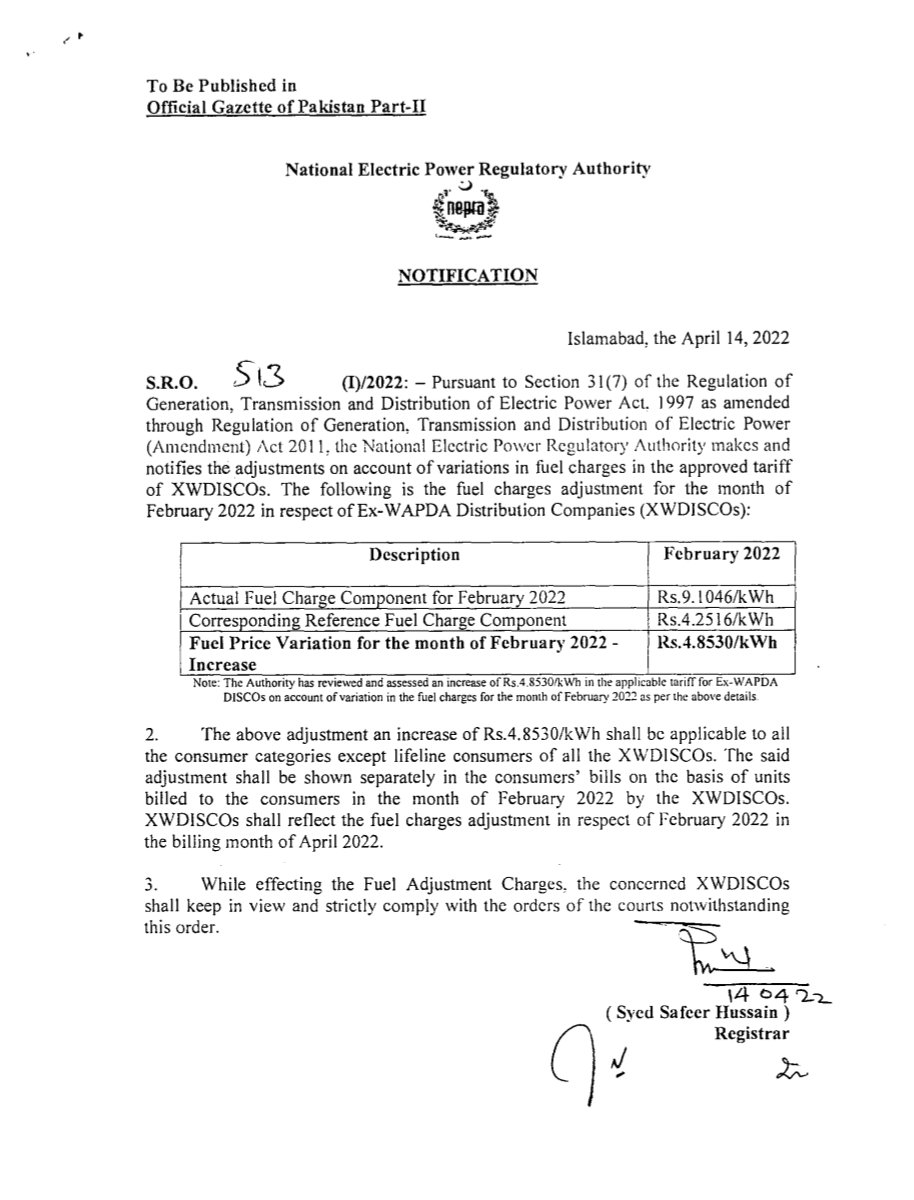
    According to the notice, the power distribution companies (DISCOs) will collect the amount from electricity consumers in the April bill. In addition, consumers will be hit with a charge of Rs37.7 billion, excluding general sales tax (GST). However, K-Electric and lifeline customers will be exempt from the hike.

    On March 31, the NEPRA held a hearing to determine the FCA but did not make a decision. The Central Power Purchasing Agency (CPPA) requested that the cost per unit be increased to Rs4.94 by the NEPRA.

    Following the monthly FCA, which only operates for one month, the administration had already hiked the power price to Rs5.95 per unit for the month of January.

    As per NEPRA’s data, the most expensive energy production sources, including High-Speed Diesel (HSD) and Residual Fuel Oil (RFO), were used more than average in the prior months, raising the overall cost of production.
  • Nepra approves Rs1.29 hike in cost per unit for Karachi residents

    On account of monthly Fuel Cost Adjustments (FCA), the National Electric Power Regulatory Authority (NEPRA) raised the cost per unit of power for Karachi residents by Rs1.29.

    It held a public hearing at its headquarters on Karachi Electric’s (KE) request to hike the power tariff under the FCA by Rs3.45 per unit for February. Chairman Tauseef H. Farooqi chaired the public meeting, which was also attended by officials Rafiq Ahmed Sheikh and Engineer Maqsood Anwar Khan.

    According to the officials, KE’s monthly FCA is decided at Rs1.29 per unit based on data analysis.

    The Chairman inquired about Karachi’s load-shedding status and if KE has a gas procurement deal with the Sui Southern Gas Company (SSGC) to address the fuel crisis.

    Load management is only done on feeders with a low recovery rate, according to the latter’s officials, and consumers only have to experience one to one-and-a-half hours of load shedding every day.

    Chairman Farooqui stated that KE’s technology needs to be modernised, and that there should be no load-shedding for bill-paying customers and locations where billing is timely.

    He also mentioned that the NEPRA has posted phone numbers on its website for inhabitants of the city to report any forced load-shedding by any power utility.

    According to the briefing delivered at the meeting, KE’s customers were charged Rs3.28 per unit in January under the FCA. Similarly, the FCA for February was decided to be Rs1.99 lesser than the January billing.

    Muhamad Tanveer, who is a representative of the Karachi Chamber of Commerce (KCCI), denied the FCA, citing that customers are already paying for the January hike and that the FCA should not be transferred to them.

    After reviewing the facts, the NEPRA issued a thorough judgment declaring that the FCA is only levied and set for the month in concern and that it is variable with each hearing depending on the fuel costs for that month.

  • Govt mulls Rs3.3 hike in power tariff to meet IMF demand

    Govt mulls Rs3.3 hike in power tariff to meet IMF demand

    The government is likely to hike power tariff by Rs3.30 per unit in line with the International Monetary Fund (IMF) conditions to get the programme rolling that has been suspended since Feb 2020.

    Daily Jang quoted a senior government official, saying the increase in the power prices will be made before the start of the next year and the government will take measures to take the masses into confidence over the move.

    The IMF bailout was availed by the Pakistan Tehreek-e-Insaf (PTI) in 2019 to provide crucial support to fast depleting foreign exchange reserves. But the package was suspended at the start of this year.

    Pakistan has to return $4.4 billion on account of foreign commercial loans during the current fiscal year for which it desperately needs the money from the monetary fund. It has also already returned $2bn to Saudi Arabia and will return $1bn soon to clear the Saudi debt.

    Earlier this week, Pakistan secured a $1.7 billion (Rs272 bn) debt relief agreement to help offset the financial headwinds sparked by the coronavirus pandemic.

    The deal provided a moratorium on debt payments for large swathes of the current fiscal year and help ease the cash-strapped country’s massive financial obligations.

    “The Government of Pakistan has successfully negotiated and concluded rescheduling agreements with 19 bilateral creditors, including members of the Paris club,” the Ministry of Economic Affairs said in a statement.