Tag: President Arif Alvi

  • VIDEO: ‘Country has not only been raped but gang-raped,’ President Arif Alvi says

    VIDEO: ‘Country has not only been raped but gang-raped,’ President Arif Alvi says

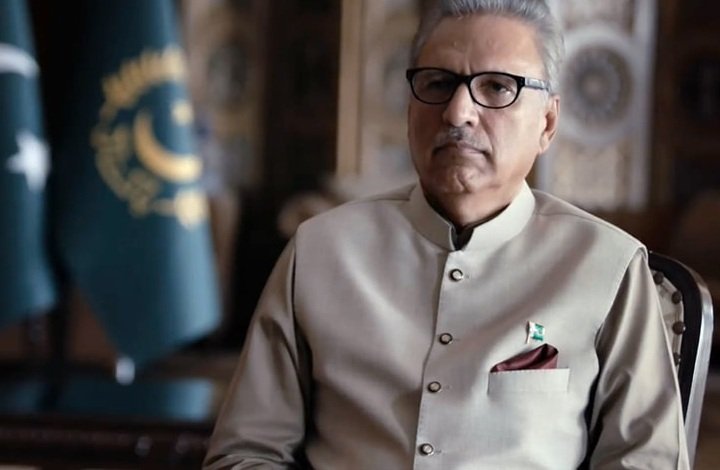
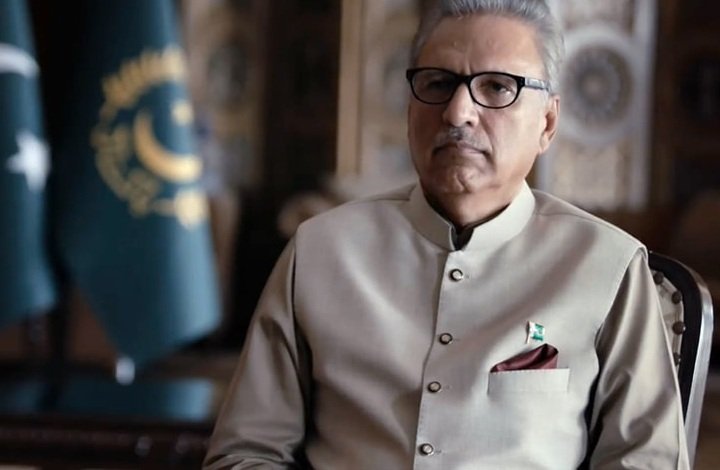
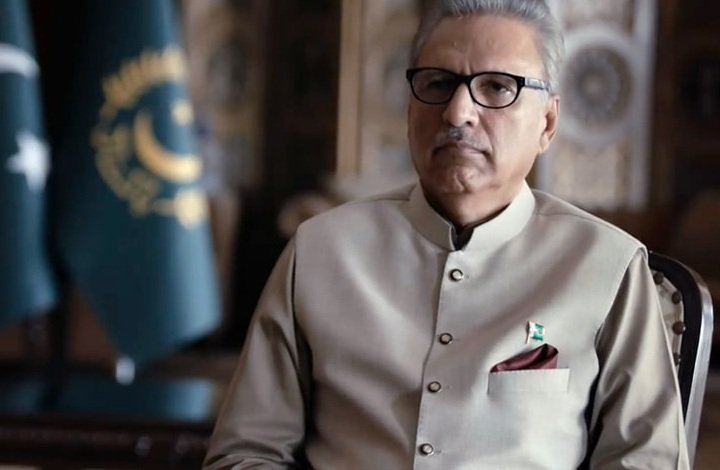
    In a rather insensitive statement, President Dr Arif Alvi, while speaking of the damning investigation report regarding independent power producers (IPPs), has said the way mafias looted the country was “not rape but gang-rape”.

    The federal cabinet on Tuesday decided to make public the investigation report on deals that allowed IPPs to earn illegal profits worth billions of rupees and also gave the nod to the formation of an inquiry commission to further probe into the matter.

    The decision came two days after the president and Prime Minister (PM) Imran Khan reportedly discussed the report.

    “I first read the executive summary of the 300-page [IPPs] report. I discussed it with the PM a day before we met [on Monday]. My exact words were… forgive me for what I am about to say and let’s not forget how the report doesn’t yet include the opinion of all stakeholders… but my exact words to the premier were that the country has not only been raped but gang-raped by mafias,” he said in a conversation with senior journalist and analyst Hamid Mir.

    WATCH VIDEO:

    WHAT DOES THE REPORT SAY?

    A nine-member committee headed by former chairman of the Securities and Exchange Commission of Pakistan Mohammad Ali was formed last year to investigate reasons behind the high cost of electricity, especially in connection with IPPs.

    According to the report prepared by the committee, deals were signed at the expense of interests of the consumers and the government. The national exchequer suffered a loss of over Rs4 trillion in the last 13 years because of circular debt and subsidies being given to power producers.

    The report further disclosed that 16 IPPs invested around Rs51.80 billion and earned over Rs415 billion in profits – having dividends taken out in excess of 310 billion — in a period ranging from two to four years.

    “Pakistan has regionally the highest power tariffs consequently raising the cost of manufacturing,” read a summary of the report. “This has been one of the prime reasons for loss of competitiveness of our industry and the stagnation of our exports,” it read.

    It was noted that the profits generated by most of these IPPs were 18.26 times than their investment and the dividends taken out were 22 times higher.

    Six companies earned an annual return on equity (ROE) between 60% and 79%. Four of them earned an ROE of 40%.

    The report further revealed that 13 residual fuel oil- and gas-based plants in the last eight to nine years of their operations earned profits of Rs203 billion against their combined investment of Rs57.81 billion.

    Excess payments of 6.33 billion to four bagasse-based plants were also identified.

    “Coal companies with government connivance obtained a tariff which is more than 50% higher than the market rate leading to an annual over payment of $477 million per annum or $14.5 billion over the life of these projects,” the report read.

    “Thermal IPPs set under the 2002 Power Policy and Nepra [National Electric Power Regulatory Authority] tariff determination were entitled to a 15% rate of ROE on a cost plus basis. However, the projects set up under this policy have been posting returns in dollar terms in excess of 50%. This could only have been possible if the tariff setting process of Nepra was compromised.”

    It was noted that the Quaid-e-Azam Solar Park was instrumental in getting a very high upfront tariff for solar power approved at US cents 14 levelised and 18 cents for first 10 years through influence peddling and corruption.

    The solar tariff in India at that time was between 7-8 cents with similar cost structure, while a much higher upfront tariff and capital cost allowed by Nepra, causing a massive loss to the country.

    “The first project in the Quaid-e-Azam Solar Park established by the Punjab government involved a kickback of approximately $50 million,” the document read.

    The committee found that private companies had provided false oil statistics to secure better tariffs.

    Malpractices by IPPs with respect to project setting up costs, actual fuel use being less than the invoices submitted to Nepra, kickbacks in commission on fuel were also identified.

    The report suggested that the power tariffs could be cut down by Rs3 per unit by adopting three measures: converting the payment to IPPs from dollar to rupee, switching from “take-or-pay” to “take-and-pay” option, and reducing capacity payments.
  • Shah Mahmood Qureshi in self-isolation after China return

    Shah Mahmood Qureshi in self-isolation after China return

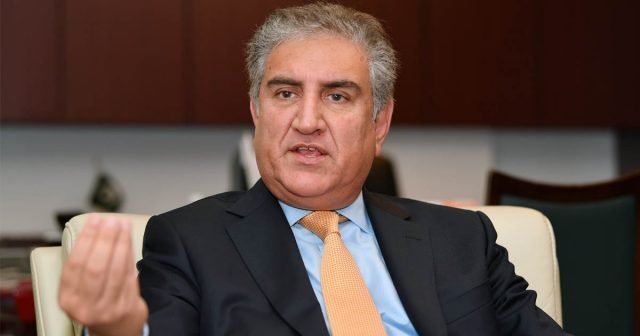
    Foreign Minister (FM) Shah Mahmood Qureshi, who on Wednesday morning returned from his trip to Beijing, has confirmed that he is in self-isolation as per instructions of the Pakistani government.

    Speaking to SAMAA TV, FM Qureshi, who was accompanied by President Arif Alvi and Minister for Planning, Development and Special Initiatives Asad Umar, said that he had self-isolated himself since the government had advised everyone returning from abroad to self-isolate in case they had contracted the new coronavirus — COVID-19.

    “Before leaving we did a swab test here and when we landed, Chinese officials took our blood samples. They both came back negative and we took another blood test after our meeting with President Xi Jinping. The results of the second test haven’t come back yet,” the minister said.

    However, he decided to isolate himself as a precaution for a few days. “My only interactions are over the phone,” he said, adding that he would undergo another swab test within five days. “I am going to follow protocol.”

    The delegation had on Monday reached China on a two-day visit at the invitation of the Chinese president.

    It was warmly welcomed by Chinese Minister of Agriculture and Rural Affairs, Han Changfu, Pakistan Ambassador to China Naghmana Alamgir Hashmi and other senior officials of the Chinese government as well as the Pakistan Embassy in Beijing.

    Other than signing multiple agreements to enhance cooperation between the two countries, the visit was aimed at expressing solidarity with China amid the deadly coronavirus outbreak.

  • VIDEO: President forgets names of Balochistan governor, CM during speech

    VIDEO: President forgets names of Balochistan governor, CM during speech

    In a rather embarrassing development, President Dr Arif Alvi has forgotten the names of Balochistan Governor Amanullah Khan Yasinzai and Chief Minister (CM) Jam Kamal Khan, calling them Amanullah Khan Yousafzai and Jamal Khan Aliani instead.

    The blunder by the president came as he greeted attendees at the inaugural ceremony of the historic Sibi Mela 2020, but went unnoticed by many until Twitterati pointed it out and said it was “just the ignorant attitude of the people of Pakistan towards the country’s southwestern region of Balochistan”.

    WATCH VIDEO:

    https://twitter.com/sardarjamali/status/1230300542301331456

    Earlier, addressing the inaugural ceremony, the president said that the China-Pakistan Economic Corridor (CPEC) would open up new avenues of progress and prosperity and change destiny of the country, especially Balochistan.

    He said the construction of Gwadar deep seaport, airport, oil refinery, important corridors and economic zones would provide job opportunities to the people of Balochistan, which would end poverty and bring prosperity to them.

    He said that Gwadar would emerge as a new developed part on the world’s map.

    President Alvi said that Balochistan was the most-affected area in the war against terrorism where the local people suffered a lot, adding the federal government was paying special attention to the construction and development of the province to end the sense of deprivation of the local people.

    He also said security forces of the country valiantly fought the war against militancy and terrorism and brought peace to the motherland, adding the terrorists would not succeed in their nefarious designs. Alvi said promotion of agriculture and livestock was need of the hour and the present government was fully concentrating on it as these two sectors were a big source of employment to the local people.

  • VIDEO: President says he doesn’t know who is responsible for wheat crisis

    VIDEO: President says he doesn’t know who is responsible for wheat crisis

    President Dr Arif Alvi has said he doesn’t know who is responsible for the wheat crisis in the country, but he should have known about it.

    According to Geo, the president on Monday arrived at National Institute of Child Health (NICH) on a surprise visit along with his wife Sameena Alvi. The two were welcomed and given a tour of the hospital by Executive Director Dr Jamal Raza.

    Speaking to journalists later, the president said he was visiting the hospital on Prime Minister (PM) Imran Khan’s advice. “It is regrettable how patients have no other choice but to share beds for treatment and their families are being sent to buy medicines from outside the hospital,” he reportedly said.

    When asked about the condition of hospitals and the government’s apparent inability to bring relief to the masses, President Alvi said the Pakistan Tehreek-e-Insaf (PTI) was unaware of the economic conditions while making its promises ahead of 2018’s general election.

    To a question about the persisting wheat crisis across the country, the president said he had no idea who was to be held responsible for it. “But I should have known,” he added.

    WATCH VIDEO:

    WHEAT CRISIS:

    The PTI government was first warned of the ongoing wheat crisis in September last year when several high-ranking officials had suggested appropriate measures. The government had ignored the warning.

    Initially, the crisis appeared when Sindh decided not to procure wheat because different officials were facing corruption probes on account of its procurement. Meanwhile, Punjab had imposed a ban on inter-provincial movement of wheat.

    Keeping in view the situation, profiteers and hoarders started exploiting the situation and stock piling wheat.

    The federal government has refused to take any responsibility for the crisis, saying it is the domain of the provinces to procure wheat.

  • Sarmad Khoosat appeals to PM, President to facilitate his film’s release

    Sarmad Khoosat appeals to PM, President to facilitate his film’s release

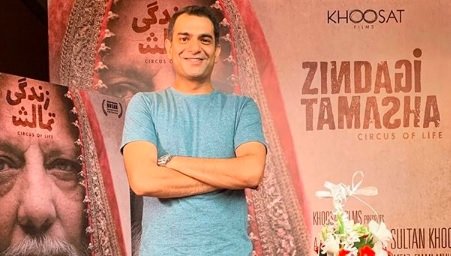
    Sarmad Khoosat’s award-winning film Zindagi Tamasha seems to have run into trouble once again.

    As the film gears up for release in Pakistan, the filmmaker took to social media to reveal that “a few troublemakers” were creating hurdles in its release “for their political ends.”

    https://twitter.com/KhoosatSarmad/status/1217818381149229062?s=20

    In an open letter addressed to Prime Minister Imran Khan, President Dr Arif Alvi, Chief Justice of Pakistan, Chief of the Army Staff and Minister for Information, Khoosat detailed the problems his film was facing in its release.

    Along with that, he clarified that “As a law-abiding citizen and with full conviction that there is nothing offensive or malicious in the film, in response I submitted the film for another review to the censor board. It was cleared once again with a few cuts to appease the complainants.”

    “I launched the promotional campaign and now, just a week before the film’s release, another attempt is being made by the same group to stop the release of the film and this time they are hell-bent on using pressurising tactics,” he said, adding that he is bringing this issue to their notice because “these series of episodes undermines a state institution like the Central Board of Film Censors.”

    Written by Nirmal Bano and directed by Sarmad Khoosat, Zindagi Tamasha starres Arif Hassan, Samiya Mumtaz, Eman Suleman and Ali Qureshi in the lead. The film is centred around a naat khwan Rahat Khawaja (played by Hassan) and his family who are outcast from the society when a secret of Khawaja’s is leaked.

    The official synopsis states: “The film is an intimate portrait of a family as well as a scorching political commentary on little gods on this earth who police our private passions.”

    The film premiered at the Busan International Film Festival held in October 2019 where it also won the prestigious Kim Ji Seok Award.

    Read more – Sarmad Khoosat’s ‘Zindagi Tamasha’s’ trailer mysteriously disappears from Youtube

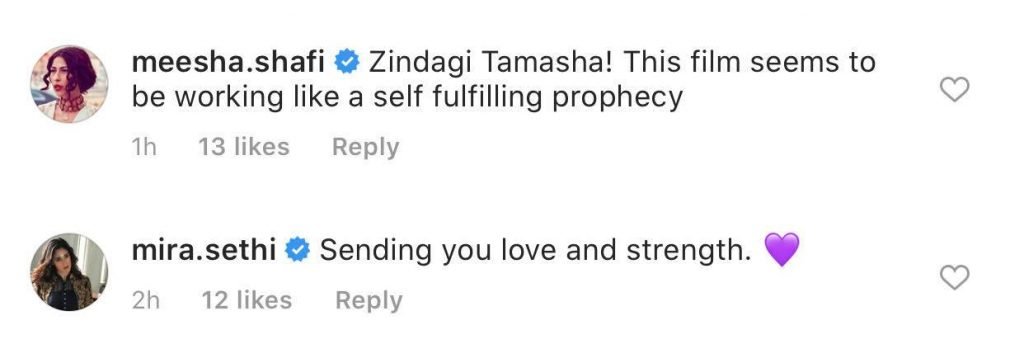
    Meanwhile, Sarmad’s colleagues including Meesha Shafi and Ali Gul Pir stepped forward to support the filmmaker and his film.

  • Pakistan offers Qatar security for 2022 FIFA World Cup

    Pakistan offers Qatar security for 2022 FIFA World Cup

    President Arif Alvi has offered Qatar of providing security for the next FIFA World Cup being held in the Gulf country in 2022, stressing that Pakistan had vast experience in that domain, The Express Tribune reported.

    According to the details, talking to Commander of the Qatar Emiri Guard, Maj-Gen Hazzaa Bin Khalil Bin Mansour Al-Shahwani, President Alvi said that a lot of scope existed between the two countries to include defence export and joint production ventures.

    Dr Alvi underscored that having vast experience in the domain of security and the professionalism of its armed forces, “Pakistan can provide Qatar security for Football World Cup 2022″.

    He also emphasised on the need for enhancing the training collaboration and professional interaction between defence forces of the two countries, appreciating the agreement for sale of eight Super Mushak aircraft to Qatar worth $57.74 million in 2016.

    The president urged Qatar to support Pakistan in its endeavours to highlight Indian human rights violations in Indian occupied Kashmir (IoK) before the world, and stressed the need for the international community to persuade India to resolve the long withstanding dispute in accordance with United Nations (UN) Security Council resolutions.

    “The fascist Indian regime is flagrantly violating the human rights of Kashmiris by revoking the special status of occupied Kashmir and by suspending their civil liberties. The Indian government has adopted a hostile attitude towards all its minorities,” the report quoted Alvi as saying.

    Maj-Gen Al-Shahwani said, “Qatar considered it a religious duty to support Pakistan at all levels”.

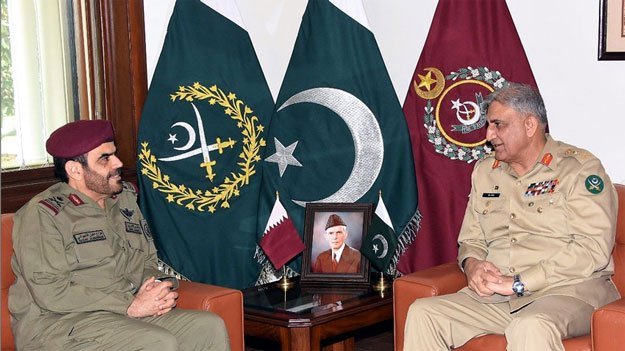
    Separately, the Qatari commander also called on army chief General Qamar Bajwa at the GHQ in Rawalpindi, and discussed matters of mutual and professional interest and regional security situation.